Search This Blog

Thursday, June 19, 2025

"Fetish" by Martha Soukup

 https://m.media-amazon.com/images/I/51fEkZamYvL.jpg

 First appeared in Ellen Datlow's Off Limits: Tales of Alien Sex. Long-listed for the Tiptree.


Summary:

A young woman wants to know what it's like to be loved with a beard. 


Discussion:

This may not be appreciated by trans or anti-trans crowd although it does illustrate the explorer crowd.

Perhaps it was daring in its day, but it doesn't carry beyond the confines of this brief tale.

Tuesday, June 17, 2025

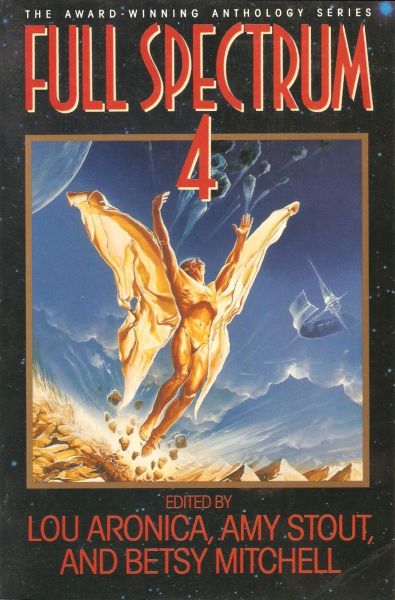
"The Story So Far" by Martha Soukup

 https://www.isfdb.org/wiki/images/5/51/FLLSPCTRMK1993.jpg

 First appeared in Lou Aronica, Betsy Mitchell and Amy Stout's Full Spectrum 4. Reprinted by Lawrence Schimel. Up for the Sturgeon, Hugo, Tiptree, and Locus awards.


Summary:

 A minor character in someone else's story tries to make a space for her own story.


Discussion (Spoilers):

The best line about the story and about this life:

"all I know is the story I am in, and I don't know most of it. Just what I see from where I am." 


The most moving lines about this story, these characters:

We dance and look up. "I ever saw clouds before," I say.

"Look closely," she says. "I think the story's almost over. You may never see them again." I turn on my elbow to her, but she is looking up at the sky. "You may never see me again, either."

"No!" I cry. "That can't happen--I've hardly seen you."

"Things end." Blue sky reflects in her eyes. "This has been the best part. With you." 


The narrator writes her own story and is going to write another.  

In this tale, like a number of hers, we readers begin displacement or confusion (what some call "estrangement"). In this case, it isn't difficult to follow, but the initial details don't create the actual reality--likely because the protagonist is learning as she goes along. I remark on this strategy as it's intriguing. Most genres want to ground you immediately. SF like confuse or pull the rug out from under the reader.

A compelling concept with limited results (necessarily so?). A lot of the details feel generic. 

As a reader, it's hard to figure out what the main story was (that is, the story about the supposed male protagonist who is a minor character here). Perhaps something literary--some sort of tragedy although it isn't clear (his story in this story is even more generic than this story about minor characters). Probably not a spy thriller. In that case, the story would not have gone back so far unless it was cursorily told. 

Even the specific details that do get told don't feel necessarily cohesive enough to build this story (that is, this story's protagonist), whatever limitations may be placed on it. This should have simmered a little longer on the stove.

Sunday, June 15, 2025

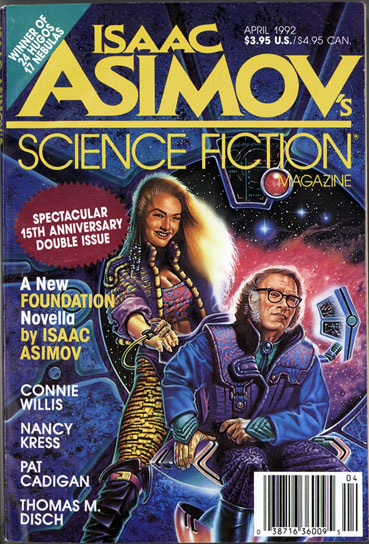
"The Arbitrary Placement of Walls" by Martha Soukup

 https://www.isfdb.org/wiki/images/2/25/IAS_1992_04_Freeman.jpg

First appeared in Gardner Dozois' Asimov's. Reprinted by Brad Templeton, Janet Berliner, Martin H. Greenberg, Uwe Luserke. Up for the Hugo, Nebula, World Fantasy, Locus, and Asimov's Reader Awards.


Summary: 

 Laura Hampton lives in a house that has fallen into disrepair. She is trapped there not only by finances but also by "ghosts" of former boyfriends. But they're not ordinary ghosts.

 Her mother stops by to help clean, but that kind of help doesn't seem to help. However, the mother initiates something that does. 


Discussion (with spoilers):

 What makes these ghosts different is that the spirits roaming her house are spirits of living people. Clever twist. This could be seen as magical realism or psychological manifestations of memories that haunt her to the point of crippling her from moving on, advancing.

Someone--writer or editor--must have thought was her best or best known work as it is the title story to her collection. Nothing garnered more attention in very different circles.

However, maybe the writer or editor thought it captured the collection. I, however, don't yet see the overall connection to the collection, but maybe. It is an excellent title.

 Now there are a number of approaches to the story. Some may not see much except a little light for the protagonist, which it has.

Some might view this as a revenge tale. Some bad boyfriends got what they had coming for them: death. When Eric dies, so does his ghost, which leads to this new idea of "cleaning up the house" by killing the real life people to make the ghosts disappear. This action is implied. This makes it an evil story in that the punishment doesn't fit the crime (unless one considers one's psychological damage to be worthy of death, which it never was true in society, but perhaps that has changed or is changing). The whole narrative spends its time getting us to care about the character until we learn she plans to murder.

Which brings the third and perhaps more complete view. We are meant to ask ourselves: Why did we invest our empathy in this character? Some things undermine her--lack of empathy for the dying. And perhaps she mislabels what Eric's dying of. It is possible to have three bad relationships, but it is also possible that we haven't yet examined our protagonist's character. That she would even consider this and plan to execute it should erode our empathy. Some might assume that one gender is more innocent than another, but this suggests that all have something to question. This is "The Arbitrary Placement of Walls": that we assume divisions between us, that one is innocent where only other are guilty, especially given clues to the contrary.

Friday, June 13, 2025

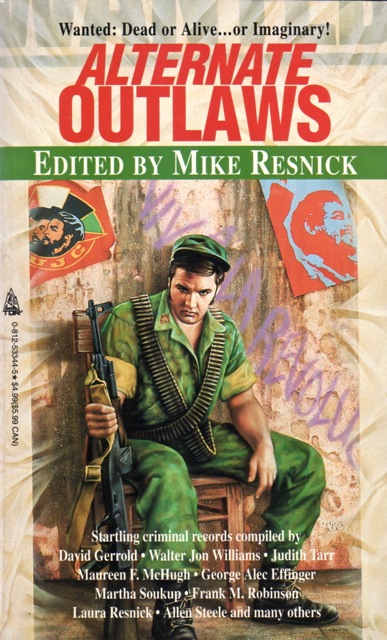
"Good Girl, Bad Dog" by Martha Soukup

 https://www.isfdb.org/wiki/images/8/8e/ALOT1994.jpg

First appeared in Mike Resnick's Alternate Outlaws


Summary:

This is the kind of story that begins in confusion, and it requires the reader to work it out. All I will say is that a boy and a dog get lost. 

Discussion (minor spoilers):

 I very much do not want to spoil this. Do read it if you can find it. If her other other stories sound interesting, you can find it in her one collection. If not, hunt down a used copy of the Resnick anthology.

The following make the opening confusing: 

  1. Who are the characters? 
  2. Who are the characters in relation to one another? 
  3. How well do they understand each other?

The story is told from the point of view of a famous dog who wants to change his life, to go wild. However, he's spent so much time as a dog of fame, that it is initially hard for him to adjust. The characters don't understand one another well, despite having some sense of each other. The dog does make a change--a rather surprising one.

This is a very different perspective from her story "Dog's Life," and serves as an interesting contrast. 


Wednesday, June 11, 2025

Martha Soukup appearances on the Internet

To round out one's understanding of a writer who has become more elusive the last few decades, here are some appearances from elsewhere:

#

Discussion of Stories (if a link isn't working, then that story discussion will be out shortly):

  1. Over the Long Haul
  2. A Defense of Social Contracts
  3. The Spinner
  4. Dog's Life
  5. Good Girl, Bad Dog
  6. The Arbitrary Placement of Walls
  7. The Story So Far 


#

Salon articles from the early 2000s

Her work does seem politically driven as the other samples also seem to suggest.

#

Anti War sentiment presumably from a similar era but it feels a bit like the 80s:


#

Clips from a sample of her plays:


Tuesday, June 10, 2025

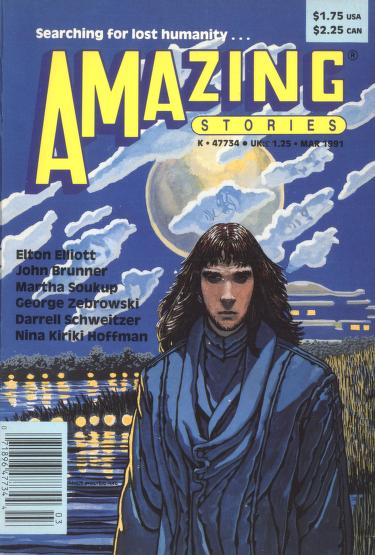
"Dog's Life" by Martha Soukup

https://isfdb.org/wiki/images/9/9d/AMAZMAR91.jpg 

First appeared in Patrick Lucien Price's Amazing Stories. Up for the Hugo, Nebula, and Locus awards. Reprinted by Fred Patten.

Summary:

 Herb, a large beige dog, and Wayfarer, a Siamese cat, demand independence from their owners.  The owners bristle since they feel they haven't been bad owners, but Wayfarer says:

"The time for talking is through. What reason is there for four-footed animals to be subservient to two-footed? It's slavery."

The pets walk out, but life is more difficult than they expected--at least, than Herb expected.


Discussion (with Spoilers):

 Utterly charming. 

I was curious about the lack of the article "a" in the title. The phrase "a dog's life" originally meant a subservient one living off scraps (circa the 17th century), but I've heard it used in the sense of a life of indolence/laziness, often in a jocular sometimes derogatorily or admiringly manner. This may have more to do with how we've changed our attitudes toward pets over time. 

This change in usage is also observed in the story. The dog starts out with a life of ease but without independence. He gains independence but endures hardships in the phrase's first usage yet ends up with independence and a life of ease--the more contemporary usage.

Is it something more? I've puzzled over this. There may be something I've missed. Perhaps it could parallel human independence from whatever system we labor under, but if so, the point of the target isn't clear, or else it is merciless toward all parties. Or it has no application toward human systems, just an amusing extrapolation if pets gained language skills and human-level sentience and started using these.

Is this how pets would talk? Possibly. Possibly not. But amusing, nonetheless. 

Not a major work but definitely a pleasant encounter. 

Sunday, June 8, 2025

"The Spinner" by Martha Soukup

 https://m.media-amazon.com/images/G/01/ciu/11/60/bd21619009a07435cf7d4110.L.jpg

 First appeared in Jane Yolen's Xanadu 2.

Summary:

Rianna, "The Spinner," can spin anything into yarn--from wool to dog fur, from flax and seed pods to horse manes. 

Then one day, a woodcutter named Rowan comes into her place and asks for her to spin so that he can have gold to win the hand of his girl from her father.

Rianna agrees, and for awhile all parties are happy. However, the arrangement seems to change.


Discussion:

 Rowan suggests that he may or may not be engaged and so they make love. But he disappears until Rianna hears of his impending marriage. She decides to ruin it for bride and groom, using her magic to bind him only to Rianna.

This feels like a retelling of the Rumpelstiltskin story from the viewpoint of the Rump--the man who in exchange for gold attempts to ruin a family by taking the first born, as was promised. However, Rumpelstiltskin does give the couple a chance to win back the baby and restore the marriage.

Here, Rianna is wholly successful. It's hard to say what to feel. Surely, instead of one sad person, we have three (and those who are sad because these are). It's quite a bitter and pointless revenge since if she actually loved him, then she would be just as sad and miserable for the rest of her life, too. If she didn't love him, then why bother?

Or are we readers supposed to feel the revenge that the secondary character deserved rather than a man who happened to fall in love more than one person (at least for a moment)? Or is it simply wish-fulfillment revenge for every woman who felt wronged, without contemplating the consequences that will ruin everyone involved? It is strange that we go from seeing the protagonist as someone we care for to someone who appears bitter and vengeful, someone we hope we never meet.

This story requires a little context. "A Defense of Social Contracts" [link for discussion] is that necessary piece.

In her comments regarding "A Defense of Social Contracts," Soukup discusses how she wanted to write about how obsession feeds into revenge than loops back to obsession (a story with "fantasy" notion). Perhaps that describes this a bit if not a perfect fit. However, obsession and revenge do seem to factor into some of her stories. It suggests, too, that theme or perhaps certain observable human patterns may come first that she wants to illustrate within a narrative frame.

Like Rumpelstiltskin, Rianna disappears although in some versions, Rumpelstiltskin tears himself in two. Perhaps there was a reason for that revision.

Friday, June 6, 2025

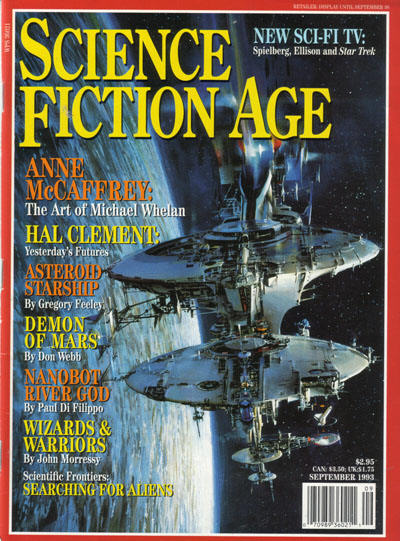
"A Defense of Social Contracts" by Martha Soukup

First appeared in Scott Edelman's Science Fiction Age. Reprinted by Pamela Sargent. Won the Nebula, up for the Tiptree awards.


Summary:

In a world that has idealized and perfected social contracts and licenses for every potential kind of love, with some crossover, Derren and Anli meet and begin a relationship with very different expectations--despite the supposed clarity of their situation.


Discussion with Spoilers: 

Anli knows Derren is nonmongomist, but that doesn't deter Anli from trying to maneuver him into a committed relationship--so much so, the story ends in tragedy, in as much as a perfect society could have a tragedy.

The best story to contrast this with would be Frederik Pohl's "Day Million." Both spend most of their time telling the story more than the standard story. 

The second and perhaps primary thing to pay attention to is the narrator's voice--both of which look down their noses at those who might disagree (although Soukup's narrator assume you'd agree). Though we feel for the situation Anli put Derren into, a number will also feel for Anli. While some readers may have zero sympathy for Anli, more than a handful may feel for her attempts to get Derren into an exclusive relationship. Unlike Pohl, everyone on the planet knows someone (or is someone or has received overtures from someone) who tried to force another into a relationship the other party didn't want.

That it won a Nebula people can debate, but it is a worthy candidate. Is it a classic? Again, one might debate its merits, but if Pohl's is a classic, then surely this is, too, being more complex. 


Wednesday, June 4, 2025

"Over the Long Haul" by Martha Soukup

https://isfdb.org/wiki/images/f/f0/AMAZMAR1990.jpg

 First appeared in Patrick Lucien Price's Amazing Stories. Reprinted by James Morrow. Up for the Hugo, Nebula, and Homer awards.

 This was adapted for an anthology show called Perverse Destiny, directed by Danny Glover, starring Erika Alexander and Lou Diamond Phillips [IMDB].


Summary:

Shawna Mooney is a single mom and a truck driver. Both. At the same time. It's not exactly a requirement, but in this future, it's become that way where people have to work. The trucks are mostly self-driven. But Shawna has seemed to have found love in the most unlikely of places: on the road, at rest stops as moves along her route. The gentleman is also a driver who only seems to have eyes for her.


Discussion with Spoilers:

After talking and making out with her at two stops, the gentleman seems to think they'd make a good couple and says he wants to introduce one of her children to his to see if they can get along in his truck. The only problem would be at mandatory child-check, but he knows where this will be and understands how the trucks talk and announce themselves. She consents as he is so knowledgeable.

However, a mandatory stop rears up before she knows it, and she does not have one of her two children and will get in trouble for that. She blows past the stop to catch up with the bad guy who is shipping contraband and needed a child to get through these stops.

The 80s and 90s seemed to be an era for wanting to inject the domestic into SF, more so than others, but this is quite astonishing mixing the future with trucks and child-rearing. This is Soukup's first story to grab the attention of award peoples, which isn't too surprising although my attention wandered in the middle. But the narrative takes off towards the end.

The premise is interesting and perhaps prescient considering how it anticipates our present--if not also problematic. Even if she doesn't need to give the truck her full attention, presumably she needs to take over, but it seems quite likely that a child might need attention when the road requires it as well. 

Much as I didn't want the protagonist to get in trouble, no doubt she would have gotten in trouble for giving away her child, potentially losing both children and her job.

Sunday, June 1, 2025

"Displaced Person" by Eric Frank Russell

 First appeared in D. McIlwraith's Weird Tales. Reprinted by Terry Carr, Peter Haining, Isaac Asimov, Martin Harry Greenberg, Joseph D. Olander, Al Sarrantonio.


Summary: 

 A man arrives in a foreign country although who he is and why is part of the mystery.


Discussion with Spoilers Galore: 

While not the most stylistically impressive, there are four mysteries to unravel. A person cannot read it too quickly. If you get only one, you'll probably hate it. Two, it's okay. Three, you like it. Four, you might consider it a minor work of genius as Terry Carr apparently did by collecting it into a major fantasy anthology. 

First is the displaced person and out feelings toward them. Most of humanity is bound to feel empathy toward this person. In fact, on the same year this story was published, the President signed the Displaced Person Act. However, this person admits to being the cause of the war. Does that erode the natural empathy a person might feel?

Second, the easiest, is that the displaced is Lucifer, but hold on to this or you'll dismiss prematurely. It refers to the war in Heaven in John Milton's Paradise Lost--a character most professors love and love to love to antagonize people of faith because his character is considered the better vs. God.

Third, remember when this written, the war that had just taken place. Who might Lucifer apply to?

Fourth, now that you have all the relevant information, which you can only get once you know who the player is, you'll need to reread. And on that reread, you'll note the careful balancing that Russell has put into play. The four surprises combine and it puts one in a weird place (hence, weird tale). It becomes a mirror for anyone's too quick response.

That Terry Carr was the first to reprint it a quarter of a century later suggests that few read the tale with the time and attention it deserves.


Sunday, March 16, 2025

"Masks" by Taylor Grant

A Feast of Frights from The Horror Zine ...

First appeared in Jeani Rector's The Horror Zine. Reprinted by Jeani Rector, Adam Millard, Zoe-Ray Millard.

Summary: 

A man finds himself changing... for the worse. Becoming a little more aggressive as each day goes by. He even finds himself grinning about what he's done in a creepy way while at the same time feeling shame.

Discussion:

I feel like I should have seen where this was going but did not. What motivates our worst behavior? 

There's no mastery of style but the story itself is superb. It'd make a great addition to a TV horror anthology episode.

This appears to be the author's most reprinted tale. It opened his first collection of stories, which was nominated for a Stoker including a story that was also nominated.

After a 2-&-1/2-year battle with cancer, Taylor Grant died about six months ago, reported on his Go Fund Me page (see last few updates). I became interested in his work after reading his posts on Facebook--often witty but at times deeply spiritual as he faced the end. The entries were so personal and heartfelt, it was as if I knew him and his passing a blow to the chest.

The battle drained his coffers and people have generously donated now for his son's education. 

He has a handful of stories not collected in a collection--not to mention an interview and essay. They don't add up to a complete collection (there may be others lurking in uncommon venues), but a collected works might be worth doing. 

Saturday, February 22, 2025

Vital Signs by Deborah P Kolodji

Vital Signs: Kolodji, Deborah P: 9781735025780: Amazon.com: Books

Vital Signs appears to be Kolodji's final book--at least while she was alive. It chronicles her journey through cancer via a series of haiku. The first haiku opens:

the blush of dawn 

through a hospital window

vital signs

The hope and fear infuse the poems as the speaker crawls through visits to the hospital, trying to claw back her life. 

The California condor, pictured on the cover, is for her a personal image of a vital sign. It has survived near extinction and bounced back.

sturgeon moon

my pillowcase covered

with fallen hair

Not much is gained by explaining the sturgeon moon, but it is "[t]he [f]ull [m]oon in August... because of the large number of sturgeon fish that were found in the Great Lakes in North America this time of year." [Timeanddate.com]

his old toolbox

no way to fix

all that's broken

Be ready to have your heart broken.

Kolodji's work has won the Dwarf Star and the Touchstone. Her chapbook, Tug of a Black Hole, was runner-up for the Elgin. Born on August 11, 1959, she passed on July 21, 2024. She has left behind several potent poems. A book of selected verse would worth pursuing.


Wednesday, February 19, 2025

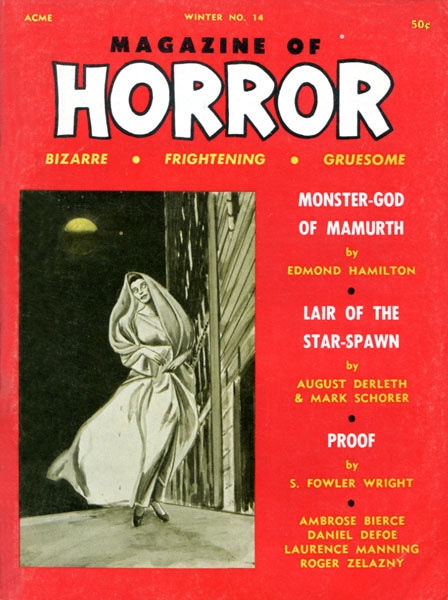
"Comes Now the Power" by Roger Zelazny

 https://www.isfdb.org/wiki/images/3/34/MGZNHRRWINTER1966.jpg

First appeared in Robert A. W. Lowndes's Magazine of Horror, finalist for the Hugo, reprinted by Lee Harding, Matthew Berger, Alexander Klapwald, Kenneth Sharp, Brian Attebery, Ursula K. Le Guin, Tracy Hickman, Margaret Weis.


Summary:

A man, who used to have telepathy, has forgotten how to do it. He finds a female mind who is able to do it, so he seeks her.


Discussion (Spoilers):

After a few failed connections, the man connects and she helps him breakthrough whatever was blocking him. However, he learns she is a young woman, hopitalized and dying, so his connection brought her memories of his life, so before her death, he gives her all that he has.

This is a wonderful, efficient little tale. I'm conflicted. It does a beautiful job executing the story in an emotionally impactful way. Any complaint would be negligible. However, is it one of the great tales? Does it resonate past its confines? Emotionally, yes. Is it a classic that makes you ponder the outcome in some meaningful way? I'm not sure that it does except to a minor degree. However, its inclusion--and a number of these brief, impactful tales--is a kind of challenge. What kind of story does belong? Does it need to be of a certain length? Fredric Brown's "The Weapon" is just a few pages long, but it wouldn't surprise me to be in such a major anthology like Norton's considering the way it forwards an integral question, better than stories 10x its length. What makes a major work? Something to ponder. 

Also interesting that this originally appeared in a horror magazine but there's really nothing of horror in it. Perhaps the major magazines passed on it--which boggles the mind--and Lowndes took it despite the lack of horror. 

(It appears that the title changed over the years and at one time had "and strange stories" which would makes more sense. Perhaps it was trying to hop on the horror train and dropped the original title.)


Friday, February 14, 2025

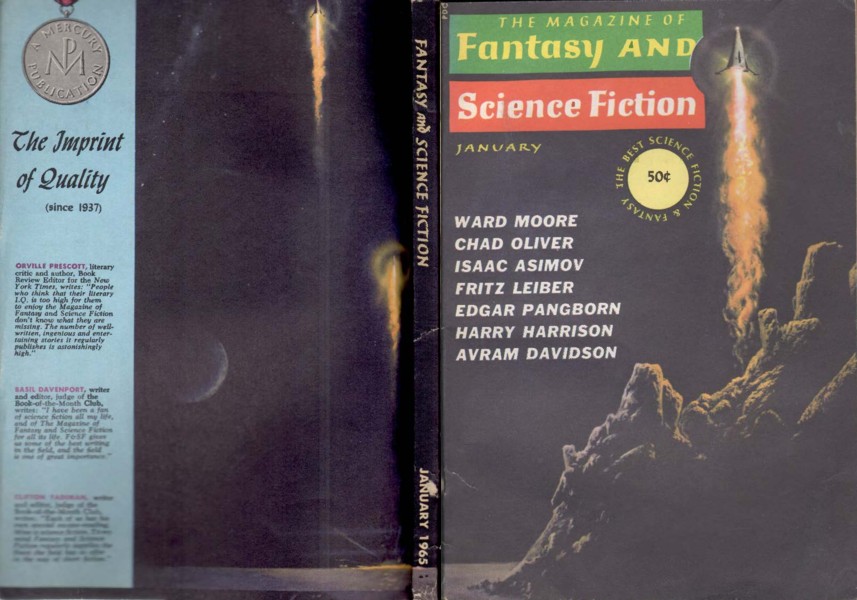
"The House the Blakeneys Built" by Avram Davidson

https://www.isfdb.org/wiki/images/8/87/FSFJAN65.jpg

First appeared in Joseph W. Ferman's The Magazine of Fantasy and Science Fiction. Up for the Nebula award, it was reprinted by Edward L. Ferman, Martin Harry Greenberg, Carol Mason, Patricia Warrick, Brian Attebery, Ursula K. Le Guin.


Summary:

 Two couples of colonists (one pregnant) arrive on a planet and find a road that leads to a castle [they seem uncertain if that's the correct term]. They want to build a house beside the Blakeneys's, a very strange extended family--presumed to be inbred after living alone together for so long--speaking a pidgin language. The Blakeneys came here to escape persecution.

When the foreigners arrive, they are welcomed. But then the new colonists go to build their own house. The Blakeneys seem less responsive, the new colonists borrow a few necessities and promise to repay. The foreigners plan to have their kids intermarry to avoid the Blakeneys for a time, but eventually they'd have to marry to improve genetic rigor.


Discussion (with Spoilers):

We are meant to think of the nursery rhyme "This Is the House That Jack Built," which is a cumulative tale. This sort of song opens simply, gradually accruings wilder and wilder causalities until it becomes the Butterfly Effect, where a flap of a butterfly's wings causes a typhoon halfway around the world.

The parallel here is similar in that what we are initially given is a simple family who seem to welcome new colonists when they are a part of the family or home. But as soon as they have a house apart from theirs, they attack. The chain of causality is not immediately apparent, but there seems to be a critical system of governance that has been violated making the new colonists worthy of death. With some irony (or maybe none, that is, it is part of the causality), the Blakeneys now persecute where before they were persecuted. Or were they? Was it their behavior that caused people to persecute them?

Perhaps one could leave it there, but this introduces the central issue with the Norton anthology. This is a strong tale. And the verbal pyrotechnics are a joy. I would not protest reading this in a Norton, but it doesn't establish what's going on. What an anthology purporting to establish SF as a field. What does that mean in other Nortons? Usually, one establishes the various movements and the major players.

Where James Gunn's anthologies succeed where others do not is that he grabs the central works that made people talk when they appeared. Le Guin's is more of a side-bar: Hey, these were good, too. Le Guin's can only work if you establish what the main line SF is. 

Only if and when you do that does this story gain more power. True quill SF establishes colonies. People work together. They build a community. That's what the new comers plan to do. The older colonists look like a group who has fallen into disrepair--in knowledge/know-how, in language, and in social etiquette. The new comers expect--as most readers might as well--that they have knowledge to trade with the older colonists that they might grow together and strengthen the community as a group. That this expectation is thwarted makes this story novel and provides context. This is the main quality lacking in this anthology. If you have a story that thwarts an expectation, first we need a story that creates such expectations. We can't assume, which is sort of the point of the story: assuming others expectations/knowledge (or lack thereof).


Wednesday, February 12, 2025

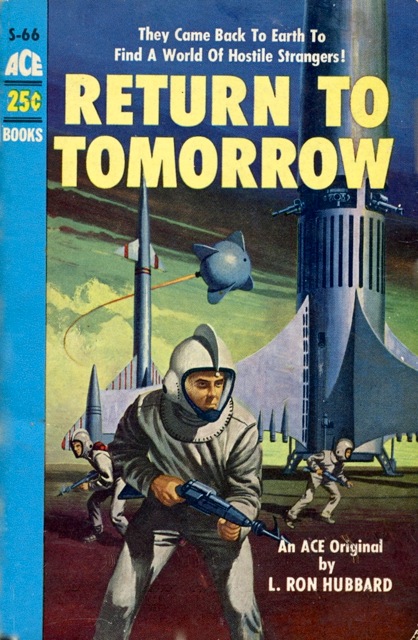
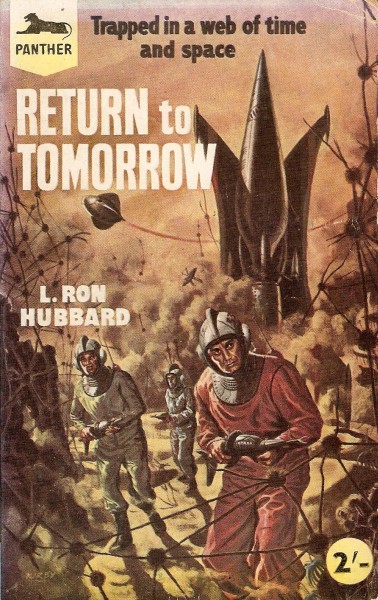
"Space Is Deep, Man": To the Stars, or Return to Tomorrow by L. Ron Hubbard

https://isfdb.org/wiki/images/7/7e/ASTFEB1950.jpg

 First appeared in John W. Campbell's Astounding. Was up for a Retro Hugo.


Somewhere far into our future, Alan Corday is in love. Despite being one of the few well educated and well bred tenth class in his day, Alan has no money to court her, so he is going to Mars to seeking his fortune. However, all that is changed when Alan has a black cat cross his path, hears piano music and steps into a packed bar that's otherwise strangely quiet, all listening intently to the music coming from the piano

In this short novel, Alan is taken on a long trip--that is, he's taken on a ship that has a distant destination. Can he get the crew to mutiny and take the ship back? Or should he just bide his time and hope his future wife is still waiting for him?

This is definitely a classic. According to the prefatory material, it was popular with readers at the time. It's easy to see why. 

The story didn't kick in until the piano scene--page 9 out of 210, about 4% in--but otherwise, it rocked. 

To compare the different titles is fascinating. Return to Tomorrow may be the more intriguing although I'm torn between which works better. It's fascinating that it underwent a transformation and returned to the original. Did the author return to his original? Or was one title forced on him?

The quote in my title is part of the opening line from the prologue, which actually says "Space is deep, Man is small and Time is his relentless enemy." As a reader and writer of poetry, I just loved the partial quote, which is perhaps too colloquial but also profound in its own way. While the prologue isn't bad and in places profound, I wonder if it hampered the tale from being more fondly remembered. After all, the story is the equal or near equal of the other works nominated.

I spent a good deal of time thinking about where it belonged in the pantheon of SF. I recently read The Time Machine by H.G. Wells, which is also known as classic (but perhaps not his best), and To the Stars hangs with Wells in scope and speculation in similar if different ways. It's true that Wells inspired what came after, but a number of space-travel-relativity stories have borrowed from this predecessor as well. Speaking of tributes, Hubbard has a tiny tribute to Tom Godwin's "The Cold Equations"--and there is a link, but perhaps more in theme than in plot.

Having recently read Frederik Pohl's best well remembered early classic, "The Tunnel Under the World," I find this hangs well with that. Arguments could be made about which is better.

Is it a must-read? I'll leave that for others to decide. Is it a classic that will repay your time? Absolutely. The reason it may not have been reprinted as heavily as some might be that it would consume half of most anthologies.

Some readers might object that women don't feature more prominently, but considering when it is written, they do play critical roles--some of whom tug at our heart although there is one I'd have liked to have seen her play a more prominent role as soon as it was clear what role she was playing although one might say the text let us imagine that role.

Highly recommended.

https://www.isfdb.org/wiki/images/1/1e/RTRNTTM1954.jpghttps://www.isfdb.org/wiki/images/a/ac/RTRNTTMRRW1957.jpg

Monday, February 10, 2025

Review: The Road to Sugar Loaf, by Eric T. Renolds

The Road to Sugar Loaf: A Suffragist's Story: Reynolds, Eric T:  9781735093833: Amazon.com: Books

Eric Reynolds, as a writer, has been published in Galaxy's Edge, Sci Phi Journal, Starship Sofa, and various anthologies. He has published Arthur C. Clarke, Lavie Tidhar, Nisi Shawl, Elizabeth Bear, K. D. Wentworth. Michael Burstein, Rudy Rucker, Stephen Baxter, Tery Bisson, G. David Nordley, Tobias Buckell, Frank Wu, Jay Lake, James Van Pelt, Eric Choi among others. But he's published anthologies of writers who are a complete unknown--at least to me.

Reynolds's writing is not far from his own personality. Simple, sweet, clear, straight forward. Here's a taste from early in the story:

During the fourth week of school, lockers and the lingering scent of freshly painted walls greeted civics teacher George Fielding as he walked the long, echoing hallway. He stopped outside Principal Holt's office when Violette emerged and handed a string-clasped envelope. He peeked inside to find Suffrage leaflets and other printed materials.

Violette looked around the hallway. "It arrived today from The Kansas Equal Suffrage Association," she whispered.

He thanked her and continued to his classroom where several students stood laughing next to the open door. They looked away when he approached. Upon entering the classroom, some students tried to suppress their snickering. Their glances toward the blackboard revealed what amused them.

George saw a caricature of himself wearing a dress while holding a sign that said, "Women Vote."

He smiled and turned to the class. "I see some of you are interested in Women's Suffrage, and I commend the artist for making more handsome than I actually am, but that dress should persuade you not to pursue a career in fashion design."

The narrator voice of the story melds perfectly with its era. At first, being from a different era, my brain's knee-jerk reaction was to question the novel's overall tone, but then I realized that it fit well. In fact, it's a bit annoying when writers try to make the past sound like the present. Reynolds's voice captures a slice of the past and brings it to us, more than a century later.

Reynolds relates the story of not just the vote in Kansas but across the fruited plains. The characters march to Washington and get thrown in jail under difficult circumstances, fueled by determination and will through protests and hunger strikes. His characters, particularly the women, are strong and well drawn. The quiet scenes were some of his strongest.

More variety, particularly among the men, might have been preferable. I met men, not from that era but immediately following the one Reynolds describes, and I still recall a gentleman joking that my grandmother thought women shouldn't have the right to vote. I turned to her, but she didn't respond, which sheds a lot of light on how people felt and behaved toward this era. There could have been a range of motivations for either party--from being totally true to totally untrue and a million subtleties between. He was clearly amused while my grandmother suppressed any response. Neither had been born during the movement, yet here it still impacted their conversation, decades later. For me, this showed more variations in character than what one might think from a casual glance.

Like a lot of other writers, writers meet writers in the course of writing. It's a small world. I edited a small journal, Mythic Circle, which required a theme of myth. He wrote a small tale set in space where myth was featured. I liked it but requested revisions. He obliged. I showed it to the lead editor and professor, Gwenyth Hood, who also liked it, and we published it. 

It may have been Eric's first publication. He may have told me that, years later, to my surprise. Possibly I am mistaken. But it was solid work if memory serves. I wouldn't have published it had I thought otherwise.

I didn't publish everyone. I had a writer of some note whose work I've praised in public. But none of the things he submitted quite fit. He was a little irked by that. I was a little surprised, too, that I hadn't, but I think if he'd have sent ten works, I'd have found one that felt right. Not unlike Picasso, he was going through a period--a style not so much to my liking.

Eric and I may have met in an online workshop, later at a convention by chance. He and his wife and kids made for an attractive family. This photo is a more recent one. He had more and darker hair back then.

Eric, later, started his own press, publishing original anthologies of speculative fiction, and in a few of these, published stories of mine, so full disclosure. 

Also full disclosure: I have a relationship with you all as well. So I try to direct the people who might be drawn to Eric's work and steer away those who would not. You have enough information to see which you are.

Eric Reynolds has published two other historical novels: The Lost Town of Garrison (a time-travel novel) and The Legend of Mulberry School (a paranormal novel).

Eric T. Reynolds Books - BookBub

Saturday, February 8, 2025

"When I Was Miss Dow" by Sonya Dorman


First appeared in Frederik Pohl's Galaxy Magazine. Made the first ballot for the Nebula and nominated for the Tiptree Retrospective award. Reprinted Brian W. Aldiss, Harry Harrison, Judith Merril, Pamela Sargent, Brian Attebery, Ursula K. Le Guin, Ellen Datlow, Heather Masri,  Lisa Yaszek.


Summary:

Aliens, who trade with humans, can change shape and gender--a bit like squishing play dough through a plastic "factory" into whatever shape desired. Despite being initially reluctant, one of the aliens enjoys becoming Miss Dow who takes a liking to the doctor she is supposed to work for.


Discussion (spoilers):

She forms an attachment both to the doctor and to her form. It anticipates Ursula Le Guin's The Left Hand of Darkness by several years and one might guess it had some influence on the novel.

Ah, now this belongs in an anthology (or at least one could see why it might be included) like Norton's. It belongs in a year's best. It is the cream if not the crème de la crème. It made the first ballot, but if you see which tales beat it out for the Nebula, you'd understand. However, as a subgenre that gained importance with the Tiptree award. You can see, from the novelty of subject matter, why Aldiss and Harrison decided to bump aside the finalists to reprint this instead.

If one takes The Left Hand of Darkness to be seminal, then this is the seed that must have spawned Le Guin's work.

Thursday, February 6, 2025

"Feather Tigers" by Gene Wolfe

Bruce McAllister [Editor] – EDGE Autumn/Winter 1973 – Science Fiction - Picture 1 of 13

First appeared in Bruce McAllister's Edge. Reprinted by Terry Carr, Brian Attebery, Ursula K. Le Guin.


Summary:

 Quoquo, a blue alien the shape of a "child-sized" bunny, is investigating Earth after a catastrophe has wipe most life other than plants which have grown wild and thick.

Humanity has left behind intelligent machines, but Quoquo doesn't find them all that useful, saying that they lie.

Proudly, Dondiil, another blue alien, has been breeding domestic cats for 40 orbits of their home world, so that they now approximate the kind that would have existed in the area [Vietnam].


Discussion (Spoilers):

Quoquo takes a blaster into the jungle and clears a path for himself. However, Dondiil has let his genetically modified tigers to escape. Quoquo blasts them until he realizes he's been hallucinating at least some of them. Finally, at his death understanding some human concepts.

Quoquo--whose name approximates "whichever" or "whatever"--has a hard time believing human culture. He's trying to be objective but failing. His name in his own language may be an intensifier: "Quo" now with even more "quo."

Humans do things that don't make sense like having a "Paris, Texas" that has nothing to do with "Paris, France" and what the aliens think they know about the species such as cannibalism, is applied over a time and circumstance and in a way that distorts understanding. Perhaps this is why Quoquo thinks the skyacht lies to him. The history is too complex, too broad and too thick to be easily understood. 

"Feather tigers" is another of those strange humans topics where humans see something where there is nothing. Only when exposed to a similar environment is Quoquo able to understand--albeit too late.

The ship is described by some unnamed narrator as being like the phoenix, and so too is the environment returning to what it once was--even if using animals different from the ones before.

This is a solid story. But Wolfe has others, better. The more I read The Norton Book of Science Fiction, the more I sense they are the B-sides of SF: These stories deserved more attention, which is great, but the book has a grander title with a presumed grander scope. No doubt the old reviews still exist. I do know some professors of the time professed their appreciation of the book. 

I've been reading the opening essays, which are informative, and establish the parameters of selection, and perhaps this urgency to get on the right side of politics held the book back from being something closer to what the book title proclaims. There's nothing wrong with what they're wanting to do, but it requires a different title: Forgotten or Neglected Stories of an Ethically Kind SF. At least that seems to be the best title for the moment. Maybe I'll have another later.


Tuesday, February 4, 2025

"The Life of Anybody" by Robert Sheckley

https://www.isfdb.org/wiki/images/8/81/ITWPDO19XX.jpg

First appeared in Sheckley's collection, Is That What People Do?, reprinted by Brian Attebery, Ursula K. Le Guin, Stefan Dziemianowicz, Martin H. Greenberg, Robert Weinberg.

Summary:

Sometime in the near future, people will have TV cameras show up in your living room. You have to be natural or they'll cut away. Better to have bad ratings than none at all. Nobody wants people acting differently than they normally would.

Discussion (Spoilers):

The couple know they are boring, so they spice up their lives in case the cameras come calling again. 

Sheckley had already predicted reality TV before most writers, but here the speculation is that we are actually boring, which is sort of interesting. The shows people watch are more interesting than most people's lives.

However, to become interesting, people would have to fake their lives, which is what we get from most reality TV--people behaving unnaturally to create drama that might get people watching your reality show.

For so short a story, the tale accomplishes much.

I am going through the Norton anthology, story by story, to get a sense for the modus operandi. They seem to be seeking shorter works, provocative works, and possibly works that present gender in a certain manner. There is no particular gender issue at play except maybe the wife chooses not to stir up marital strife for the sake of ratings.

But Sheckley has had better stories than this, so it's odd that this one is selected. Maybe this is the academic aspect, allowing professors to select this among other TV tropes.

The other possibility is that stories were selected to make them easier for non-SF readers; however, you'd think that a course in SF would be more interested in making a splash as opposed to easing people into the waters (especially by 1960-90). When this was published in 1993, most readers would have already been exposed to far stranger SF on TV and movies.

Sunday, February 2, 2025

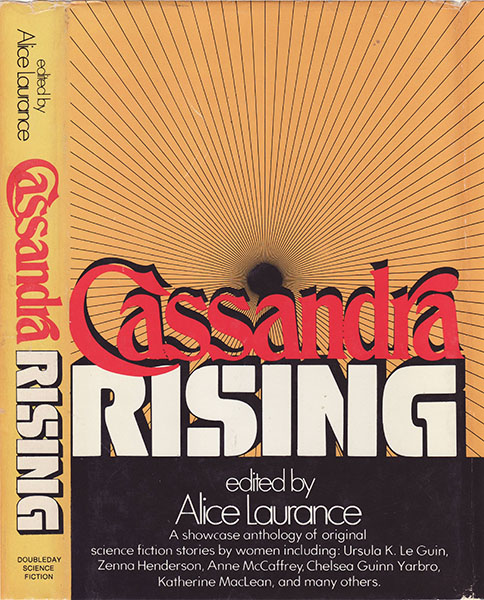
Night-Rise by Katherine Maclean

 First appeared in Alice Laurance's Cassandra Rising. Reprinted by Ursula K. Le Guin and Brian Attebery.

Summary:

A reporter takes in the story of a "Dark Christ"--a person or people who are, in this world, not necessarily anti-Christ or maybe they are. They are described more in terms of Yin-Yang--the destructive version of Christ. The reporter is witness to a murder.

Discussion (with Spoilers):

The reporter does not report the crime. Drunk, he goes down to the docks and he himself is killed by the same group.

It has long been a debate whether journalists should be involved in news or just report on it. If the journalist had reported them, perhaps he might have still been alive.

This is philosophical fiction, yes, but is this SF? It speculates on this religion, but it could as well be of our world now or in the past.

Probably the most interesting thing about the story is where it appeared. The editor opens with a small window on women in SF and probably one of the more interesting looks women in SF, looking at the male writers, too, discussing what she considered worthwhile portrayals of female characters. 

Moreover, some complained about the political nature of Le Guin's The Norton Book of Science Fiction. And we have a story that no one else noticed (which could be cool, rescuing a good story from obscurity), but it isn't really SF, which lends some credence to the complaint.

While written by a woman, however, the story is about a man. Given the above, is this meant to be a critique of men? Let's come back to this after parsing possibilities.

So we have a religion who feels free to take lives. There's no discussion of the beliefs, per se, so maybe it could be any affiliation--political, social--except they define themselves as like but opposite of Christ.

They kill a man who is interested in boys. Is this ethical? If it is, then a journalist who doesn't report this murder, shouldn't be held responsible, but yet he is killed as well. Why? Is it because he drank? Is that ethical? Are both murders justified or neither or only one? How do you as a reader feel about the murders?

Once we establish this, we might understand better how we might feel toward the murder of the journalist. Because we inhabit the journalist, my suspicion is that we are meant to find some empathy toward him. Not always, of course. And maybe not completely. 

"[The journalist] imagined he saw young, sympathetic faces around him, sympathetic but mistaken. But it was took black, he could see nothing.

"Trying to speak, felt the caress of white silk around his neck." 

The speaker gives positive attributes to the killers ("sympathetic" and caress") but also calls them "mistaken." In retrospect, he sees himself as blind (or "could see nothing.") 

Back to the topic of men and women, then, what does this suggest about male and female traits? Is this meant to suggest that men are more likely to kill and turn a blind eye?

Friday, January 31, 2025

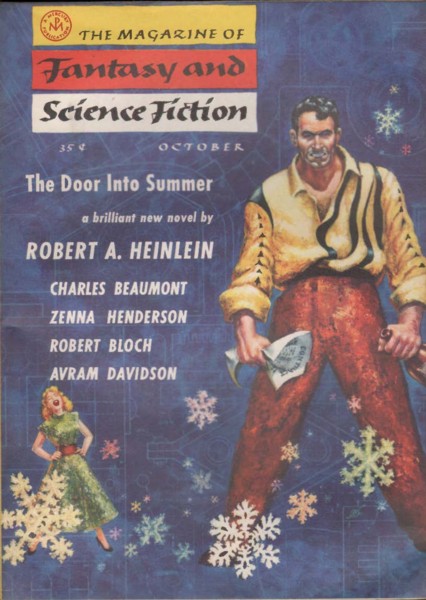
"The Anything Box" by Zenna Henderson

 https://www.isfdb.org/wiki/images/d/d9/FSFOct1956.jpg

First appeared in Anthony Boucher's The Magazine of Fantasy and Science Fiction, reprinted by Judith Merrill (twice), Damon Knight, Isaac Asimov, Martin H. Greenberg, Charles G. Waugh,  Richard Glyn Jones, A. Susan Williams, Pamela Sargent, Margaret Weis, Garyn G. Roberts, Gordon Van Gelder, Ann VanderMeer, Jeff VanderMeer.


Summary: 

A teacher spies one of her students who seems to be way too preoccupied with imaginary things, pawing at and staring into something invisible at her school desk. However, when the student hands the "Anything box" to her teacher, she learns that it is, in fact, real.


Discussion:

When her father is taken to the state penitentiary, the girl becomes too involved in her box, even falling down, so the teacher takes it away, trying to convince the child that it isn't and never was real. The teacher loses track of the box for awhile. 

Meanwhile, the child becomes more lifeless. The teacher eventually gives the box back but exacts a promise from the girl that she'd never again try to go into the box.

This is a paradox. It is a story whole central speculative conceit may or may not be real--the kind of thing that SF readers are supposed to hate. We could say, on the one hand, that the box is real because the teacher experienced it; however, you could just as well say that that may just be an overzealous empathy, identifying with her students. 

The strange thing is that this is also a metaphor for SF itself--a thing of imagination whose purpose we can't really pin down but we can see that for those who love it, it has a transformative power over people's everyday lives.

The power of this paradox and metaphor can be seen in Merril's decision to have it part of a decade's representation for speculative fiction, but no one else did for another four decades. Then it returns. Perhaps it is this metaphor that editors return to this story, and/or perhaps they want to represent a popular writer of her time. How strange that a tale should both represent a thing yet also defy it?


Wednesday, January 29, 2025

"Webrider" by Jayge Carr

First appeared in Ellen Datlow's The Third Omni Book of Science Fiction, reprinted by Donald A. Wollheim, Arthur W. Saha, Pamela Sargent.  

Summary:

Twig is a webrider. She can travel over space and time. The danger is groupies--those who, like her sister, try to ride the web but cannot and die.

Discussion:

This opens with a fine energy--matching William Gibson's more frenetic prose with Samuel Delany's Aye and Gomorrah, adding a touch of Jeffery-Carver-style space travel (where travel is, at least in part, a state of mind) and something of the author's own. It's an interesting concoction. It's not a major work but thought-provoking. It takes a look at art--how hard it can be to learn on one's own, but with the proper mentor....