
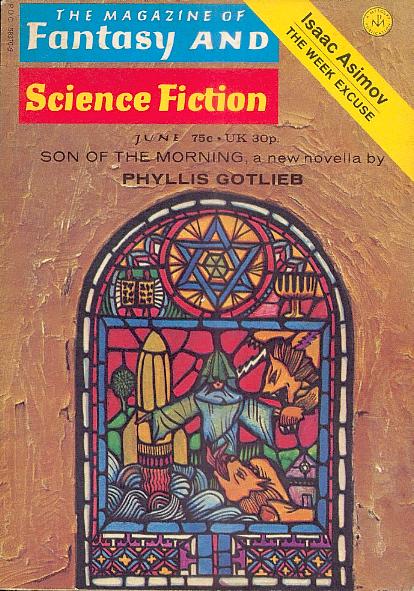
First appeared in Edward L. Ferman's F&SF.
Summary:
Sam is a screenwriter. After the discovery of the Martians, he wants to capitalize on this and make a new movie, which is essentially Edgar Rice Burroughs' Mars. He has to get past his agent's and director's reluctance to sell it.
Discussion with Spoilers:
All is for naught. The aliens look nothing like those of the real Martians once the photos come out--more like seals. They can't even be made sexy.
Like Pohl's tribute to Doc Smith in "The High Test" or to Jack Williamson in "The Mayor of Mare Tranq," here is a tribute here to Burroughs--the popular appeal, its power. But also it bears a critique to the aliens in Burroughs' Mars, their realistic possibilities (perceived, of course, since we have no aliens to compare to).
Side-bar: This story may prove interesting to compare and contrast against Geoff Ryman's "The Film-makers of Mars" (audio link).
What's interesting about the story's appearance in the novel, The Day the Martians Came, is that the story is streamlined just to this bit of narrative, which is interesting but not necessarily profound. What it loses in profundity, it gains in a smoother narrative that works better in this novel atmosphere.
This spurred me to speculate that this may have been Pohl's original core of the story--a narrative he found compelling, but missing the necessary piece to elevate it from the ordinary. Here it is one example among several of the impact of species of creatures that impacts without ever having set foot on planet Earth, as yet. A rather intriguing prospect in that light.
While we don't other possibilities that Pohl may have tried, we do have the original publication, which has our protagonist, Sam, being studied by aliens who will use his character to decide whether humans are worth saving or destroying. Once our alien protagonist knows Sam and his fellow Earth inhabitants are doomed, he wants a different Earthling to examine, but he cannot. Earth is doomed.
But the interesting bit is that the death ray won't arrive for 64,000 years. (If that information that was beamed to them also took 64,000 years, then that would mean Earth has 128,000 years to prepare after Sam's departure. So a story that began, announcing humanity's doom actually ends in the possibility of hope. This is fascinating, but it does bog the narrative down.
One suspects that this core of the story was looking for another part to give it significance. The original is in some sense the more powerful, but also perhaps a swamp of narrative.
While the great-aliens (who seem to be in the same galaxy but maybe on the opposite side) part of the story seems not to be wholly lost. It survives in a few conspiratorial mentions. See the comments on the story "Saucery" for more on this.

