APB-SAL is a blog about education, science, science education, fiction, science fiction, literature, literary stories, poetry, and anything else that strikes the blogger's fancy.
NOTE: This blog interrogates art. It rarely make moral proclamations. For that attend the church or politician of your choice. This blog concerns aesthetics, not propaganda. Consider this as interviews with books where the interviewer presents interviewees, so you get what you need to do your own thinking.
I'm interested in chatter about AI than the product itself. The primary problem is that there's no mind behind it. The mind behind the work is part of why I read, why I watch, why I take in any kind of media. I want to know how others think. The mind behind the writing is what makes a work powerful.
Experimental writing is vibrant if people put thought into it. If not, it's a tome/tomb of half-legible graffiti. Dear writer, please don't waste people's time pondering something you didn't time to ponder yourself. AI? Uh, no thanks.
One person did almost get me to buy into their thinking, and I was instantly riveted because, wow, this is actually a new thought, unblindered by cult politics, but it usually breaks down within a few paragraphs.
An example of non-AI that knocked me out immediately: A kid was supposedly falling off the cliff, but there was an obvious place to put your foot. Put your foot there! Good god, man, put your foot there and climb out!
Imagine a string of such incidents, idiocies--minor or major. Does AI discriminate, choose what might work well in this instance? Or will be as likely to select the problematic as the brilliant? The accidental juxtapositions might create fascinating, but will the parts connect? If what you do can be replaced by AI, then you will be replaced.
Here's the paradox. I don't oppose repurposing words. Good art could be produced by planting a mind behind the AI. However, the people who would want to use AI are not the people who can make good art. They want short cuts. Rather, to make good art out of AI, you'd have to oppose it. You'd have to be willing to put in the same amount of time to sculpt words as if you spent the time writing them yourself. It is only by critical thinking that the work of AI can have any value.
I discussed John Hughes's work here,which has relevance here. He, however, did his own selecting, so seems a better choice than leaving it to something else, but so long as a mind orders the material it might, in theory, be worthy of the term "art."
It's hard enough to order one's own words, let alone someone else's. I don't oppose art made through AI, but it will be hard to make it yours.
This is interesting, but way too long. Yet they come up with some interesting uses of AI in media, but it remains in a grey area (the interesting stuff was name-dropping famous older actors whose looks may be rewound to earlier version):
Earlier last year, Hughes wrote a defense of his work, which seems like a cursory overview, but then critics of his defense were weaker still, which makes his defense look stronger than his critics. It's actually a pretty good justification for what he was doing although a broader and deeper paper may be necessary.
The book blurb on Hughes's Someone Else does show this is his modus operandi:
"Like The Idea of Home, Someone Else uses the essay as a form of autobiography. Here, however, the essays are fictions. Or are they? Hughes tells the stories of the figures who live in his mind by making them tell his stories – and in doing so engages in an art of literary ventriloquism."
So Hughes has told people all along what he was doing. Why the surprise?
I wrote a series of poems completely borrowing Shakespeare's or the King James Bible's words about the moon in order to write a series of love poems. They were all their words, but reordered so that the final result was that their words no longer discussed what they had intended to discuss. Is that plagiarism?
No. It is art. What is found poetry? What is erasure poetry? What is collage?
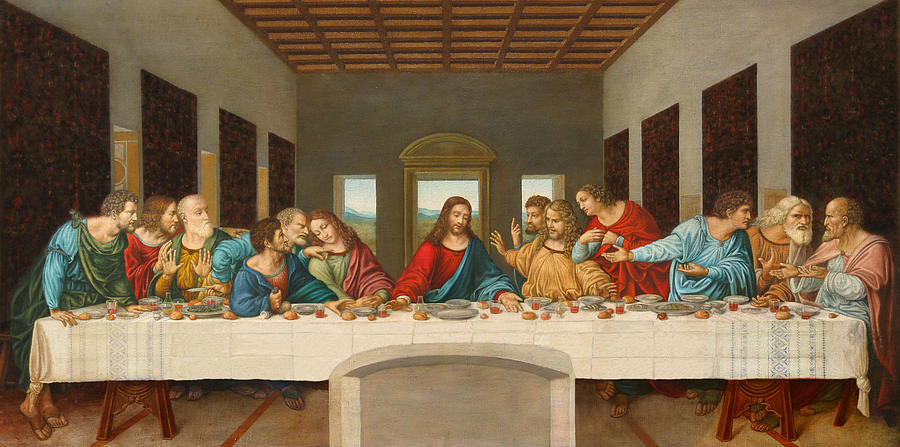
The measure is whether the borrowing is well done. Let's take Leonard da Vinci's Last Supper as an example.
I'd need to rewatch Robert Altman's MASH to see how this fits in, but it does seem to contribute both to the story and as commentary of the art/event (a man is going to commit suicide (or so he thinks) and his friends are sending him off with this "last" supper):
Most stagings of the Last Supper, though, have been brainless or not art. It sort of fits the image of, say, Battlestar Galactica, but it doesn't slide into the series very well--a bit stagey (but still some cleverness so some thought went into it):
You could say that MASH's use of da Vinci is also stagey. True, but they try to make it fit smoothly into the narrative. Perhaps it's worth complaining about, but it is comic, which makes it more difficult to critique.
Disappointingly, they have no analysis. It's more of a dramatic dum-dum-dum than an actual discussion. Proof of plagiarism!
Someone needs to actually read the books in question. To know whether the borrowings are significant, one must ask
How does Hughes use it?
How does Tolstoy use his text?
How do they compliment or debate?
How does the borrowing add meaning and/or reflect back?
However, Hughes borrows liberally. You can't see much of a purpose--at least not from these clips without more of the book. At present, this is a failure to read.
It does look like rather drab borrowings, though. It may be Hughes was simply learning sentence patterns from them--a rather banal borrowing, unfortunately. It's puzzling why he borrowed so much and why the passages don't seem particularly indicative.
An homage should be brief but enough to suggest where and what is being borrowed. For instance, "I'll be back" is a famous saying, but it requires more set-up than just those words. We'd need more. Also an homage should try to capture some particular tell-tale, briefly, that indicates what he is borrowing. It is curious.
Finally, the borrowing should be unobtrusive. That it took so long to discover Hughes's borrowings suggests his work is unobtrusive (but also not distinctive). The Altman clip is less obtrusive than the Battlestar Galactica. Should it be invisible? Should it be somewhat obtrusive so at least some people pick up on the nod? That's probably a question of taste.
However, I don't think homage is the highest form of art since not everyone has a photographic memory. It's what many call the "Easter egg"--the piece of art that's hidden that some may uncover. There should be no guilt associated with not recognizing homages.
Earp, in the article above, seems to think this won't hamper Hughes's career, but I suspect it may. Time will tell. But condemnation, without a deeper investigation, suggests brainless book burnings--to the shame of those who complained... unless they actually did the requisite legwork and found Hughes's borrowings not especially necessary to his art.
#
There's been a lot of hand-wringing over AI visual art and AI-generated stories. They "scrape" or "plagiarize" [to borrow the Guardian's accusations] writers and artists to create their "new" works. People--writers, even--find it convincing. All the people who think Hughes plagiarized without digging deeper should be banning such AI works, but though I've heard complaints, I haven't heard of any movements to block the AIs from doing their [illegal?] work.
My guess, for now, is that, without an intelligence guiding the art, human art is safe. If it should develop a method of creating intelligent art, then we can despair.
#
None of the above is to suggest where I come down on Hughes as a writer, but it does suggest a method for evaluating Hughes's work.