Search This Blog

Showing posts with label Poetry Magazine. Show all posts

Thursday, January 18, 2018

Mary Ruefle Lectures (essays on poetry)

28 Short Lectures:


Lectures I Will Never Give (includes Q & A):


Opening lectures from Madness, Rack, and Honey

Kangaroo Beach

On Fear: 
Our positive capability.

I Remember, I Remember:
On the handsome roofers, attentive cows, and sudden tears of youth.

On Erasure: Visual and Textual

On Imagination  (includes Q & A):


Thursday, April 20, 2017

On Dreams, Song, Alice, and a Lewis Carroll Poem

"A Boat Beneath a Sunny Sky" or "Of Alice in Wonderland"

A boat beneath a sunny sky,
Lingering onward dreamily
In an evening of July —

Children three that nestle near,
Eager eye and willing ear,
Pleased a simple tale to hear —

Long has paled that sunny sky:
Echoes fade and memories die:
Autumn frosts have slain July.

Still she haunts me, phantomwise,
Alice moving under skies
Never seen by waking eyes.

Children yet, the tale to hear,
Eager eye and willing ear,
Lovingly shall nestle near.

In a Wonderland they lie,
Dreaming as the days go by,
Dreaming as the summers die:

Ever drifting down the stream —
Lingering in the golden gleam —
Life, what is it but a dream?

*

This was Poetry Magazine's poem of the day last week, and the last line struck me as familiar. Ah, but of course: 

Row, row, row your boat, 
Gently down the stream. 
Merrily, merrily, merrily, merrily, 
Life is but a dream.

Wikipedia lists this song's first printing as 1852 (although it was possibly in existence before that). Which came first? Was he the originator or merely referencing the song? Carroll would have been 20. Possibly the phrase predated both. Carroll references Alice in Wonderland (published 1865 although he'd written earlier versions prior it's first printing. 1862 is listed as the date he first orally told the tale, so he had to have at least written that--likely later than 1862, then. Bartleby suggests the poem's first printing was 1895 under the above alternate title.

Carroll may have been referencing that song although it is an American song, which hampers that possibility a bit. However, if the poem was composed nearer 1895, then Carroll's likelihood of hearing the phrase from the verse seems probable.

When you hear "Life is but a dream," what does that mean? In "Row Your Boat", the use of "gently" and "stream" and the repetition of "merrily" four times (not to mention the lilt of the song itself) suggests that the song presumes "Life is unbearably wonderful." Is that wishful or hopeful thinking, or indoctrination of young minds? Who thinks of life being a dream? BeyoncĂ©? At least she had a documentary called that. Songwriters in the fifties released sugar-coated songs with that title. It just seems odd or perhaps someone was born extraordinarily lucky and/or rich.


Carroll's use of the phrase seems quite different. His interpretation adds a bittersweet flavor, especially if it were composed so many years later. The persona's voice sounds wistful for the time he rowed the young ladies out ("Lingering onward dreamily") as well as for the Alice of the tale ("Still she haunts me"). Throughout, he mentions the end of things: evening, frost, Autumn, not to mention "Echoes fade and memories die").

In fact, he equates the dream with Alice herself: "Never seen by waking eyes." So a tale is a dream. When Carroll gets to his final line, he references the old song's blind devotion to believing life is unbearably wonderful, but ties to that idea that life is fleeting and story-like, perhaps due to the uncertainty of memory.

Interestingly, the poem that references a song became another song, which seems to mirror the moods mentioned here. The song (or poem?) is apparently famous enough to get riffed here and here.

Thursday, March 23, 2017

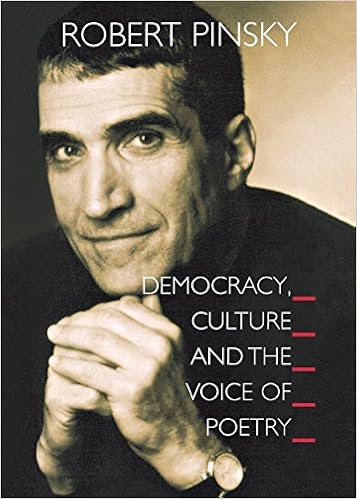
Democracy, Culture and the Voice of Poetry by Robert Pinsky

Robert Pinsky tackles Democracy, Culture and the Voice of Poetry, which seems a rather daunting task, especially for the book's modest size. A subtitle might ask what poetry's current role is in America. During his tenure as U.S. Poet Laureate, one of his self-appointed tasks was to get average Americans to comment on favorite poems. An immigrant from Laos, Pov Chin, here comments on how much Langston Hughes's "Minstrel Man" means to her. A critic apparently took the approach to task, saying it illustrated American narcissism. Pinsky, on the other hand, seems to admire the poem's strength through its adaptability, to fit someone's circumstances in a wholly different cultural context. I tend to lean in Pinsky's favor.

Pinsky opens the brief book by distinguishing wrong-headed impetuses that can damage a democracy: 1) colon, that is the tendency to all the same within a culture, and 2) cult, the tendency to divide and fragment a culture. In opening with this, he lends special weight to the idea but never comes back to it--at least not explicitly. Maybe he means to suggest that these are twin ditches ("keeping it between the ditches") or Scylla and Charybdis that the wary poet has to sail his ship between. In referring to the above critic, maybe Pinsky means to suggest the critic fell prey to one ditch or the other.

Pinsky quotes Alexis DeTocqueville (from Chapter XVII OF "SOME SOURCES OF POETRY AMONG DEMOCRATIC NATIONS" of DEMOCRACY IN AMERICA) as saying
"I am persuaded that in the end democracy diverts the imagination from all that is external to man [such as Nature] and fixes it on man alone."
Pinsky makes no direct connections, but maybe he means to suggest a specific meaning to this. He refers to a handful of poems without ever explicitly what his point in analysis is. These are "Home Burial" by Robert Frost, T. S. Eliot's "The Love Song of J. Alfred Prufrock", Elizabeth Bishop's "In the Waiting Room", and Edward Arlington Robinson's "Eros Turannos". This last Pinsky contrasts with the Carl Sandberg's Chicago poems which appeared that same issue and won poetry's then biggest award*. Sandberg's is probably more ostentatiously American--broad, sweeping, encompassing--but Pinsky calls on the voice of an anonymous American wife for whom the Robinson poem took on special meaning because her husband was away on business all the time and got hooked on drugs and alcohol.

It may be that Pinsky agrees and disagrees with his critic. Yes, people do take in poems and make it their own--not for narcissistic reasons but personal ones. That a poem can be absorbed by average human beings must be part of the appeal of doing a project that has "Americans [say] poems they love." Truly, that must be the democratic appeal of such an unofficial survey.

* Pinsky doesn't quite dismiss the Sandberg poems, but he does suggest that Robinson's poem is superior from this vantage in the future. His argument mirrors David Orr's in favor of Bishop over the ambitious Robert Lowell. This seems to represent a shift in predominant thought about poetry in the twentieth century. In Sandberg's poems, the voices of Walt Whitman and Allen Ginsberg echo although in general I am probably in agreement with Pinsky and Orr.