Search This Blog

Showing posts with label Eileen Gunn. Show all posts

Wednesday, February 16, 2022

Literary (Ballard, Burroughs, and Gibson), TV, and movie links +

Eileen Gunn on William Gibson's first famed novel, Neuromancer, approaching 40 years old.

#

Here's J. G. Ballard on fitting himself and Burroughs within the larger literary culture.

#

Words known better by males than by females (left), and vice versa

#

Amazon revisits Tolkien's universe. Billion dollar investment. Interested. Withholding judgment. 


#

Promising trailer for Dino glory?


Wednesday, March 10, 2021

Comments Published, Howard Waldrop story updated, Future Posts


"The King of the Beasts" by Philip José Farmer

It's interesting that "The King of the Beasts" is #17 on this blog's most popular posts. That suggests that the story has more impact on readers than one might have supposed. Time permitting, I will need to revise it. It has more relevance than the tone may have implied. 

The theme deals with how, as a consequence of allowing so many species to become endangered. humanity itself might become one of its own victims. Potent, surely. 

I still contend that, instead of building up to the surprise, the idea might have been developed a little more although one could argue that that would be unnecessary due to its brevity. 

I will rewrite this post to incorporate the above.

"Microcosmic God" by Theodore Sturgeon

This post is #8 on the all-time most popular blog posts. I will need to reread the story with the question of ethics and morality in mind. What a fascinating question. Thank you.

I looked up the definitions and commentary and it appears that most of us use them interchangeably. However. some view morality as a personal thing and ethics as a group thing. 

I don't. I see morality as a group and personal thing. They are the rules we live by and sometimes share with others. Ethics would be examining these rules closely, trying to eliminate bias, to understand our rules and others' rules. Morality would be the vine that grows naturally. Ethics would be the trellis that someone constructed (or that someone examined). Others have made different distinctions--if there are any. 

I hope to eventually write a post addressing this, assuming that, when I reread it, I will come up with something interesting. Great question. 
 
Future Posts

I hope to write about more mentors and colleagues who became friends as a result of our mutual interest in writing. SF is a small field. Some mentors were kind, some were not. Some I disagreed with ethically, some not. You probably cannot guess which is which by the way I write about them here since I try to maintain integrity in examining the stories. Stories are not people. Besides these comments are as much for me as for others.

Howard Waldrop was a mentor. As Chad Oliver called him, he was a story doctor, knowing how to diagnose a story's ills. His perspective always surprised our Clarion class.

After winning the Writers of the Future contest, I plan to read and discuss stories from those anthologies as well L. Ron Hubbard's own oeuvre. I discussed a few of his works on here: Fear and "Beyond All Weapons." I thought there had been more. In terms of books, Battlefield Earth I found particularly interesting for its discussion of economics though I forget now what that discussion entailed (hence, the blog). Ole Doc Methuselah wasn't as effective. As a young man, I remember getting enthralled by the opening of the Mission Earth sequence; however, my rereading was interrupted. I am most fond of his pulp stories, though. So I plan read those. I seem to recall being particularly fond of "Crossroads."

The WotF contest has its own, self-guided workshop with essays by Hubbard and videos with Orson Scott Card, Tim Powers, and Dave Wolverton. Pretty interesting, so far.

Some claim they have the contest figured out. I don't, so I don't know that I can offer general advice. However, I do think the "After the Workshop" podcast on this link is particularly enlightening. If you're submitting a story to the contest, good luck!

Monday, April 28, 2014

Sales + State of the genre

20% off all Mad Scientist Journal Quarterlies with these coupon codes.

2 ebooks 
by Cassandra Rose Clarke
-- finalist for Philip K. Dick award for The Mad Scientist’s Daughter
$1.99

Horror 101: The Way Forward 
by Steve Rasnic Tem, Graham Masterton, Edward Lee, Jack Ketchum, Harry Shannon, Ellen Datlow, Iain Rob Wright, Ramsey Campbell, Joe Mynhardt, Mort Castle 
$0.99

State of the Genre:

How America’s Leading Science Fiction Authors Are Shaping Your Future By Eileen Gunn at Smithsonian Magazine
"The literary genre isn’t meant to predict the future, but implausible ideas that fire inventors’ imaginations often, amazingly, come true"
Why Today's Inventors Need to Read More Science Fiction by Rebecca J. Rosen
"MIT researchers Dan Novy and Sophia Brueckner argue that the mind-bending worlds of authors such as Philip K. Dick and Arthur C. Clarke can help us not just come up with ideas for new gadgets, but anticipate their consequences."

The Underrated, Universal Appeal of Science Fiction by Chris Beckett
"Why do so many readers still look down on the genre of Orwell and Atwood?" 

The genre debate: Science fiction travels farther than literary fiction*
"In the second of our series on literary definitions, novelist Juliet McKenna argues that far from being inferior to literary fiction, science fiction and fantasy can create debate around the most complex political issues"

* -- clearly an article of bias, especially as it's written by a speculative author.  Each genre has its merits and probably should not be compared, lest lines be drawn and someone do an actual comparison and show similar lacks because, say, the speculative field does not concern itself with such topics.  H.P. Lovecraft trashed Henry James because Lovecraft examined James through a single lens: Does James evoke fear powerfully enough? Still the article's worth checking out.

Sunday, November 17, 2013

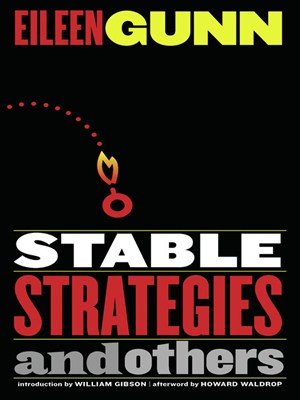
Reader’s Guide to "Stable Strategies for Middle Management" by Eileen Gunn

First appeared in Asimov's.  Later collected multiple times in several major anthologies by editors Gardner Dozois, Ursula K. Le Guin, Brian Attebery, James Patrick Kelly, and John Kessel.  Nominated for the Hugo and Locus Poll awards. 

Summary and Commentary:
The story has struck a business-world nerve, comparing corporate life to the insect world.  Editors Kelly and Kessel note its very Kafka-like influence, and Dozois points at its more SF'nal features of genetic engineering--all within a claustrophobically corporate atmosphere.

The narrator awake to find herself changed involuntarily by her corporation into a mosquito--likely a metaphor for their blood-sucking ability.  While involuntary, she does have and later uses this another human.   Also, she's not human before she drinks coffee and cannot drink coffee. She is part of the system, indicated by how she desires a leadership role and how she does not have a compound eye to see things from different angles (although she does have a comb to clean them, indicating that she may in the future).  She develops chitinous skin over time, hardening her surface.

She contemplates quitting; however, when the narrator learns that corporate leaders are squeezing her out, she fights back.

Questions:
  1. What does it mean to the narrator that she's becoming an insect?  Is there more than one feeling?
  2. How does the corporate world see her becoming more like an insect?  What's the problem with that?
  3. Look at the passages concerning coffee.  How does that tie in?
  4. How are the narrator's actions as an insect positive and negative?
  5. List each anatomical insect part mentioned.  How does each insect part contribute to the overall theme?
  6. What does she transform into?  Why?  How does that play as a pun and corporate life?
  7. How does evolution play into what Gunn has to say about corporate life?

Saturday, November 16, 2013

"Hive Mind Man" by Eileen Gunn and Rudy Rucker

First appeared in Asimov's.  Collected in Rudy Rucker's Collected Stories.

Diane hooks up with Jeff and Jeff hooks up to the internet.  He makes money through the internet--albeit not enough to support himself--promoting bands, chirping, flooding opinion polls with phony responses.  Dubious if not criminal.  But he's a sensitive guy, and as much Diane would like to dump, he does things that draw her back to him.  When he hooks his brain completely to the internet, it seems to spell doom for the relationship. He's a walking advertisement.

The ending threw me for a loop.  I'd expected--was set up for?--one ending and received quite another.  I do appreciate the change-up, though.  More fun.