Search This Blog

Showing posts with label Charles Bukowski. Show all posts

Saturday, August 28, 2021

Open for Business--novel openings

Thumbing through a bunch of novels--all varieties--it surprises me at how few make the narrative interesting. They must be decent books. Someone took time to hone it and probably inflicted it on friends and mentors to read. And later, an editor bought it and--one would think--helped hone it further so that you have something interesting happening in the first two pages. Something. I'm not asking for a gunfight or a verbal one, but maybe. Something. 

This scene from Together is amazing on how it engages the viewer, and it's just two people talking to us:

(The first version I watched was cut so that it seemed like she'd just now made this meal for him with the aforementioned mushroom which was even more interesting, but best to cut it since it isn't a part of the movie.)

Presumably the writer has worked harder on his opening than any other part (with the possible exception of the ending), yet as I comb through book after book, here are a bunch of dull starts. I don't get how that's even possible. If I were the editor, the opening would be my first priority. Yes, we need a narrative that flows and makes sense and moves us at the end, but readers have to start somewhere, usually at the beginning.

I used to read Charles Bukowski as a young man--in part because he wasn't me. I liked his devil-may-care attitude, his humor, and his commitment to art despite being destitute and drunk half of his waking life. Honest where most keep silent, he opened life to the seamier side. His perspective should not be construed as matching mine.

But the point here at the beginning of his novel was that it not only hooks but also gets the reader to think about the narrative, about life. He packed more in a few sentences than some writers put into two pages. The following opening from Women isn't the full paragraph but it's enough. Even one sentence is enough, but reader beware. Bukowski is definitely R-rated and not recommended for the woke and the strict religious type--or really anyone who thinks people should only think as they do.

I was 50 years old and hadn't been to bed with a woman for four years. I had no women friends. I looked at them on the streets or wherever I saw them, but I looked at them without yearning and with a sense of futility.

Not beautiful, not evocative, but functional. We get character and struggle immediately in the first sentence. Whether the reader feels for his plight is another matter, but that may say as much about the reader as the writer.

One of my all-time favorites is Of Mice and Men. It starts off with two pages of setting (also theme although I didn't notice that until a later reading), and I was never bored. Rereading, I see that on a surface level, it's about the land and about how it's been used by animals and men before of characters enter. It's not what sells me on the book, but it's interesting enough--for a moment. Steinbeck seems aware of what he can get away with and how much: well written and a touch of interest.

A few miles south of Soledad, the Salinas River drops in close to the hillside bank and runs deep and green. The water is warm too, for it has slipped twinkling over the yellow sands in the sunlight before reaching the narrow pool. On one side of the river the golden foothill slopes curve up to the strong and rock Galiban mountains, but on the valley side the water is lined with trees–willows fresh and green with every spring, carrying in their lower leaf junctures the debris of the winter’s flooding; and sycamores with mottled, white, recumbent limbs and branches that arch over the pool. On the sandy bank under the trees there leaves lie deep and so crisp that a lizard makes a great skittering sound if he runs among them. Rabbits come out of the brush to sit on the sand in the evening, and the damp flats are covered with the night tracks of ‘coons, and with the spread pads of dogs from the ranches, and with the split-wedge tracks of deer that come to drink in the dark.

There is a path through the willows and among the sycamores, a path beaten hard by boys coming down from the ranches to swim in the deep pool, and beaten hard by tramps who come wearily down from the highway in the evening to jungle-up near water. In front of the low horizontal limb of a giant sycamore there is an ash pile made by many fires; the limb is worn smooth by men who have sat on it.

Simple and effective. 

If you can't sustain my interest for two pages--the two pages you presumably worked hardest on--how can you maintain it for a book? Maybe it picks up later. When you get a sample today, though--you only get ten to twenty pages of the opening--somehow you have to persuade the reader that this book is worth reading. 

I picked these not as exemplary but as simple and effective, picked because they aren't hitting you over the head with their hooks.

Sunday, April 2, 2017

Reduced ebook lunches (expanded)

Map: Collected and Last Poems by [Szymborska, Wislawa]For whomever likes poetry and reading on Kindles, Wislawa Szymborska is on sale for $3.49.

Time to read her work again.

#

Song of Kali 
by Dan Simmons 
$1.13

#

Beyond the Farthest Suns: The Complete Short Fiction v.3 
Greg Bear 
$1.99


#

Jack of Shadows (Rediscovered Classics) 
by Roger Zelazny
$3.99 

#

Henry and June: From "A Journal of Love" -The Unexpurgated Diary of Anaïs Nin (1931-1932)
by Anaïs Nin 
$ 1 99

#

Alien Morning  
by Rick Wilber 
$2.99

#

The Essential Rumi 
by Jalal al-Din Rumi
$1.99 

#

Ham On Rye: A Novel 
by Charles Bukowski 
$1.99

#

Post Office: A Novel 
by Charles Bukowski
$1.99

#

This Boy's Life: A Memoir 
by Tobias Wolff
$1.99

#

On the Road: The Original Scroll
by Jack Kerouac 
$1.99

#

The Sheltering Sky 
by Paul Bowles
$1.99

#

I Sing the Body Electric: And Other Stories 
by Ray Bradbury
$1.99

#

White Noise 
by Don DeLillo
$1.99

#

The Fireman
by Joe Hill
$1.99

#

Neuromancer 
by William Gibson
$1.99

#

Rendezvous with Rama 
by Arthur C. Clarke
$1.99

#

Lilith's Brood: Dawn, Adulthood Rites, and Imago
by Octavia E. Butler
$1.99

#

The Lacuna 
by Barbara Kingsolver
$1.99

#

The Collected Novels: Lie Down in Darkness, Set This House on Fire, The Confessions of Nat Turner, and Sophie's Choice 
by William Clark Styron
$1.99

#

Number9Dream
by David Mitchell
$1.99

#

Anansi Boys 
by Neil Gaiman
$1.99

#

Anathem 
by Neal Stephenson
$1.99

#

Seveneves
by Neal Stephenson
$2.99

#

A Natural History of Dragons: A Memoir by Lady Trent 
by Marie Brennan
$2.99

#

Synners 
by Pat Cadigan
$2.99

Wednesday, January 1, 2014

I Saved Charles Bukowski...

...in a dream, that is.  We were walking along, and he about fell down a ladderwell.  I lugged him on my shoulders after he'd injured himself, only then realizing how much bigger he was than me (my dream may have exaggerated--he had girth on him, too).

Of course, Charles Bukowski [bukowski.net] has long since passed away--in two months it'll be twenty years, in fact.  What drew me to him?  A small cult movie called Barfly, directed by Barbet Schroeder--a movie my family accidentally rented.  The script was written by Bukowski (pictured with the actors, Faye Dunaway and Mickey Rourke, below) and bears both some autobiography and much of his philosophy.  Some lines still resonate (from memory):.
"To all my friends!"  [and everybody was his friend when he had money to spend on them.]
"Why'd it have to be Eddie?  He represents everything that disgusts me: obviousness, unoriginal macho energy."
Nobody else in the family enjoyed it.  It was a "sad movie about a drunk" for them.  But it wasn't.  It was a little guy with a superhero personality, fighting to make his way in the world, to make art amid poverty, and rail against injustice.  He picked fights he knew he'd lose, yet we cheered for him.  His superhero strength wasn't fists but wit.  He was hilarious.  For a long while, I used the movie to measure how cool a person was:  Can they see the humor in Barfly? [the following quotes are not from memory but from IMDB]
Wanda: I can't stand people, I hate them.
Henry: Oh yeah?
Wanda: Do you hate them?
Henry: No, but I seem to feel better when they're not around.
It's true that a doomed fatality hangs like a heavy mist over the story, but its power derives from how Henry Chinaski soldiers on, uncompromised by health, wealth or power.  When offered a chance not to live so poor, Henry tells Tully, the beautiful magazine owner, she's "trapped in a cage with golden bars."
Henry: Nobody who could write worth a damn could ever write in peace.  
and
Tully: You can really write. Why do you live like a bum?
Henry: I am a bum. What do you want me to do? Do you want me to write about the sufferings of the upper classes?
Tully: This may be news to you but they suffer too.
Henry: Hey baby, nobody suffers like the poor.
Ironically, according to Wikipedia, Black Sparrow Press did help support him so he could write full time. But that's his thing, swimming in the bowels of America.  He's at the perfect vantage to critique people--not just the government or the rich or people in high places--everyone's ready to sit under his scalpel of wit.  The post office, the bar, everywhere you go:
Henry: This is a world where.... somebody laid down this rule that everybody's gotta do something, they gotta be something. You know, a dentist, a glider pilot, a narc, a janitor, a preacher, all that. [sighs]  Sometimes I just get tired of thinking of all the things that I don't wanna do. All the things that I don't wanna be. Places I don't wanna go, like India, like getting my teeth cleaned. Save the whale, all that, I don't understand that.
and
Wanda: I hate the police, don't you?
Henry: I don't know, but I seem to feel better when they're not around.
Bukowski's critics are legion (Poetry Foundation has a good summary), due in part to the above attitudes. "Hey, Bukowski's attacking my lifestyle," they seem to be saying.  "So I'll attack his.  Artists do not have have to live like Bukowski to be artists."  E.g.:
Henry: Some people never go crazy. What truly horrible lives they must lead.
 and
Henry: That's it.
Wanda: That's what?
Henry: I'm broke. Can't buy another drink.
Wanda: You mean you don't have any money?
Henry: No money, no job, no rent. Hey, I'm back to normal.
and
Tully: Why don't you stop drinking? Anybody can be a drunk.
Henry: Anybody can be a non-drunk. It takes a special talent to be a drunk. It takes endurance. Endurance is more important than truth.
I do agree with critics on much of his poetry.  Adam Kirsch writes, "Bukowski’s poems are best appreciated not as individual verbal artifacts but as ongoing installments in the tale of his true adventures, like a comic book or a movie serial. They are strongly narrative, drawing from an endless supply of anecdotes."  This is partially true, but Bukowski's loose style created its own resonance.  Maybe one in ten or twenty poems sang, but if gathered together, they'd represent the choir of a solid poet. He was prolific.  He probably needed money for beer, cigarettes and visits to the racetrack.

The critics are not as legion as his fans.  For some guys I met, Bukowski was the only poet they read. Bukowski brought art to those who weren't in to art, which is probably a foreign idea to many who seek funding for the arts.  Perhaps connecting with more than one population segment is the way to do it.  Kick out the exclusive club and broaden your scope.

He is a writer that twentieth-century letters has to wrestle with, even if he falls outside the canon.  This is what writers do, intentionally or unintentionally, by equating Bukowski to supposedly lower art forms: "like a comic book or a movie serial" (which I suspect some sequential artists might take exception to).  If you slap a label, you don't have to actually think about what the writer's accomplishing.

Salman Rushdie said, "To look at the picture, you have to step outside the frame."  With Bukowski, you have to step way back.  He uses language and images that put people off.  Somehow critics have to turn off their censors (increasingly difficult these days), and focus on the crux.

That said, I've not read as much Bukowski as I used to.  Despite the wit and vitality, his vein is not one I plan to mine--at least not directly.  Unless you plan to be an underground writer like Bukowski, a sample may be all you need.  In the current political climate of systematized, unified thought, I doubt a Bukowski could bloom.  However, doesn't that sound like the American nineteen fifties that are still mocked for their single-minded rigidity?  Perhaps the lock-step political climate is already nurturing such writers.

Thursday, July 11, 2013

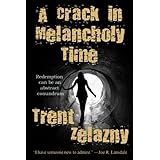
Review: A Crack in Melancholy Time by Trent Zelazny


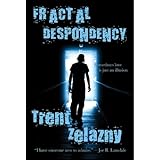
Crack in Melancholy Time (great title) is the sequel novella that began with Fractal Despondency.

Blake Gladstone has lost Sarah, his girlfriend, to suicide and doesn't know if he should join her.  Worse,  he loses another, Denise [Fractal Despondency treats their relationship].  Homeless, jobless, but full of alcoholism and cigarettes, he slinks home to Santa Fe.  Visions and memories of his old girlfriends return as he struggles with survivor guilt. He has to face his miseries and miserable thinking.

Blake gets a second (or third chance) with Laura, an old high school friend who's as lost,  and messed up with alcohol ss he is.  If he can save her, maybe he can save some of what he's lost.

Another reader compared these novellas to Charles Bukowski.  I immediately disagreed until I reread it.  Yes, they differ in humor and tone, but they share a concern for capturing the dark hole some have struggled to climb out of.  The events are a bit discombobulated, mirroring the title and Blake's own mind.

Whether you should read this depends on where you stand on these two aesthetic matters:

  1. If you groove on the opening line: 
  2. "A sad-voiced specter with piercing eyes flitted in the nightime as dewy air filled the malevolent room."
  3. and if you agree with William Wordsworth's idea that art should be "emotion recollected in tranquility" [Preface to Lyrical Ballads William Wordsworth (1800)].  This is a direct feed from the raw, real emotion, written when similar events had just occurred to the author. 
Good line:
  • "Her balance was that of an antique doll."