APB-SAL is a blog about education, science, science education, fiction, science fiction, literature, literary stories, poetry, and anything else that strikes the blogger's fancy.
NOTE: This blog interrogates art. It rarely make moral proclamations. For that attend the church or politician of your choice. This blog concerns aesthetics, not propaganda. Consider this as interviews with books where the interviewer presents interviewees, so you get what you need to do your own thinking.
I'm repurposing the use of a term ("ephemera" meaning printed matter not intended to exist for long--which seems to be the most popular use according Google searches) by going back to the word's primary use in order to get at a phenomenon that intrigues me--and possibly others, which is "something of no lasting significance" (according to Merriam-Webster).
When I combine the term with "cultural," I refer to those things that momentarily struck a culture's zeitgeist, for whatever reason. The reason is usually the fascinating part. Why did it strike the culture's fancy?
Here's an example. Art Linkletter (Wikipedia) was a talk show host on a variety of radio and TV programs. You sometimes hear people still using Linkletter as the butt of a joke--as if the meaning of the joke should be clear--although its use is rather dated if not obscure to most of society now.
Art released the following spoken word audio, "We Love You, Call Collect," which peaked at #42 on Billboard Top 100 and won that year's Grammy Award:
Supposedly, there's a rebuttal from the daughter ("Dear Mom and Dad") though I couldn't locate that.
The power of this ephemera is not how it delivers its art, which is nigh nil except for its moving last line, but how it captures the generational divide of its time. One can extrapolate both perspectives.
Note that even in Linkletter's excoriation of Leary, he also praises Leary, which makes Leary smile (see video linked above). Whatever else one may have against Linkletter, he was talented at engaging people, even in anger.
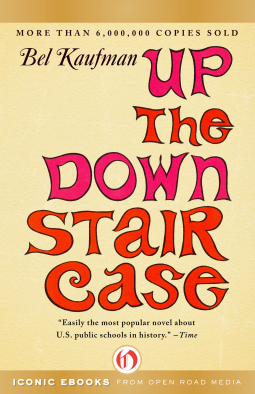
Up the Down Staircase by Bel Kaufman Open Road Media General Fiction (Adult)
It boggles the mind: 6,000,000 copies sold. A novel--if it can be called that--about a teacher and her students.
Kaufman had her finger on the pulse of the American zeitgeist of the time. She wrote for Esquire--the first female to do so. Her grandfather was the writer Sholem Aleichem, and her mother also wrote. So writing as a livelihood was accepted in the family.
The format of the novel is related in letters, memos, student essays. No narrative thread carries the readers through this wash of memoranda. Imagine wading through a bunch of teacher memes on Facebook, which this novel is in essence.
It is true that Americans were ready for a change in narrative format. Metafiction hit the literary world in the 1960s, and the New Wave hit SF. An anthology on Points of View, edited by James Moffett, had been out, detailing all the different ways narrative has been presented.
Historically, school integration was in full swing, and people were still uncertain about it as this novel attests.
Maybe this is what drew people to the novel. It seems most appropriate for new teachers, especially English teachers, getting ready to step into the classroom. It still has a great deal of relevancy, too, despite being fifty years old.
The novel treats Sylvia Barrett, a first-year teacher, thrown into the inner-city New York classroom with over two hundred students to teach, with classes of over forty students per class. She has an older mentor who reassures her along the way. She has a love interest in a young teacher who composes Rodgers-and-Hammerstein style lyrics for every educational event. Her students are mostly in love with her, except for a few, one who hates women teachers. Her bosses have a dictatorial style that Barrett doesn't believe is helpful.
Barrett takes a keen interest in her students. A few of them have dramatic events that draw the reader back in after feeling the monotonous onslaught of essays and memos. One student dies due to an unprofessional abortion, another attempts death when the man she falls in love with (a teacher) doesn't reciprocate her feelings.
Finally, Barrett decides to teach at a private school where she can have her own seminar over Chaucer, but things get hectic at her old school. Her request to leave gets lost. And her foot gets smashed in a cafeteria melee. Her students rally around and she returns.
That is the plot. Yes, full of spoilers, but if I hadn't spoiled it, some might put the book down in boredom. An arc does exist. The characters are vividly and charmingly portrayed in all their ungrammatical and misspelled splendor even if the characters are not dynamic.
It has much to teach us about the 1960s, the worries and concerns, which are not wholly alien to today's human yearnings. Even more potent are the trials of the teacher: trying to juggle student concerns with adminstrators' concerns and those of the parents. Even the parents are the same, begging for their kids to pass even if they don't deserve it. If there is a significant difference between Kaufman's era and our own, this must be it. While similar, the helicopter parenting has spiraled upward.
What is amazing about the novel is that all of the future changes (or pushes for change) in education can be found in here. Sometimes it's as a joke, sometimes not. But even what was an educational joke in the 1960s is taken seriously today. It's almost as if the novel is prescient.
This may not be a novel for the casual reader. That is, while I love the format, it doesn't develop characters enough through it. If your fascination runs to education or the 1960s, your interest will not flag. New teachers might steel themselves for the teaching life with this novel, though.
There is also a movie version, starring Sandy Dennis.
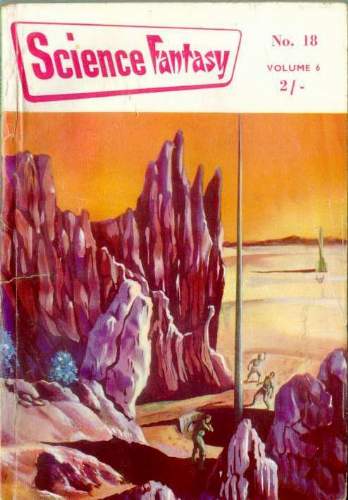
First appeared in John Carnell's Science Fantasy. Reprinted by Damien Broderick.
Summary:
Recruited from the twenty-fifth century by time-machine inventors further down the timeline, the protagonist is to help the last of humanity pick itself up and keep going. Instead, they are burying themselves, seemingly to stop existing, although what is happening and why remains a question he cannot comprehend.
Discussion:
Time stories often deal with paradoxes, either to revel in them or say they cannot exist. This falls into the latter camp.
But it's less a story about time than generations, layering four generations of humanity, observing one another, growing impatient with each other:
Present-day readers, reading and interpreting
Completely flummoxed 25th-century aid workers--closest in time to us and our understanding
Later time-machine inventors--still puzzled if less so
The dregs of humanity who seem to have knowledge of doom that we cannot understand.
Of course, if a 25th-century man cannot comprehend, how much less you and I?
But it is not a tale of nonsense. Rather, it asks how evolutionary language barriers impede comprehension the other, anticipating the generational conflict of the next decade: the 1960s. It assumes a progress of intellectual advance from one to the other, so that the less knowledgeable ancestors are paradoxically called "the Children."
The future labels "strubeck" as the cause of failure and, later, we learn that the past generation are strubeck, so the seeds of future failure are sown in the past, which likely bears much truth--not to say that one does not have responsibility for one's self. The effects of the past ripple into the future.
Now that Aldiss is on the other end of the generations, it'd interesting to hear what he thought of the tale. It's not a classic, but definitely thought provoking.