Search This Blog

Showing posts with label gender. Show all posts

Thursday, June 19, 2025

"Fetish" by Martha Soukup

 https://m.media-amazon.com/images/I/51fEkZamYvL.jpg

 First appeared in Ellen Datlow's Off Limits: Tales of Alien Sex. Long-listed for the Tiptree.


Summary:

A young woman wants to know what it's like to be loved with a beard. 


Discussion:

This may not be appreciated by trans or anti-trans crowd although it does illustrate the explorer crowd.

Perhaps it was daring in its day, but it doesn't carry beyond the confines of this brief tale.

Sunday, June 15, 2025

"The Arbitrary Placement of Walls" by Martha Soukup

 https://www.isfdb.org/wiki/images/2/25/IAS_1992_04_Freeman.jpg

First appeared in Gardner Dozois' Asimov's. Reprinted by Brad Templeton, Janet Berliner, Martin H. Greenberg, Uwe Luserke. Up for the Hugo, Nebula, World Fantasy, Locus, and Asimov's Reader Awards.


Summary: 

 Laura Hampton lives in a house that has fallen into disrepair. She is trapped there not only by finances but also by "ghosts" of former boyfriends. But they're not ordinary ghosts.

 Her mother stops by to help clean, but that kind of help doesn't seem to help. However, the mother initiates something that does. 


Discussion (with spoilers):

 What makes these ghosts different is that the spirits roaming her house are spirits of living people. Clever twist. This could be seen as magical realism or psychological manifestations of memories that haunt her to the point of crippling her from moving on, advancing.

Someone--writer or editor--must have thought was her best or best known work as it is the title story to her collection. Nothing garnered more attention in very different circles.

However, maybe the writer or editor thought it captured the collection. I, however, don't yet see the overall connection to the collection, but maybe. It is an excellent title.

 Now there are a number of approaches to the story. Some may not see much except a little light for the protagonist, which it has.

Some might view this as a revenge tale. Some bad boyfriends got what they had coming for them: death. When Eric dies, so does his ghost, which leads to this new idea of "cleaning up the house" by killing the real life people to make the ghosts disappear. This action is implied. This makes it an evil story in that the punishment doesn't fit the crime (unless one considers one's psychological damage to be worthy of death, which it never was true in society, but perhaps that has changed or is changing). The whole narrative spends its time getting us to care about the character until we learn she plans to murder.

Which brings the third and perhaps more complete view. We are meant to ask ourselves: Why did we invest our empathy in this character? Some things undermine her--lack of empathy for the dying. And perhaps she mislabels what Eric's dying of. It is possible to have three bad relationships, but it is also possible that we haven't yet examined our protagonist's character. That she would even consider this and plan to execute it should erode our empathy. Some might assume that one gender is more innocent than another, but this suggests that all have something to question. This is "The Arbitrary Placement of Walls": that we assume divisions between us, that one is innocent where only other are guilty, especially given clues to the contrary.

Monday, February 10, 2025

Review: The Road to Sugar Loaf, by Eric T. Renolds

The Road to Sugar Loaf: A Suffragist's Story: Reynolds, Eric T:  9781735093833: Amazon.com: Books

Eric Reynolds, as a writer, has been published in Galaxy's Edge, Sci Phi Journal, Starship Sofa, and various anthologies. He has published Arthur C. Clarke, Lavie Tidhar, Nisi Shawl, Elizabeth Bear, K. D. Wentworth. Michael Burstein, Rudy Rucker, Stephen Baxter, Tery Bisson, G. David Nordley, Tobias Buckell, Frank Wu, Jay Lake, James Van Pelt, Eric Choi among others. But he's published anthologies of writers who are a complete unknown--at least to me.

Reynolds's writing is not far from his own personality. Simple, sweet, clear, straight forward. Here's a taste from early in the story:

During the fourth week of school, lockers and the lingering scent of freshly painted walls greeted civics teacher George Fielding as he walked the long, echoing hallway. He stopped outside Principal Holt's office when Violette emerged and handed a string-clasped envelope. He peeked inside to find Suffrage leaflets and other printed materials.

Violette looked around the hallway. "It arrived today from The Kansas Equal Suffrage Association," she whispered.

He thanked her and continued to his classroom where several students stood laughing next to the open door. They looked away when he approached. Upon entering the classroom, some students tried to suppress their snickering. Their glances toward the blackboard revealed what amused them.

George saw a caricature of himself wearing a dress while holding a sign that said, "Women Vote."

He smiled and turned to the class. "I see some of you are interested in Women's Suffrage, and I commend the artist for making more handsome than I actually am, but that dress should persuade you not to pursue a career in fashion design."

The narrator voice of the story melds perfectly with its era. At first, being from a different era, my brain's knee-jerk reaction was to question the novel's overall tone, but then I realized that it fit well. In fact, it's a bit annoying when writers try to make the past sound like the present. Reynolds's voice captures a slice of the past and brings it to us, more than a century later.

Reynolds relates the story of not just the vote in Kansas but across the fruited plains. The characters march to Washington and get thrown in jail under difficult circumstances, fueled by determination and will through protests and hunger strikes. His characters, particularly the women, are strong and well drawn. The quiet scenes were some of his strongest.

More variety, particularly among the men, might have been preferable. I met men, not from that era but immediately following the one Reynolds describes, and I still recall a gentleman joking that my grandmother thought women shouldn't have the right to vote. I turned to her, but she didn't respond, which sheds a lot of light on how people felt and behaved toward this era. There could have been a range of motivations for either party--from being totally true to totally untrue and a million subtleties between. He was clearly amused while my grandmother suppressed any response. Neither had been born during the movement, yet here it still impacted their conversation, decades later. For me, this showed more variations in character than what one might think from a casual glance.

Like a lot of other writers, writers meet writers in the course of writing. It's a small world. I edited a small journal, Mythic Circle, which required a theme of myth. He wrote a small tale set in space where myth was featured. I liked it but requested revisions. He obliged. I showed it to the lead editor and professor, Gwenyth Hood, who also liked it, and we published it. 

It may have been Eric's first publication. He may have told me that, years later, to my surprise. Possibly I am mistaken. But it was solid work if memory serves. I wouldn't have published it had I thought otherwise.

I didn't publish everyone. I had a writer of some note whose work I've praised in public. But none of the things he submitted quite fit. He was a little irked by that. I was a little surprised, too, that I hadn't, but I think if he'd have sent ten works, I'd have found one that felt right. Not unlike Picasso, he was going through a period--a style not so much to my liking.

Eric and I may have met in an online workshop, later at a convention by chance. He and his wife and kids made for an attractive family. This photo is a more recent one. He had more and darker hair back then.

Eric, later, started his own press, publishing original anthologies of speculative fiction, and in a few of these, published stories of mine, so full disclosure. 

Also full disclosure: I have a relationship with you all as well. So I try to direct the people who might be drawn to Eric's work and steer away those who would not. You have enough information to see which you are.

Eric Reynolds has published two other historical novels: The Lost Town of Garrison (a time-travel novel) and The Legend of Mulberry School (a paranormal novel).

Eric T. Reynolds Books - BookBub

Saturday, February 8, 2025

"When I Was Miss Dow" by Sonya Dorman


First appeared in Frederik Pohl's Galaxy Magazine. Made the first ballot for the Nebula and nominated for the Tiptree Retrospective award. Reprinted Brian W. Aldiss, Harry Harrison, Judith Merril, Pamela Sargent, Brian Attebery, Ursula K. Le Guin, Ellen Datlow, Heather Masri,  Lisa Yaszek.


Summary:

Aliens, who trade with humans, can change shape and gender--a bit like squishing play dough through a plastic "factory" into whatever shape desired. Despite being initially reluctant, one of the aliens enjoys becoming Miss Dow who takes a liking to the doctor she is supposed to work for.


Discussion (spoilers):

She forms an attachment both to the doctor and to her form. It anticipates Ursula Le Guin's The Left Hand of Darkness by several years and one might guess it had some influence on the novel.

Ah, now this belongs in an anthology (or at least one could see why it might be included) like Norton's. It belongs in a year's best. It is the cream if not the crème de la crème. It made the first ballot, but if you see which tales beat it out for the Nebula, you'd understand. However, as a subgenre that gained importance with the Tiptree award. You can see, from the novelty of subject matter, why Aldiss and Harrison decided to bump aside the finalists to reprint this instead.

If one takes The Left Hand of Darkness to be seminal, then this is the seed that must have spawned Le Guin's work.

Sunday, February 2, 2025

Night-Rise by Katherine Maclean

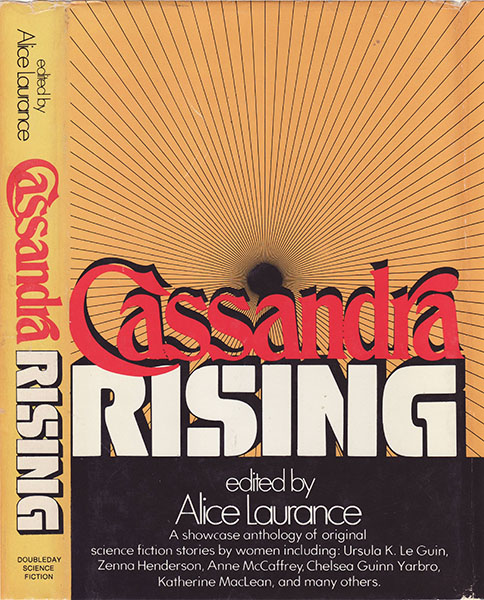
 First appeared in Alice Laurance's Cassandra Rising. Reprinted by Ursula K. Le Guin and Brian Attebery.

Summary:

A reporter takes in the story of a "Dark Christ"--a person or people who are, in this world, not necessarily anti-Christ or maybe they are. They are described more in terms of Yin-Yang--the destructive version of Christ. The reporter is witness to a murder.

Discussion (with Spoilers):

The reporter does not report the crime. Drunk, he goes down to the docks and he himself is killed by the same group.

It has long been a debate whether journalists should be involved in news or just report on it. If the journalist had reported them, perhaps he might have still been alive.

This is philosophical fiction, yes, but is this SF? It speculates on this religion, but it could as well be of our world now or in the past.

Probably the most interesting thing about the story is where it appeared. The editor opens with a small window on women in SF and probably one of the more interesting looks women in SF, looking at the male writers, too, discussing what she considered worthwhile portrayals of female characters. 

Moreover, some complained about the political nature of Le Guin's The Norton Book of Science Fiction. And we have a story that no one else noticed (which could be cool, rescuing a good story from obscurity), but it isn't really SF, which lends some credence to the complaint.

While written by a woman, however, the story is about a man. Given the above, is this meant to be a critique of men? Let's come back to this after parsing possibilities.

So we have a religion who feels free to take lives. There's no discussion of the beliefs, per se, so maybe it could be any affiliation--political, social--except they define themselves as like but opposite of Christ.

They kill a man who is interested in boys. Is this ethical? If it is, then a journalist who doesn't report this murder, shouldn't be held responsible, but yet he is killed as well. Why? Is it because he drank? Is that ethical? Are both murders justified or neither or only one? How do you as a reader feel about the murders?

Once we establish this, we might understand better how we might feel toward the murder of the journalist. Because we inhabit the journalist, my suspicion is that we are meant to find some empathy toward him. Not always, of course. And maybe not completely. 

"[The journalist] imagined he saw young, sympathetic faces around him, sympathetic but mistaken. But it was took black, he could see nothing.

"Trying to speak, felt the caress of white silk around his neck." 

The speaker gives positive attributes to the killers ("sympathetic" and caress") but also calls them "mistaken." In retrospect, he sees himself as blind (or "could see nothing.") 

Back to the topic of men and women, then, what does this suggest about male and female traits? Is this meant to suggest that men are more likely to kill and turn a blind eye?

Saturday, February 18, 2023

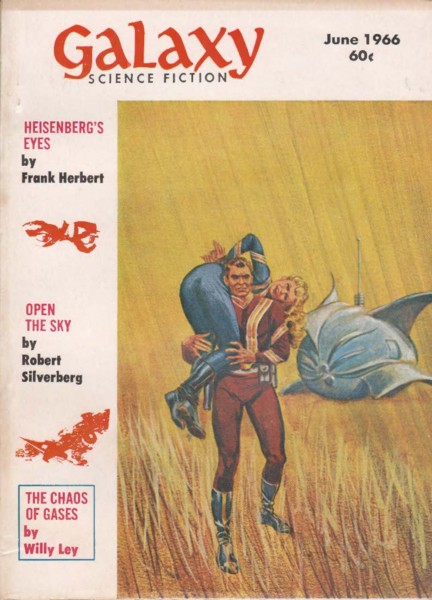
"Frozen Journey" or "I Hope I Shall Arrive Soon" by Philip K. Dick

توییتر \ @RobinSandza در توییتر: «Very rare #illustration ...

First appeared in Playboy.  

Reprinted in various major retrospectives by Terry Carr, Brian Attebery, Ursula K. Le Guin, Chris Hables Gray, Alice K. Turner,  Jonathan Lethem. 

This won a Playboy award and was up for a Locus.

#

A man is cryogenically suspended for the duration of a journey across space. His chamber malfunctions so that he awakens ten years from his destination. He cannot be fully awakened or have his chamber repaired, so the ship computer dials up his memories for the man so he can dream pleasantly. But none of it goes as planned. 

Discussion (with spoilers):

The man keeps turning the memories into something darker, and as the ship's computer adjusts, trying to compensate, making the dreams lighter. The new, fake if dark memories bleed into every adjustment the computer makes. He can see through the illusions the computer makes.

When he arrives, his ex-wife summoned from another planet to help him adjust, he cannot accept the true reality.

Brilliant concept--at least not one I remember seeing before (although right after writing this, a newer TV show had a similar scenario, but not as thoughtfully executed. It doesn't feel like a classic but at least as profound as the great classics, so maybe it is classic? 

The story suggests that the past is preparation for whatever reality or future distorts how we view the present reality. Probably true--to an extent as we do test reality.

Terry Carr summarizes the above, more or less, and closes with "Could any computer, no matter how extensive its abilities, keep him sane?"

Is it about sanity? Maybe, kinda. But part of this summary is refuted by the story because the computer is not all powerful. In fact, it is relatively "dumb," limited in what it can do. It does see a problem, but not how to correct it. This, for me, is a critical part of the story, mentioned a few times. The computer doesn't intend to channel the person's reality--but simply to make him happier, which it fails to do.

This point in the story many not be wholly true as people (as opposed to the ship's computer) do actively try to channel people toward how they should view reality, but the basic concept is solid and thought-provoking. Perhaps it was somewhat less the case in the 70s and 80s that one might ignore the influence.

It's interesting that Dick's original title was rewritten by Playboy--probably more evocative or enticing to a reader. What's surprising is that Playboy's title is reprinted, not Dick's, despite Dick publishing his preferred title, even titled such as part of a collection. The Playboy title does suggest the man is stuck in his journey, frozen in time. 

"I Hope I Shall Arrive Soon" suggests more of the protagonist's state of mind, inviting the reader in to entertain the state, the feeling of making progress, of wanting to reach the destination but never arriving. It is more empathetic (his belief that he should be arriving soon even though he already has) and, hence, more tragic toward the character's failure to accept his reality. The "Frozen" unintentionally looks down on the character.

Ursula LeGuin's The Norton Book of Science Fiction has a nice tribute to Dick in the introduction, that he was finally getting his due. However, beyond adding the usual Dick-plays-with-reality, it offers no insight into this particular story, and it doesn't really add much insight into any particular story except in broad strokes. 

A famous, knowledgeable writer once said that the anthology chose the stories for a certain brand of politics. It may not have been, but let's entertain the notion. This will take a while since it's not high priority, but I'll touch on it.

The anthology arranges stories by year, presumably to show either progression in sensibility, changes in topical concerns, quality, etc. But presumably those were the best stories from that year. Only Carr selected this story as one the best of the year. It's numbered eight on Locus (with no other award nominations), so maybe the listing by year (in terms of quality) is misleading. However, an editor may think stories were overlooked in a given year, so that may be a factor. It could be the issues facing the public during that year. Was 1980 a year of being frozen in place, compared to any other year? But if so, why doesn't the anthology discuss issues facing the field during that time?

Finally, this could be the story most representative of the writer from 1960-1990, but then the listing as stories by year would be misleading. Moreover, a lot of important writers were excluded from this collection, which would be a major flaw for an anthology with this particular title, which sounds like it has a wide-enough-angled lens to capture the full scope. The anthology was never revised, so maybe the flaws are well known as being too limited in scope to bear its current title, lacking a number of key players who helped shape the field during this era.

The anthology does use the Playboy title over Dick's. If it were a political selection, it was the positive portrayal of the ex-wife. She was empathetically drawn. Hopefully, it is not for the wise woman/foolish man (or worse men-bad/women-good) portrayals, which would be sexist if this is a consistent pattern--limiting both genders to certain roles that can be played. Hard to say from this distance. Perhaps the editors felt they needed to counteract other portrayals, but still it's problematic if it's men-good/women-bad. Humanity has lots genes, lots of differences to limit the species to a handful of portrayals. 

Feminism becomes important to the field, especially during this era, so one would expect it to be addressed, but it is certainly not the only issue, and the anthology would require a different label to be more honest to the public about the anthology's aim. But that's only the case if it were true that LeGuin's anthology is political--a hypothetical claim being entertained at present. And we'll come back to it later, fingers crossed.

Still, the story's a lovely little gem, whatever reason people selected it.  Maybe some will read it as a tale about sanity, or about gender-power dynamics, tripping some triggers. That's okay. For me, it's a potent tale with a broader application for all humanity--not a select few--about a human being whose propensity to find flaws in his own life led him to a place that made it difficult to deal with his present circumstances. Surely, that is a theme that people of whatever gender can empathize with.

Monday, March 9, 2020

Daisy Miller by Henry James


Daisy Miller by Henry James

Set Up (summary):

The story begins in Vevey, Switzerland where “in the month of June, American travelers are extremely numerous; it may be said, indeed that Vevey assumes at this period some of the characteristics of an American watering place.”  The protagonist, Winterbourne—not the narrator who remains an unnamed first person—meets Daisy Miller, an American free spirit, unencumbered by societal rules. Winterbourne falls for his countrywoman while abroad and tries to educate her in the customs of Europe, which she ignores. At first, she seems to insist on his attending to her, perhaps suggesting her interest, but that changes when an Italian, Giovanelli, courts her without a chaperone, which is scandalous to everyone except Miller’s family. There are hints that maybe if her father had left Schenectady with his family, this would not have occurred, but that’s hard to say. It may be just Winterbourne’s jealousy or the narrator’s opinion.

Discussion with spoilers:

Daisy Miller seems to string both of these young men along although initially she seems to have no interest in Winterbourne. Once she secures Winterbourne’s interest, she mostly ignores him but even then she would entertain both gentlemen at the same time. Although she spends more time with Giovanelli, he doesn’t think she ever loved him, either—at least not enough to marry.

She gets sick and dies. The narrator, Winterbourne, and perhaps Giovanelli himself to a degree think this is due to taking her out on the town during late hours. If only she’d been chaperoned....

This could be read as a morality tale: Follow the ancient customs of the foreign land you find yourself in. In fact, some critics put James into that category, pointing out that the author defended writing about customs:

“[I]t takes an old civilization to set a novelist in motion – a proposition that seems to me so true as to be a truism. It is on manners, customs, usages, habits, forms, upon all these things matured & established, that a novelist lives – they are the very stuff his work is made of.”

But this doesn’t take into account the frame story. Why develop the frame story at all? Keep Winterbourne the protagonist and have him lament at the funeral. Instead, there’s more complexity here. Furthermore, just because an author prefers European customs in his fiction doesn’t mean he has to follow them in his theme.

The narrator’s identity is shrouded, but perhaps he is not American and/or not young, saying of the protagonist: “in whatever fashion the young American looked at things.” At one point, describing details about the protagonist, he writes, “I hardly know” although later writes commandingly about the details. He speaks for instance of the man’s friends who would say he is “studying” at Geneva—the narrator’s quote which suggests he knows the young man intimately although intriguingly. He writes:

“When his enemies spoke of him, they said—but, after all he had no enemies; he was an extremely amiable fellow, and universally liked.”

It’s possible that Winterbourne has no enemies, but consider his name and that Daisy Miller found him “stiff.” Perhaps the narrator knows what the enemies would say and catches himself and feigns that Winterbourne has none. Certainly, the author wants us to catch the hiccup or he’d have cut this from the story (unless James were too lazy to edit, which seems improbable for a writer held in high regard).

This dialogue with Daisy Miller’s young, little brother suggests his family’s attitude toward Europe or at least a key interpretive passage (Winterbourne has just told the child to be careful with his teeth, eating sugar):

“I haven’t got any teeth to hurt. They have all come out. I have only got seven teeth. My mother counted them last night, and came out right afterward. She said she’d slap me if any more came out. I can’t help it. It’s this old Europe. It’s the climate that makes them come out. In America they didn’t come out. It’s these hotels.”

How do we take this? Is this a natural process that would happen anyway, no matter where he was?  Given that his sister dies due to climate, does the boy have a grain of truth? Yet he says “I haven’t got any teeth to hurt” while admitting he still has seven teeth. He, perhaps like his sister, discounts his own actions as having an effect on his predicament.

James himself discussed the story with people who spoke of the Daisy-Miller type. It seems to surprise him that his character has been typed. Sociologically, it’s interesting that Miller typified the behavior of some other women—perhaps a woman unready to settle into a marriage but very keen to develop multiple admirers (see Scarlett O’Hara in Gone with the Wind although Scarlett did have a man she wanted to marry, but was more than willing to encourage multiple admirers)—but James’s reaction seemed more surprised that his character was not a character but a type, suggesting that the morality was not necessarily his aim.

Giovanelli, for instance, thinks she was “innocent.” This seems likely in multiple senses since when she first encounters Winterbourne she hates European society and doesn’t understand why she didn’t have all the attention she received in the U.S. Like her brother Randolph, she doesn’t see how her actions affect her reception. Before she passes, she tells her mother to tell Winterbourne that she wasn’t engaged to Giovanelli. The mother doesn’t know why that was important to share. There are two possibilities: 1) She realizes belatedly that Winterbourne was the man for her all along, or 2) Winterbourne is her moral conscience and she wants to be remembered as innocent.

The latter seems more likely since she never really seems fully invested in Winterbourne. When she first meets him, she keeps looking around for something else—perhaps the society she has been looking for. Interestingly, at this encounter, Winterbourne is willing to bend the rules of etiquette to pretend they were formally introduced so that he can talk to her (which suggests that breaking societal rules is not really what killed Daisy):

“It seemed to Winterbourne that he had been in a manner presented.”

The narrator says that Winterbourne’s real reason to be in Geneva was being “extremely devoted to a lady who lived there—a foreign lady—a person older than himself.” What is meant here by “foreign”—American? Swiss? neither? Could it be referring to Daisy Miller at this point? Or someone else? This is also how the novel ends: “he is much interested in a very clever foreign lady.” Is this the same foreign lady or a different one? Again, what is “foreign” to an ex-pat living abroad? He does say, “I have lived too long in foreign parts” (yet continues to do so). This indicates that foreign to him is anything not American, perhaps.

Perhaps this indicates that Daisy Miller was more exciting to him than the foreign lady—that he abandons her yet returns when Daisy passes. Perhaps Daisy is the only remarkable episode in his life.

Who is Daisy Miller? She’s a simple flower, ground up and/or who grinds others up. Perhaps they are all ground to a useful purpose to become flour. However, it isn’t clear that these events made anyone wiser.

Thursday, March 5, 2020

Larque on the Wing by Nancy Springer


 See the source image
You will know from the first paragraph whether you’ll want to read this book or not:

Mother used to call it change of life, but Larque never expected to change quite so much. Gender, for God’s sake, which is really basic, the first thing anybody notices about a person. Then, becoming not only male but gay—what a way to do the big Four-Oh, when all along she thought she was quite happy.

This won the James Tiptree award, which is all about gender examination, and this is a tour-de-force of such an examination. So if you believe in two genders, or immutability of sexuality (especially by puberty), read no further.

The strange gender extrapolations is the novel’s strength. The narrator is a painter in her mid-life and suddenly to the chagrin of some of her family undergoes changes and gains a doppelganger named Sky who says, “Boogers” upon meeting our protagonist. The doppelganger is a youthful version of the protagonist:

“Who are you?” 
“Traitor,” the kid shot back, “you should know. I’m you.”
Sky is Larque’s adolescent escort not only through the changes of life, gender, and sexuality but also through adolescent difficulties—high expectations from her mother, abandonment of her father once her mother divorced him. There’s also Shadow, the cowboy animus, who knows the male side of her.

The weakness is the voice, which feels more light-hearted YA than adult, although perhaps that can be explained by the narrator going through a second puberty—a time of confusion. It isn’t just the colloquial expressions but the reactions. Examples:
“for God’s sake.... Childhood’s a bitch.... Adolescence was hell.... She’s a twerp.”

and

See the source imageSky snorted like a pony and got up from the table. “Look what you turned into,” she muttered. 
“Look what I was to start with,” Larque shot back. 
“You like this place you’re living in? Looks like a dump to me.” 
Larque felt all the attractiveness of child abuse as a life option. Yet, the obnoxious kid spoke truth. The place was in fact a dump. Dog hair rolled everywhere.

and
[Hoot, her husband, inquires about her doppelganger’s abilities:] “Does [Sky] walk through doors?” 
“I don’t think so.” 
“Are you sure?” 
“Reasonably sure.” Actually. I don’t know and I don’t really care. Give me a break.
 
and
“Liar. You lie all the time.” 
Larque slapped the brat.


If you like many extrapolations and playful YA, you may well like Larque on the Wing. It takes lots of risks.


Monday, June 8, 2015

"Replacements" by Lisa Tuttle

First appeared in Dennis Etchison’s MetaHorror. Reprinted by Ellen Datlow, Terri Windling, Stephen Jones, Ramsey Campbell, Joyce Carol Oates, Otto Penzler, Paul Tremblay, John Langan, Jeff and Ann Vandermeer. Read online.

Summary:
Stuart Holder spies a helpless if disgusting alien creature lying on the side of the street. His first instinct is to destroy it. He does. Then he spies another but refrains this time.

Meanwhile, his wife brings one home. She wants to keep it as a pet. He does not but wants to discuss it before making any decisions. It's too late, however. It is helpless and she wants to care for it. Stuart finds himself replaced by the creature into his wife's bed.

Discussion:
Stuart learns his own secretary has a similar creature to which/whom she is bound by a golden chain. As she refuses to give up the creature, she finds employment at another press. He is thrust out of his marriage and apartment. He feels attracted to another woman but sees she has a similar gold chain and creature. Stuart walks to his old apartment spies a toddler-like creature in the window. His ex-wife pulls the creature inside, closing the curtain.

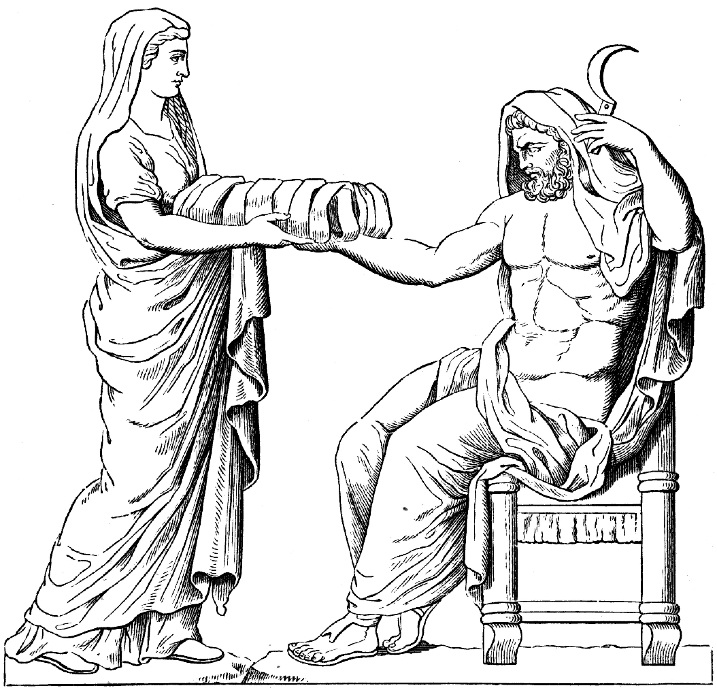
In Greek mythology, Cronus ate his own children (to prevent the prophecy of his overthrow). Some men may feel this need to destroy the next generation. Lacing the Greek myth was probably a fear of mortality. And no doubt, some men find babies as women do. But for most, likely, it is a simple indifference. The kids show no human personality except crying and need. Women admit to a special attraction to (even a preference for) infants that most men do not share. Such men might feel temporarily displaced in their wives' affections as their relations change. From the outside, it may look like vampiric relationship: an "ill-proportioned" helpless creature who has nothing but need, drinking the blood of its caretaker.

Stuart is ironically named: "steward" or going back to the Old English, house. He is not able to steward, care for his house, or hold on to his family.

Thursday, June 4, 2015

“Bite-Me-Not or, Fleur de Fur” by Tanith Lee

First appeared in Shawna McCarthy's Asimov’s. Reprinted in some major genre retrospectives by Alan Ryan, Leonard Wolf, Martin H. Greenberg, Stefan R. Dziemianowicz, Robert Weinberg, Tom Shippey, and Otto Penzler.

Summary:
Inside a magic-fortified, erased-of-the-color-red castle, the inhabitants huddle away from the flying vampire beasts that will drink the blood of any being. Here, the Duke accepts Rohise, a scullery maid, as his own daughter since she is uncannily like her. Empathetic, Rohise has dreamed has dreamed of such a moment to help the Duke. Her empathy knows no bounds.

Meanwhile, a vampire beast, Feroluce breaks through a chance-cracked window. He is able to slip through, maiming his own wing. He spots the Duke's lion and drinks its blood, even as it maims his wing further that he has to sleep off the injury... and finds himself caged upon waking.

Rohise hears Feroluce's silver voice, enchanted. The Duke plans to sacrifice the beast to feed the Fleur de Fur, a vampire repellent.

Commentary:
Rohise frees Feroluce, which thinks of Rohise as its pet. It can drink of Rohise's blood. It cannot understand her love but only her passion.

The story opens:
"In the tradition of young girls and windows, the young girl looks out of this one. It is difficult to see anything. The panes of the window are heavily leaded and secured by a lattice of iron."
This suggests a primer for young women, who look out on the world, wondering about what's outside, but the view is obscured. Safe yet also trapped and uneducated. The primer teaches on men: fathers and lovers. Her father stumbles upon her, gradually comes to love her, if by accident. He despises the beast that Rohise comes to love fiercely. Her love frees the wild beast who cannot love her as she loves. But the beast, too, comes to a kind of love, if unlike her own.

Lee describes of Feroluce and his tribe:
"He is the Prince of a proud and savage people. The pride they acknowledge, perhaps they do not consider themselves to be savages, or at least believe that savagery is the proper order of things."

On the one hand, it may appear reductive to have only two types; on the other, it is a short story, not a doctoral dissertation. Moreover, this may be how men appear from the outside. The story shows as well an admirable acceptance of things or attitudes foreign to herself, which is becoming rare.

Saturday, March 30, 2013

Classics Revisited: Alastair Reynolds' Galactic North: "Nightingale" and "Galactic North"


Dexia Scarrow and a group of former professional soldiers are hunting down a war criminal, Colonel Jax.  His last known whereabouts was an artificially intelligent, hospital ship that had served to heal  both sides of the war.  She heals soldiers who are sent back to fight.   When the hunting party learns where Colonel Jax is at, they worry:  Can the ship be sane without something to do with its time?  Why had people told stories that it had been destroyed?  The ship, though, is "alive and kicking," still producing organs and parts.  They sneak in to avoid detection, but they are detected anyway.

A complex tale on war, no matter what your perspective.  While it clearly shows the connectivity or ecology of people yet it remains beautifully complicated by a ship that may not be sane.  The reread of this, which should have been similarly powerful as the first read as it gave plenty of food for thought, but this may have been its dramatic--not thematic--construction.

The closing tale, "Galactic North"--ambitious ride through millennia of time and across the galaxy--involves pirates again but who successfully take over the transporter's ship, a ship transporting human cargo toward which the captain has been made to have a motherly instinct.  The head pirate may be from "Grafenwalder's Bestiary" (verifying the moral complexity of that tale).  The pirates tortures Captain Irravel and Markarian.  Each stands up admirably until a dire end is brought before them.  Being made motherly toward these humans, Irravel (she who will not "unravel" despite her incarnations) cannot forgive Markarian, even though he did it to protect her.  The reader may vacillate sympathies between the pair initially toward Captain Irravel but later toward Markarian when her actions endanger more than seems necessary.

One powerful aspect of this tale is how it mirrors the long-view of our own lives:  how we begin with this strong, primary drive that gradually gains complexity over time.  This one's scope is tremendous and the most ambitious of the collection.  My first impression was that it fails to close, which is only somewhat true as this could be read as an attempt to reconcile two different male/female perspectives--a reading that pays off in the reread.  Yet the final note focuses on the children, sort of.

The stories of Galactic North were originally published reprinted in the following (from Wikipedia)

Thursday, November 29, 2012

"Heaventide" by K J Kabza

Fantasy and Science Fiction, November/December 2012

Daybreak-Under-Clouds is in a quandary.  In her world if you consort with a traveler, you're a woman.  If you travel, you must be a man.  You can't do and be both.  After catching her consorting, her grandmother consigns Daybreak to womanhood.  Still, with the traveler's aid, Daybreak continues to attempt travel, building a boat and going where she ought not to.  When she's caught for the last time, there's really only one choice left.

A story about triumphing over those who would stamp the fluidity of gender.