Search This Blog

Showing posts with label Bruce Boston. Show all posts

Saturday, July 17, 2021

Rhysling Awards (short and long poems of note)

Another Rhysling anthology in the books. Votes are being tallied. 

Here are my selection of the notable. I usually pick about ten percent, but I read more quickly, so seven percent this time. 

As usual for the past decade or so, the majority (60-odd %) of nominees were women. Of these, I selected fifty-fifty men and women, without paying attention to the author's gender until I got here. In fact, I had no idea of gender, race, name, etc. until I reached the end of the poem. Maybe not then. [ETA: Voting complete. See results at link. Presumably 83% female.]

As far as magazines go, New Myths, Polu Texni, Star*Line, and Strange Horizons are not strangers to publishing good work. Speculative North is a new magazine to place on your radar, albeit Canadian. Of course, who knows how the poems were selected, but there were some good candidates.

Short:

“Sealskin Reclaimed” • Alison Bainbridge • Glitchwords 2

  • What's powerful here is the well used space--very conscious of words and packing so much into a small space. A quality often strangely lacking. Beautiful close.

“a siren whispered in my ear one night” • Ashley Bao • Arsenika 7

  • Sound and repetition conscious. Particularly surprising and thought-provoking was "where to place my feet to avoid glass-infested blood."

“Chrono-Man” • F. J. Bergmann • Polu Texni, May 11

  • Bonus: word play and passage to various time tropes.

“The Edge of Galaxy NGC 4013” • Warren Brown • Speculative North 3

  • A traditional but moving leap.

“He Sold What He Had Left” • Diane Callahan • Speculative North 1

  • Interesting wrap where a prisoner goes on a hallucinogenic journey, beginning where he ends.

“Back Story” • David Clink • Strange Horizons, 12 September 2020

  • Self-referential. A closing that doesn't close but opens up.

“The Forest in the Full of the Moon” • Geoffrey A. Landis • New Myths, December

  • Myth exploration that ends on a note of mystery.

“A Tempest” • Sheree Renée Thomas • Star*Line 43.4

  • Thomas plumbs the Shakespearean oeuvre. A plaintive note of longing.

Long:

“The Third Sister” • Andrea Blythe • Twelve (Interstellar Flight Press)

  • A love song to readers, libraries and books--how they shape us.

“Devilish Incarnations” • Bruce Boston • Star*Line 43.1

  • I expected and got a good poem. I didn't expect the poem to haunt me after reading it. 

“An Offering” • Michael Janairo • Line of Advance (2020 Col. Darron L. Wright Memorial Awards)

  • Evocative writing about what may be a spiritual or hallucinatory experience.

“Robo sapiens Thinks He Thinks” • Geoffrey A. Landis • Eye To The Telescope 35

  • This one smacks the reader with a powerful speculative conceit, which strikes to the core of SF. You'd think more poems would aim more for this tenor.  

Wednesday, July 7, 2021

~Top 10% of the Dwarf Stars anthology

Scifaikuest and Star*Line had the most nominees and best work (three each). Although the nominees favor women once again, my choices for the first time leaned toward men. I may not have selected these poets as having written the best poems in the previous years.

My top five poems out of fifty-odd were (in order of appearance, not rank)


Also check out these poems:

Tuesday, May 12, 2020

400,000 hits

This site passed 400,000 hits, so I did a quick scan of my favorites from the past year, plus things I read in the past year but still haven't reviewed yet.

Best novel was Theodore Dreiser's An American Tragedy, discussed here. The recollection of it still wounds. I doubt I'd read it again, but a fine, troubling novel.

"Brenda" by Margaret St. Clair (book reviewed here) -- I can't shake the imagery of this one. St. Clair was firing on all cylinders. You can find it in her collection: The Hole in the Moon. If you read nothing else by St. Clair, read this one although she has a few other well known works.

Bruce Boston’s “The Ruined Library” You can read it online here and my commentary on part of what makes it so successful here.

Best new poetic voice I've read in a while -- Clif Mason's Knocking the Stars Senseless (reviewed beginning here -- interview begins here)

Speaking of new voices, Daniel Braum's is one to read, reminiscent of Lucius Shepherd (short novel reviewed here, He's also published a few story collections), with future work forthcoming in Ellen Datlow's Best Horror.

Best book of poems -- Speech Minus Applause by Jim Peterson -- Catalogs the tipping of a worldview (perhaps). Some poets excel at the poem, some the book. This one does both admirably. Stunning, revelatory, haunting. I'm still writing the review--interrupted by illness and lunar lacunae. Hopefully an interview will follow.

Best series: Peter V. Brett's The Demon Cycle. It begins well  with The Warded Man, but really is most stunning in The Desert Spear. Enthralling. More reviews to follow.

Two of the most thought-provoking if flawed yet highly recommended SF novels: Dark Universe by Daniel Galouye -- fascinating speculation -- is discussed here. Pierre Boulle's brilliantly designed Planet of the Apes is discussed here.

Most attention for written works: David Gerrold's novel The Man Who Folded Himself got the most hits--an eye-popping wonder--although the middle doesn't quite stack up as strongly as the beginning and end (SF readers of the old school might look into his When HARLIE Was One, a thought-provoking, speculatively high-octane work). Joe Lansdale's Cold in July, a fascinating look at the male psyche, was right up there with the hits. Jane Yolen's collection and discussion of such a literary form, How to Fracture a Fairy Tale, trailed by a nose hair.

The #1, biggest hit winner of the year by a landslide: Poet and editor, Sarah O'Brien's interview.

Friday, July 26, 2019

Top 20 Dwarf Star Poems


Disclosure: I have a poem in here and am pleased to be included. I won’t suggest where or if it belongs on any of these levels. Readers can judge for themselves. I link to it at the bottom. It’s part of a whole suite of moon poems that accrue meaning. For interested parties, I’ll include other poems of that series that I can find online, so they can get a feel for how they fit together.

Observations on the top 20:

I organized the poems into groups although I could see them sliding up or down according to one’s taste. I was definitely surprised to find three of my top four to be haiku. I love haiku, but they’re rarely done well. These are not only emotionally potent but carry double duty.

Forms that slip from prose poem to haiku, so far, seem better without the haiku.

The list in the admirable middle group could be argued to be higher. They generally capture something of a feeling or thought that resonated with me. John C. Mannone’s is clever, but I feel it operates at a higher level, especially as it takes one voice and transforms it into another.

Once again Star*Line has the most representatives here with five (a quarter of the representatives!). Scifaikuest has three, and Troutswirl has two, both in the top group. Again, I don’t try to balance gender, but it is awfully close. Bruce Boston and F. J. Bergmann are the only poets to appear in the top Rhysling and Dwarf Stars while Christina Sng is the only poet to have two good ones in one.

It will be interesting to see how others vote on these poems.

Note 1: Within each group, poems are organized alphabetically by title.

Note 2: If I can find the poem online, a link will be provided. I had a hard time locating most.

The Mid 8


The Top 4:


The Clever 8:


#

Trent Walters, Man on the Moon poems online, the first is the nominee. The others are part of the poetic suite.


Life on the Moon v.2.0 Right Hand Pointing (about half way down, formatting off--for formatting, see first poem)

Sunday, January 15, 2017

Review: Sacrificial Nights by Bruce Boston and Alessandro Manzetti

Every review is a tightrope walk. You navigate between being fair to the author and fair to the reader. The review's job is to point readers to books they might love, and steer away those who would not. It is to their mutual advantage as both might forge future relations.

This one is especially tricky due to all of the genres involved: poetry, fiction, experimental, supernatural, natural, mystery, horror.

For instance, a blurb claimed this novella/collection was noir, so I kept searching for noir and being disappointed that is wasn't there--as might other readers. Not only are proper labels useful but they are also critical to avoid aggravating readers that they damn works through no fault of the author.

Who will be interested?

As far as poetry, those who read primarily for mood or tone will be delighted. As for fiction, we have multiple story threads with dark bodings bordering the land that lies between horror and mystery--although the supernatural bent is more hinted at. The threads are too tenuous to build characters, but they do intrigue in how they weave together, so those who love strangely assembled narratives--think along the lines of Theodore Sturgeon's Some of Your Blood--may also fall for this one.

The book is lavishly illustrated (by Ben Baldwin) and is its own wonder. If you admire the combination of art and moody words, look no further.

If you are seeking Bruce Boston's more thoughtful verse, this probably is not the droid you're looking for. This is my first book for Manzetti, so I have nothing to compare.

But it does have art. Two ubiquitous motifs are rain and fire. They are tiresome until you realize they have been cultivated for the opposite reason they are normally employed:
"Watching the pendulum of the wipers on the rain-spotted glass, she prays silently for rain and more rain, a rain to end all rains, one that could wash her mind clean of the cold white darkness that infests it like disease." --from "Rose and the White Stalker"
It takes a few readings to glom on to this reversal. It is the rain--or at least the waters it leaves behind--that allows disease to fester. It is not until the extended conflagration scenes that baptism by fire occurs.

"Rose and the White Stalker" is probably where my interest was first piqued by the individual poems. A woman, Rose, kidnapped--but nothing happens to her, which is both a momentary relief and curious. All's well that ends well, right? Her story doesn't end here.

More fascinating is Eva in "Cannibal at Large" who follows Harry, despite knowing he has consumed her father and mother. The narrative returns to her and Harry at the end, with a surprising twist. These may be my favorite characters of this circuitous narrative.

Of interest, as well, is "The Xacto Killer: Interior Monologue," which details how a serial killer might decide to up his game.

Other characters include Jean-Paul, a painter; Sandoval, a detective on the trail of the Xacto Killer; and Eugene who begins the fire at the whore house. The narrative picks up again with Eugene final act--an act which ties up (mostly) the dangling loose ends.

This collection/novella isn't for everyone, but for some, they will hug this testosterone-boosted adventure into cross-genres fiercely.

Wednesday, February 12, 2014

Review: Dark Roads by Bruce Boston (Final Part: 6: Circling Back)


Eventually, Boston circles back to home, back to surrealistic mode but changed, darker, carrying his new voice, his new insights on the field after a lifetime of trucking down these darker roads....
"Fire Is the Devil's Only Friend"  
The devil loves destruction (and those of his ilk), but it isn't especially bright or pleasant companion.

"The Changing of the Flesh"  
A tale of overcoming, notable for its dual voices.

"The House Broods over Us"  
Lovely prose poem about house/family relationship that is as intricate and mysterious as myth.

"The Crow Is Dismantled in Flight"  
Another strong poem--well paired to contrast with the above--about a woman-crow and a man who "eats crow."

"The Restaurant That Is No Longer There"  
Memory plays tricks, invents itself where it had never been:
Just like its patrons,
creatures of blatant needs
and transient significance,
who have also succumbed
to time and been changed
by the years passing by. 
Tonight I invite you
to dine at the restaurant
that is no longer there.

"Thirteen Ways of Looking at a Vulture"  
A nod to Wallace Stevens concerning long-hated carrion eaters who often bode an  end approaching.

"Dark Rains Here and There"  
Fascinating poem about the muse and symbolic expectations. Dark literature may reap positive effects:
When the dark rains fell
on many different worlds,
here and there,
she learned to live with love 
and
when life seemed dry and spare
as the [cloudless... high desert] around her,
she found herself watching
for one more dark rain
she could walk in.

"Surreal Fortune"  and "The River Magnus Winds through the Shadow City" and "Thirteen Ways of Looking at and through Hashish"
These last three play out the promise of "Dark Rains Here and There". We return to Boston's surreal origins, but darker (I take the drugs as a metaphor of genre-like dreams, but you can take it at face value). It ends:
Tendrils of illumination
Cling to my thoughts,
Trailing in my wake,
Puzzling to those
Whose paths I cross,
Those ever immersed
In the dull endurance
Of their daily tasks,
Without illusions,
Without perception
Of what lies beyond
The stolid borders
Of the everyday,
Insensate and
Unable to travel
In the domains
Of space and time
And consciousness.

Sunday, February 9, 2014

Review: Dark Roads by Bruce Boston (pt 5: The Harvest)


These, for my money, are some of his best poems.  They present interesting reflections on the field and his own work.
"The Blue Pomegranate"  
"The Blue Pomegranate" falls into the same period of the height of jazz improv: "Lesions of Genetic Sin", "Pavane for a Cyber-Princess" and "In Far Pale Clarity".  In some sense, it belongs with those poems as it comments on that poetic flavor (although a claim could be made for any speculative poem, but its indefinite-ness argues against that reading):
you can only reach [the blue pomegranate] by riding
a tired horse for three days
and nights through the rain.
Often when we are tired, our minds can be paradoxically most receptive to art.

Do not eat the blue pomegranate.
If you must ingest this fruit,
cut it cleanly from the tree
with a single stroke of your blade,
trap its roll upon the ground,
sever its leathery hide and consume
its sticky seeds in a single sitting....
The warning that is not meant to warn but intrigue. It ends with a Poe-like declaration of what a story is.

Those who worship the blue fruit,
inveterate pomegranate-eaters,
gourmet cultists of the bizarre,
credit it with the most heavenly
of all flavors known to Earth.
In truth it has little flavor at all
except for a slight aftertaste of lime. 
It is, of course, highly hallucinogenic.
A number of contradictions: the knowledgeable claim flavor. Our persona in an authoritative voice claims otherwise. He, too, is full of contradictions. See below.

The results vary dramatically
according to the individual fruit
and the individual consuming it....
Generally the more rigidly defined
the personality of the individual,
the more devastating the experience....
Your reading experience may vary.

So stay away from that horse.
Do not go searching for that tree.
Come and sit here by the hearth
while the burning logs crackle.... 
Forget the blue pomegranate.
Remember the blue pomegranate. 
Never forget what I have told you.
Contradict your contradictions to leave the rigidly defined thoroughly confused.

"Film Artifact: A Review
This reminded me of Paul Auster's The Book of Illusions. This would have been published around the same time. A fascinatingly bizarre book. David Zimmer researches director Hector Mann's films for a book. It's an intense story within a story, told with a distancing effect. I read it awhile ago, so clearly it had an impact.

This poem acquires a similar voice to Auster's yet applied like "The Blue Pomegranate":

meaning real or symbolic
from its reeling progression,
the events portrayed seem
to shift ever so slightly.
(Further evidence of tampering
by time travelers or merely
the flaws of imperfect memory?)....
There is no dramatic structure
nor any clear effort to convey
a theme or sense of the whole.
You aren't necessarily meant to understand.

what frightens you most,
more than its incomprehensibility,
more than its tedious repetition
or the way it jump cuts inexplicably
from one Grand Guignol to the next,
is the undeniable realization that
you have seen your own likeness,
your absolute image as a celluloid clone,
looming larger than life on the screen.
Yet the seeming chaos/tedium/madness reflects our lives.

"She Was There for Him the Last Time"
I've commented in some detail here.  I wish now I'd actually written out all of my original thoughts. I'll add more later if I think of any, but my original assessment seems rather complete.

Review: Dark Roads by Bruce Boston (pt 4: The U-Turn)


Notes on individual poems:
"Confessions of a Body Thief"
Within this new context, I read this poem as a far more powerful statement than I initially read it. Writers and poets are body thieves. The lone wanderer is a more dynamic figure than in previous incarnations: This presents his coming of age, the coming into the man of his own:

Flush with youthful vigor,
a burgeoning libido,
and a head full of ideals,
I promptly chose the latter
without a shade of doubt. 
Wielding my axe like a pen,
and often like a sword,
I defined a shaggy credo,
my generation’s song.
With the lyrics of another...
He lives as a rock star, Wall-Street accountant, woman, other races, but realizes
I am not the one to judge.
I have stolen other lives.
I’ve ravaged mind and limb.
I have left my spirit far behind
and forsaken my own name.
This has a nice resonance and contrast with the opening poem. But it also reads as a credo, a stance to demand to do his own thing. Which stands to reason:  How often have we thought we were doing or own thing only to discover that, no, this was someone else's thing foisted upon us?

For me, this is the collection's pivotal poem--not because it won a Rhysling award, but because it announced the poet's intentions (visible in earlier poems actually) of making a sea-change. That's probably the way of things as well:  We announce our changes in the middle of doing so.

In case you weren't sure, check out the next poem title:

"Scenario for a Muse Cycle So Far Off Broadway There Are Tide Pools in the Wings"
This poem backs up earlier thought with its conclusion (he=poet persona, she=muse):
he may excavate
another worm-eaten truth
only she could understand.

"The Star Dreamers" and "Tale of the Dream Merchant" and "The Wordmonger's Tale"
A trio of poetic tales about words and the dreams they induce. In the first, the cryogenically frozen dream (that word again). While the dreamers dream they seem younger than they are having lived a thousand lives, this time the dreamers are not doers but merely dreamers whose lives have passed them by.

The latter two deal with the dealers themselves. The first wonders why he's imprisoned for giving dreams, for easing lives with fantasies. The second understands that lamentably his words have been twisted into battle cries.
"Lesions of Genetic Sin" and "Pavane for a Cyber-Princess" and "In Far Pale Clarity"
These three are the pinnacle (or nadir, depending on your perspective) of Boston's pyrotechnic, jazz-like experimentations with sound and style--"so far off Broadway" as it were. These test your stamina to read poetry.  And why not?  It's not like every poem is quite this challenging. But this is where Boston picks up the gauntlet he threw down in "Confessions".

I and Bruce Boston discuss the poems here ("Lesions") and here ("Pavane" and "Clarity"). I will merely add that upon this new reading of "Pavane" it reads like either a writerly (muse and/or trope) or feminist challenge to writers who use the Cyber-Princess. The opening to "Lesions" reads like the above invitation to challenging poetry (apologies since Blogger won't let me simulate the original shape of the poem):
loosen your collar your tie
& let the bruised &
bloodied vocabularies
of the urban night descend between
your cool shirt & warm belly

Saturday, February 8, 2014

Review: Dark Roads by Bruce Boston (pt 3: Boston takes on Bostonian style)


Notes on individual poems:
"In the Darkened Hours"
While not his first Rhysling winner, it is his first in the collection.  It followed a Rhysling winner from the previous year.  It does not yet fully bear the earmarks of the Bostonian style. It nears. Mostly I suspect, this win liberated his style, given some lead way to dabble and experiment, which I will comment on more fully in the next post.

This may the poem the collection's title refers to, which may be a keystone holding up the collection. It states:
So you must travel alone
without weapons or maps
to the house of your father
It is traveling back to roots though where it is is not clear.

We were given dreams earlier (see Part 2: Opening Poems), but the dreams gain a darker tint from the the title but also from the phrasing: "you call it a dream." Not it is a dream, but you call it that. It may not be. Also, the poem begins with the refrain, "So you are lost again", as if this were a previous, continuous if possibly unpleasant conversation picked up again.

"Three Evocations of the Mutant Rain Forest" and "A Missionary of the Mutant Rain Forest" 
These placed third and fourth in the Asimov's Reader Poll, so they had some popularity. More remarkable, though, is that these show more of the Boston style--his penchant for the unusual word and densely packed poetry, full of adjectives: "it swells like a gargantuan amoeba in mitosis" and "A poison rain/ of defoliants and excoriation falls in waves" and "they divinate its growth/ and foretell our changeling future." and "scattered shards of unthatched sky".

My favorite of the two would be the latter, wherein a missionary is forced to convert to the Mutant Rain Forest's deity of cats.

"The Last Existentialist" and "The Last Existentialist Continues His Descent into the Maelstrom of the Twenty-First Century . . . Contemplating the Death of Shadows . . . Suffering a Hostile Glance as He Moves along the Quay"
I discuss "The Last Existentialist" favorably and in some detail here. I will just add that Boston re-paints the trope of Last Man as an absurd existentialist figure:
“Why?” he asks the butcher,
the baker, the man who mists
the vegetables with a spray
he suspects may contain
something more than water. 
As the rest of “humanity”
rushes or jogs past him

"In the Short Seasons of a Long Year without You"
 A kind of anti-love love poem where the persona waits too long for his beloved.

Review: Dark Roads by Bruce Boston (pt 2: Opening Poems)


These are notes on individual poems:
"The Tiger Does Not Know"
The opening salvo seems to set up the poet's modus operandi: The poet, the lone wanderer amid jungles whose writing:
we could not read...
a loose plenum of graphite bones
treading the white water of the page. 
He wrote that he was trying to live à terre
like the king who spends his life in the saddle. 
He wrote that he was dedicating himself
to the transcription of realities.
He wrote that he was weary of “endless
first person confessionals wrung from
the pistils of wilting flower souls.”
Note the paradoxical desire to write realities within a frame of unreality. This changes except for the inner realities, but even this changes from poem to poem. It closes, encapsulating that in writing the writer is named, "The tiger does not know that it is tiger named" -- ironic given the rejection of confessional poetry (popular in 1971).

"The Walnut Dark Sea Is Blooming Swiftly"
This meditative poem on dreams has a fairly effective refrain repeated in slightly different guises:
The desire is light and the flesh is heavy.
The dream is light and the flesh is heavy
and the walnut dark sea is blooming swiftly.
It may remain forever fallow, unplowed, or consume us:
like a flame-drawn moth
which pauses at the moment of incineration, our
carriage reins short before the bulk of its blackness.

 "The Stardrifter Grounded" and "Human Remains"
These two Boston plants his flag firmly in the speculative field with one poem whose drifter is now among the stars, thinking of settling down.amid an alien world. I love that he reads the union notices.

The second is a triptych amid human-like being--android, mutants, and cyborg--reflecting on what remains of their humanity. These very much taste of the era they were written in, but with some stylistic flair that had waned briefly in this era:
he staggers into the... night,
bare to the waist, his belly
gray-haired and round as a pot,
still hard beneath the aging flesh.
and
Though now in factory wombs
and factory towers
we have bred our selves
with random circuits

Review: Dark Roads by Bruce Boston (an overview)

This is the overview. The following discuss the career-retrospective collection in detail:
I have reviewed several of the long poems collected in this career retrospective (forty-one years: 1971-2012) here and here at SF Site.* Back then, "She Was There for Him the Last Time" was a favorite, and "The Last Existentialist" well pleased.

For the voters of the Rhysling award, both "In the Darkened Hours" and "Confessions of a Body Thief" won the award while "Dark Rains Here and There" and "Pavane for a Cyber-Princess" were runner-ups. "The Lesions of Genetic Sin" placed third. This collection is up for the Bram Stoker award for best poetry collection and looks to be a strong contender.

What strikes me on rereading these is the remarkable road map of Boston's career, the main routes and subsequent detours. It not only made a U-turn but also circled back.

He opens with a surrealistic look at what his generation is concerned with, and later makes a break both in viewpoint and treatment. Along this dark road, he develops the Bostonian voice and, finally, uses that voice to reexamine the world from Boston's own surrealistic stance.

M. Wayne Miller beautifully illustrates the collection. A sampler (four long poems and accompanying illustrations) can be found here.  I highly recommend it as it contains much of Boston's best work. I'll reread it again to see if I have more to add.

*Rereading the reviews was like running into a doppelganger--someone who could have been me but wasn't. The humor and length surprised me as my review methodology has changed since becoming a teacher:  more "Get in and get out." Say what needs to be said and no more, but longer reviews have their pleasures.


Tuesday, October 15, 2013

Science Fiction and Mundane SF

"Elizabeth Bear proclaimed that [science fiction] was the literature of testing ideas to the breaking point."
--Lou Anders on Elizabeth Bear on SF, from Writers Workshop of Science Fiction & Fantasy, edited by Michael Knost

Notes:

Kudos to Elizabeth Bear.  That's about the coolest definition I've read.

Lou Anders treats Mundane SF as a subgenre, mentioning Julian Todd and Geoff Ryman, which is cool, but didn't mention my contribution, which allowed for Anders' explanation of MSF differing from hard SF.  Thanks to Ted Chiang and other critics--in and out of the group--I milled for years, chiseling out a solid ethos to ground Geoff's manifesto.  Should it matter?  Probably not.  As Kurt Vonnegut said, "So it goes."

Since I'm on the topic of Mundane SF, my contribution to the subgenre in terms of story--workshopped with Gene Wolfe ye these many eons ago--is forthcoming in Eric Reynolds' Global Warming Aftermaths.  Bruce Boston, Steve Ramey, Sue Linville, and Julian Todd critiqued it as well--probably others I'm forgetting.

Wiki:  Mundane SF:
Trust the manifesto, not the description.  We originally intended it to be projected into the far future as well as solar system developments (although a few only wanted it on Earth--you can't get everyone to agree on everything).  Future technologies were acceptable as long as it adhered to today's science. Moreover, it was after Clarion that we discussed this, spurred by my idea for the need of experimental SF, and Julian Todd's idea that we don't explore oceans much in SF.

Mundane SF blog :
The blog is largely inactive these days.  I had to stop posting when I started teaching, learning on the job.  It appears I'd done about 80% of the posts up until that time.  Since then, they averaged a post a month.  We also had an explanatory website (now Chinese) that got sucked into the internet's black hole of oblivion.  I may have access to rough drafts of the original posts if I dig around.  UPDATE:  Found some old posts from our original group, but Yahoo is a pain in the butt.  Maybe I'll access them later when Yahoo irons this out.  Leave a note if interested to remind me.
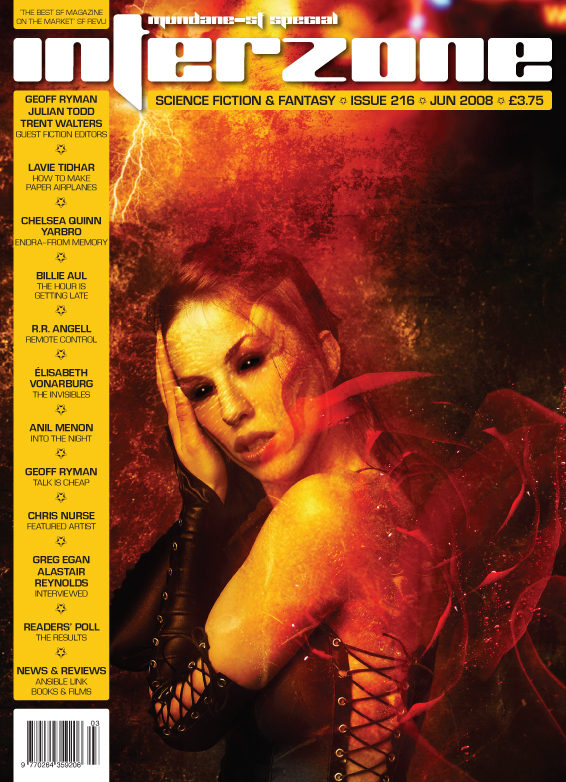
We edited an issue of Interzone and Geoff did his own anthology as well, When It Changed.  It's critique was that it was too science-y science fiction, but that sounds pretty cool to a science major/teacher.