Search This Blog

Showing posts with label politics. Show all posts

Wednesday, June 11, 2025

Martha Soukup appearances on the Internet

To round out one's understanding of a writer who has become more elusive the last few decades, here are some appearances from elsewhere:

#

Discussion of Stories (if a link isn't working, then that story discussion will be out shortly):

  1. Over the Long Haul
  2. A Defense of Social Contracts
  3. The Spinner
  4. Dog's Life
  5. Good Girl, Bad Dog
  6. The Arbitrary Placement of Walls
  7. The Story So Far 


#

Salon articles from the early 2000s

Her work does seem politically driven as the other samples also seem to suggest.

#

Anti War sentiment presumably from a similar era but it feels a bit like the 80s:


#

Clips from a sample of her plays:


Thursday, May 25, 2023

Greg Bear on Politics in Writing

"To handle the issue [terrorist action in "The Wind from a Burning Woman"] honestly, I had to make the “Burning Woman” fight for a cause that I, myself, would cherish. One editor, reading the story for an anthology on space colonies, rejected it because it didn’t overtly support the cause. It would have been dishonest to force the story into such a mold; however pleasant or unpleasant the result, my stories must work themselves out within their own framework, not according to some market principle or philosophical bias. It may be remarkable that, with such views, I’ve come as far as I have in publishing."

--Greg Bear from the "Preface" to The Wind from a Burning Woman.

I invited Greg Bear to write for an anthology that proposed a fascinating new ethos. And he said, "Stay away from ethos." My point was an SF-nal one: So many interesting ways of seeing the world. Let's go for a swim. He could have played the game yet opposed the ethos, too. 

His perspective, I think, could be summed up by the above. Each story has it's own way of thinking. Even as I felt he'd misunderstood, I admired as his staunch position about the writer being outside any set of predisposed rules.

Monday, May 18, 2020

COVID Success Stories by State: More Fun in Reading Graphs

This is the last (for now) of my posts about COVID and reading data/graphs. I'm returning to books.

The first post was about possible optimism in the spread of COVID-19 in the U.S.

The second about the political nature of our response.

Here are two graphs of the COVID spread, comparing two states. Clearly, New York has had a way better response than Wisconsin. Right?

Is there anything wrong with this comparison? If so, what?

I am using the same criteria as I had in the earlier post about possible optimism in the spread of COVID-19 in the U.S.


There are no numbers. So we don't know what's being compared. If anyone hides numbers and properly labeled axes, don't trust them. It looks like Wisconsin could still be climbing while New York is improving. That may be the case. However, take a look at the properly labeled graphs below:


Wisconsin seems to be wavering between fifty to sixty cases per million per day. Meanwhile, New York may be descending toward one hundred cases per million per day. So is Wisconsin doing better than New York?

For about twenty days, Wisconsin was hovering at twenty-five cases per million per day. Should that be its normal? Something else? Some states are hovering between ten to thirty, though: West Virginia at ten, Washington state at thirty.  What should it be?

Here are some states or territories that are whooping all the others' butts:


(Apologies for making the graphs small, but here I'm just looking at trends, not numbers. Feel free to make your own graphs to check.)

These guys are at or near zero. Why are they so much better? You'll probably guess as soon as I list them. Respectively, they are Alaska, Guam, Hawaii, Montana, Northern Mariana Islands, Vermont, and Virgin Islands.

A lot of them are islands (with ocean barriers), and/or have mountain/snow barriers, and/or have low population density. In fact, when numbers plateau, that may be that state's or territory's best rate, under the circumstances. Population density may explain the different-sized plateaus we're seeing (for instance, the difference between Wisconsin and New York). Still, can these be improved?

Puerto Rico, an island, throws a monkey wrench in this discussion. Perhaps they are less prepared to accommodate to this virus than other islands. There are mainland states who still have climbing rates as well, so they need to investigate ways to work on this, brainstorm with allies.

The graph for Northern Mariana Islands is interesting in that the case load hovered at or near zero for ten days, then popped back up. This could mean that we will not eradicate this virus. At least it needs to be for longer than ten days. How much longer? And what does that mean for us?

We can try two things: One, open up the country, business as usual but with masks, etc. (except working with masks is problematic, especially work that requires exertion, and brains need oxygen. Will there be later class-action lawsuits against businesses with strict mask policies? But do we care about the health of such people's brains? They're just low-wage workers, right?) Perhaps we need better masks or a switch to face shields, as silly as they might look. We will probably wear the masks until a vaccine is developed.

Two, we can try a near-complete shut-down of the country, save a bare-bones medical workers and bare-bones crew of those running power and a bare-bones police force. As you can see from the aforementioned post about the political nature to our response to COVID, most people are willing to wait until June, so we can try four more weeks of shut down. People would have one day to gather food for a two-week hibernation. If you had any symptoms after two weeks, you have to stay in hibernation. There would follow the final two weeks of partial lockdown. Then open the country up. Period. No masks unless you or your business wants to, except when an outbreak occurs within a company. If it doesn't work, it doesn't work. We live with the consequences.

Of course, people would complain about either action, and maybe there are other avenues to explore.

This last bit is just some ideas that occurred to me to curb economic repercussions. They have nothing to do with graphs.

To limit business failures, if I were President, I'd make it illegal to collect rent [UPDATE: I'd use a carrot-and-stick approach--either collect rent and face full taxes without deductions (this includes all members of a board. These taxes would be distributed among those who lost their businesses) or allow the rent-free period and receive generous tax breaks]. All electrical power is charged at cost. Anyone who has already paid rent, can get refunds or future credits, depending on the business owner's needs in order to reopen. Those who own buildings or land that's being rented can deduct this off their taxes. Those who had a lot of perishable waste can deduct that as well. That's as close to a reset, that I can think of.

I'd probably do the same for low-income people who lost jobs and defaulted on rent or house payments. Middle-class can put off payments (interest free) if necessary (i.e. unemployed).

Other ideas to mitigate income loss for people and businesses?

Sunday, May 17, 2020

The Political Nature of Responding to COVID in the U.S.

This continues discussion begun in "The Rate of Covid-19 Spread in the U.S.: Optimism in Reading and Interpreting Graphs".

A friend pointed out that I had posted this COVID graphing website (Flip the Script) earlier, and at that time, the U.S. was in the middle of most countries battling COVID. Back then, many news outlets compared numbers without adjusting for different population sizes, which led to wide-spread anxiety. The friend felt relief when she'd seen the graphs adjusting for different populations. It's possible the news outlets didn't know any better.

However, countries (mostly smaller in size and population) have done better than the U.S. at limiting the spread. I discussed this earlier, albeit indirectly. How this should be resolved is a present debate in the U.S.

According to one poll (see NPR website on April 23 based on a poll taken between April 15-20), some states are opening about when (or before) a majority of agree when the U.S. should open. I have organized NPR's data which was strangely out of order, probably confusing most readers trying to make sense of the data:

  • 3% want it open now, meaning April 15-20 [3% of the population*]
  • 14% can wait less than a month [that is, 17% of the population want to be back to normal by April 21 - May 15ish]
  • 37% can wait for it to open in a month or three [54% of the population ~ May 15 - July 15]
  • 10% can wait for it to open in four to six months [64% of the population ~ August 15 - October 15]
  • 34% can wait for more than six months [98% of the population  ~ November +]

Why would anyone organize the data any differently?

This means that most of the population wants us out and about by June, more or less.

One determining factor for how long someone is willing to wait might be how hard hit was the area where each person was polled. So a New Yorker or a Californian may want to stay home.

Another determining factor would be how much money a person has in the bank.

But no one is asking about questions about why we do or don't want to stay at home. Could it have less to do with health than with political repercussions? Could how we feel about staying at home have to do with the political party we root for?

The greater the economic devastation = ousting Trump. The least amount of economic devastation = a plus for getting Trump back into office. You can already see writers laying the economic devastation due to stay-at-home orders at the Trump administration's feet (I've read others but this is from The Atlantic Monthly):

The economic devastation wrought by the pandemic, and the Trump administration’s failure to prepare for it even as it crippled the world’s richest nations, cannot be overstated. Tens of millions of Americans are unemployed. Tens of thousands line up outside food banks and food pantries each week to obtain sustenance they cannot pay for. Businesses across the country are struggling and failing. The economy cannot be held in stasis indefinitely—the longer it is, the more people will suffer.


The association is drawn by juxtaposition. However, if it's the Left that wants to stay home and it causes greater economic devastation, then who should be blamed?

I vote for no blame, but who doesn't love the blame game? I'll go first: Let's blame the ewoks.

Could the Trump administration have better prepared for it? Maybe so. Maybe we should have been stricter. But opinions will fall along party lines. The hindsight of armchair quarterbacks is remarkably keen.

Here's an opinion piece that supposedly addresses how lethal the virus is, saying that more of us are probably infected but we haven't been tested. The reason it appears to be more deadly than a flu virus is that we hadn't had a vaccine ready.

I gleaned this second hand. I haven't signed up to read The Wall Street Journal as I don't want extra spam in my email box.

This intriguing idea is at least partially true since not everyone will go to be tested. But I'm not sure I buy the idea completely. That would mean ten to thirty times the current population listed as having been infected were actually infected. So instead of 1.5 million cases, fifteen to forty-five million Americans were infected, most of whom didn't show serious symptoms. Possibly?

Whatever the case, we must move forward.

#

I have another post to write, extracting more data from the graphs. It will lead us to hard questions for both political parties. (I mean beyond, "Why is it so hard to make a good Star Wars movie?" and "Why do people put nuts in cookies and how can we stop these evil-doers?")

* Isn't it interesting how much attention we give to that 3%? How many worried news spots have you seen about them? Well, it is a sizable chunk of the population. But sometimes things are magnified to make them seem like 30% of the population.

On the other hand, how can we know what size a population we're dealing with until we ask the question? But had anyone asked? Now that we know, why haven't more connected the dots?

Thursday, August 15, 2019

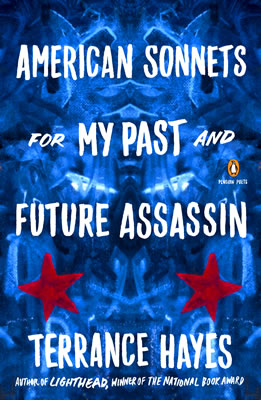
American Sonnets for My Past and Future Assassin by Terrance Hayes


See the source image

While I did both the audiobook and the book, the audiobook helped draw attention to items I might not have noticed otherwise. It repeats one poem and leaves out another. I suspect this is an accident that may be rectified later on.

First, each sonnet is titled "American Sonnet for My Past and Future Assassin." When I got the book, I just assumed that it was the book title repeated on each page. No, that's the name of every poem. This presents a number of possibilities.

Is this just one poem? The second item (also noticed via the audiobook--discussed below) will appear to bolster this idea. And the acknowledgements don't mention "poems." However, the book title is American Sonnets, plural. Maybe someone forced that title on him? Or maybe the multiple sonnets work as one.

Is each sonnet a revision? You'd think the sonnets would be closer in alignment where the poet got closer to the thing he wanted to write.

A third possibility is that each poem has a generic title as a way of untitling, but clearly it'd be easier to have no title if he'd wanted them untitled.

The fourth and possibly best possibility is that he wants this title to apply seventy different ways to seventy sonnets. I'm not sure that they do except in a few cases. It'd be easier to apply if it didn't insist on the duality of "Past and Future" in each. Maybe it isn't intended to fully apply, but then he could have left out "Past and Future" entirely.

The second thing one notices via the audio (although some may have noticed without the nudge) is that the first-line index is presented as a series of five sonnets, but listed and read as one poem. It's certainly interesting although I'm not yet convinced it works except as a grab-bag of interesting lines. I'm willing to be convinced otherwise, of course. It might be a good cue that this series is meant to be read as one poem (see above).

According to the back matter, this was "Written during the first two hundred days of the Trump presidency," which suggests political subject matter, which that is here, but there is also variety--from the personal to the political. Also the tone shifts as well.

The first poem sets the stage for poetry that may not fully recognize what it is or where it's headed:

"The black poet would love to say his century began
With Hughes...but actually
It began with all the poetry weirdos & worriers, warriors....
skittery, [Sylvia Plath] thought her poems were ordinary.
What do you call a visionary who does not recognize
Her vision? Orpheus....
meant I am blind without you. She thought he meant
I never want to see you again. It is possible he meant that, too.

So accident, chance lead the poet to meanings he meant and meanings he didn't know he meant. This may explain the index--a happy experiment of first lines tossed in a stew to see what comes about. It helps that some of those opening lines repeat (regarding "black male hysteria" which is a quote he says in the notes he may be misremembering).

A handful of poems do attack Trump head on. If you're okay with attacking Obama, then you should be fine with attacks on Trump. And vice versa. (Of course, it rarely works that way. It's great when the leaders of opposite party are attacked. Politics is heroin.)

I'm just interested in aesthetics (sound, imagery, line breaks), not the politics. Here are some good lines (or bad ones if you like Trump):

Are you not the color of this country's current threat
Advistory?...
Color of the quartered cantaloupe
Beside the tiers of easily bruised bananas cowering
In towers of yellow skin? And of Caligula's copper-toned
Jabber-jaw jammed with grapes shaped like the eyeballs
of blind people?...
Pomp & pumpkin pompadour,
Are you not a flame of hollow Hellos & Hell nos

The sonnets here (as the last) do not necessarily have turns or voltas. Hayes writes the "Voltas [are] of acoustics, instinct & metaphor. It is not enough."

That last line ends "To love you. It is not enough to want you destroyed." This is the kind of volta that appears here. You might suppose that the "you" is Trump. It may or may not be. It may be the reader. It may be the author. In fact, you might suppose that Trump and past America are the assassins, but later, we learn that the speaker's self may be also involved. This complexity adds the necessary layer of richness to the poem(s):

I tend to repeat my mistakes. I'm a camera
With no cameraman, my own personal
Assistant & assassin.

and

He sings "Preface to a Twenty Volume Suicide Note"...
Leroi Jones
Wrote the night before Baraka put a bullet in him.

Note: LeRoi Jones is Amiri Baraka, hence the "song" he sings.

"You assassinate..." is a litany in one sonnet and concludes "You will never assassinate my ghosts." "Probably," he writes in a later sonnet, "our ghosts are allergic to us.... / This bitter earth is a song / Clogging the mouth before it is swallowed or spat out."

He does talk about Christianity and gets the details and essence wrong, but hey, he's mad-libbing to the profit of his poems: "Christianity... / is the story / Of a son whose father is a ghost." Later, he writes, "After blackness was invented / People began seeing ghosts.

The current culture conspires to perpetuate the past, however subtly and unintentionally:

Even the most kindhearted white woman...
may find her tongue...
Chanting n-words... inwardly
Softly before she can catch herself...
what is inward, is absorbed.

Hayes himself uses the term, albeit usually the phonetic version:

It feels sadder when a black person says Nigga...
one whose master has no Lord....
You will always be my nigga, I say to the mirror

The best poem is "In a parallel world where all Dr. Who's / Are black." (I'll link to it if I can find it online.... Not found. You'll have to look it up. It's toward the end.)

Friday, June 7, 2019

American Hunger by Eli Saslow


American Hunger 
The Pulitzer Prize-Winning Washington Post Series 
by Eli Saslow 
Knopf Doubleday Publishing Group 
Vintage 
Politics
It's easy to see why Washington Post reporter Eli Saslow won the Pulitzer Prize for Explanatory Reporting. He drops us into the lives of real people, real politician, real citizens living in poverty. We sit in their houses, sit at their same dinner tables, stand in long lines with them as they wait to collect free food. If your heart isn't breaking for the hungry before, it will be afterwards.

Saslow begins the series of six articles following Representative Steve Southerland from Florida, who tries to get colleagues on the same side, to find a way to feed the hungry yet help them also get working. However, he comes up against opposition on both sides of the aisle. What's fascinating is Saslow's choice. He shows 1a) Republican politicians that this is an issue worth paying attention to, 1b) Republican voters that this has potential solutions that they can be invested in, and 2) Democrats that Republican indifference is politically expedient dishonesty. As Southerland says when he tries to explain to his daughter how he cannot cross the political aisle to gather allies:
He reached two milk shake glasses to help him illustrate the problem, setting the glasses side by side on the table, their rims touching. "This is me, and this is the other guy when we get to Washington," he said. "Different ideas, different people, but we are close. We are touching. Democrat and Republican. We can do something with this.
He started to slowly pull the glasses in separate directions, ticking off reasons for the escalating divide. "Fund-raising. Campaigns," he said, moving the glasses farther apart. "Votes, strategy, rushing around, lobbyists, name-calling," he continued, spreading the glasses farther, moving his daughter;s plate to clear a path for one of them. "I have my meetings and they have theirs. I run by them. They run by me. It's all about winning, winning, winning. Winning--not fixing problems--defines all."
Then there's the Munoz family who can get more of the cheap food that fills them, but it comes at a cost. It's not healthy, and they require doctor visits for cholesterol, diabetes. Should food programs regulate what people get to eat?

The Richmond family struggles to stretch their food stamps across the whole month. They go to locations that have free food. Her children's fathers don't provide child support. They stand in line for hours just to get hand-outs that may not be there or leave something to be desired.

We had to Woonsocket and meet Pichard, a grocer whose primary customers are those on food stamps, and the Ortizes who try to live on minimum wages and food stamps.

Then Dillie Nerios is a recruiter for the food stamp program among the senior citizen set. Some had misfortune and lost their savings and now qualified for assistance, but they are reluctant to give in, seeing it as shame.

Finally, we have Rick Bible who drives a bus around the Appalachia area delivering bread to the hungry.

It's a painful journey with, as yet, no answers. Saslow sketches the scope of the problem in human detail. Give it a read.

Saturday, March 25, 2017

"Liking What You See: A Documentary" by Ted Chiang

This was up for the Hugo (withdrawn), Sturgeon, Seiun, Tiptree, and Locus Awards. It was reprinted by Robert Silverberg, Karen Haber, Debbie Notkin, Jeffrey D. Smith, Karen Joy Fowler, Pat Murphy.
Summary:
 Tamera Lyons is a college student at Pembleton. As a child her parents made her take calliagnosia, a treatment that causes the brain not to see beauty and be unduly influenced by it. She chooses to go off it voluntarily. Meanwhile, across the nation, people debate whether everyone should go on it. The cosmetic companies gather and form a group of concerned citizens, but they are also behind new technologies that push that beauty's influence even further.
Commentary:
Somewhere, I read that the reason for withdrawing this story for the Hugo is that the story had been rushed. It wasn't up to Chiang's usual standard. If the other stories are any guide, he was probably waiting on another big concept to splice it with. In terms of story attributes, it shares similarities with most others in his oeuvre.

And so it works within this framework, as is. The film-documentary narrative mode utilizes Chiang's strengths and focus on the ideas themselves while telling the story from multiple viewpoints. It illustrates perfectly what Chiang says in this The Asian-American Literary Review interview:
"[N]o technology is all bad or all good.  The more interesting science fiction story tries to show both sides of technology—the positive and negative consequences, and an ambiguous future as a result. To me, that is the more honest kind of science fiction."
This is exactly what I admired most about this tale. We have people with varying points of view speaking up/out on whether people should be subjected to calli.

It would be interesting to see what Chiang would do with this if he came back to it, allowed himself to "finish" it, give it the time it needs. Of all the tales in the collection, this one seems the most ripe to expand into a novel--at least a short one--although sticking only to the present format may hamper expansion. Each permutation of perspective on the science of beauty could be given its own story. There are also perspectives buried within the text that could brought out into the light of day as well.

Tuesday, March 14, 2017

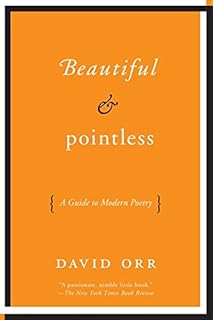
Beautiful & Pointless by David Orr

"I don't expect you to agree with everything that's said in each of [the chapters]; in fact... I hope you don't. If you do, you'll be preventing your own response, the most vital and disturbing faculty you possess, from fully developing its power. You want to become a reader of modern poetry, not a receiver of the verdicts of modern poetry critics."
--David Orr, "Introduction" 
In his introductory essay, David Orr makes a case that this book should be where a poetry reader / poet starts, as opposed to the usual topics of introductory poetry. The opening three essays probably would supplement a good poetry-writing or -appreciation course, but a few of the essays would push new readers out of their depth. I'll leap off the above quote to deviate along a parallel course.
Let's start with the final essay first: "Why Bother?" [with poetry, presumably]. It provides the main course for discussion in other chapters.

Orr presents the possibility often stated in poetry, that poetry is pointless but beautiful. He astutely shows that poetry is no greater a human endeavor than, say, gardening. We'll pass on the "beautiful." It may or may not be--each reader's aesthetics may vary (not that all are equivalent)--but let's examine the idea of pointlessness.

Historically, people have feared pointed-art as it might eschew art to become didactic. However, a simpler truth underlies art with a point: What does it mean to be human?

Orr describes how he tried to teach his father poetry as he lay dying. Why do this? Probably it was 1) to forge a bond, 2) to show his father why Gregory did what he did, 3) to justify himself, 4) to teach poetry or teach how words convey meaning between humans. Why did his father participate? 1) to forge a stronger bond with his son before leaving. I cannot guarantee this, but one could probably wager, visit the senior Orr in the after-life, inquire and probably win the bet.

For some, if art has a point, it must be as didactic as a classroom meter stick slapped across the palm. August Kleinzahler likely was speaking directly to this when he wrote as a blurb:
“David Orr reminds us that poetry is an ancient and living art, a robust American art, and not a commodity or vehicle for self-expression, social betterment, or career enhancement.” 
But sometimes art is just that frisson, that tiny burst of energy which addresses a small aspect of humanity we've just recognized or forgotten. It doesn't have to be world-shaking or political or personal or didactic--just human.

A-ha! someone asks, what about "The Red Wheelbarrow"? A moment in a human being's life, a moment noted and captured. That would explain "so much depends upon".

What about language poetry? Isn't that what humans use to communicate? Of course, it is human... if at a remove.

What about sounds and emotions and symbols, etc. in poetry? All of these are implied above. There is probably a human aspect to any human endeavor.

What about animals? Human create bonds between themselves and animals, often anthropomorphizing. SF has been dealing with aliens for a century and a half or more. Not only do we see our connection with the other, but also we often put ourselves in its place. However, some aliens are easier to connect with than others. More human? After all, not many weep over the death of thousands of cells every time you scratch your head or spray Lysol to kill germs in a hospital.

How well a poem addresses the question may explain how well and how many respond to the poem.

Plenty of caveats lurk in the sage brush, waiting to ambush us. On the one hand, this is not to advocate any single human perspective, since any single perspective would be limiting, privileging one group of humans over another. On the other, a single human perspective is all we have. We are individuals and as such we have individual voices, capable of utterances that are both human yet paradoxically unique.

*

Orr launches into the opening section called "The Personal" 1) to point out the popular misconception of poetry being so personal as not being able to critique it, and 2) to talk about confessional poetry. On the first point, he uses embarrassment as a key to discerning whether the personal is art or not, drawing up a make-believe scenario where a man plays a kazoo to lament the passing of his mother. But embarrassment is human and should be fodder for poets and artists to exploit. Woody Allen and other comedians rely on it. Whether the kazoo is beautiful or not, is a different matter.

The second aspect is confessional poetry. Some love it, some hate it. In some ways it addresses "What does it mean to be human?" better than most poetry. The problem with this sub-genre, for me, lies in its inability to step out of its frame. As Salman Rushdie said, "To see the picture, you have to step out of the frame."

When I was a child, my mother would ask--whenever I cried about someone else's behavior--"What did you do to them?" I had to experience this earth-shattering revelation multiple times before it sank in: I created some scenarios that I was suffering through. When I punched/sassed Johnny, Johnny punched/sassed back.

However, sometimes I had done nothing to deserve the attack. I still remember a kid flicking a paper football in my eye having done nothing to provoke him. He was just a bully. So it goes. Sometimes we provoke our bullies, sometimes not. I made these revelations between six and eight years old (even if I implemented them imperfectly); therefore, writers with more maturity than an eight-year-old can and should stand outside one's self for a broader perspective, to see the whole picture.

Reading a famous confessional, I felt for the persona's plight when I noticed that a completely different set of explanations for people's behavior could exist than those the persona assumed. That she didn't challenge her assumptions made her an unreliable narrator, and the text didn't doubt itself. I put the book down. Maybe it justified itself later. I try again at a later date.

Is this an authorial embarrassment for the confessional? Maybe. Not necessarily a detrimental one. It can at least be appreciated for its aesthetics--its skill at craftsmanship, the way sound splashes across the page. But it does have dribble stains across its shirt front.

*
"Almost all poets, including myself, lean left. There are maybe five conservative American poets, not one of whom can safely show his face at a writing conference for fear of being angrily doused with herbal tea." --Orr, "The Political"
The aforementioned "What does it mean to be human?" also affects "The Political" section. Art should not be immune to the political as it impacts humanity, but the political limits itself when it remains inside the frame.

Too much art is wasted being voluntarily walled in with Fortunato for a chance to sample a cask of Amontilado. Unless one is in the business of propaganda, it would behoove one's political poetry to take a wide-angle lens, to photograph native politicos in the wild as they behave, not as one's political party would have it. Be it liberal, conservative or something that lies outside the two-party system, political poetry should be more than a mouthpiece. Moreover, to state what is stated on a political platform is not asserting one's individual voice, "preventing your own response, the most vital and disturbing faculty you possess, from fully developing its power," as Orr put it.

Orr also suggests that poets and politicians both persuade although "[a]dmittedly... of very different things." Yet when one examines the important poetry, how much is persuasive? Further, poetry is a rather small community. Whom are they trying to persuade? the "maybe five conservative poets"? or the choir? One is reminded of Hamlet's soliloquy: "to take Arms against a Sea of troubles."

This isn't to say that politics or any subject matter is forbidden, but persuasive essays will likely serve best as it frees them from the shackles of having to reproduce humanity with accuracy. As one removes these shackles, however, one moves away from art, toward propaganda. If you aren't interested in art, then it shouldn't trouble you when you engage in propaganda.

On the other, other hand, today's battlefield of political words exists in pithy memes. One might make a case for poetry entering the fray there. However, the shorter the vision, the more reductive one's persuasion, the less faithful one is to the greater swath of humanity, the less accurate and less vital one's art. Art services humanity over partisanship. This does not preclude opinion but leavens it.

*

The other three essays cover their territory. The first essay, "Form", discusses form that is rigid, organic, apparent, and shapeless. Orr's take is original and thoughtful but leads to few surprises.

"Ambition" (called "The Great(ness) Game" from 2009), however, was surprising and thoughtful. It first appeared in The New York Times Book Review. He references Donald Hall's "Poetry and Ambition" reprinted online here. One must imagine some consternation at its publication. It posits that ambition as defined by writers like Robert Lowell, Geoffrey Hill, Jorie Graham, and Derek Walcott--as being an aggressive, extroverted poetry with words like pyre and fire. Whereas, the presently more popular Elizabeth Bishop resides at the opposite end of the continuum: the small, minute topics which she brushes away.

Did Orr hit the target? or is he being reductive? This will require some study.

The most provocative essay, "The Fishbowl", makes one question everything about poetry as an institution. Is it just a shell game? One hears of contests where the winners were predetermined. I've heard of famed magazines--from those who had worked behind the scenes--that did the same, soliciting works and ignoring submissions entirely. It puts a new spin on the book's title, However, we probably should not think the worst of a rather broad field. But this essay might open a few eyes.

Thursday, September 4, 2014

Politics makes us dumber

“Divergent” and “Hunger Games” as capitalist agitprop: 
"We're all told we're "Divergent," all the time -- behind the bogus dystopia lies a panegyric to consumer society."
The horror!

YA dystopias teach children to submit to the free market, not fight authority 
"The Hunger Games, The Giver and Divergent all depict rebellions against the state, and promote a tacit right-wing libertarianism."
And I take it that this is evil as it goes against everything the article writers believe in. I agree. In fact, I've got an idea. Let's only write a certain kind of story! One kind only! With one theme. One theme only! It will never get old. Nor will the exclamation marks!

We'll check with the proper authorities to make sure it has the proper theme. I can't wait to dive into this dystopian future we're creating. I will chair the committee. All stories must be pre-approved by me or it cannot be published.  We will only publish stories that slant toward a certain political party. All unapproved published works will be burned (and their authors).*

Related, but less shocking:

Project Hieroglyph: Fighting society's dystopian future

Thought Experiments:Tomorrow Through the Past by Allen M. Steele

Here, the authors advocate positive futures.  That's great.  In fact, I'd like to get the anthology when the price goes down. Advocate whatever you want, so long as you don't say what writers can and can't write about.

Let's allow people to tell whatever story they want. If you disagree with the theme, say so. As a reviewer, I used to post the author's comments if I disagreed. Why? To give authors a voice, not to bash them. I could be wrong. I was not out to silence anyone.

Let's not create some moral imperative that any theme can or cannot be read. Open your mind. Look at negative possibilities, look at the positive. Allow yourself to read things you don't agree with. Avoid telling people not to read things.

Some scientific evidence to back this up:

David Brin discusses how self-righteous indignation gives you a high.  Self-righteous indignation is a major component of politics. (Perhaps, as self-righteous indignation gives political addicts a high, the FDA should regulate its use.)

Science confirms: Politics wrecks your ability to do math.  That's right.  Both parties got dumber. (A left-wing article reported only the right-wing problems.)

Political Diversity Will Improve Social Psychological Science: Bias can skew data.

If you want to get smarter, you have to challenge yourself. Read something you don't agree with. Excluding what can and can't be read and discussed makes you and the people you encouraged to become dumber. No, you don't have to read everything, but don't tell people not to.

You might ask, "Weren't you part of the Mundane SF lot?" Yep. Not because I was against any type of SF, but that it represented a type of SF not being voiced.

* By the way, this is satire.

Saturday, November 30, 2013

Ray Bradbury on writing and politics

"Steinbeck is one of the few writers out of the thirties who’s still read, because he didn’t write for causes at all. He wrote human stories that happened to represent causes indirectly."
 -- Ray Bradbury from a Paris Review interview

Tuesday, November 26, 2013

Ray Bradbury on politics

"You can’t write for other people. You can’t write for the left or the right, this religion or that religion, or this belief or that belief. You have to write the way you see things."
 -- Ray Bradbury from a Paris Review interview 

Tuesday, August 6, 2013

Should You Watch/Read Ender's Game? 10 Reasons to Consider

  1. Here is K. W. Jeter's interesting claim:  That voting against the movie before seeing it votes against making movies from living writers.  You can read his reasoning here.
  2. I can't find it now, but one writer advocated seeing the movie and donating to your favorite charity.
  3. You don't have to agree with an author to read his work.  The same holds true for many authors.  Many left-leaning writers read Robert Heinlein--even when his writing game had fallen.  People still read Ezra Pound, Louis-Ferdinand Céline, or H. P. Lovecraft whose personal beliefs were less pleasant.  I haven't read Mein Kampf, but I don't advocate boycotting it either.  Although I'm a Christian, I read atheist writers and other religious/philosophical affiliations opposed to mine.  Mario Vargas Llosa's Nobel prize speech states the necessary mental state of readers and writers when approaching fiction:

    "When [various unfortunate events occur in fiction], the shudder is the same in the reader who worships Buddha, Confucius, Christ, Allah, or is an agnostic, wears a jacket and tie, a jalaba, a kimono, or bombachas."
  4. Art should be about art or its aesthetics, rather than its advocacy of any one stripe of politics.  Politics change.  What's popular now may fall into disfavor, not only invalidating but also stamping censorship on any literary work.
  5. SF is supposed to be a genre of ideas--even or especially ideas we disagree with.
  6. The author should be separate from the work, which is not unrelated to Roland Barthes' "The Death of the Author".  In this case, the work has nothing to do with the writer's belief (see discussion of Ender's Game theme here.)
  7. Boycotting could have the opposite effect:  Drawing attention to what you what want to hide.
  8. You might change your mind, or find that what you thought, wasn't the case.  I once signed a petition against bringing the Martin Scorsese's movie The Last Temptation of Christ to theaters because it misrepresented Christ.  Later, curious, I watched it.  One, the movie opens stating that it was not representing the gospels. Two, while the first half exceeded credibility, the second was extremely moving.  Atheists have said it made them feel religious.
  9. I suspect Orson Scott Card bases his belief primarily on religious conviction, not because of animosity. 
  10. My strongest claim is that this action advocates a political censorship.  Mario Vargas Llosa writes that dictatorships favor censorship because they fear the imagination.  If we disagree, we are free to state so.  However, if we openly suggest that many should boycott a work because of our disagreements with an author, this opens the door to the same thing happening to works you agree with.  This economic battle hurts no one but the already difficult financial prospects of artists.
Your mileage may vary.  Feel free to comment but with reasons and with courtesy.

Friday, January 28, 2011

NPR Audio story

I played this for students:
Are U.S. Schools Really Falling Behind China?
The idea behind this was to get students to see how current politicians and other countries consider science and math not only important but also vital to their future. Students had plenty to say. Also relevant this past week:
In The Heartland, Obama Calls For Innovation