Search This Blog

Showing posts with label John Joseph Adams. Show all posts

Saturday, August 17, 2019

The Mad Scientist's Guide to World Domination: Original Short Fiction for the Modern Evil Genius, edited by John Joseph Adams


In preparing to review this John Joseph Adams anthology, I grappled with what it means to be a "mad scientist." The quintessential anthology was Stuart David Schiff's Mad Scientists. From these and from scientific ethics (at least that was why the subgenre originally arose), I distilled the quintessential elements of the sub-genre--that is, a scientist believes himself working for the greater good though he may not be. It seems that now, at least in reading the anthology under review, we have lost sight of the original point of the trope, which is both good and bad: good, in that we trust scientific endeavors (no questions asked); bad in that science, to be rigorous, requires that we ask questions, not just to challenge our assumptions bound to be behind any study but also to probe our own ethics.

I pointed to this story as the basis of the Mad Scientist trope. (I have other thoughts on the use of the trope here). Some stories just have a scientist doing something crazy, like Arthur C. Clarke's "Big Game Hunt" which has a scientist try to control a giant squid, but it lacks the dynamo that makes the sub-field fascinating.

Most famously, we have Mary Shelley's Frankenstein, the scientist who wanted to create life. What was his motivation: to bring back loved ones? to spawn new creatures? to play God? Whatever his motive, I think we can understand it at least to an extent, so long as we isolate his original motive from the outcome. Frankenstein's sin may be his lack of follow-through, or maybe just the attempt itself if you believe the movie versions. Whatever his motive and whatever his sin, it is their contrast that powers Shelley's famed novel. Otherwise, the mad-scientist tale comes off flat.

Some narratives contrast two ethical stances, one or both of which may be problematic (who is the mad or madder scientist?) Sometimes the mad one isn't even the ostensible mad scientist. While the narrator isn't always "mad" or a scientist, the ones who aren't problematic is some fundamental manner dull the narrative.

Many feature unreliable narrators, but that need not necessarily be as we witness in Frankenstein. As you can tell by the title of this anthology, the stories can run from humorous to the serious, but still a contrast between one's goal and ethical outcome make stronger stories. If it's just a gag, the story will fall flat.


  • Professor Incognito Apologizes: An Itemized List • short story by Austin Grossman
This is an apology told in the mad scientist's voice, which is this story's primary strength. It feigns at the mad scientist trope to talk as a metaphor for the failure of relationships.
  • Father of the Groom • short story by Harry Turtledove
This literalizes a common joke about bad brides. 
  • Laughter at the Academy: A Field Study in the Genesis of Schizotypal Creative Genius Personality Disorder (SCGPD) • short story by Seanan McGuire
Interesting thought-piece on the creation of mad scientists.
  • Letter to the Editor • short story by David D. Levine
This is a kind of tour-de-force critique of Superman (or Ultimate man) with a call to action. What makes this succeed is the switch on whom we should root for. The ending doesn't carry the same weight, but as a letter-to-an-editor format, it's still impressive for those limitations. 
  • Instead of a Loving Heart • short story by Jeremiah Tolbert
A robot, who serves a mad scientist, has to contemplate his existence against the impending arrival of something more intelligent and more powerful than anything that has existed before.
  • The Executor • short story by Daniel H. Wilson
A mad scientist has set up a legacy for his descendants, but in order to get it, someone has to answer the riddle within five seconds.
  • The Angel of Death Has a Business Plan • short story by Heather Lindsley
The protagonist works with mad scientists on their monologue. Cute.
  • Homo Perfectus • short story by Dave Farland
Damien uses pheromones to get in with Asia, but as he approaches what he thinks he wants, he recognizes a subtler and more accurate approach.
  • Ancient Equations • short story by L. A. Banks
A mad scientist need not use science but call up Kali, for more than one reason.
  • Rural Singularity • short story by Alan Dean Foster
A reporter finds a young girl capable of miracles--scientific ones--but he doesn't quite buy into what he's told. Interesting but ends still questing for significance.
  • Captain Justice Saves the Day • short story by Genevieve Valentine
A good secretary is needed to keep these guys in line--not that they'll ever notice.
  • The Mad Scientist's Daughter • novelette by Theodora Goss
This was a runner-up for the Locus award. It has inherent drama just from the scenario: a bunch of mad scientists' daughters gather to tell their stories. They are neglected and abused but from so great a remove that the narrative gears are absent. Interesting concept, though.
  • The Space Between • novella by Diana Gabaldon
While this sounded interesting, it may require knowledge of the series, which I have yet to explore. It seems interesting, but probably not a good entry point into the series.
  • Harry and Marlowe Meet the Founder of the Aetherian Revolution • short story by Carrie Vaughn
Carrie Vaughn gives a thrilling episode in her series with. Although the story can be appreciated alone, it would help the reader to be versed in the background of this dynamic duo. Their relationship seems to be developed elsewhere.

  • Blood & Stardust • short story by Laird Barron
Laird Barron has an ugly henchwoman who was been raised as the mad scientist's child but steps out (see also Goss's work, albeit a bit more dynamic)
  • A More Perfect Union • short story by L. E. Modesitt, Jr.
L. E. Modesitt, Jr., more than most of the writers here, really works on the trope in "A More Perfect Union" and takes it into an interesting direction: political science. Unfortunately, the writer must have had constraints for the tale isn't as engagingly told as it could be.

  • Rocks Fall • short story by Naomi Novik
Naomi Novik's "Rock Fall is more of superhero comic-book villain, but the scenario is the setup is unique. The follow-through didn't fully click.

  • We Interrupt This Broadcast • short story by Mary Robinette Kowal
Mary Robinette Kowal's place us empathetically in the mind of a true mad scientist who makes devastating miscalculation. Solid work.
  • The Last Dignity of Man • novelette by Marjorie M. Liu
Marjory M Liu's "The Last Dignity of Man" has a similar slipstream which flips Ford's situation (opening and development are fascinating, the closing not so much). 
  • The Pittsburgh Technology • short story by Jeffrey Ford
A handful of works don't really engage the trope but still provoke thought. Jeffrey Ford's "The Pittsburgh Technology" tackles a familiar set-up: a loser looks for a better life and is given the opportunity (arguably slipstream--the opening isn't strong, but that ending zings).

  • Mofongo Knows • short story by Grady Hendrix

Grady Hendrix's "Mofongo Knows" is really the highlight of the anthology. It takes you inside the decline and "fall" of a dynamic superhero Steve Savage and his foe, the "Gorilla of the Mind, Mofongo," who can influence people and things through the power of his mind. However, Mofongo has been captured by Savage and they've been a sideshow ever since. Mofongo seems to exist merely to have someone to taunt and be taunted by. When Savage passes, the course of Mofongo's life will change--for good or for ill. It starts humorous and becomes surprisingly moving.

  • The Food Taster's Boy • short story by Ben H. Winters
The collection closes with strong work by Ben H Winters. A mad scientist conducts a cruel experiment just to witness cinematic results that don't quite pan out as he expected. Interesting (since it's intentionally problematic) thought piece.


Saturday, January 10, 2015

"Beautiful Boys" by Theodora Goss

First appeared in Sheila Williams' Asimov's. Reprinted by Jonathan Strahan in his Year's Best and John Joseph Adams in Lightspeed.

Summary:
The story is rather simple. A PhD professor studies "Beautiful Boys" which are aliens come to Earth who mate with women and leave. The professor herself gets intimately involved with one and eventually has a child with one herself. He, predictably, flees.

Discussion:
Despite mentioning aliens and being publishing in Asimov's, this probably shares more in common with interstitial fiction. Yet one can squint and call it SF as it nominally investigates aliens. These aliens, though, are more of dissection of the real-life male who never settles down--with work or women, dabbling in varieties of both.

One might anticipate a scathing diatribe. Instead, it's a rather light-hearted poke at the male type, alternating between an academic discussion and the professor's engagement with a member of this species.

Thursday, March 6, 2014

New Ebook Releases


Serpent Catch trilogy by David Farland ($3.99 each)
  1. Spirit Walker
  2. Serpent Catch
  3. Blade Kin


Saturday, May 4, 2013

The Go-Slow by Nnedi Okorafor

First appeared in The Way of the Wizard, edited by John Joseph Adams
Also in Tor.com

After an ongoing spt with his spouse, his unlikely and somewhat unlikable hero--for some readers--comes across women in the form of emus.  He hits one giant bird and stuffs it into his trunk to give the meat to his mother until it starts pounding on the trunk.  He lets her out and, lo, it is not bird, but a woman.  They help the protagonist with his political and marriage situations.

Friday, February 22, 2013

Review of 4 stories from The Mad Scientist's Guide to World Domination


The Mad Scientist's Guide to World Domination 
John Joseph Adams, editor 
Tor/Forge
Tor Books

In Austin Grossman’s “Professor Incognito Apologizes, An Itemized List”  Prof. Incognito speaks to his fiancé through a letter.  He describes how she must have broken into his secret lab to learn his secret identity.  On purpose--his purpose.  A few more surprises await.  A humorous and poignant story about the selves people hide from others. It may have been more powerfully told through a more narrative letter.  Still, worth reading.

Harry Turtledove’s “Father of the Groom” is a mad scientist who reifies the irked bridesmaid’s comment that his daughter-in-law-to-be is Bridezilla.

Seanan McGuire (Mira Grant) looks at the source of mad scientists in “Laughter at the Academy” for a clever twist of the trope.  A detective unravels Clarissa Garrity’s role in the number of mad-scientist incidents occurring, but she’s widening the scope of her operations.

David D. Levine’s “Letter to the Editor” recasts light on the mad-scientist-as-arch-superhero-nemesis.  Levine turns our sympathy toward the presumed sociopath as he scientifically reasons why the superhero is a threat to society.   He then enlists the aid of the entire planet with one clever step.  Impressive as is.  It would have been fun, however, to puzzle more over whether he’s to be trusted, perhaps through readers poring over detailed, previous exploits or “crimes.”

Saturday, February 16, 2013

Auspicious Eggs by James Morrow


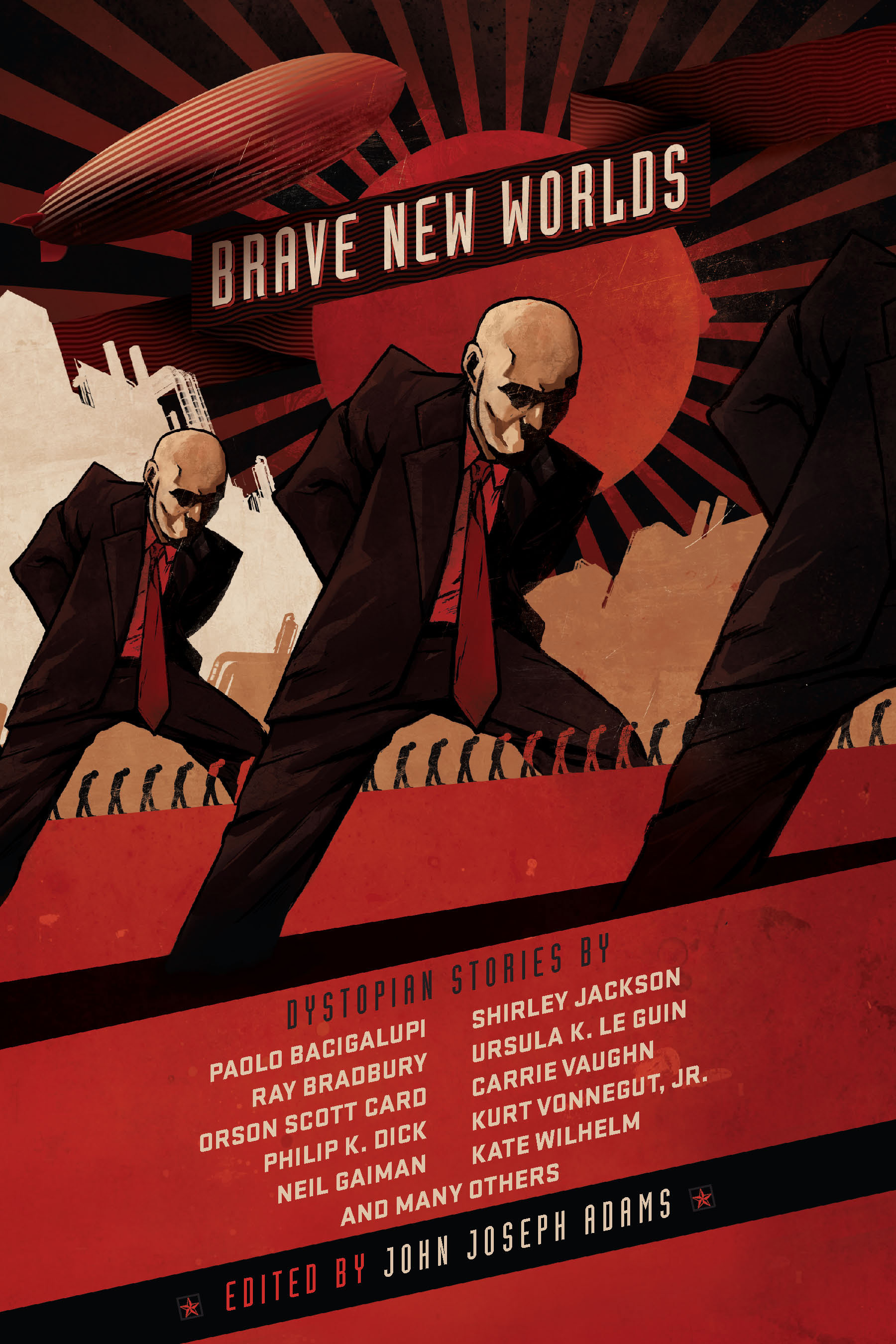
From Brave New Worlds, 2nd edition (originally from Fantasy and Science Fiction)
edited by John Joseph Adams
(Note:  This anthology originally appeared a few years ago but has been re-released with new stories as the first edition didn't get publicized well enough.)  
Father Cornelius Dennis Monaghan witnesses an odd baptism:  The priest baptizes a twin who is to be killed because she is not fertile.  The mother runs away with her the remaining twin.

You know you're in a strange alternate theocratic universe.  Not only is infertility worthy of death, but also prayer staves off a global-warming flood.  Nothing is more important than procreation and only procreation.  If you can't procreate, you will be baptized until dead.  Father Cornelius  regrets his actions and tries to escape the theocracy.  Fate has a surprise.

This isn't an extrapolated society if unchecked, but 

Thursday, February 14, 2013

The Perfect Match by Ken Liu (from Brave New Worlds, 2nd edition)


From Brave New Worlds, 2nd edition,  
edited by John Joseph Adams
(Note:  This anthology originally appeared a few years ago but has been re-released with new stories as the first edition didn't get publicized well enough.)  
Sai relies on Tilly, an electronic aid that keeps track of his interests in order to help and recommend various products.  Jenny, his neighbor, sows seeds of doubt that allowing corporations access to his interests may be detrimental.  Sai starts to notice that with Tilly comes a lack of surprise and challenging thought.  Jenny has a plot to destroy Tilly.

(I can't help but wish I could own at least part of a Tilly.  This may function as a Valentine's story.)  

From Brave New Worlds, 2nd edition,  
edited by John Joseph Adams
(Note:  This anthology originally appeared a few years ago but has been re-released with new stories as the first edition didn't get publicized well enough.)  

Wednesday, February 13, 2013

Cull by Robert Reed (from Brave New Worlds, 2nd edition)


From Brave New Worlds, 2nd edition,  
edited by John Joseph Adams
(Note:  This anthology originally appeared a few years ago but has been re-released with new stories as the first edition didn't get publicized well enough.)  
On a spaceship  erratic behavior--no matter how small--cannot be tolerated.  Orlando, a boy genius, has hit his sister, just one in a series of crimes.  The father makes excuses, the mother asks for drugs, but drugs dampen performance on a spaceship.  A robot doctor has to decide the boy's fate.  The boy is ready to be culled.  The robot gives the genius boy hope that he has a different destination, a new living world with secret homes on asteroids.

This feels like Shirley Jackson's "The Lottery" made logical and necessary if not attempting Jackson's verisimilitude.

Personal Jesus by Jennifer Pelland (from Brave New Worlds, 2nd edition)


From Brave New Worlds, 2nd edition,  
edited by John Joseph Adams
(Note:  This anthology originally appeared a few years ago but has been re-released with new stories as the first edition didn't get publicized well enough.)  
"Personal Jesus" is an electronic watchdog that everyone must wear, advising proper religious behavior and applying electrical shocks when wearers misbehave.  A vignette written as a promotional pamphlet.

Tuesday, February 12, 2013

Red Card by S. L. Gilbow (from Brave New Worlds, 2nd edition)


From Brave New Worlds, 2nd edition,  
edited by John Joseph Adams
(Note:  This anthology originally appeared a few years ago but has been re-released with new stories as the first edition didn't get publicized well enough.)  
"Red Card" originally appeared in Fantasy and Science Fiction.

Anyone can shoot one person in Gilbow's society, so Linda Jackson shoots Larry, her husband.  The town approves.  She reports her act, turns in the Red Card that allowed her to carry out the act.  Now that she's turned in her card, though, people don't have to like her.

The Lottery by Shirley Jackson (from Brave New Worlds, 2nd edition)

From Brave New Worlds, 2nd edition,  
edited by John Joseph Adams
(Note:  This anthology originally appeared a few years ago but has been re-released with new stories as the first edition didn't get publicized well enough.) 
"The Lottery" originally appeared in the New Yorker

Shirley Jackson paints a small town's seemingly charming habits with well-worn customs and mannerisms toward one another, and then she turns the town on its head--at least for the reader.  Undoubtedly, this captured the seemingly random hate of a small town in Jackson's time--the town's willingness to destroy its citizens, no matter how well the citizens knew one another.  While the story may seem more quaint as small towns disappeared, the internet has become its own map of small towns, some of whose citizens sometimes go around stoning.  However unfortunate, this story may never date as long humans exist.