Search This Blog

Showing posts with label children's books. Show all posts

Sunday, July 14, 2019

Review: Short by Holly Goldberg Sloan

Short
by Holly Goldberg Sloan
PENGUIN GROUP Penguin Young Readers Group
Dial Books
Children's Fiction , Middle Grade
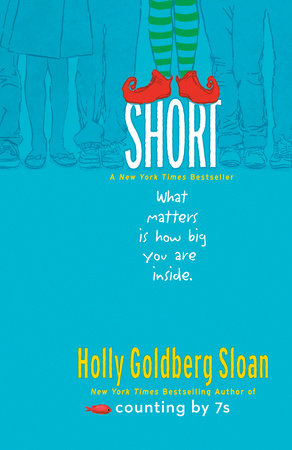
Image result for Short by Holly Goldberg Sloan PENGUIN GROUP Penguin Young Readers Group Dial Books Children's Fiction , Middle GradeAs a kid, after school, I'd stop by Mom's classroom, and if she didn't have me grading her papers or cutting something out or cleaning something up, I read her books. At first my favorites were the ones with unreal illustrations. Eventually, I grew curious about the ones I avoided. Sometimes I was right, sometimes not,

I like 99.9% of kids and kids' books are like a dip back into childhood. Some writers like Neil Gaiman and L. Frank Baum have special voices that tease and charm back the magic of childhood from you.

So my primary desire is to fall in love with every kid's book--although I obviously prejudices that favor the imaginative variety.

This one starts out promisingly as the child protagonist is irked by her parents' comment that it's good that she's a short female, rather than a short male, but the story gets derailed for two chapters as she meanders, visits the piano lady and her brother without promising a goal or a problem that gets tackled except indirectly.

The voice has some charm in the sense that complainers can have for a short time but lacks full development. Maybe it's too much to ask for a child to be developed as a character.

This didn't click for me until our protagonist gets accepted as a munchkin in the play for The Wizard of Oz--and really only when Shawn Barr shows up, a director who is short, along with those affected by dwarfism. Plenty of readers found it worthwhile. If you do get bogged down, try skipping ahead to chapter 3.

Saturday, June 29, 2019

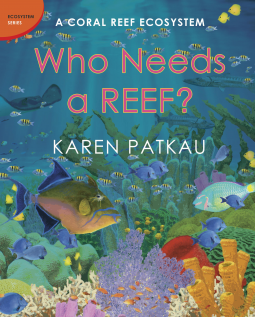
Review: Who Needs a Reef? A Coral Ecosystem by Karen Patkau

Who Needs a Reef? 
A Coral Ecosystem 
by Karen Patkau 
Random House of Canada Limited 
Tundra Books 
Children's Nonfiction

I love these Karen Patkau books. They're well written--lean sentences with zip:

"Crunch, crunch, crunch." A parrotfish munches on the algae-covered corral. Sea snails graze on it, too....
A triggerfish pokes at a starfish that is prying open a clam. 

The books are also well illustrated and explained. How does a coral reef form? What kinds of plants and animals thrive in this peculiar yet teeming ecosystem? How do nutrients and energy flow through the system? What kind of climate impacts it? How do reefs protect beaches and harbors? What can damage a reef? How do reefs improve human life?


The books also include a glossary and further explanations for the inhabitants that occupy the coral reef ecosystem.

These books are sure to enthrall the special science nerd near and dear to your heart in your home or classroom.

Monday, June 24, 2019

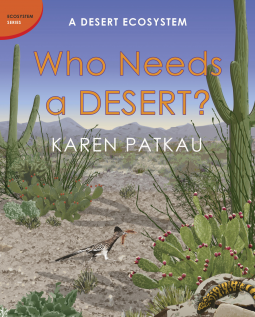
Who Needs a Desert? A Desert Ecosystem by Karen Patkau

Who Needs a Desert? 
A Desert Ecosystem 
by Karen Patkau 
Random House of Canada Limited 
Tundra Books 
Children's Nonfiction
These Karen Patkau books are a treasure. They're well written--lean sentences with zip:

The sun burns in a cloudless sky. Scrubby "Yip-yip-awoooo," howls a lone coyote. Plants, rocks and boulders are scattered. In the distance, another howls back.
The books illustrate and explain the core concepts well. How do plants and animals thrive where there's so little water? How do nutrients and energy flow through the system? What kind of climate impacts it? What can damage a desert?

The book also includes a glossary and further explanations for the inhabitants that occupy the desert ecosystem.

These books are sure to stun the special science nerd in your house or classroom.

Wednesday, February 26, 2014

Review: Don't Dangle Your Participle by Vanita Oelschlager

Don't Dangle Your ParticipleVanita Oelschlager, author
Mike Desantis, illustrator
Vanita Books

For some reason I thought of the dangling participle as a junior high/high school grammar topic. As author Vanita Oelschlager and illustrator Mike Desantis make clear, grade school students can learn the topic as well.

The book opens with a illustrated grammar puzzle:  What dangling modifer is presented by this picture? The cover also serves as a similar puzzle although it is not mentioned. The answer is supposedly on the author's website (I couldn't find it).

Next, it explains what a dangling modifier is and illustrates the possible humorous misunderstandings along with the correct understandings.  Following the explanation are several examples to reinforce understanding and potential pitfalls. Including the puzzles there are ten examples: eight explained, two that have to be figured out. It's nice that not everything is explained, but the book allows readers to work things out for themselves.

Profits from this book are donated to charities, especially toward multiple sclerosis, which the author's husband suffers.  From the site:
"VanitaBooks donates all net profits to The Oak Clinic for Multiple Sclerosis and other charities where 'people help people help themselves.' "
You can view a sample here.

Sunday, February 23, 2014

Review: Oddkins by Dean Koontz

Oddkins
A Fable for All Ages

Dean Koontz
Open Road Media
This was up for a Locus award.

Toy maker Isaac Bodkins gives toys life, the ability to come alive only for the children they serve, but they must pretend to be lifeless around adults. Before Bodkins passed away, he passes over responsibility to the toys to find the new toy maker before another group takes over.

Rex and an army of evil toys--robots, puppets, Jack-in-the-Boxes, and a switchblade bee--come alive and try to set in place a serial killer as the new toy maker so that their reign of terror on the hearts of children can return.

Isaac's nephew, Victor Bodkins, feels the pull to step out of his work, and to enter something different. As he drives around, he runs into the evil toys who attack him, and the serial killer himself. Meanwhile, the good toys, ill-prepared to attack like the evil toys since they are soft and without the evil toys' armaments, must fend off both the other toys and natural dangers in a world where they are only to be alive for their own children.

While this doesn't have the children-storytelling voice I mentioned earlier in "The Voice of the Children's Author", the characters have their charm, and the tale conveys the pacing, suspense, chills and thrills you'd expect in a Dean Koontz novel.

It's curious that this is subtitled, "A Fable for All Ages" since the characters are toys, albeit animal toys (According to the dictionary.com a fable is "a short story, typically with animals as characters, conveying a moral."). What's the fable's moral? It may be good vs. evil (helpfulness vs. indifference, violence vs. kindness), or technology versus nature, or some religious parable whose parallel is not readily apparent. You'll have to decide for yourself.

Friday, February 21, 2014

The Voice of the Children's Author

One of my chief pleasures in reading children's books is the authorial voice (or the book's storyteller voice), which tends to be different from adult books. I've examined a few favorite books to help nail down what it is.

Funny/Odd Character Names:
In Roald Dahl's Charlie and the Chocolate Factory, the grandparents' names match: George and Georgina, Joe and Josephine. In Neil Gaiman's Coraline, we have Miss Spink and Miss Forcible. Sometimes the other characters have odd names but not the protagonist.

A Childlike Voice of Amazement
The voice may use "huge" or "very" (Neil Gaiman in Coraline) or otherwise verboten adverbs and simple words of aggrandizement (Dahl again):
"The house wasn't nearly large enough for so many people, and life was extremely uncomfortable for them all.... The bed was given to the four old grandparents because they were so old and tired. They were so tired, they never got out of it."* [emphases mine]

*The Absurd, Odd or Surreal Not Remarked upon
Note there's one bed for four people, two married couples in one bed in which they stay all the time for being tired. I first noted this in L. Frank Baum's Ozma of Oz as a child. Why isn't the character or storyteller more amazed?:
" 'Over to those trees, to see if I can find some fruit or nuts,' answered Dorothy. 
"She tramped across the sand, skirting the foot of one of the little rocky hills that stood near, and soon reached the edge of the forest. 
"At first she was greatly disappointed, because the nearer trees were all punita, or cotton-wood or eucalyptus, and bore no fruit or nuts at all. But, bye and bye, when she was almost in despair, the little girl came upon two trees that promised to furnish her with plenty of food. 
"One was quite full of square paper boxes, which grew in clusters on all the limbs, and upon the biggest and ripest boxes the word "Lunch" could be read, in neat raised letters. This tree seemed to bear all the year around, for there were lunch-box blossoms on some of the branches, and on others tiny little lunch-boxes that were as yet quite green, and evidently not fit to eat until they had grown bigger. 
"The leaves of this tree were all paper napkins, and it presented a very pleasing appearance to the hungry little girl."

Stating the Obvious (or the Obvious from a Childlike Perspective)
Sometime the voice tells us what we already know (Neil Gaiman in Coraline), which is part of the charm (is it because nothing should be taken for granted?):
"It was a very old house--it had an attic under the roof and a cellar under the ground."
 Here's a famous Lewis Carroll line that some may or may not take to be true, yet it has a certain ring of truth even if you don't agree:
" 'What is the use of a book,' thought Alice 'without pictures or conversations?' "
 ***

I doubt this is any way complete, but it's what strikes me on a quick revisit of old favorites.

Wednesday, February 20, 2013

Review: The Long, Long Journey: The Godwit's Amazing Migration


The Long, Long Journey
The Godwit's Amazing Migration 
Sandra Markle, Author
Mia Posada, Illustrator
Lerner Publishing Group

The Long, Long Journey trails the godwit bird’s nonstop, 7,270-mile migration from its birth in Alaska to its arrival in New Zealand.  When the birds are hatched, the chicks hunt insects and parents keep them warm.  To fool predators, chicks blend in with surroundings and the adults swoop in to attack.  In a month the chick tests her new feathers and wings until she flies. 

The young stay with the father as the mother moves on, waiting for the young to strengthen.  Godwits migrate to mud flats to sup on worms and clams.  When they fatten and the weather changes, the long journey begins.  Falcons attack, but some live on, thinning and weakening.  At last they arrive at New Zealand mudflats.  The young godwits stay in New Zealand two years until they can make the journey back.

The appendix contains further reading (websites and books) and more specific facts.  A pleasant book, well-illustrated with simple paintings about an uncommon bird.

Tuesday, February 19, 2013

Review: How Do Hang Gliders Work?


How Do Hang Gliders Work? Jennifer Boothroyd Lerner Publishing Group
Who hasn’t dreamed of flying?  Jennifer Boothroyd’s How Do Hang Gliders Work? fulfills that dream vicariously and answers its title's question. I suspect the target age is K-3 with its simple sentences and large font, pointing out “The hang glider is high in the sky!”  Equipment vocabulary is listed without complication.  This pays off later when the text puts them into action.

Basic scientific terms like gravity and lift (including ridge and thermal) are introduced.  Concepts such as weight shifting the glider like a tire swing are brilliantly brought to the kid’s level, using objects kids are likely to have used or seen.

The appendix contains a diagrammed illustration, a glossary, an index, further reading (websites and books), and fun facts like hang gliders have flown for 400 miles.  Of course, I would have liked a little more explanation of lift (I suspect the higher end of the target grade levels could have handled it), but this book takes a technical subject and allows readers to feel they can go hang-glide immediately after.  Well done.

Wednesday, November 28, 2012

Book review: There Were Dinosaurs Everywhere!: A Rhyming Romp Through Dinosaur History by Howard Temperley


There Were Dinosaurs Everywhere!: A Rhyming Romp Through Dinosaur History
Howard Temperley Illustrations by Michael Kline
KWS Publishers
JKSCommunications
  • ISBN9781937783167
  • Price24.95
  • CurrencyUSD
  • EditionPaperback
Do you have a young dinosaur-lover in your home?  There Were Dinosaurs Everywhere! represents a light-hearted look at dinosaurs with Michael Kane doing an excellent job drawing compelling illustrations.  Despite the verse, the book is largely a nonfiction work, targeting those precocious ones with an unquenchable thirst for all-things-dinosaur.

The book treats early dinosaurs (evolution, Scutosaurus, Brachiosaurus, Lesothosaurus, Diplodocus, Barosaurus), finding them (fossils, paleontologists), flying dinosaurs (Microraptor, Incisivosaurus, Caudipteryx, Pterosaurs, Pterodactylus), dinosaur facts (intelligence, diet, digestion), sea dinosaurs (Ichthyosaurus, Liopleurodon), later dinosaurs (Velociraptor, Carcharodontosaurus, Styracosaurus, Parasaurolophus, Troodon, Euoplocephalus, Oviraptor, Tyrannosaurus rex, Ankylosaurus, Triceratops), and the end of dinosaurs.

The choice of verse as the method of presentation--as well as the subtitle's "Rhyming Romp"--might lead one to suspect a book of humorous verse.  Perhaps this is a symptom of reading Shel Silverstein.  Some poems are written as humor, others as non-sequitors, a few as moral compasses (eat your organic veggies), but most are just an alternate presentation of nonfiction--maybe with the design of better recall.  

Yet more humor might have given the book a longer longevity, no matter how low the humor.  It is written for young people, after all. And if adults are to read it, you'll want to give them something to take pleasure in, more than rhyme and illustrations.  However, the author does prove capable of humor:

This scutosaur is a sorry sight,
...It looks as if its life's a bore.
I'm glad I'm not a scutosaur.

The balance of fact and humor might have been too difficult to navigate.  Still, it is a book sure to please young dinosaur-lovers everywhere.