Search This Blog

Showing posts with label Ellen Klages. Show all posts

Friday, March 14, 2014

"The Green Glass Sea" by Ellen Klages

First appeared in Strange Horizons. Reprinted by Peter Straub's view of the new horror in Poe's Children. It was up for a Locus award. 

Dewey Kerrigan is sent to live with the Gordons in Los Alamos. Like her father, Dr. Gordon is scientist who has a girl, Suze, her age. They have a picnic to watch the bright flash that has something to do with "the gadget," whatever that was.

They drive out to a green glass sea, for Suze's birthday present. They select pieces as souvenirs.

Thursday, March 13, 2014

"Guys' Day Out" by Ellen Klages

First appeared in Sci Fiction.

Although recommended to institutionalize his mentally retarded son, Andrew keeps the boy, Tommy. Wheen Andrew takes Tommy fishing who needs explanation of simple things.

"Household Management" by Ellen Klages

First appeared in Strange Horizons. 

Underneath Sherlock Holmes' nose is the landlady who cares for the famous, highly observant detective. However, he does not see how she manipulates and pulls off feats and unpleasant deeds without his notice.

Wednesday, March 12, 2014

"Mobius, Stripped of a Muse" by Ellen Klages

First appeared in Portable Childhoods. Reprinted in audio. 

A character is about to get killed when... A future writer--first novelist in space--has stumbled against writer's block in the middle of his noir thriller... which is written a Thirties writer down on his luck... which written by... which is read by... which is...

A circular tale endlessly writing itself.

"Ringing up Baby" by Ellen Klages

First appeared in Nature. Reprinted in audio. 

A second grade girl wants a sister, someone she can boss around. Her mother's busy (and will give rearing to someone else anyway), so she gets to decide the traits. [Insert rubbing hand and maniacal laughter here.] 

Fantastic child's voice, thought-pattern, and imagination. Of all her plotless charm set pieces, this may be her best. Great ending. This may be the best story I've read in Nature.


Tuesday, March 11, 2014

"Intelligent Design" by Ellen Klages

First appeared in Strange Horizons. Reprinted by Jonathan Strahan's Year's Best and in audio -- twice. 

God invents the universe at his grandmother's house. It fulfills the promise of its opening quotation, through a child's eyes:
"If one could conclude as to the nature of the Creator from a study of creation, it would appear that God has an inordinate fondness for stars and beetles." —J.B.S. Haldane, 1951
 Although it sounds like it will hold up adherents to ridicule, apart from making God a child, it's actual more of a plot-less inventive charm centered around the quote than a slam on those beliefs different to the author.

"Travel Agency" by Ellen Klages

First appeared in Strange Horizons (no longer available online). Reprinted by David G. Hartwell and Kathryn Cramer's Year's Best. 

An aunt is excited by her niece's excitement to be staying in a proper attic, alone with a bunch of books. The aunt goes for her and finds she's traveled to another land "for a holiday," quite literally (literalizing the metaphor of what books do). The aunt is quite pleased although it remains slightly disturbing as well--whisking the child away without expression permission of the child or parents--which adds a dimension of deviousness to the tale.

Monday, March 10, 2014

"Echoes of Aurora" by Ellen Klages

First appeared in What Remains from Aqueduct Press. Reprinted in Strahan's Year's Best.

This tale builds on nostalgia for old things and mysterious stranger who nonetheless looks familiar. Two middle-aged women fall in love. As suspected, the stranger is magical and cannot stay. Although the plot takes a while to kick in, it's a bittersweet ending.


Sunday, March 9, 2014

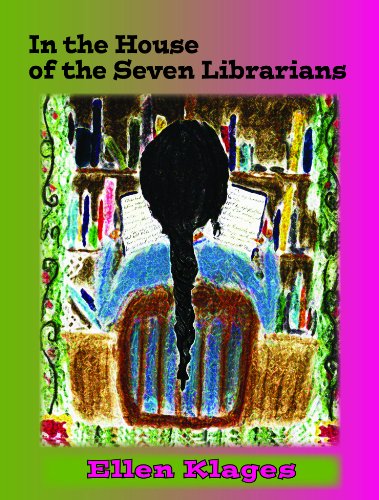
"In the House of the Seven Librarians" by Ellen Klages

First appeared in Firebirds Rising, an anthology of children's fiction. It was up for the Locus award. Reprinted in two year's best anthologies by Jonathan Strahan, Ellen Datlow, Gavin J. Grant, Kelly Link, and Rachel Swirsky did the audio. 

This story positively oozes charm, a Klages specialty: protagonists you care about. Bonus: a cool speculative library.

The beautifully built Carnegie library is abandoned for new technology. Seven librarians are left behind with this forgotten library and one day a child is left with them. She grows up among the spinsters in a library that fulfills wishes (a teddy bear, if well used), hides readers in alcoves that disappear later, and bends time (or maybe the librarians aren't especially good at monitoring the days--they celebrate the fourth of July during a snowstorm).

The story doesn't gather steam until the librarians want to hand the keys over to the new girl as another retires because she cannot reach the shelves any longer.  But she wants to witness the world before taking over, first.


"Basement Magic" by Ellen Klages -- Addendum added

This first appeared in Fantasy and Science Fiction, won a Nebula award, and was reprinted by Kathryn Cramer, David G. Hartwell, Gardner Dozois, and Paula Guran.

Klages does a fine job building our sympathy for an adorable girl, Mary Louise:
"[Mary Louise] closes her book and tucks Bankie securely under one arm. She follow Ruby down the wide front stairs, her small green-socked feet making no sound at all on the thick beige carpet."
Mary Louise's father is absent and her new stepmother, Kitty, is cold. She hires Ruby as a maid. Ruby takes an immediate shine to Mary Louise, making grilled cheese sandwiches. When Mary Louise has problems with Kitty, Ruby solves them with simple household items that protect Mary Louise and makes Kitty's hair fall out. This only serves to make Kitty angry, so that Mary Louise needs more protection. Ruby teaches what she knows, but one day Kitty finds the alcohol cabinet unlocked and blames Ruby, firing her.

Spoiler: A protection Mary Louise made electrocutes Kitty.

Did Kitty deserve death? Who caused the death? The child, the teacher, or the magic? These are the questions the narrative leaves me. Are these what I'm supposed to ponder? Kitty was not loving or especially generous, but not killing others and not even intending damage to others in so far as I can tell. This is far more than an eye-for-an-eye justice. Maybe this is intended as an accidental "The Veldt".

Addendum: In the comments below, John Williams astutely points out that Kitty may not have died. This is a critical possibility I overlooked, which may be true as she is able to howl. If true, this would eliminate a serious ethical problem although new questions arise.

The good news is that Mary Louise is able to use her basement magic on her own, it appears. The bad is that she uses it to run and hide. At this age she may be able to do no more. Therefore, she needs a spokesperson to speak on her behalf. Negotiations.should be opened. Granted, the stepmother has powers over the child (as do all parents), but so does the child over the parent. While children make good points adults ought to consider, often their perspective is skewed, limited to themselves. Having power without perspective may cause her to torture her stepmother--as we've seen.

The best scenario, seeing that cruel punishments have been meted out to the stepmother, is to keep Ruby and work things out. They'd need to concoct an explanation for why she was in the liquor cabinet that needn't involve magic: i.e. "Sorry, it was me. I was playing in there, but I saw you in there, but I didn't drink anything. Please don't fire Ruby." Come up with some agreed upon compromise. After all, the child shouldn't be in the liquor cabinet. Besides Ruby could use a good recommend if she is leaving.

Anyway, negotiations should be exhausted, and if Kitty is cruel and deserves punishment, she shouldn't have married in the first place. Maybe she didn't know she didn't work well with other people's children (or children, period). As someone who works with and cares for other people's children, it's easier to see this character needs more voice.  By the way, I am glad this wasn't a plain and simple bad stepmother.

Thursday, September 26, 2013

Links on Success, Short Sentences, Starships, Campus Novels and Quantum Physics

Malcolm Gladwell on success (I could listen to this guy for hours)

A success story:  "Donal Ryan, a civil servant from Limerick, Ireland, wrote two novels. He sent them to agents and publishers and got back 47 rejections over three years [until two were published and one] made the cut for the Man Booker Prize long list."

Others:  Top internet stories of 2012--Story South's Million Writers:  includes Alan Baxter, Christopher Barzak Justin Howe, Molly Gloss, Ellen Klages, Yoon Ha Lee, Mari Ness, Christie Yant,  Caroline M. Yoachim, among others.

The success of having friends write you into novels.

On the success of the short sentence.

Thursday September 26th 12 noon PDT / 3pm EDT Geoff Landis, Physicist and Science Fiction Author and Allen Steele, Award Winning Science Fiction Author, will hangout with SETI Institute scientists Cynthia Phillips and Franck Marchis (host & moderator) to discuss on the Starship Century book and symposiums dedicated to the exploration of our galaxy using a starship

50 campus novels

Quantum Physics:

Thursday, January 10, 2013

"Household Management" By Ellen Klages

Strange Horizons, 02 November 2012

online

What was a certain landlady like--landlady of a famous detective?  Might she be up to more than an excitable old lady?