Search This Blog

Showing posts with label Robert Bly. Show all posts

Sunday, March 14, 2021

"Fair Game" by Howard Waldrop

Note: Photo found on HuffPost, unattributed. Image search turned up no attributions.

Story first appeared in Pamela Sargent and Ian Watson's Afterlives, reprinted by Gardner Dozois (his 4th annual Year's Best--and probably the only way to get Waldrop a few cents for reading this story) and Robin Wilson. Was up for a Locus award.

Summary:

Ernest Hemingway is in Bavaria when a village bürgermeister calls upon him to hunt down the Wild Man wandering the area, causing havoc.

Analysis (spoilers):

Ernest kills the Wild Man and discovers the man he hunted is himself.

[Side Bar: Ken Burns is debuting a documentary on Ernest Hemingway next month, so this story is timely. I'm optimistic it will be rich and dynamic, instead of stuffing a straw man.]


Without context, Waldrop's story seems to suggest that Hemingway needed to kill himself as he may have been upsetting the environments he was in. The title "Fair Game" suggests that perhaps, the only "fair game" is the death of one's self; however, the author fishes, so that cannot be the whole story.

Let's add context. First, the story was written specifically for Sargent's and Watson's anthology Afterlives, which has the subtitle "Stories about Life after Death." So Hemingway is already dead. The story leaves what may be hints: "hovering mountains" which may or may not be figurative. Perhaps he is paying penance for committing suicide, so he has to kill himself again and again. Perhaps this is a "fair game" with game meaning both the hunted and a sport.

We also need to look at the "wild man" figure from mythology.

One thing not to include (unless Robert Bly had been famously doing Iron John tours a half-decade before he wrote his Iron John book) is Bly's version of the wild man from Iron John. There Bly suggests that men need to embrace their inner wild man. But perhaps Joseph Campbell was saying similar things. Avoid misreadings like this one from The New York Times. The book, though, is problematic for my reading. The longer Bly hypothesizes, the less I buy into his theory (see my take-down of The Little Book on the Human Shadow--my feeling is that creative genius like Bly's is sometimes born through strange ways of thinking. See also William Butler Yeats.) though I'm sure many men would disagree. Instead, I recommend his anthology, Rag and Bone Shop of the Heart, which is far less theorizing--just a little theory backed up with ample illustration from literature across the ages. The more Bly shows what he means instead of describing, the more I dig his ideas.

Searching for Joseph Campbell, I found this interview with Bill Moyers from 1981, which Waldrop could have watched and internalized--regarding Gilgamesh's grief over pending death of Endiku, the wild man whom Gilgamesh befriends and whom Gilgamesh tries to save by seeking the elixir for immortality:

"what it says to me is that man knows that there is an eternal life inside him, because the going into the depth, there is always the going down until he finds the thing in oneself."

Unfortunately, the wild man [Wiki] has come to mean several things over the millennia, so it's difficult to narrow down, let alone nail down exactly what Waldrop is getting at in this story. A few possibilities:

  • loss of civilization
  • to be alive (via forest)
  • wisdom (which one gains by losing civilization--people would capture and tie up the wild man and would not give him his freedom until he revealed his wisdom)
  • abandoned person/orphan
  • amazing, strange
  • etc.
Perhaps the story suggests that, by killing himself, Hemingway lost his aliveness/vitality although it was probably the other way around. Maybe Waldrop did it the right way: First, the wild man is killed; next, he learns that the wild man is himself. 

Another possibility in killing Hemingway is the writer is killing the previous god so they don't have to wrestle with him. James Gunn used to say that Hemingway said that writing was like getting into the ring with Tolstoy. However, the only ring/Tolstoy quote I found attributed to Hemingway was that he would not get into the ring with Tolstoy. Whatever he said, there is a certain amount of anxiety writers feel about the great writers (see Harold Bloom), so maybe his death here is a writer's way of getting into or not getting into the ring with Hemingway.

As fun and provocative as the story is, it seems to fall short. It might work at a longer (novella) or a short-short length. A writer should have to wrestle with Hemingway and his achievements, especially in a story so built around his biography--as well as wrestling with suicide. The story shows potent promise, but we need more.

I will discuss/speculate on a related, Arthur-Conan-Doyle-and-Hemingway connection later.

Waldrop on Style
The Robin Wilson anthology, Paragons, includes a paired essay on style (mostly about literary chameleons), but I don't think it aids one in reading this story. The best piece on Waldrop's writing is probably Lewis Shiner's introduction to Strange Monsters of the Recent Past where this story was collected.  However, I do highly recommend his story notes. They're just fun reading and indirectly give more insight into the man's voice, style, and sense of humor.

Thursday, May 18, 2017

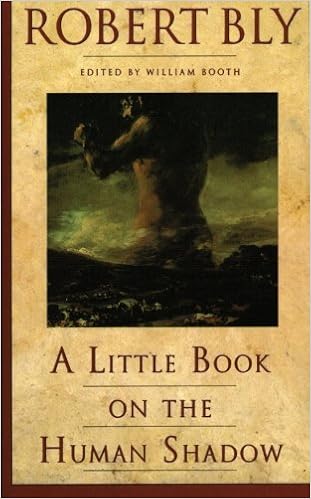
Review: A Little Book on the Human Shadow by Robert Bly

Had I known what kind of book this was, I might not have bought it. But then again, I might have. It is a strange hybrid on poetry, writing poetry, myth (fairy tales--not in the pejorative sense, but I'm sure some would like to apply that as well), self-help, and pop psychology. Clearly, Bly saw a deep connection between all of these things, and part of the appeal is how strongly integrated he views them. He takes the entire field of poetry (especially Wallace Stevens) to task for not using these ideas as he has. Most writers consider their field of study as pointless. See my review of David Orr's Beautiful & Pointless, so it is gulp of cool water in so vast a desert to come upon Bly's drinking trough.

Note: I do not tend to write glowing reviews. I try to steer away readers who would dislike such a book. Most books, like humans, are flawed and sometimes those flaws are part of the appeal. I hate to state this over and over for every review, though.

I also bought the audiobook that followed after this edition. It is always curious to read (or hear) how a writer revises his work after second and third thoughts. Bly is uncannily honest and states in the audio that his work has truth and lies, but he doesn't know which is which.

There is a great deal of useful information in here, and a little that rings less useful. The overview: Bly asks that people find balance in their writing and their lives. We have a tendency to blame our failures on others, but Bly states we should take ownership, pull out the aspects of our personality that we've hidden away, and develop our lives fully.

First, a definition, if possible: The shadow is the darker side of ourselves, which we need to embrace. The shadow is not evil, Bly said. Following Bly's definitions requires paradigm-shifting, not to mention accepting squishy definitions.

The book is divided into five sections:

  1. Problems in the Ark. This details the author's own experiences in finding his shadow and dealing with it in his poetry. Later, he points out that some of the things he hated in others (Alexander Pope, businessmen) he had in himself, and he had to accept this before he could appreciate such men. Paradoxically, he mentions politicians he also hated (or at least he suggested he did), so perhaps this is a never-ending process.
  2. The Long Bag We Drag behind Us. Society tells us to hide certain aspects of ourselves. These aspects (the feminine, the masculine, the witch, the giant, the shadow, among others) we hide in a bag and drag it around with us.
  3. Five Stages in Exiling, Hunting and Retrieving the Shadow. We start at birth and, say, hand our witch to our mothers (who expresses it for us) and later hand it to our wives. The witch is what allows us to get what we want. We need to retrieve this by asking for these missing parts back.
  4. Honoring the Shadow. This is an interview with William Booth, the editor, who gets Bly to expand on ideas he mentions only in passing earlier, such as eating one's shadow, etc.
  5. Wallace Stevens and Dr. Jekyll. Bly believes the personality is also a part of the poet and needs to be examined as part of a poet's oeuvre. Stevens, Bly says, brought out the shadow in his poetry, but never lived it out in his own life, so the gifts of the shadow were wasted on Stevens and this shows up in Stevens' late poems.
The positives of the book outweigh the negatives. The main positive is asking people to face themselves, instead of shifting responsibility on others. This could also be a negative since people often create or contribute to a problem, but at some point, we must realize the person who may have done damage doesn't care, and we must work through issues for ourselves. One can read an abundance of poetry where that is its primary failing. It keeps stumbling over the flaws of others as if that were one's only failing in life: other people.

This is where Bly's methodology steps in and tells you to ask for your missing parts, the aspects of yourself you gave away. I keep imagining how this might play out in real life: the puzzlement on the other person's face. 
"Hey, give me my witch back." 
"You want your what? 
"My witch!"
"Oh. Okay. If you lost your witch doll, I'm sorry, but I don't have it."
Still, it is a physical statement, a stance that makes the metaphor real, which is both good and bad. The good is that you are telling yourself that you are changing. The bad is that it is a metaphor:
"Projection without personal contact is dangerous. Thousands, even millions of American men projected their internal feminine onto Marilyn Monroe. If a million men do that, and leave it there, it's likely she will die. She died."
It may be within the realm of possibility that that is why she died, but it seems doubtful. Unless she were part of a hive mind, she probably had her own issues. One of the measures that some poetry readers use to decide the quality of a poet is their personal mythology. It seems likely that Bly's is unique, so maybe he'll remain within the canon for centuries to come.

Unfortunately, Bly does judge Stevens by a measure that maybe Stevens had not considered or might have rejected as part of his poetics. All humans are problematic, so to judge one because he does not follow your aesthetic is dubious at best. If we had a time-traveling recorder to mark our every misstatement, we would all be exposed as cruel. This is where David Orr's "pointless" perspective on poetry gains legitimacy.

No matter. A Little Book on the Human Shadow has plenty to recommend it. The audiobook is similar, covering overlapping territories, but it goes a little further into fairy tales and skips much of the later discussion found in sections four and five of the book. I do recommend both but with caveats, We should be examining our various aspects of personality we may be leaving out.

What book doesn't require caveats? Maybe that is the  measure of a book that takes risks. Flaws are, after all, where the personality shines through.