Search This Blog

Showing posts with label Donald Wollheim. Show all posts

Thursday, December 24, 2020

James Gunn (July 12, 1923 – December 23, 2020)

 James Gunn was a science fiction writer, an educator, an advocate for science and all points between. No one quite codified the field as this man did. His life spanned nearly a century: from flappers to the Depression and WWII, to the economic boom of 1950s (including the proliferation of SF magazines) to Vietnam and counter culture, to the New Wave to the Cyberpunks, all the way to the present. He'd seen much.

He started in radio and moved to SF, publishing in Startling and Thrilling Wonder Stories in 1949. Considering the flowering of the field, it was the perfect time to enter. His first big sale would have been the next year to John W. Campbell's Astounding,  the leading SF magazine of the time, and in Amazing, the oldest SF magazine. 

Comparatively, it was a strange time to publish SF. Novels were not as common as the magazines, so one could find a home for their stories and later reassemble them into novels. Once the book market opened a lot of writers did that, so that it seemed the best way to make novels (Ray Bradbury's Martian Chronicles, for instance, was sold as a novel, but was really just a collection). 

Throughout Gunn's career, this was how he often built novels. He considered the novelette the ideal length for SF, and would publish them first in the magazines, later as a novel. Sometimes the stories were more successful as stories, sometimes as novels. Usually, the first story in the series got him the most attention. Examples:

  1. "The Cave of Night" opened Station in Space and was reprinted by Judith Merrill and Isaac Asimov as among the best of SF published that year.
  2. "Child of the Sun" opened Crisis! and was reprinted by Arthur W. Saha and Donald A. Wollheim as among the best of SF published that year.
  3. "The Listeners" of the novel The Listeners was up for the Nebula award and reprinted by Poul Anderson as among the best of SF published that year. [The novel was the runner-up for the Campbell award]
  4. "The Giftie" of the novel Gift from the Stars was up for the Sturgeon award and won the Analog reader's poll.
The novel The Immortals is sort of an exception where Barry Malzberg thought the opening novelette, "New Blood"  was an important work of the 50s, where as Isaac Asimov thought "The Immortal" was an important story of the year. It became a TV series of the same name. If you want SF built for fun, this is probably the best place to start.


"Breaking Point" from the collection of the same name is another starting place if you like short stories. It's a kind of Twilight Zone in space, if memory serves. Brian Aldiss collected it for his Space Opera anthology.   

While he wrote fun stuff, his main aim, it seemed to me, evolved until his goal was to make SF realistic. How might it really happen? He liked the fun stuff, but he wanted to make SF serious (contrast this with the image above--fun, absurd, and perhaps helpful for sales off the magazine rack, but it undermined the serious intent that some wanted to invest in the field).   

He won a Hugo for his scholarly book about Isaac Asimov, Foundations. Asimov's SF, the magazine, will be publishing the last story he wrote next year. They also have an essay about religion and SF. The marvel of Jim Gunn--one of the reasons many called him a gentleman--was that everything was up for discussion, in person, in stories. You could disagree with him, and it did not affect your friendship. It will be good for humanity if we could have more of his kind on the planet.

I studied under him several times both online and in person: to learn about SF and stories. When it came to SF, his advice was always wise.

I restarted his online classes, and he tasked me to round up students. To make it happen, I had to use myself twice, once as myself and once as a pseudonym. I divided my artsy self from my science-y self and wrote SF and speculative stories. I varied my critiques, likewise. My critiques for myself, which might seem to be tricky, weren't too hard as they described what I intended to do in the next draft. I pulled off the pseudonym so well, that when I admitted to what I'd done, he didn't believe me. I pointed out that I paid for "both" students, which I think I must have originally explained that "he" didn't have a checking account. Electric Velocipede, a fun little zine sadly no longer in print, published the story under my real name.

I reviewed a number of his works over the years and interviewed James Gunn here.

If new memories occur to me, I'll add them here, later. 

    Saturday, May 3, 2014

    "Give Her Hell" by Donald A. Wollheim

    First appeared in Two Dozen Dragon Eggs.  Reprinted by Martin H. Greenberg, Terry Carr, Isaac Asimov, and Al Sarrantonio.

    Rather odious wife- and child-beater and domestic tyrant makes a deal with the devil.  His daughter ran away, his wife left him for his business partner (for shelter) and is about to get custody of their child.  So he makes the deal to put both women in their places, plus he gets use of a new life after his has gone.  He pays of asylum doctors to shock and generally mistreat his daughter.

    *Spoiler* He's reincarnated only into past lives--this time as his daughter.

    Clever plot.  Title gives double play, literal and figurative.

    "Storm Warning" by Donald A. Wollheim

    First appeared in Future.  Reprinted (once in a genre retrospective) by Groff Conklin, Robert Silverberg, Terry Carr, and John Gregory Betancourt.

    The narrator and Ed, meteorologists, head out to Wyoming to check out a meteor and unusual storms, one after another.  The researchers discover glass globes instead of a meteor and strange, vegetative air you'd smell on a warm day... except it was cold.  They spy something glassy a ways away.

    *Spoiler* The meteors are glass bubbles, leaking alien air. Aliens are converting our atmosphere into something more comfortable for them.

    Funky fun speculation:  The tale proposes water as a source of life, rather than an excellent solvent and transport medium.  Earth's air and this alien air duke it out for supremacy.  Perhaps this is the source of storms, epic battles waged without our knowing.  The science is a little wonky although maybe less so when it was published.

    The story ends on "That's what I think." which is either a blemished ending or calls into question what's been said, which makes sense for the odd science hypotheses, but then it's hard to tell what occurred otherwise.  If there's an unreliable narrator, some alternate theory (theories) should be supplied.


    Friday, May 2, 2014

    "Top Secret" by Donald A. Wollheim

    First appeared in Fantasy and Science Fiction.  Reprinted by Groff Conklin, Terry Carr, Robert Weinberg, Stefan Dziemianowicz, Martin H. Greenberg, and John Gregory Betancourt.

    At a government building, the protagonist runs into a trio of aliens in slouch hats.  He picks up a coin and insinuate that the space program has been more successful than he thought.

    While minor, this story might gain more power rubbed against "Mimic", his best story, which also had beings in slouch hats.  You'd get a darker flavored Men in Black.

    "The Haters" by Donald A. Wollheim

    First appeared in Unknown.  Reprinted by Martin H. Greenberg, Terry Carr, and Isaac Asimov.

    A man sends off to Africa to hate his enemy to death so that he loses weight, goes into a coma and dies. However, the man's check is going to bounce...

    Lots of revenge and comeuppance in Wollheim's work.


    Thursday, May 1, 2014

    "Malice Aforethought" by Donald A. Wollheim

    First appeared in Fantasy and Science Fiction.  Reprinted by Judith Merril, Martin H. Greenberg, Terry Carr, Isaac Asimov.

    Clever story about writers and where their ideas come from. Writers Allen San Sebastian and Marvin Dane are often confused by fans as they wrote similar material.  Trouble grew worse for Sebastian because Dane was the faster writer. The editor at Grimoire rejected his stories when Dane turned in something very similar, earlier.  The editor insinuates that Sebastian has been seeing Dane's work. Sebastian is furious, but there's no way that either could have seen the other's work.  He toys with the theory that writers pluck ideas from a common ether.  Since Dane is the faster writer, Dane will always have the drop on Sebastian. How can he take out his rival?  Not murder but...

    *spoiler* by copying a famous horror story by H.P.Lovecraft:  "The Rats in the Walls".  The editor, who isn't as well read as his readers, publishes it and hears an outcry against plagiarism.  Dane never writes again and Sebastian can pull ideas from the ether without worry of Dane's competition.

    Wednesday, April 30, 2014

    "The Rag Thing" by Donald A. Wollheim

    First appeared in F&SF.  Reprinted (once in a major genre retrospective) by Groff Conklin, Terry Carr, Martin H. Greenberg, Isaac Asimov, Al Sarrantonio, Robert Weinberg, and Stefan R. Dziemianowicz.

    Landlady leaves her "cleaning rag" out (presumably, it is not a rag) last November.  The landlady turns off the heat too soon in March, so that the rag seeks out warmth.

    Once again, we have the misunderstood single man in the apartment.  This time he set his apartment ablaze, but why?  They chalk it up to careless smoking in bed.  A new woman buys the boarding house....

    Perhaps this explains why landladies shouldn't turn the heat off too soon.

    Analysis of "Mimic" by Donald A. Wollheim

    First appeared in Astonishing Stories. Reprinted--in a few major genre retrospectives--by Alden H. Norton, Mary Gnaedinger, Chester Whitehorn, Robert Arthur, Terry Carr, Bill Pronzini, Barry N. Malzberg, Isaac Asimov, Martin H. Greenberg, Stefan R. Dziemianowicz, Robert Weinberg, Brian Thomsen, Steven Utley, Michael Bishop, Jeff VanderMeer, and Ann VanderMeer.  Made into a movie directed by Guillermo del Toro.  Read online.

    Fascinating use of plot structure and societal prejudices.  The plot relies on an unusual structure for its effectiveness.  It begins with nonfiction, then delivers the speculative content in a narrative manner although the narrator isn't heavily involved in the tale except as an observer.  Nonetheless, it delivers quite a creepiness punch as the narrative closely parallels the nonfiction.

    First, it tallies off all of humanity's recent discoveries to say how little we know about the world we live in (raise credibility for the incredible that's to come).  Next, it describes mimicry in nature, how various insects have used it, how it's used to protect itself by looking like something dangerous. Third, we are introduced to a solitary man who clothes himself mysteriously in slouch hat and coat, keeps to himself, draws himself up short when women pass, and makes strange noises in his apartment.  Finally, the narrator and police let themselves into his apartment after a time when he doesn't show.  He's passed away....

    Spoilers:

    As you may have guessed, the single man/recluse is an "it."  Various parts are made to look like normal human parts, i.e. wings are his coat, etc.  If that's not creepy enough, the best is saved for last:

    The creature has had babies.  When they open a box, out fly a bunch of little men creatures into the night.   And the narrator--no one else--spies a creature in the shape of a chimney, peel off a roof and pursue the little men.  Cool.

    I haven't investigated Wollheim's initial claims for the example creatures of mimicry in nature, but his point remains the same.

    What's most fascinating is a hidden assumption within the text.  As a single guy who's lived in tiny towns, where residents are so bored they make guesses about your sexuality (decorated on desks, whispered to you by preschoolers, newly placed chairs propped next to your bedroom window), how intriguing it is that the single man is a mysterious alien creature whose motives are impossible to fathom.   He was and apparently still is--at least in some areas of the US.

    Sunday, June 9, 2013

    "Hawksbill Station" by Robert Silverberg

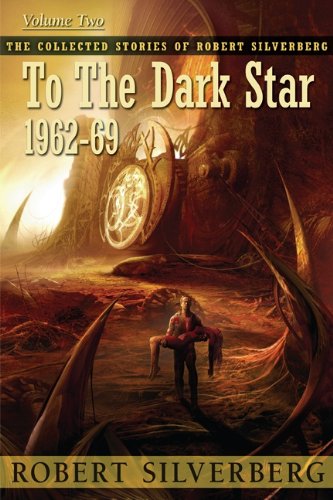
    Collected in To the Dark Star: 1962-69, it first appeared in Frederik Pohl's Galaxy, reprinted in both Donald Wollheim/Terry Carr's and Brian Aldiss/Harry Harrison's Year's Best anthologies.  It was nominated for the Hugo and the Nebula awards.  It is Silverberg's first story to capture award nominators' attention.

    Because time travelers can only go backwards, the government has placed their troublesome, male revolutionaries in the Precambrian where they cannot create time paradoxes, accidentally destroying an evolutionary ancestor.  The former revolutionaries go a little crazy without anything to do or females to spend their time with.  One actually "creates" a woman out of mud and grass.

    Our hero is Barrett, "the uncrowned King of Hawksbill Station," due to his length of stay, mental stamina, and size although he became crippled after a rock slide, eroding his power somewhat--at least in his mind.  They keep hoping for a female although one never comes.  Lew Hahn arrives and everything changes.  The men get suspicious as he cannot explain his.  Stranger still, he's been taking damning notes on everyone at the station, saying it ought to be gotten rid of.  The men consider him a spy and watch him carefully... until he disappears.

    This is truly a significant work:  the power in one's powerlessness, the search for importance and the fear of losing it even when you'd suspect that one's position should be anathema.  These themes create a potent tale.  The novel doesn't work as well as the stir-crazy aspects and crucible conditions get lost (although it has its own appeal).

    The plot-pivotal character, Hahn, probably should have been a psychologist and his assessments not so quickly lost--or at least misinterpreted.  However, this does not erode the power of the novella because this is Barrett's tale--his effort to hold the station together, come what may.