Search This Blog

Showing posts with label Michael Skau. Show all posts

Monday, May 8, 2017

Interview with Michael Skau, pt 1

Image result for michael skau
Michael Skau is a professor emeritus at University of Nebraska at Omaha. He has written critical works on the Beat poets. He has one book, Me & God (reviewed here), and one chapbook of poetry published, with two more collections on their way. Part two of this interview appeared here.

*

Part 1 - Beginnings

When did you first start writing poetry?

I first started writing poems when I was in high school, but actually what I was writing then was more verse than poetry. I would be embarrassed now to have anyone see what sappy, simplistic, and self-indulgent doggerel I wrote back then.


Did you always want to write poetry or did other creative forms call your attention first?

Poetry was always my favorite genre, though I have occasionally flirted with fiction, probably because my poems have a tendency to lean more toward narrative rather than toward image. Story and humor are like the poles of a horseshoe that attract my creative filings.


Who are some of your literary models?

By literary models, I suppose that you mean writers who have most influenced me, a factor which is always difficult to ascertain. Instead, I guess that I would cite the poets whom I most enjoy reading--William Butler Yeats, W. H. Auden, William Blake, Percy Bysshe Shelley, John Keats, and Emily Dickinson.


Why the Beats?

When I was a Teaching Assistant at the University of Illinois, I was assigned an experimental course, a Freshman English class taught in the lounge of the dormitory where the students lived. My assignment came too late for me to have ordered books for the class, and so during our first class meeting, I asked the students what they were interested in reading and writing about. At that time they were all interested in the Hippies and wondered where they came from. I explained a little about the Beat Generation, about whom I had limited knowledge myself, and the students decided that they would like to read and write about the Beats. As the semester continued, I found that I really liked and appreciated what the Beats were doing, and so I decided to write my dissertation about them: Jack Kerouac, Allen Ginsberg, William S. Burroughs, Lawrence Ferlinghetti, and Gregory Corso.


Did you have mentors to help you along the way, or were you formed from the head of Zeus?

I was certainly not sprung from the head of Zeus; perhaps, however, from the head of Seuss. I did not have any mentors actively working with me as I began to develop in small ways as a poet. In fact, only recently have I joined a writer's group to share my poems in progress. On the other hand, I did extensive research on poets and poetry from the pre-Romantics to the present, English and American, for the courses which I was teaching. In other words, I read a lot of and about dead white male poets--and learned a lot from them.


What do you think of the writer's group: help or hindrance?

The writer's group is able to point out problems that I may be too close to the poems to see. The group provides me with some objectivity and distance that often help me to re-view the poems. This is usually very valuable.

Clearly, you wrote and published poetry while you taught, but you had just one chapbook published. Now you have more books forthcoming. Did teaching limit your writing, and now you're making up for lost time? Or were you writing and published all along, and are just now collecting your back catalog poems into books?

Yes, I definitely feel that teaching (mostly the grading, but also the class preparations and committee work) limited the time and energy that I could spare for writing poetry, especially for finding appropriate outlets to which I might submit. I had published about a hundred poems in various periodicals before I retired. I have been collecting some of my older writings, but I am not just recycling. I am also exploring new avenues for my writing. For example, of my latest publications, two of them were written to celebrate the late musical genius, Prince, and I have just had a poem accepted today to celebrate the late master Leonard Cohen. As with many other poets, I also find myself gravitating lately toward poems of social and political protest.


How do you feel about this process? How do you decide the order poems should be in a book?

I have no problems with the process of compiling collections of previously published poems or of creating new ones. My poems often seem to have a narrative thread to them, and so ordering them is a lot easier than it might otherwise be. One whole section of Me & God involves a road trip, and so I used a geographical organization for that section. Elsewhere, I structured the organization on my imagined development of the relationship between the primary characters.


What's the process of book publication like for you? How did your first chapbook come about? your first book?

After hearing me read some of my poems, the wonderfully talented Denise Brady invited me to submit poems for my first chapbook, Me and God Poems, which she crafted into a beautiful hand-set chapbook collection in 1990. I had continued writing poems in that series, and one of the new ones, "Pinballs," was selected by Jim Reese as Paddlefish's Winner of the 2013 William Kloefkorn Award for Excellence in Poetry. Jim suggested that I try to find a publisher for the entire collection, and he mentioned Wayne State College Press, where Chad Christensen accepted the volume and helped to shepherd it toward its final publication.

Saturday, May 6, 2017

Interview with Michael Skau, pt 2

Michael Skau is a professor emeritus at University of Nebraska at Omaha. He has written critical works on the Beat poets. He has one book, Me & God (reviewed here), and one chapbook of poetry published, with two more collections on their way. Part one of this interview appeared (or will appear) here.


*

Part 2 - The Work

Is publication something you pursue like a rabid dog, is it just mad pleasure, or is it like standing on your head trying to stack BBs?

For me, publication is a very strange animal, a platypus. At times I go for a year without a single acceptance. Then all of a sudden I will have 4-6 poems accepted within a couple of months. I do not know how to explain why publication works in phases like this for me. Sometimes I go for a year or more without sending off any poems, but I keep on writing anyway. I guess that the completion of poems is often satisfaction in itself. On the other hand, publication is important for me too, serving as both a testimony to my efforts and a spur to keep on writing. It is all very confusing to me.


How does a poem come to you? How do you get it into a shape that pleases you? Do have an example?

I honestly do not know how to explain the genesis of a poem. Sometimes, I get an idea that I would like to explore; sometimes, the beginning is just a line or two; at still other times, the poem arrives almost fully formed. I wish I knew the process because I would much prefer the poems that arrive needing only some minor tooling. I could give you an example of how a poem takes shape by looking at the way that the first poem in my book, "Pinballs," developed. The poem is written in loose iambic tetrameter. I knew that I wanted to do a poem about pinballs (I even used to own a pinball machine) and me and God, and I knew that I wanted God to win, but not the narrator because the game corresponded in my mind to rebirth/reincarnation (thus, God plays a machine involving "Zeus and other myths"). I set the poem in a bar to suggest that we humans live in a world of darkness ("dark in the mid-afternoon"), finding fitful pleasure ("lit only by the blinking lights") only in intoxicants ("beer signs"), the arts ("juke box"), and the trivial enjoyment of electronic games ("corner pinball games"). God should have created us to be able to find more fulfillment in life, "but he wasn't / the type of guy you could tell what to do." The narrator has not been playing well, but finally has "a good last ball," yet he does not win "a free game." Thus, even if we recover from our erratic past and devote ourselves to "good" during the last years of our life, it does not matter ("You can't win on that machine"). We get no free game: no heaven, no rebirth, no reincarnation. Only God gets "replays." These were the ideas and details with which I was playing when composing the poem.


One of the things I love about your poems--if the review hasn't already made this clear--is their humility. They step outside of the frame to see the picture. The poet sees himself and the world and god, warts and all. My first question is how do you develop this skill? Does come naturally? Or is this emotion recollected in tranquility, as Wordsworth would have it? Or is this objective revision where the first draft is the mad passion and subsequent drafts resee the events dispassionately?

How dare you accuse me of humility! No, seriously, what you refer to as the humility in the poems probably comes from my inability to believe that I have all of the answers. In fact, part of the point of the Me & God collection is to raise questions rather than to impose answers. W. H. Auden has said that poetry is the "clear expression of mixed feelings," and I agree with him on this point. Part of the problem in our current society stems from people who feel that they--and they alone--have all of the solutions. We do not need such demagogues.


What is your perspective of the poem "Wind"?

The narrator's response is innocent and naive. If "a few... might consider it objectifying," I wonder how they intend to reproduce, and I pity them for being unable to appreciate the beauty of the human body which artists have celebrated from at least the time of Praxiteles up through the time of Picasso. I used to resent having to provide "trigger warnings" in my classes. Everyone has sensitivities and vulnerable areas, but education and society do not have the responsibility to warn against possibly irritating those bruises.


Why poems about God?

My Me & God poems were originally inspired during a period of spiritual questioning, when I was trying to discover sense and value in a world that had begun to strike me more and more as meaningless. I would not dare to pretend that I was suffering from the disabling despair of a "dark night of the soul." My difficulties were less like a profound hopelessness than like a nagging irritation.


Do you see your work addressing one religion or several?

[There are] references, to cite just a few, to the Arabic "gardens of Yannah" and "Nirvana" in the poem "Entropy," to "Mecca" and "Moslems" in "Beliefs," to the evocations in "Potters" of the the potter fable in the Persian Rubáiyát of Omar Khayyám, and the allusion to a line by the Zen master Rinzai in the conclusion of "Bruises." My objection is not to just the Judeo-Christian religions, but to organized religions in general. The thrust of these religions often seems to be "My Dad can beat up your Dad."


What books do you have forthcoming? What can you tell us about them?

I have a chapbook entitled After the Bomb due to be published by WordTech Editions in May 2017. The poems attempt to envision the conditions of a post-nuclear bomb and the efforts of the survivors to regain a sense of humanity. WordTech has also contracted to publish another chapbook of mine, Old Poets, in May 2018. This series of poems examines a variety of approaches to poetry, particularly in its themes and forms.

Thanks for the good questions.

My pleasure.

Thursday, May 4, 2017

Review: Me & God by Michael Skau

Me & God 
by Michael Skau 
Wayne State College Press

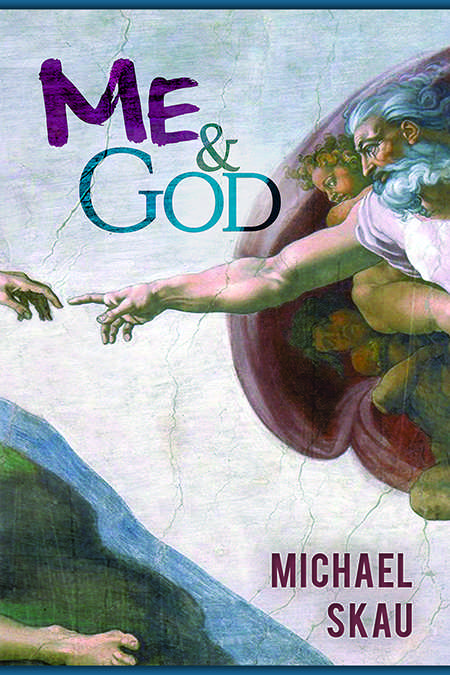
With a book title like Me & God, you might expect ambition, even a critique, if not irreverent humor from the colloquial "Me" (and placing it before God) and the cover. And you'd be partially correct. The poems, which should appeal to readers of Billy Collins and anyone who ponders religion, point up the humor ("When angry, he projected/his voice in surround sound" from "Muse"). However, overall, it isn't cruelly or vindictively irreverent. In an interview with Laura Madeline Wiseman, Skau states:
As for the use of foils, as my introduction indicates, “The God that I have fashioned for the poems is one whom I have created in my own likeness.” The advantage here is that I can invest the God figure with my own faults and flaws, and this makes criticism of him much easier. The disadvantage is that the poems encompass a God based on myself, a first person speaker (“I” or “me”) also modeled on myself, and I the poet, who is manipulating the other two: the process can be quite schizophrenic. I try to balance the scales here by sometimes giving God the upper hand, sometimes allowing the I or me to undermine God, and sometimes portraying them both as either right or wrong.
One suspects the primary model is the Judeo-Christian one, as the cover suggests. Yet the god in this book encompasses good and evil and thus mirrors more of the Greco-Roman gods. Combining this with the above quote creates an intriguing dynamic: Who is truly being critiqued? God or the self? The latter gains more weight if we have an agnostic approach. The reading becomes bifocal--with two simultaneous interpretations.

I don't mean to make the book overly intellectual but stimulating without mental gymnastics on the reader's behalf. The language is as clear as if the poet were addressing the reader directly. In fact, the temptation would be to dismiss it as simplistic. Listen to the poem on the video.  More underlies its seeming simplicity.

His stylistic preference is unsurprising as he spent years as university professor teaching the Beats. He has published book-length critical works on Lawrence Ferlinghetti and Gregory Corso.

His poetry is as accessible as work by Charles Bukowski while remaining thought-provoking. In "Pinball" God is racking up the points while Skau's persona is having difficulty:
Finally, I had a good game--
actually just a good last ball--
and turned the score over, but it never
popped for a free game. God had stopped
to watch me play, and I muttered, half
to the machine, "What do you have to do
to win?" God replied, "You can't win
on that machine."
Skau wrestles with God over unluckiness ("Pinball" cited above and "A Day at the Races"), troubles ("Soul-Making" and "Entropy": "Nothing/here is perfect, not even me.") and with his persona over ecology, dreams and vain imaginings (" 'I/am not to blame,' he answered,/'for what I do in your dreams.' "--"Dreams"), road rage ("Goodness": "'Because I said so,' he replied,/reminding me again of my mom."), relationships ("Marriage": "Don't/blame me for human mistakes"), etc. The poem "Fire" challenges both God and his persona.

Two of the more poignant works include "After Birth" where Skau's persona wrestles with the destruction of a new puppy born with a defect that will trouble it to its death, perhaps mirroring why God in "Potters" behaves this way:
Most of [God's pots]
were marred in one way or another:
crooked bottoms, ungainly torsos,
crude handles clumsily attached....  
Still God fired his pots in the kiln,
scratching his signature, "I AM,"
into the unbalanced bases.
He never kept his work, giving
away these luckless mistakes, imposing
the gift of responsibility on others.
One of the more fascinating works--possibly his most famous with a classic feel that often delights listeners at readings--is "Wind" from a 1980 issue of Laurel Review. It predates the 2003 Jim Carrey movie, Bruce Almighty, by twenty-three years. Wind lifts the skirts of a woman on the street.
"Wow," I said to God. "Did you see that?"
Slowed and hampered by the tightened skirt,
she soon let go and resumed her stride.
God turned to me, eyes atwinkle,
and asked, "Want to see it again?"
This elicits belly laughs from the audience, but possibly consternation from a few who might consider it objectifying. Should readers need a counter balance, they should dip into "Gender" where Skau's persona, like Tiresias, gets transformed into a woman and receives cat calls.

The targets in this collection vary; the humor is spot on with the right bite; and Skau provokes thought about religion and the self because if you don't believe God exists, who else can you blame? This should tickle the fancy of most readers on both sides of politics and religion except those at the extremes.

"Winter" could have ended this collection. Skau's persona and God saunter across the winter landscape, and the conversation turns to snow angels, Lucifer's sin, pride, and light. It concludes:
God became pithy: "Light
is a difficult honor to bear."
And then He pelts the persona with a snowball.