Search This Blog

Showing posts with label animal behavior. Show all posts

Friday, June 13, 2025

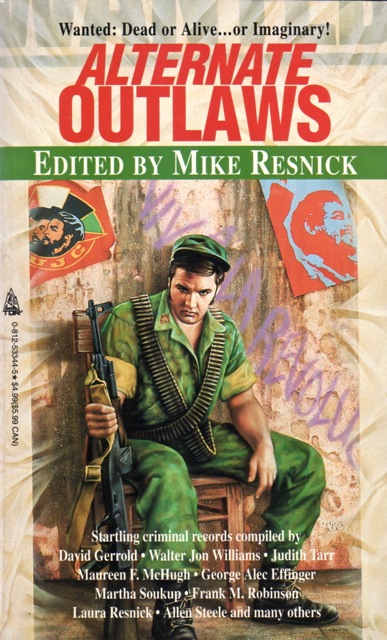
"Good Girl, Bad Dog" by Martha Soukup

 https://www.isfdb.org/wiki/images/8/8e/ALOT1994.jpg

First appeared in Mike Resnick's Alternate Outlaws


Summary:

This is the kind of story that begins in confusion, and it requires the reader to work it out. All I will say is that a boy and a dog get lost. 

Discussion (minor spoilers):

 I very much do not want to spoil this. Do read it if you can find it. If her other other stories sound interesting, you can find it in her one collection. If not, hunt down a used copy of the Resnick anthology.

The following make the opening confusing: 

  1. Who are the characters? 
  2. Who are the characters in relation to one another? 
  3. How well do they understand each other?

The story is told from the point of view of a famous dog who wants to change his life, to go wild. However, he's spent so much time as a dog of fame, that it is initially hard for him to adjust. The characters don't understand one another well, despite having some sense of each other. The dog does make a change--a rather surprising one.

This is a very different perspective from her story "Dog's Life," and serves as an interesting contrast. 


Tuesday, June 10, 2025

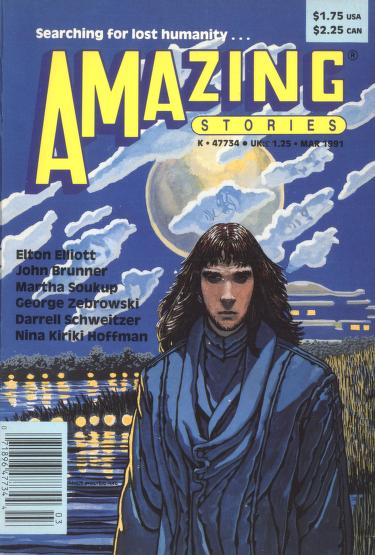
"Dog's Life" by Martha Soukup

https://isfdb.org/wiki/images/9/9d/AMAZMAR91.jpg 

First appeared in Patrick Lucien Price's Amazing Stories. Up for the Hugo, Nebula, and Locus awards. Reprinted by Fred Patten.

Summary:

 Herb, a large beige dog, and Wayfarer, a Siamese cat, demand independence from their owners.  The owners bristle since they feel they haven't been bad owners, but Wayfarer says:

"The time for talking is through. What reason is there for four-footed animals to be subservient to two-footed? It's slavery."

The pets walk out, but life is more difficult than they expected--at least, than Herb expected.


Discussion (with Spoilers):

 Utterly charming. 

I was curious about the lack of the article "a" in the title. The phrase "a dog's life" originally meant a subservient one living off scraps (circa the 17th century), but I've heard it used in the sense of a life of indolence/laziness, often in a jocular sometimes derogatorily or admiringly manner. This may have more to do with how we've changed our attitudes toward pets over time. 

This change in usage is also observed in the story. The dog starts out with a life of ease but without independence. He gains independence but endures hardships in the phrase's first usage yet ends up with independence and a life of ease--the more contemporary usage.

Is it something more? I've puzzled over this. There may be something I've missed. Perhaps it could parallel human independence from whatever system we labor under, but if so, the point of the target isn't clear, or else it is merciless toward all parties. Or it has no application toward human systems, just an amusing extrapolation if pets gained language skills and human-level sentience and started using these.

Is this how pets would talk? Possibly. Possibly not. But amusing, nonetheless. 

Not a major work but definitely a pleasant encounter. 

Sunday, June 27, 2021

"King of the Beasts" by Philip José Farmer (reassessed)

http://www.isfdb.org/wiki/images/a/aa/GALJUN1964.jpg

Warning: This is all discussion, or all spoiler. You can find a PDF of the original publication here.

So earlier this year, I found a comment on the brief "King of the Beasts" by Philip José Farmer, asking what the theme was. I think the theme was implicit in comments.

I still stand behind my initial assessment although I didn't give it its full due. After the first reread, I added this comment:

"The King of the Beasts" is #17 on this blog's most popular posts. That suggests that the story has more impact on readers than one might have supposed. Time permitting, I will need to revise it. It has more relevance than the tone may have implied.

The theme deals with how, as a consequence of allowing so many species to become endangered. humanity itself might become one of its own victims. Potent, surely.
But I reread it several more times, pondering. At first I felt it should have been longer, perhaps characterizing better, but then the punchline loses its punch.

Then I finally decided to examine it, line by line, to see what worked, what didn't. These lines were especially effective:

Passenger pigeons strutted. A rhinoceros trotted like a dainty battleship.

The strutting or arrogance of a species that had been wiped out--much like humanity within this tale. The next line was even more potent: there's nothing dainty about a rhinoceros or a battleship and it serves as an effective contrast.

One thing I originally listed as a problem--hiding the identity of the characters as aliens (to us)--may or may not be. The only way we can enjoy the surprise ending--humans are the extinct species resuscitated!--is by hiding physical details that we would have known were we there. A cheat.

On the other hand, what if the story assumes we are one of the aliens and can observe humanity from the outside? On the other other hand, wouldn't we be unlikely to make the visitor's shocked comment?

The one thing that I dislike about the story isn't the common misanthropic punchline, but that shocked comment:

 “Then it must be...But you wouldn’t dare!”

Some may feel it's necessary, but we're being fed what our reaction should be. After all, in the far future, would humanity be more likely be forgotten, seen as a foolish mistake, or seen as a terror unleashed upon the universe? While the above suggests part of one problem, the dialogue also limits some of the tale's thematic potential. 

What is the source of the misanthropy? Nuclear war? Certainly that would have been at the backs of many minds when this was published (note the aforementioned battleship). Our destruction of species? That may be here with the passenger pigeon although many here were not extinct and endangered species at the time of writing. Perhaps it is a combination of sins.

"King of the Beasts" is a great title, which suggests that humanity is nothing more than a beast like the rest of the animal kingdom and this little vignette might have focused more tightly on that.

If we consider ourselves as just one of the animal kingdom, it's interesting that such a theme arises when it arises. The literary past has plenty of precedent for respecting animals (the Bible, native American legends), but if we see ourselves as animals before we considered ourselves as insulated and safe from wild animals, one suspects that this now common misanthropic conclusion in the modern world, would have seemed incongruous in an earlier time. Of course, we would have seen our kind as dangerous, but imagine complete annihilation? Probably not. 

While many would have been saddened at the passing of a species, would it have been seen as the accidental victim of "progress"--an idea we cling to this day? This is not an agreement with such an interpretation, but merely a SF'nal thought, exiting our own perspectives to see our perspective again. It's a claret, a palate cleanser. Perhaps one day, our children will see our modernity through yet another lens.

Friday, March 1, 2013

Review: Deadly Adorable Animals


Deadly Adorable Animals
Nadia Higgins
Lerner Publishing Group

Target Audience:  Age 9-14 


Over Facebook, old and young people share photos of these adorable creatures.  They're all cute, photographed in a certain way--giant otters, slow lorises, long-tailed weasels, bottle-nosed dolphins, puffer fish, house cats, golden poison dart frogs, polar bears, platypuses, giraffes, swans and chimps--but watch their behavior long enough, and you'll note disturbing behavior.

This book is genius.  It introduces the animals with an adorable (targeting a substantial young female audience) and flips the scenario where the animal directly or indirectly is doing something not so adorable--generally deadly for some hapless creature or other (which targets the other gender although your results may vary).  The genius is in how the author targets the broadest swath of interest in animals and brings them together in one book.   The otter attacks fish; the lorises, birds; and weasels, rabbits.  Some of the creatures surprise you.  I myself have witnessed friendly seeming dolphins pacing the ship I sailed on.  But they apparently attack porpoises.  The cat example is indirect and an excellent method to introduce young readers to microorganisms.  Other surprises await.

The back of the book has a section of websites, leading young readers to other fascinating animal behaviors.  This is highly recommended for most elementary libraries and classrooms.  Readers fascinated with animals are bound to love this one.  Undoubtedly, such readers will be eager to share their knowledge of animal behavior with parents and friends.

Friday, January 21, 2011

"Down in the Bottomlands" by Harry Turtledove

Availability + Resources:
Summary:
  • Radnal vez Krobir takes visitors on a tour of "Trench Park"--the widening between present day two continents. A mountain range rises up connecting the continents and dries up the ocean so that a vast desert stretches between them. Moreover, the Neanderthals did not disappear but exist with an uneasy peace between themselves and the other human species. Any small act could upset the peace.
  • That's exactly what happens. An enemy officer, a citizen of Morgaffo, is murdered and a starbomb (nuclear?) is planted--either of which could spark a war.
Questions:
  • After reading the story the first time, point out the foreshadowing in the following passage:
"The pretty Highhead girls looked particularly upset. The placid donkeys worried them more than the wild beasts of the Trench.

"'Let's put off the evil moment as long as we can,' Radnal said."
  • What is one of the criminals' names? If one name has thematic purpose, what might the other refer to?
  • Biology: What are some adaptations for life in the Bottomlands desert?
  • Earth: Find how long ago that the Bottomlands appeared (also reread early passage explaining). Check out this Classzone animation or the one on wikipedia. Hypothesis: How might the Bottomlands have kept water from flowing into its basin?
  • Prehistory: When did Homo sapiens appear? When did Neanderthals disappear? Considering the answer you came up with for Earth, how likely is this scenario? Hypothesize how something like this could have happened.
  • How is animal behavior responsible for the story's climax?
Application:
  • Prehistory extrapolated 20 million years
  • Earth science: in particular Earth movement.
  • Biology: animal behavior, desert biomes
Comment:
  • What if #1: Neanderthals continued to live?
  • What if #2: Laurasia did not separate into two land masses separated by an ocean?
  • Sexual content (for whom this may concern): While not explicit, the details here are not covert.
  • Less patient readers may have difficulty getting through beginning story set-up, but it should please them if they stick with it.
Availability:
  • Prehistory extrapolated 20 million years
  • Earth science: in particular Earth movement.