Search This Blog

Showing posts with label religion. Show all posts

Sunday, February 2, 2025

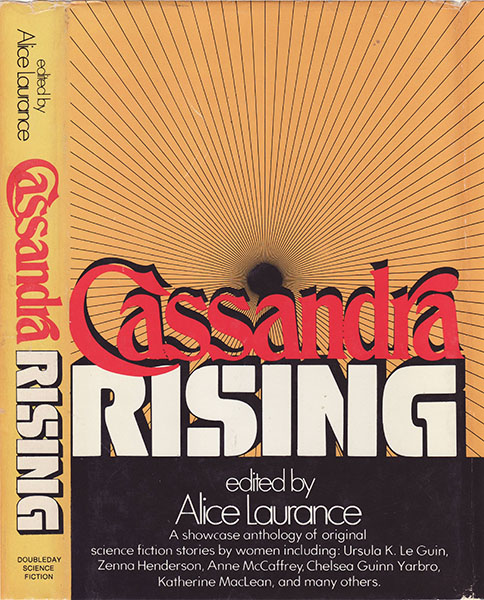
Night-Rise by Katherine Maclean

 First appeared in Alice Laurance's Cassandra Rising. Reprinted by Ursula K. Le Guin and Brian Attebery.

Summary:

A reporter takes in the story of a "Dark Christ"--a person or people who are, in this world, not necessarily anti-Christ or maybe they are. They are described more in terms of Yin-Yang--the destructive version of Christ. The reporter is witness to a murder.

Discussion (with Spoilers):

The reporter does not report the crime. Drunk, he goes down to the docks and he himself is killed by the same group.

It has long been a debate whether journalists should be involved in news or just report on it. If the journalist had reported them, perhaps he might have still been alive.

This is philosophical fiction, yes, but is this SF? It speculates on this religion, but it could as well be of our world now or in the past.

Probably the most interesting thing about the story is where it appeared. The editor opens with a small window on women in SF and probably one of the more interesting looks women in SF, looking at the male writers, too, discussing what she considered worthwhile portrayals of female characters. 

Moreover, some complained about the political nature of Le Guin's The Norton Book of Science Fiction. And we have a story that no one else noticed (which could be cool, rescuing a good story from obscurity), but it isn't really SF, which lends some credence to the complaint.

While written by a woman, however, the story is about a man. Given the above, is this meant to be a critique of men? Let's come back to this after parsing possibilities.

So we have a religion who feels free to take lives. There's no discussion of the beliefs, per se, so maybe it could be any affiliation--political, social--except they define themselves as like but opposite of Christ.

They kill a man who is interested in boys. Is this ethical? If it is, then a journalist who doesn't report this murder, shouldn't be held responsible, but yet he is killed as well. Why? Is it because he drank? Is that ethical? Are both murders justified or neither or only one? How do you as a reader feel about the murders?

Once we establish this, we might understand better how we might feel toward the murder of the journalist. Because we inhabit the journalist, my suspicion is that we are meant to find some empathy toward him. Not always, of course. And maybe not completely. 

"[The journalist] imagined he saw young, sympathetic faces around him, sympathetic but mistaken. But it was took black, he could see nothing.

"Trying to speak, felt the caress of white silk around his neck." 

The speaker gives positive attributes to the killers ("sympathetic" and caress") but also calls them "mistaken." In retrospect, he sees himself as blind (or "could see nothing.") 

Back to the topic of men and women, then, what does this suggest about male and female traits? Is this meant to suggest that men are more likely to kill and turn a blind eye?

Thursday, April 25, 2024

"Adeste Fideles" or "A Martian Christmas" by Frederik Pohl

Book page image

First appeared in Ellen Datlow's Omni. Up for a Locus. Reprinted by Datlow and David Hartwell. The title is Latin for “O Come, All Ye Faithful.”


Summary:

 Henry Steegman is a construction engineer--that is, he drove tractors that bore holes through the deep rock of Mars. He and the Mars colonists have accidentally imbibed water contaminated with radioactive products so that they are all dying off. Meanwhile, it's Christmas and the inhabitants are celebrating. Steegman drives off on his tractor to make a number of discoveries.


Discussion with Spoilers and analysis:

 The first discovery is what appears to be a department store. Of course, everyone back on Earth is excited about Mars again. After people try to take credit and keep Henry from exploring his discovery for himself, presumably due to the advanced state of his illness, he goes on a second expedition, this time presumably finding the Martians himself where no one else can take credit.

The story defies any wisdom about writing I've heard. First, the character's goal is submerged (not fully conscious) and, if anything, is more ours than his. Second, the plot doesn't follow anything that plotters would say is a good plot--following no real established patterns that I can see. I can't see any literary writers finding it a knockout--and the majority of SF readers probably wouldn't either. It is a kind of literary SF, thought-provoking in a subtle manner. The thought provoked (or theme) is actually far outside whatever goals or conclusion the character himself may have come up with.

But it satisfies, in a few ways that stories have--one of the best of that collection. If I had to throw it against most SF stories, it would be at least in the top 10%. We need a definition of story the encompasses this kind of work.

There is, what may be, a flaw here in the main plot. Why a department store? Maybe because humanity at least used to flock to department stores during Christmas? Or is it because these aliens are just pets of another species? This is a minor blemish and doesn't much distract from the work as a whole.

My own idea about how the story satisfies: 1) mystery. Pohl has mined this territory in the Heechee series. 2) We are affronted on the character's behalf since he doesn't seem to care himself, but clearly Pohl knew we'd feel that way and had a road named after him.

Now the theme--the third way the story satisfies--is weird in that it is not so much connected to the character or our feelings about the character. This theme comes from the title--at least this is my reading. It's the opening story in the collection and the final vignette "The Huddling" (discussed here in a week, more or less) seem to confirm this (the two most important spots in any fiction): We now have a new savior whose ways are superior to ours. We need to learn their ways.

That may be, to wrestle with Pohl's theme, but if one savior failed to convert the masses toward his superior ways, why should we suspect these aliens to be any better at improving humanity?


 For links to other stories in this series/novel and comments on the novel they make, follow this link.

Monday, April 4, 2022

The Dark Land by C. L. Moore

First appeared in Farnsworth Wright's Weird Tales. Reprinted by Roger Elwood and Vic Ghidalia for a feminist anthology.

Jirel, on her death bed after receiving a pike-wound to her side, cannot be healed. As she is about to enter death with a priest to deliver last rites, she is whisked away to a new world.  

Commentary (with Spoilers)

Jirel is miraculously healed in the new world. However, it is by Pav, King of Romne, a kingdom with strange borders and ways of moving through it. She is not grateful, and he seems full of himself. He allows her to seek a weapon to fight him. If he should win, he gains her. If not, she gains her freedom.

She encounters a witch, described not unlike Jirel was described on her deathbed--white and death-like ("the face of Death itself") yet somehow attractive (Jirel is near the mountains she claimed to throw herself off of if Pav should somehow win her). The witch claims that Jirel is her rival, so presumably she had been or at least desired to be Pav's companion, lover, or queen. 

Despite the announcement of their rivalry, Jirel accepts the witch's advice on how to defeat the king--to put out the flame around his head with the flame around her head which he'd given to her. Presumably, the act is a humbling or breaking down of his ego. He protects her despite this, presumably because he might not be able to stop the witch from killing Jirel, a rival on the loose. 

Does Jirel like him now? Well, he's watched and admired her from afar. He's saved her life twice. She may or may not have cottoned to him as a partner (her first "lover" had done far less to merit her love, though), but surely she understands him differently.

Father Gervase is an interesting figure--some sort of Christian priest, presumably. He appears in two tales. With good advice in the first, he warns against certain action, which we learn to be wisdom--at least to an extent. His appearance here is probably to lend credence to the belief that, when her bed is empty, she was snatched by the devil himself. 

That may be her own perspective when she arrives. It seems that she likely has another feeling when she leaves. 

Christian imagery runs through the opening. It doesn't appear to be meant to make her be a Christ figure, but just to recall similar scenarios. She has a spear in her side as Christ had. And she spends time in another realm before returning to her own. Perhaps this is meant to signal that she'd visited Paradise--or a kind of--and, rejecting it, was ejected.

This is the first story to challenge Jirel's perspective, that her judgment of others or perspective may be flawed. This actually goes a long way to explaining Jirel's actions in the first two stories. The story foreshadows this perspective with "[t]he great two-edged sword which she wielded so recklessly in the heat of combat." 

Moore takes the sword away and this forces a new kind of confrontation, which would likely have been useless in this situation, anyway.  The witch calls her a "presumptuous fool" whom she promises to kill:

"Blind, hot, earthly woman, with your little hates and vengeances, how could you have reigned queen over Romne that is Darkness itself"

Perhaps as stated near the beginning, Pav is a kind of devil, but he seems awfully kind to be a devil. Perhaps he is a middle ground, or perhaps it is a place run by heaven and hell. Whatever it is, it's never really clarified. But comparisons to the afterlife are plentiful. 

On second thought, it seems Jirel is just happy to be back, which no one can blame her for. She left home where she was in control in multiple ways. Whether the events of the tale impacted her may not be visible until a later story--in the same way this story illuminates the reading of the first two. Perhaps not, though.

It's unclear yet what the stories are addressing--perhaps other stories of love between men and women in the genre, or perhaps her own encounters (the men often manipulate reality, which might mean writers, and she did marry the writer Henry Kuttner). Or is she addressing women, addressing possible misunderstandings? Or perhaps she's addressing society with an upper-class barbarian--too civilized, or not civilized at all.

Tuesday, March 29, 2022

Black God's Shadow by C. L. Moore

 First appeared in Farnsworth Wright's Weird Tales. A direct sequel to "Black God's Kiss."


Jirel hears Guillaume's voice calling to her, both beckoning and calling her his "murderess." She returns to the underworld or the dark dimension beneath the dungeons of Joiry to find the lost, tormented soul, for whom she holds complicated feelings. 

Commentary (with Spoilers)

Jirel articulates her guilt. Perhaps Moore seems to be exploring Jirel's strange feelings toward the conqueror she realized too late that she'd come to love. After following the voice across the lands, she discovers the black stone god who'd been tormenting him with visions of Jirel.

Not only does Moore get a chance to explain Jirel, but also the writing improves.

Religion returns. The surface world might be governed by something akin to Christianity while beneath the dungeons (the subconscious?) lurks a darker, more primal religion (underworld? hell? or an existence beneath our conscious selves?). Verifying the subconscious interpretation is the way the underworld unfolds in a dream- or nightmare-like manner. Using a variant of Taoism, Jirel concludes that Guillaume must have had goodness to complement the evil.

When she frees his shadow, she is expunged of her guilt (eternally damning Guillaume due perhaps to her neglecting to allow him to repent).

At one point, she names Guillaume as a lover, which raises a host of questions. Does this suggest forced love? Or is this just a label for one who loves? The former seems unlikely given her attitude toward Guillaume, but perhaps her feelings are truly complicated.

If written today, these might have difficulty finding a publisher, or if published, they might have created a negative stir--despite their feminist attitudes--due to her complex feelings toward her conqueror, but perhaps later generations, more interested in art than politics, will see her more as a complex character than a mirror of or opposition to one's political ideals.

The terms "Shadow" and "Kiss" from the titles could equally belong to Guillaume and the Black God [not a reference to melanin, as far as I can tell ], perhaps conflating them, or playing with Guillaume's elevated stature in her world, and this journey is one within her own self, liberating her sense of love, liberty and guilt. 

It's not completely clear the final allusion to Philippians 4. Is it the self who brought the peace? Or is it another? Or has it come via the self's act through another because it was ordained by a supernatural other?

Monday, March 28, 2022

Black God's Kiss by C. L. Moore

First appeared in Farnsworth Wright's Weird Tales. Reprinted by L. Sprague de Camp, Martin H. Greenberg, Robert Silverberg, Jessica Yates, David G. Hartwell, Jacob Weisman, Lisa Yaszek, Mark Finn, Chris Gruber, Jeffrey Shanks.


Jirel of Joiry is the commander of Joiry's army--arms trussed and taken before Guillaume, the conquering enemy. He is surprised to find his fierce opponent is actually a wild, red-haired woman. Admiring her beauty, he steals a kiss but is rebuffed. He smacks her to the ground and has her taken to a cell.

Commentary (with Spoilers)

Jirel escapes and ventures into a dark land where she steals a kiss from a black stone god to deliver to Guillaume.

The darkness is either an escape from evocative writing, or a self-imposed limitation to force the narrative into interesting directions--just as "Shambleau" takes place in just one room. There are a few inspired moments--such as walking the bridge, and the opening and closing.

Speaking of Shambleau, this tale serves as a kind of parallel or opposite to that earlier (arguably stronger) tale. They seem to invite comparison.

What's fascinating here, though, is Jirel's regret. The opening does not necessarily suggest attraction, but the ending does, even as she delivers her death blow with a kiss. This complication makes it fascinating. Perhaps violence is, for this character, foreplay.

That is not the only complication. She carries a crucifix, yet she carries another god or demon within to kill the enemy she now has new feelings about.

Discussion of the sequel will appear here.

Saturday, November 27, 2021

Realistic Portrayals of Religion

See the source image

 A group of us were discussing religion, science and science fiction, and Andy Dibble came up with some excellent rules for portrayal of religion, using Ursula LeGuin's The Telling as an example.

I'd also add one weird aspect to religion. It picks up whatever's around it like Silly Putty--sometimes not contradictory necessarily, but sometimes it is. Christmas trees, Ptolmeic solar system, holidays, etc. 

I forget which illustrated coffee table book it was, but Joseph Campbell pointed Hebrew coins where God had the feet of serpents. This would seem to contradict their religion due to the serpent in Eden. Campbell listed one reason for their inclusion as the bronze serpents they had to kiss thanks to Moses, but other interpretations might be possible. Still did the image seem to conflate the two contradictory images? Or was one trodding on the other? A nuanced view is preferable to the uncharitable.

We have names for things in the culture that are supposedly forbidden, but that isn't quite what happened. Some things are clearly verbotten in religions although contextual clues give a nuanced interpretation. Other times they're a verbal tradition, based on an interpretation that's difficult to pin down.

Within any religion, though, there are selective interpretations that suit believers, and sometimes don't suit them, so that they wrestle with passages trying to understand. This isn't not usually good guy vs. bad guy scenario, although it can be an interpretation that suits one's worldview. Perhaps the aforementioned Silly Putty analogy is the desire not to conform to the text, but to unite with those around them.

This may be perhaps too nuanced for a short story to handle well or a cursory examination of a religion. And my placing this here does not constitute approval or disapproval--merely an observation.

Wednesday, June 23, 2021

A Word That Means Everything by Andy Dibble

Appeared in Writers of the Future 36, edited by David Farland.

On the planet Murk, Pius is trying to translate scripture into a language for the Thulhu, aliens with tentacles and vestigial wings--aliens that look a lot like Lovecraft's creatures of Cthulhu. His first challenge is even to get them to respond to him. Translating the Judeo-Christian scripture into something these creatures can understand is proving nigh impossible.

Suddenly, Pius's slow and modest success is interrupted by a famous translator, David Nestor, sent to replace Pius.


Comment with some spoilery bits:

This tale of religion and language treads similar ground as Ted Chiang, James Blish and Mary Doria Russell--some august company to keep.

It's hard to tell what what Dibble's theological perspective might be, but he is clearly knowledgeable of his subject matter. People think they can deviate anywhere with a theology and proceed to make rookie mistakes, but deviations within a theology occurs within certain boundaries and Dibble seems keenly aware of those boundaries, aware of where he can play. It's stunning. Even on a second read, I'm just as hooked as the first. 

The language issues seem very genuine as if Dibble is equally skilled at languages, too, although I suspect it would be hard to begin the process of any language if your alien won't communicate (an issue I didn't think about until I was combing over it on a third read to pick at the story with a lens and tweezers).

Least probable are the aliens. I suppose one could say, given the vastness of the universe, anything is likely to occur. But a creature whose primary locomotion is water based (water propulsion and tentacles) is probably not going to have vestigial wings. Of course, there are flying fish, but these occurred with fish who leap out of the water, which an octopus is unlikely to do.

Of course, the whole point of the story is to ask what it would be like to communicate the concept God to a Lovecraftian creature. So in a sense, this alien biology critique is nitpicking.

Dibble's style is very Asimovian and it works well at this length. The density of philosophical or linguistic discussion--while almost pure joy--is a workout, and might tire out a reader at novel length unless it were specifically designed as a novel of short stories or novelettes, so that the reader can exercise, then rest on the side of the pool before leaping forward.

With impeccable timing Dibble throws the monkey wrench of David Nestor into the story which enriches and gives Pius a new challenge.

While all of these writers are a pleasure to discover, Dibble provides an old-school (or a Ted Chiang sensibility, if you prefer), uncommon level of speculation  As Dibble's craft improves, this writer might be the discovery of the decade.

The author has appeared multiple times in Sci Phi Journal

Sunday, August 30, 2020

Analysis of William Blake's "The Tyger" and "The Lamb"

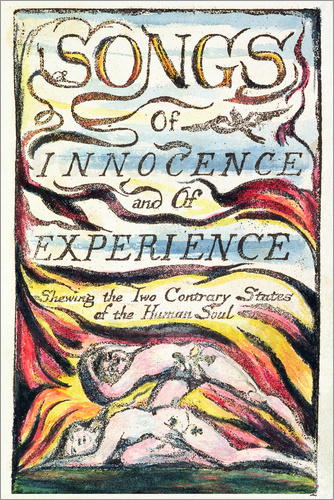
Here are two of William Blake's most famous poems in his inimitable drawings (if you find them difficult to read, here are text versions of "The Tyger" and "The Lamb").

See the source image


See the source image
These were published in William Blake's 1789/1794 Songs of Innocence and Experience. These often but not always had mirrored poems, where one upon reflected upon another, setting up the contrast of innocence and experience, which is probably the most useful tool in examining these poems. The book's subtitle, as seen here, is another, underutilized tool:

"Shewing [Showing] the Two Contrary States of the Human Soul"
 "The Lamb" illustrates innocence, "The Tyger" experience. Commonly, "The Lamb," which the persona addresses to the lamb itself ("Little Lamb who made thee"), is seen showing God's sweetness in giving

clothing of delight, 
Softest clothing wooly bright; 
Gave thee such a tender voice
God himself became a lamb.

By contrast, "The Tyger" is commonly read as at least a tentative questioning if not a critique of God. How could this fearful deadly predator be made by the same hand that made the lamb ("Did he who made the Lamb make thee?")? How can the God who makes good also make evil?

It may be saying these things, and I think it is important to keep in mind, but take a closer look at "The Tyger." The first stanza is the same as the last. In other words, it has symmetry. Within that symmetry, poem asks, "What immortal hand or eye, / Dare frame thy fearful symmetry?"

What hand or eye? Why, Blake's obviously. He just did it.

We have a frame followed by what one could describe as the wildfire of the Muse. The whole centerpiece is less a description of a tiger than the a poet's process:

In what distant deeps or skies.
Burnt the fire of thine eyes?
On what wings dare he aspire?
What the hand, dare seize the fire? 
And what shoulder, & what art,
Could twist the sinews of thy heart...? 
Did he smile his work to see?
Art? Work? What else would God, a creator like the poet himself, do but smile with pride on his creation?

Do you doubt this interpretation? Try the next line:
"Did he who made the Lamb make thee?"
Why, yes. Blake wrote both "The Tyger" and "The Lamb."

How about the subtitle of the collection: "[Showing] the Two Contrary States of the Human Soul"? He may be talking about God but more pointedly about humanity. So the same critique one just applied to God has to be applied to himself.

When we turn to the question of "The Lamb" [Little Lamb who made thee], we have to ask what a lamb is. Yes, a wooly animal. Yes, as stated in the poem itself, God (at least in Christian terms). Also, believers. And a child, too, is considered a lamb--a usage still somewhat common today. Now these lines read differently:

He became a little child: 
I a child & thou a lamb, 
We are called by his name.

God is a child, the lamb is a child, the poet narrator is a child, and all "called by his name." So God is a child is a lamb is a poet/creator. We all have the same name.

"Why, the nerve! Calling himself god and 'immortal!' "

That does take some balls. Maybe Blake is egotistical, but it makes the poems fascinating. For now we see our humanity reduced to contraries--formed of opposite poles. These aren't poems about innocence and evil--at least not so much--but of innocence and experience. Does the tyger have less right to exist? It does exist. It's already here, and it exists within us, next to the lamb. Are they at war? Are we at war with ourselves, our contraries? Let's rephrase our critique of God and point it at ourselves: "How can we who make good also make evil?"

Much as these poems seem simple, simplicity isn't Blake.

Monday, August 24, 2020

Poem Analysis: Paul Zimmer's "Upon Entering the Storm, Unable to Swim, Zimmer, Rollo, and Cecil Are Saved"

 This poem appeared in The Republic of Many Voices and the University of Georgia Press edition of Paul Zimmer's Crossing to Sunlight: Selected Poems. You can read it on Google Books here. You can hear the poet read the poem here (you'll have to forward to the proper poem).

The poem opens "A storm mixed and fell upon the lake." We have three figures, presumably all men are stuck during a storm while having a boating mishap. The first two seven-line stanzas describe this outcome.
The volta comes at the beginning of the third and final stanza: "Then a great voice said, 'Rub-a-dub-dub!' "

The trick of this multiple it's a shift in tone--referencing a nursery rhyme where three men are out to sea. One version calls the men "fools": They are, after all, not sailors but men of other professions trying to sail in a tub.

The final line claims: "And we sailed off believing, believing." There are a number of ways to read this transformation:
  1. Straight. Three men are inexperienced sailors who fear drowning until they encounter a "great voice" [God or something like a god]. This reading fails to take into account the tone shift with "Rub-a-dub-dub!" however. Perhaps God is amused at their ineptitude. Their belief is real. Perhaps God sees them as absurd and foolish.
  2. Imaginative. Three young boys imagine themselves out in lake, shower head raining down on them and their imagination leads them to despair until a parent reminds them of who and where they are. The main tone, though, undermines this reading unless the boys are imaginative. Their belief is both absurd and real. Parents provide illusory protection.
  3. Both interpretations simultaneously. These men are boys, fools, but God makes them feel secure as if parent talking to them. Their belief is both absurd and real. But should they be believing? Or was it just their imagination? Maybe their fear was absurd. They are, after all, on a lake, albeit in a leaky boat.
What makes this one fun are the multiple possibilities in delineating what's happening too much. Some details make it seem real, others do not. The possibilities make it a tantalizing joy to read.

Paul Zimmer calls the poem "kind of irreverent," which perhaps shuts down reading #1, but maybe not since God is unlikely to quote from a nursery rhyme. He does, however, mention that it's original inspiration is based on an event that occurred in reality, which bolsters reading #1 or #3.


Sunday, September 8, 2019

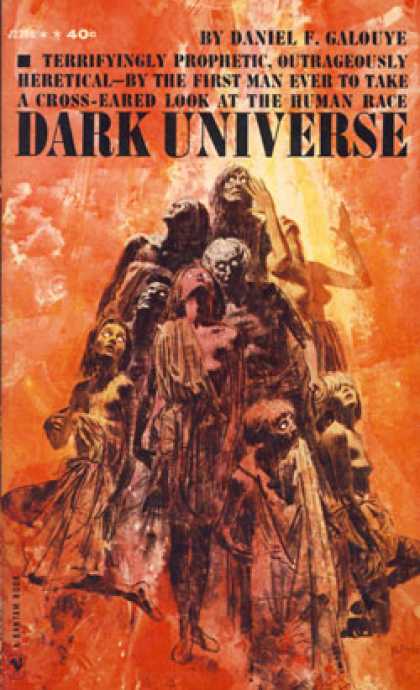
Dark Universe by Daniel Galouye


 See the source image
This novel was up for a Hugo. (According to Mike Resnick, if Galouye had voted for himself at the awards, he would have tied for a win.)


While there may be a few things I disagree with Richard Dawkins about, I do agree on the worth Galouye’s novel—not because I agree with the politics but with the quality of the speculation. However, we do disagree on ultimate destination, some significant science errors (interpretations?) that make it fun to discuss.

The novel is fascinating dissection of human society that (perhaps due to accident has fractured society by how it observes the world and, due to that, how they interpret the world. One group uses their ears to “see” while others use their eyes to pick up infrared while there’s a mysterious third group of “monsters,” little understood—those taken by them never return—not to mention assorted creatures of the cave system like the soubat.

I must admit to being put off by the novel, initially, because of the writing (obnoxious dialogue tags like “he determined”) and coyly hiding itself at first behind pronouns without antecedents. I was going to give up on it when I flipped to the end and read the ending and started over, which enhanced my enjoyment. If you struggle with it, try that.

Spoilers with Analysis:

Everybody’s living in caves (great literalization of Plato’s Cave metaphor). I’m not sure how large a population could actually be supported by a cave—probably not all of these levels with all of these people who have presumably adapted new genetic traits to survive in these habitats.

Dawkins loved this book because, essentially, a kind of atheistic science prevails; however, much as this was intended, a few problems remain. First, the "monsters" are destroying habitats of different cultures in the name of spreading its “superior” culture—another Manifest Destiny, which is no longer in favor. Or is it? Sometimes people today try to force their morality on others and punish them with loss of jobs. Should this be or not? In the novel it is definitely coerced although it’s ultimately presented as a good thing.

What if some of these people could not survive outside their habitat? In fact, if they evolved to live in a cave, they may have lost the ability to survive in other habitats.

Still, I loved the different descriptions of how various groups navigated the caves in different situations. Highly recommended.

Tuesday, August 6, 2019

Quick Notes on Shakespeare and (Re)interpretations

A few thoughts I had on rewatching the famed dramaturge. These aren't Cliff Notes, but maybe there's an idea for an essay in here.
MacBeth
I looked up Lady MacBeth to find an actress and got "Movies about marriage." Hmm. I don't recall the MacBeths being marriage role models. They are very devoted to each other in terms of their careers.

Strangely, I have always loved and hated MacBeth. So many wonderful things marred by the MacBeths' too quick surrender to insanity.

King Henry V

  • Great lines
  • moving and intriguingly devised scenes (king moves disguised to hear what his troops think)
  • yet an amazingly dull play. That doesn't seem possible, but it is so. Seems likely a large-scale structural issue. Basically a guy goes to war and wins. Hmm.
  • There's a "meta" frame story where it talks about itself as a play. Methinks this is merely to set the stage. I don't see how it adds to the story to talk about itself as a play. Change my mind.
  • You can woo a stranger to marry within a day? Maybe it helps if you're a conquering king


Much Ado about Nothing

  • Fantastically well constructed
  • Re: the Title few today would find the lack of virginity an impediment (although the night before a marriage is poor timing), but really, even just a 100 years ago, wouldn't it have been an impediment still for many?
  • As such, with changing mores, will this story be outdated one day soon? viewers unable to connect?


Taming the Shrew 

Shakespeare isn't progressive and no progressive should read him. Clearly he should be kicked out of the cannon. He writes about the 1% and favors the subjugation of women. Fie on him! Hopefully, word about this criminal will spread so we can stop reading him and watching this no-talent word-smythe.

I suspect he isn't racist although it's hard to say. He often sets plays in different countries and not as a mockery.

Where do people in England come from when they pronounce "nothing" as "nuffin"? They are exceedingly difficult to understand. I canna unnerstan nuffin dey say. We non-Englanders need translators.

Cymbeline
A tragedy where the main characters don't die? Maybe Shakespeare was rebelling against form. Nice change. Surely, I read it before as I thought I'd read all of Shakespeare's tragedies. Surely, I'd seen the movie as well. Somehow I didn't remember them.

Good line: "Fortune brings in some boats that are not steered."

The movie takes liberties. One line I misheard at first was "Of God we ask one favor that we may be forgiven from what we presumed to know," which fits the movie. The line is actually Emily Dickinson's, which fits her poem better than Shakespeare. I have no idea why it's in the movie as it doesn't seem to be questioning God as Dickinson is. Here's Dickinson's poem:


Of God we ask one favor,
That we may be forgiven --
For what, he is presumed to know --
The Crime, from us, is hidden --
Immured the whole of Life
Within a magic Prison
We reprimand the Happiness
That too competes with Heaven.
Hamlet

One thing I didn't remember was that Hamlet didn't want his uncle to go to heaven, so he waited to kill him. It seems strange to ponder. Today people want to kill people in church. Does that send them to heaven? Is the murderer trying to do the victims a favor, or does that make today's murderers nonbelievers? On the other hand, how strange to think that if we die one moment one might make it to heaven and in another moment, not. Actually, I don't think most believers think that, do they?

Maybe I read this passage and didn't fully understand what the big deal was--just Hamlet being wishy-washy about whether he was going to do it or not. Fascinating quandary though. I can't recall a similar concern in the literary arts.

Rosencratz and Guildenstern Are Dead  (Tom Stoppard)

Rosencratz and Guildenstern Are Dead is so closely related to Hamlet that I think you'd have to watch the latter then the former. In fact, to be played well, you'd have to have Hamlet actors who'd just done Hamlet do Stoppard's RAGAD for it to feel the most natural since there'd be a tendency to play the characters as if the formerly primary characters as if they were secondary, but they can't be if we are to intrude upon Rose and Guild in the Hamlet play as they do. I expected to love Stoppard's play more than I did. But there are some good lines. My favorite is this:

"There must have been a moment at the beginning where we could have said no. But somehow we missed it."

Monday, July 29, 2019

Aesthetics vs. Beliefs/Morality in "The Boys"

See the source imageWatching "The Boys" is rather mesmerizing. It is an interesting, dark, acerbic take on the superhero phenomenon--a long awaited critique. Warning: the show is violent and gruesome.

One of the intriguing promises was the use (or abuse) of religion, but it was at best disappointing as the writer seemed unaware there's actually a whole philosophical/narrative thread behind people's beliefs. There are reasons why people believe what they believe. Every speaker at that two-dimensional cardboard cut-out religious conference would have been analyzed and picked apart, critiqued by a host of religious leaders--on TV, on the radio, on the internet.

Where characters like Starlight eventually wind up with their beliefs matters less than presenting coherent belief systems--that is, when we're talking objectivity and aesthetics which, of course, differs from personal beliefs. This is something that people have lost the ability to do--to separate art from belief. That inability leads to a loss of objectivity. A loss of objectivity also leads to a less meaningful critique of the art. To critique "X," you have to inhabit X. You have to put it within its proper context. Otherwise, you're critiquing either nothing or something else entirely (hence, the new addendum I added above, so I wouldn't have to repeat myself).

Now if Starlight has been involved with religion, she would have to know the philosophical and narrative framework of that religion. She would speak to that framework. She'd work within and/or against that framework. If she doesn't, it's like being thirteen and claiming to have been at Woodstock. As is, it is impossible to believe anyone at the conference has anything but a superficial knowledge of religion.

It's like putting cacti, camels, mirages, sand dunes and horse chases in the middle of New York City and pretending it's a serious critique of today's NYC. It doesn't make sense.

To critique a thing, you have to understand it. Remove the proper context, you remove the critique. (This is not to say that morals are not important, but you can't discuss art meaningfully unless it's on a level playing field, with terms people agree upon. You can't communicate unless people are speaking the same language. Otherwise, the quality of art would depend solely on whether it matches your particular belief system, which may change.)
Still, I finished the season. Hopefully, if they do anything more with religion, it will make sense.

Wednesday, June 12, 2019

Review: Rumi: Unseen Poems by Rumi


Rumi: Unseen Poems 
by Rumi 
Knopf Doubleday Publishing Group 
Everyman's Library 
Poetry, Religion & Spirituality
Rumi, a Sufi poet from the thirteenth century, was made popular in the US by poets Coleman Barks and Robert Bly. Brad Gooch and Maryam Mortaz claim to have gotten closer to Rumi's intent while maintaining the spirit of the originals. Gooch and Mortaz collect, as the title suggests, poems that had yet to be translated, or ones that hadn't quite hit their mark.

Both Barks and Bly would play instruments and slowly read the poems. It is nice to divorce the words from the extra sounds and just revel in their cadence.

Without music, some poems attain a rhythm close to what Rumi states: "Physician, recite a magic spell":

Once again you are unkind. Remember.... 
Saying we'd be joined until the Resurrection. 
Now you're joined with cruelty alone. Remember. 
You whispered in my enemy's ear.
You saw me and you hid. Remember.
or perhaps my favorite, Blakean poem:
What better cure than madness?
Pull up a hundred anchors with madness!
Sometimes the intellect gives rise to apostasy.
Have you ever seen doubt caused by madness?  
When your pain grows fat, go mad.
Your pain will grow thin from madness.  
In the tavern where the mad ones go,
Quickly grab a cup of madness.... 
To find your love,
I opened a hundred doors of madness. 

Elsewhere he speaks against madness. Like Whitman, he accepts contradictions. Likewise, he speaks against wordplay, but we entire into contrariness and wordplay in this lovely passage:

Whether I call it a pen or I call it a pennant
It is both aware and unaware, such unaware awareness! 
The mind cannot fully explain such contraries,
A kind of artful artlessness, a marvelous form freely formed.

Some poems have rhythms or repetitions that do not feel natural in English (translations make it difficult to lay blame although certain liberties may have been needed):

Where is the grace I saw in your face all night?
Such a sweet story I heard from you, all night.  
Although your flame burned the moth of my heart,
I circled the flame of your beautiful face, all night.  
Before your beautiful moonlike face, night veiled itself.
I ripped apart the veil of night, all night. 
My soul, full of joy, licked itself like a cat.
Like a baby, I sucked my thumb, all night.

and
Today the line between a stranger and me,
   I do not know.
So drunk that the road to my own house,
   I do not know.
Beautiful passages do dot the book:
O heart, since the royal falcon hunted you,
You are able to translate the secret language of birds. Such translations!
and
where did that tall, shapely cypress tree go? 
He spread his light among us like a candle.... 
Go to the garden and ask the gardener... 
Go to the rooftop and ask the watchman--
That unique sultan, where did he go?
Some passages we may need more context in terms of 13th century Persian language and in terms of the Quran:
I blush when I call love human.
I fear God too much to say that God is love.
This seems a rebuke of Judeo-Christian notions, which is fine, but what does he propose instead? Is it implicitly understood? Or is it the leaping, dancing and fire? Those, though, seem more of an aspect of the believer than of God, unless by doing them the believer becomes God. It's hard to tell without context.

The other problem is that much of the text is addressed to a lover, which I understood to be both literal and God, but maybe it is just the lover, or maybe just God. If the lover is God, then in what ways is God love or not love? How are we to know without more context? I am asking for a generous introduction, setting the stage for our reading.

I cast my net wider to find my own net wider and read on Wikipedia, "Rumi spent the next twelve years of his life in Anatolia dictating the six volumes of this masterwork, the Masnavi." This only raises more questions. Are these poems pieces of one larger work? Or just dissociated poems? If the latter, are we to read meaning into them or read meaning out of them?

So I spread my net wider. Gooch, one of this volume's editors, apparently was more forthcoming with the BBC:
says Gooch[,] “[Rumi and a wandering mystic known as Shams of Tabriz] have this electric friendship for three years – lover and beloved [or] disciple and sheikh, it’s never clear...." Shams disappeared. "[Rumi's] work comes out of dealing with the separation from Shams and from love and the source of creation, and out of facing death.... a line from Rumi: “Out beyond ideas of wrongdoing and rightdoing there is a field. I'll meet you there.” 
In the same article, Anne Waldman addresses the implied question that Gooch raises, calling the verse “homoerotic... consummated or not." Maybe. But could it be a vibrant Platonic love--something our culture cannot fathom because we have bound or limited all "love" to just one: the sexual kind?

"Rumi's poems articulate what it feels like to be alive," says Lee Briccetti.... “And they help us understand our own search for love and the ecstatic in the coil of daily life.”

Mojaddedi relates for the BBC Rumi’s four innovations:

  1. his direct address to readers in the rare second person 
  2. his urge to teach [‘inspirational’ literature] 
  3. his use of everyday imagery
  4. his optimism of the attainment of union within his lyrical love ghazals. The convention in that form is to stress its unattainability and the cruel rebuffs of the beloved. Rumi celebrates union.
This all helps although it doesn't seem true that the "you" is the reader. Perhaps the lover, or an aspect of one's self (e.g. the heart as seen above), or even God. Or are all these conflated: reader, lover, self, God?

It's great to know how Americans read it, what they find appealing. But how do Muslims read it within their tradition? 

Again Wikipedia goes on to say that Rumi speaks on his own work:
I am the servant of the Qur'an as long as I have life.
I am the dust on the path of Muhammad, the Chosen one.
If anyone quotes anything except this from my sayings,
I am quit of him and outraged by these words. 
[T]he book of the Masnavi... is the Explainer of the Qur'ân.
Do any of our Western readings chaff the Quran? Would Rumi be outraged? Do Muslims accept or reject the way Westerners read Rumi? Do they have something in between or have a different interpretation entirely? One Muslim acquaintance called Rumi's work religious, and we Westerners tend to remove the verses from this context. Why do we do that, and what is the religious context?

The title of the collection is curious as well. This isn't the normal way we'd call such poems. We might call them [previously] "uncollected or "new translations," not "unseen." Does that suggest that we haven't yet seen Rumi and here he is now? Or are these poems that ask us to un-see? Why do they suppose these verses had yet to be collected? Why are they choosing these verses for this volume? What does it add or reshape what we know about Rumi and his vision?


As you can see, the volume raises questions that a good introduction needs to set straight, given that these poems have traveled so far in time, distance and language. But we do get moving selections, selections to inspire us, selections that sway with grace.

This volume will appear on September 10, 2019.

Wednesday, May 10, 2017

"It's a Good Life" by Jerome Bixby

First appeared in Frederik Pohl's Star Science Fiction. Reprinted in major retrospectives by Frederik Pohl, Edmund Crispin, Alfred Hitchcock, Brian W. Aldiss, Laurence M. Janifer, Isaac Asimov, Robert Silverberg, Thomas E. Sanders, Robert Silverberg, Leslie A. Fiedler, Leonard Wolf, Malcolm Edwards, Kingsley Amis, Stuart Gendall, Isaac Asimov, Martin H. Greenberg, Charles G. Waugh, Richard Matheson, Alberto Manguel, Sebastian Wolfe, Gary Goshgarian, Peter Haining, Syd Bentlif, Joan Kahn, Jean Marie Stine, Jeff VanderMeer, Ann VanderMeer. It was twice filmed--once as part of the Twilight Zone series and again for the 1983 movie.

Summary
In a small town, people unwillingly come to Anthony's house. Anthony is a young lad who can make things happen by thinking about them. A rat bites his tail off. A man on a bicycle wants to bike away quickly, but Anthony reads the thought and sends the man rocketing away only because Anthony was in a good mood. Around Anthony, everyone mumbles and thinks simple multiplication tables so that he cannot read their thoughts. They talk about how good everything is, lest Anthony improve things for the worse.

Analysis with Spoilers:
Can there be a spoiler with this? The tale is less a story than a slice of life (albeit, a rather extraordinary one), but there is no plot, per se. Just events. In fact, the tale doesn't seem to have received much notice until Frederik Pohl reprinted it seven years later, followed the next year by Alfred Hitchcock's reprinting.

There is no one character perspective, either. It hops from mind to mind. Or is Anthony's mind the true observer? If so, Anthony often makes no commentary on or takes no action against the minds that think negatively toward him.

Anthony goes out into the cornfield to improve the lives of the insects and animals that live out there, which he seems able to do with their simple minds and thoughts. But when he returns, he puts on his own television show. The town is cut off from civilization (or maybe the rest of civilization is destroyed since their world ends a little ways off). Anthony's TB show is little more than abstract figures, but when Dan Hollis drinks too much and gets upset he doesn't have a record player to hear an album he received for his birthday, Anthony picks up on the thought and buries Dan (alive?) in the cornfield.

That's the climax. The denouement wraps up with everyone thinking in response what a good life it is. Close on irony.

The tale can be read at least four different ways:
  1. Our society over-caters to youth who control how society is run.
  2. If there is a god, he is capricious at best, unknowingly cruel at worst.
  3. If there is a god, he serves animals well since they are simple creatures whose lives he can improve. Humans are so complex in their wants, that it is impossible to improve their lives without making it into a living hell.
  4. This is the snapshot of a child's mind: how it interprets its influence on the world. The world even stops at the point of his journeys. He sees himself as the deserved center of attention.
The story also influenced Star Trek (he wrote four episodes though not the ones this story likely influenced). See "Charlie X" and "The Squire of Gothos".

Thursday, May 4, 2017

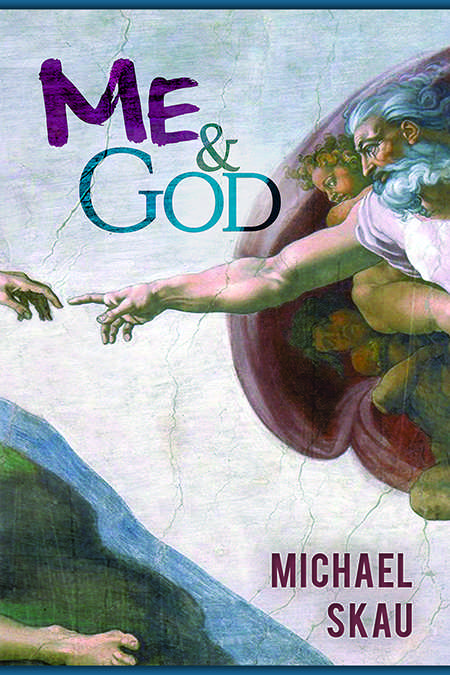
Review: Me & God by Michael Skau

Me & God 
by Michael Skau 
Wayne State College Press

With a book title like Me & God, you might expect ambition, even a critique, if not irreverent humor from the colloquial "Me" (and placing it before God) and the cover. And you'd be partially correct. The poems, which should appeal to readers of Billy Collins and anyone who ponders religion, point up the humor ("When angry, he projected/his voice in surround sound" from "Muse"). However, overall, it isn't cruelly or vindictively irreverent. In an interview with Laura Madeline Wiseman, Skau states:
As for the use of foils, as my introduction indicates, “The God that I have fashioned for the poems is one whom I have created in my own likeness.” The advantage here is that I can invest the God figure with my own faults and flaws, and this makes criticism of him much easier. The disadvantage is that the poems encompass a God based on myself, a first person speaker (“I” or “me”) also modeled on myself, and I the poet, who is manipulating the other two: the process can be quite schizophrenic. I try to balance the scales here by sometimes giving God the upper hand, sometimes allowing the I or me to undermine God, and sometimes portraying them both as either right or wrong.
One suspects the primary model is the Judeo-Christian one, as the cover suggests. Yet the god in this book encompasses good and evil and thus mirrors more of the Greco-Roman gods. Combining this with the above quote creates an intriguing dynamic: Who is truly being critiqued? God or the self? The latter gains more weight if we have an agnostic approach. The reading becomes bifocal--with two simultaneous interpretations.

I don't mean to make the book overly intellectual but stimulating without mental gymnastics on the reader's behalf. The language is as clear as if the poet were addressing the reader directly. In fact, the temptation would be to dismiss it as simplistic. Listen to the poem on the video.  More underlies its seeming simplicity.

His stylistic preference is unsurprising as he spent years as university professor teaching the Beats. He has published book-length critical works on Lawrence Ferlinghetti and Gregory Corso.

His poetry is as accessible as work by Charles Bukowski while remaining thought-provoking. In "Pinball" God is racking up the points while Skau's persona is having difficulty:
Finally, I had a good game--
actually just a good last ball--
and turned the score over, but it never
popped for a free game. God had stopped
to watch me play, and I muttered, half
to the machine, "What do you have to do
to win?" God replied, "You can't win
on that machine."
Skau wrestles with God over unluckiness ("Pinball" cited above and "A Day at the Races"), troubles ("Soul-Making" and "Entropy": "Nothing/here is perfect, not even me.") and with his persona over ecology, dreams and vain imaginings (" 'I/am not to blame,' he answered,/'for what I do in your dreams.' "--"Dreams"), road rage ("Goodness": "'Because I said so,' he replied,/reminding me again of my mom."), relationships ("Marriage": "Don't/blame me for human mistakes"), etc. The poem "Fire" challenges both God and his persona.

Two of the more poignant works include "After Birth" where Skau's persona wrestles with the destruction of a new puppy born with a defect that will trouble it to its death, perhaps mirroring why God in "Potters" behaves this way:
Most of [God's pots]
were marred in one way or another:
crooked bottoms, ungainly torsos,
crude handles clumsily attached....  
Still God fired his pots in the kiln,
scratching his signature, "I AM,"
into the unbalanced bases.
He never kept his work, giving
away these luckless mistakes, imposing
the gift of responsibility on others.
One of the more fascinating works--possibly his most famous with a classic feel that often delights listeners at readings--is "Wind" from a 1980 issue of Laurel Review. It predates the 2003 Jim Carrey movie, Bruce Almighty, by twenty-three years. Wind lifts the skirts of a woman on the street.
"Wow," I said to God. "Did you see that?"
Slowed and hampered by the tightened skirt,
she soon let go and resumed her stride.
God turned to me, eyes atwinkle,
and asked, "Want to see it again?"
This elicits belly laughs from the audience, but possibly consternation from a few who might consider it objectifying. Should readers need a counter balance, they should dip into "Gender" where Skau's persona, like Tiresias, gets transformed into a woman and receives cat calls.

The targets in this collection vary; the humor is spot on with the right bite; and Skau provokes thought about religion and the self because if you don't believe God exists, who else can you blame? This should tickle the fancy of most readers on both sides of politics and religion except those at the extremes.

"Winter" could have ended this collection. Skau's persona and God saunter across the winter landscape, and the conversation turns to snow angels, Lucifer's sin, pride, and light. It concludes:
God became pithy: "Light
is a difficult honor to bear."
And then He pelts the persona with a snowball.

Friday, March 31, 2017

Star Trek: Season 1, Episodes 11 & 12. "The Menagerie"

 Summary:
Enterprise asked to divert from course although planet does not why. Captain Pike is handicapped and can only answer yes or no through beeps. The crew members interrogate and get no answers. Spock asks to remain behind to which Captain Pike agrees. Spock continues a near-monologue with Pike

The Commodore denies message sent, and they do not find any messages sent to Enterprise. They check computer center, but Spock arrives to doctor computer banks.

Captain Kirk shown that that Pike's message was impossible. Kirk forced to consider whether Spock can lie. In theory, as a Vulcan, he's not supposed to be able to lie.

Talos IV is the only planet that, if visited, carries a death penalty. Spock has maneuvered the Enterprise to leave without her captain. Captain and commodore pursue without sufficient fuel to get back to base.

Spock has himself arrested and placed on court martial in order to explain himself. Ship assumes direct route to Talos IV. Any interference would have damaged life-support systems.

Court martial proceedings appear in videos from an unknown source, which turn out to be direct from Talos IV.
Analysis with spoilers:
Pike's Enterprise discovers distress signal from SS Columbia. Pike refuses to investigate without evidence of survivors. He confesses to ship doctor that he's tired of giving orders that risks lives.

After receiving a distress signal, the ship goes to discover survivors, quite aged, except for Vina who is quite young and lovely. We discover aliens are watching. The survivors are in excellent health. Vina takes Captain to secret location where, after survivors melt away, he gets abducted. Crew try to open mountain with phasers but fail.

Pike visits a number of illusions through the carrot-and-stick to get him acquiesce to becoming a specimen--not just a specimen, but a breeder for observation and for the aliens to live vicariously since the aliens are so old they have apparently lost many of their former skills and technologies. The only way they can survive is through an Adam-and-Eve program of caretakers on their planet, whose surface the last war wiped out.

Pike refuses to be party to this and he and the Enterprise crew look for ways to free him. Apparently, they have accomplished more than they've imagined, but the illusions prevent their seeing what they've accomplished.

They do escape, but the lone crash survivor, who old, ugly and deformed, wants to remain with the illusions. Pike, who fought so hard to escape the illusions, suddenly understands the desire to stay. In fact, he decides to return. However, he put up a good front of being against Talos IV for quite a while. Meanwhile, the aliens seem dead set on keeping humans off their planet, but they welcome back the man who impressed them that humans were too violent for their planet. Moreover, the story never explains how Spock knew what to do for Pike (the most probable being the Keepers somehow communicated to Spock and he took it upon himself to decide best what Pike's fate should be, which Pike did agree with in the quotes below for his companion).

Those are the flaws, here, but the strengths outweigh the minor deficits. It did win a Hugo. The original pilot is pretty good, but somewhat minor, considering that it ends agreement that for the handicapped, it is better to live with illusions. Since much of the imagery and metaphoric discussions is religious (see quotes below), it might mean to imply that the religious are handicapped and should retain their illusions. The idea, while interesting, is a bit condescending and minor.

The framing episode, however, is genius and raises the original pilot episode to its own level. Spock is seemingly breaking not only his own code, but the code of the Federation, doing something mysterious to risk own life. How rare is it that the frame is at least or even more interesting than the main tale?

The main flaw comes at the end of episode one where the frame keeps stopping the main story, presumably to extend the episode to proper length. Either it should have been cut for aesthetics or found better, or at least less repetitious, justification.

One of the more fascinating aspects--probably a story problem to begin with--was who was telling the tale. The episode asks what was the source of this video. Today, it would have been too patly as surveillance. This wasn't easily resolved, though, creating a fascinating viewer within a viewer within a viewer perspective. We the audience watch what the current Enterprise crew watches, who watch what the Keepers watch, who watch the older Enterprise crew. The frame of viewing makes it quickly apparent who is doing the viewing but it does take a moment of adjustment and it reminds the viewer of all the levels.

An element that makes the telling so dynamic is the constant presence of the older handicapped Captain Pike viewing his own past and younger self with rapt attention. This is highlighted by his willing to see more of his past whenever he's asked if he wants to see more.

The religious tone of the story remain with addition of the frame. It attenuates some aspects while accentuates others. With Pike rejoining his former prisoner mate in their former cell, he effectively states that illusion or religion is preferable to imprisonment within one's handicap.

One unnecessary flaw was Pike's too quick appearance on Talus IV, right after being escorted out of the room. Why bother escorting Pike if they could instantly teleport him out?
Quotes:

  1. [Captain Pike is shown a vision of burning hell.] Keeper: From a fable you once heard in childhood.
  2. [Keeper refers to illusion.] Would you say this is worth a man's soul?
  3. --What's happened to Vina? Isn't she coming with us?
    Pike: No, and I agreed with her reasons. [Her reasons are that she is old and deformed in reality, not in illusion.]

Notes:

  1. In Star Trek III, the inverse is done: Captain Kirk himself steals The Enterprise, putting him at risk to be court marshaled. 
  2. Apparently, the impetus for genius was time (see Wikipedia), necessity being the mother of invention. They were falling behind in the making of the show due to special effects, so they utilized a previous show whose effects were already complete and created the surrounding episode in one week, effectively two shows for the price of one.

Tuesday, March 21, 2017

"Hell Is the Absence of God" by Ted Chiang

First appearing in Patrick Nielsen Hayden's Starlight 3, this swept the Hugo, Nebula, Locus, and Seiun Awards; was shortlisted for the Theodore Sturgeon Memorial Award, reprinted by Robert Silverberg, Karen Haber, David G. Hartwell, Kathryn Cramer, Vonda N. McIntyre, Charles N. Brown, Jonathan Strahan, James Patrick Kelly, John Kessel, and Rachel Swirsky.


Summary:
Angels are appearing on earth, and their appearances bring as much death and destruction as healing. The following three lives come together due to these chance healings and destruction occurring in this wake.

Neil Fisk had never been religious although ultimately he becomes so. He was born with a congenital defect "that caused lost his left thigh to be externally rotated and several inches shorter than his right." Neil didn't come to love or hate God because of this. His wife, however, was a quiet believer, which encouraged him to be more disposed to liking religion. She is killed, though, when an angel appears. Much as he's angry with God, he knows he cannot be with Sarah again unless he gets to Heaven which requires loving God.

Janice Reilly lost both of her legs at birth. Janice became a famous evangelist until one day her legs are restored. She wonders what her new purpose should be now that she cannot be an evangelist to the handicapped since she is no longer handicapped.

Finally, we have Ethan, a man who encounters an angel but is neither healed nor killed. He cannot understand why, so he seeks out Janice, believing she has the answer to this mystery.
Commentary:
From all the awards and reprints, this should be a story to expect great things from. The set up is cool. Again, we have characters that represent different ideas: Neil seeks God but should hate Him. Janice should love God but is confused by his gift, and Ethan has been neglected by God. The scenario is ripe with potential.

The imagery is spare except for the last scene, which is eye-popping. The disappointment is Janice. She doesn't feel like a genuine believer. It's like you can open up her and soul casing and find it barren.

In an interview Chiang said he read the books of handicapped believer Joni Eareckson Tada as research, and Joni is supposed to be devout. That doesn't mean that believers don't doubt, but that she would have an arsenal of theological thought to wrestle with and against.No wrestling with actual theology goes on.

What may have happened was that Chiang swept away religion-specific markers to protect the story from being a critique of one religion (and Tada), but leaving out specificity made her feel artificial or a shiny new believer fresh out of the wrapper, which isn't the kind of believer you'd want to discuss complex religious issues with.

Here's an example. In the "Story Notes" Chiang writes:
"one  of the  unsatisfying things about the Book of Job is that, in the end, God rewards Job. Leave aside the question of whether new children can compensate for the loss of his original ones. Why does God restore Job''s fortunes at all?... One of the basic messages of thebook is that virtue isn't always rewarded; bad things happen to good people. Job ultimately accepts this, demonstrating virtue, and is subsequently rewarded. Doesn't this undercut the message?
...If the author were really committed to the idea that virtue isn't always rewarded, shouldn't the book have ended with Job still bereft of everything?
Chiang typically uses a lot of qualifiers, which is nice. His qualifiers answer his own question: "isn't always" implies there are times when behavior is and is not rewarded. Sometimes people go through limited trials, and sometimes the testings extend to the end of one's life. Sometimes virtue is rewarded. Of course, the believer doesn't see this world as the final reward although that is sometimes difficult to recall when going through troubles.

This is what I mean, in part, about having an arsenal of theological thought. Someone's already thought of something similar that may apply. A believer may doubt, but they'll have something to ponder. They will pit their circumstances to those they've read in their scriptures. Put it another way: Imagine a kid has an astrophysicist father, and the kid's given a difficult homework problem concerning astrophysics. Does the kid give up after he cannot answer it? Or does he consult his dad or his dad's books?

Since Joni and the text are Judeo-Christian, the ending doesn't make sense within that framework (although it may apply to other religious contexts). Why would a Judeo-Christian god do that? There's no record of such within the text. More likely, if God revealed himself it would be to some end.

Chiang must have felt The Book of Job connected (see again the quote above) and that this is the more fitting end. Eternal suffering then must be more pious and loving than temporary.

Suffering in Job, however, is not an end but a means. It was a proof that he could remain faithful in the face of adversity, not just success. It was also a way to stop those who connected every event, positive or negative, to God's like or dislike of the believer. Finally, God corrects Job on second-guessing God. Because God knows all, who is Job to judge and tell Him what He should do? [See also the Lord's Prayer, and Jesus' final petition to God not to be crucified: "Take this cup."] It's been awhile since I read Job, so there may be further purposes I'm leaving out. Here's the text, but be warned that it is difficult to interpret without a solid understanding of the rest of the Book. The link provided does have "Tools" on the left, which can help guide the reader and give the original Hebrew.

Clearly, others were taken by the tale, so I may have missed something, or some lack a full understanding of the context. Or maybe this is a critique of an entirely different religion. Definitely, food for thought.

Wednesday, March 8, 2017

"Tower of Babylon" by Ted Chiang

First appeared in Ellen Datlow's Omni, reprinted by Gardner Dozois, James Morrow, Robert Silverberg, and Mike Ashley. It won the Nebula and was up for the Hugo, Locus, and Science Fiction Chronicle Readers Poll Awards.
Summary:
Hillalum begins his own construction on the Tower of Babylon as it nears the vault of heaven.
Commentary with Spoiler:
Hillalum ascends and a storm sweeps him away, carrying him into the vault. The vault pours him through its waters to the other side: back on the surface of Earth, not far from the Tower Babylon.

Assuming we are on a facsimile of Earth and its humans, the width of Chiang's Tower is approximately sixty to seventy-five miles, the height between 120 to 180 miles (calculated via Naismith's rule). There are other things to consider, such as rarefied air--"Earth's atmosphere is about 300 miles (480 kilometers) thick, but most of it is within 10 miles (16 km) the surface. Air pressure decreases with altitude"--but clearly these are not at stake in this universe. Hillalum would not be able to breathe so high. In fact, it probably would not be if we buy Hillalum's interpretation of what his universe is: a cylinder.

I'm not sure I'm visualizing this universe correctly, but half-way to the vault, the walkers should have a hard time not bobbing off the tower's surface. In fact, at the half-way point--sixty to ninety miles, where the air is most rarefied and difficult to breathe--the builders should be able to leap to heaven. Granted, they probably wouldn't survive the fall.

In one of his interviews, Chiang discusses that he didn't deem this one dealing with religion. The first time I read it, I assumed it was: The universe isn't what they thought. Religion is all built on lies, etc. This may have been part of what drew Thomas Disch, atheist, to champion the tale to Ellen Datlow, or so the traditional story of the story sale goes.

My latest reading, after sizing up Chiang's literary MO, is that while that interpretation is possible, so is Hillalum's interpretation as equally likely:
"[T]hrough their endeavor, men would glimpse how ingeniously the world had been constructed. By this construction, Yahweh's work was indicated, and Yahweh's work was concealed."
Of course, the Bible's tower of Babel was destroyed. It states:
"If as one people speaking the same language they have begun to do this, then nothing they plan to do will be impossible for them."
In other words, God wanted some things to be impossible for humanity. Incidentally, I didn't realize at my first reading that Babel and Babylon were interchangeable. I assumed Chiang was conflating stories to another end. Perhaps he was. It's hard to tell what that may be though: confusion + paganism? As far as I can tell, this only confuses the story's interpretation.

When I first read this, I was disappointed. Hype set me up for a literary SF story, lauded by many. My idea of literary must differ from others, which is why I quoted Damien Walter and Chiang on his own philosophical work here. In picking apart "Division by Zero", I uncovered a lucid perspective for reading his work.

This is why I carefully set up the best parameters for what Ted Chiang is up to. He writes old-school philosophical SF. It's good, but if you read for depth of character, dynamic plot, or linguistic pyrotechnics, you'll be miserable, reading for all the wrong reasons. I wish I could tell my younger self:
"You like Borges, yes? He's an Asimovian Borges. He writes how ideas impact humanity with a penchant for interesting narrative structures."
I'd have said, "Oh, okay. That sounds cool," and reread, clear-eyed. Rereading this story while understanding Chiang's MO--at least for this reader--makes the tale far more pleasurable.

Sunday, January 31, 2016

"God Whisperer" by Daniel J. Davis

Appeared in David Farland's Writers of the Future.

Here's clever little pithy tale.

Jack has a miniature god living with him--not unlike a pet. It is awkward for him as the god, Zu'ar, leaves a trail of carnage: a pyramid bird skulls and such as trophies. Also, like a pet, he destroys the furniture. Jack has to do something... So he gets a god whisperer.

Writers of the Future works lean more toward entertainments. This one gets the mental gears turning. Basically, your god is something that needs to be tamed, under your control. While I'm not sure I buy the theme, Davis renders it with charm and some humor. I don't have to buy the politics to admire the story's aesthetics. If Davis can follow up this story, he should have an admirable career.

Monday, November 30, 2015

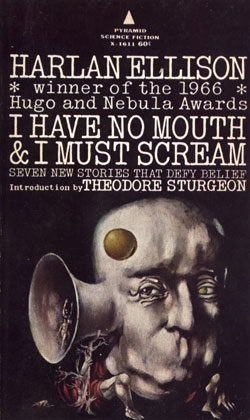
"I Have No Mouth and I Must Scream" by Harlan Ellison

First appeared in If. It won the Hugo and was reprinted in several major retrospectives by Donald A. Wollheim, Terry Carr, Robert Silverberg, Damon Knight, Total Effect, Isaac Asimov, Stephen V. Whaley, Stanley J. Cook, Thomas Durwood, Armand Eisen, Leonard Wolf, Clarkson N. Potter James E. Gunn, Eric S. Rabkin, H. Bruce Franklin, Thomas F. Monteleone, Frederik Pohl, Joseph D. Olander, Patricia S. Warrick, Charles G. Waugh, Martin H. Greenberg, Edel Brosnan, and Peter Straub.

Summary:
Humanity has been slaughtered an artificially intelligent machine, built to fight WWIII. The last five humans are trapped, immortal but tortured in the belly of the machine. Any time they attempt escape, their fates are made worse.

Analysis:

Despite--or because of--his protestations to the contrary, the narrator is insane (he has to emphasize his own statements which he has not had to do elsewhere):
"I was the only one still sane and whole. Really.
"AM had not tampered with my mind. Not at all."
Note, too, that this is written in the past tense, so when we reflect back, it's hard to believe any of his past had much sanity or a lack of tampering. Strange, too, that the five should journey for months and still be inside the machine, with deck plates.

One might question the veracity of his tale, but the story would fall apart. If we were to buy into his narrative, we could understand why he might be insane.

"[D]eath was our only way out. AM had kept us alive, but there was a way to defeat him."
The narrator kills his companions to spare them of eternal horror. The computer--as much a creator as the created--transforms the narrator to be stripped of his humanity:

"Outwardly: dumbly, I shamble about, a thing that could never have been known as human."

The title comes into play. Like his creature/creator, the narrator cannot express himself, even his horror, which is what supposedly drove the AI insane:

"We had given AM sentience. Inadvertently, of course, but sentience nonetheless. But it had been trapped. AM wasn't God, he was a machine. We had created him to think, but there was nothing it could do with that creativity."
In other words--I suspect--the computer went insane because it couldn't move (or whatever feature that humanity has that the computer cannot have). Stephen Hawking's sanity despite ALS seems to disprove this theory (although maybe Hawking is too intelligent to display his insanity or lacks the omnipotence to destroy humanity and turn the rest of us into slugs, but let's assume he's sane). Moreover, if AM has this incredible omnipotence, yet is trapped in place, wouldn't his powers be enough to simulate movement or create a facsimile of himself that can move?

Also in the above passage, it negates an earlier comparison of the computer to God:
"Most of the time I thought of AM as it, without a soul; but rest of the time I thought of it as him, in the masculine... the paternal... the patriarchal... for he is a jealous people. Him. It. God as Daddy the Deranged."
But this machine god does not act like previous gods, but one of pure malevolence. Rather, the interesting part is the masculine aspect. In fact, he describes Ellen's having sex with the men as being "serviced." So perhaps what we hear described is what happens when men become machines.

It's hard not to feel for Ellen. She clings to or favors the man who favors men. Why? Because he presumably does not expect anything from her. She'd taken the narrator twice out of turn, which the narrator refers to with some pride. But this shows a number of aspects in their relationship: She mechanically does each man, presumably to keep them happy. Does it make her happy? The narrator seems to assume so. Four men, one woman. If the reverse were true, presumably the men would be equally pleased.

The narrator, however, is jealous of her affection toward Benny and describes her:
"Oh Ellen, pedestal Ellen, pristine-pure Ellen; oh Ellen the clean! Scum filth."
It's hard not to imagine this attitude slipping out in tone and/or subtext, even if it were not verbalized. It's at least partially understandable that she is not as fond of the narrator as Benny who was apparently gay. Despite this, for some reason, Benny has been making love with Ellen.

While this theme is critical, it falls behind the Luddite message, or maybe ties into it:
"two great machine with glass-faced dials that swung back and forth between red and yellow lines whose meanings we could not even fathom"
Like Ellen, the machine is the thing we cannot fully understand. When we create, we do not anticipate the later repercussions. We create relationships, machines, things we don't fully grasp. We end up down a long, painful road going somewhere we hadn't intended, unable to voice our horrors. Insane.

Ellison was a younger man when he wrote this, which may explain some of the above exaggerated story aspects. Behind closed doors, the technology-positive writers must have disliked the tale.

Ellison's writing is so full of inventive energy--and so admired--that it's strange that more writers didn't follow his lead. Maybe some tried, and their work rebuffed. Instead, the new speculative literature writers followed Brian Aldiss and J. G. Ballard. This is probably due to influential editors like Gardner Dozois, but still surprising that so admired a writer didn't create similar writers.