Search This Blog

Showing posts with label Weird Tales. Show all posts

Sunday, June 1, 2025

"Displaced Person" by Eric Frank Russell

 First appeared in D. McIlwraith's Weird Tales. Reprinted by Terry Carr, Peter Haining, Isaac Asimov, Martin Harry Greenberg, Joseph D. Olander, Al Sarrantonio.


Summary: 

 A man arrives in a foreign country although who he is and why is part of the mystery.


Discussion with Spoilers Galore: 

While not the most stylistically impressive, there are four mysteries to unravel. A person cannot read it too quickly. If you get only one, you'll probably hate it. Two, it's okay. Three, you like it. Four, you might consider it a minor work of genius as Terry Carr apparently did by collecting it into a major fantasy anthology. 

First is the displaced person and out feelings toward them. Most of humanity is bound to feel empathy toward this person. In fact, on the same year this story was published, the President signed the Displaced Person Act. However, this person admits to being the cause of the war. Does that erode the natural empathy a person might feel?

Second, the easiest, is that the displaced is Lucifer, but hold on to this or you'll dismiss prematurely. It refers to the war in Heaven in John Milton's Paradise Lost--a character most professors love and love to love to antagonize people of faith because his character is considered the better vs. God.

Third, remember when this written, the war that had just taken place. Who might Lucifer apply to?

Fourth, now that you have all the relevant information, which you can only get once you know who the player is, you'll need to reread. And on that reread, you'll note the careful balancing that Russell has put into play. The four surprises combine and it puts one in a weird place (hence, weird tale). It becomes a mirror for anyone's too quick response.

That Terry Carr was the first to reprint it a quarter of a century later suggests that few read the tale with the time and attention it deserves.


Monday, April 4, 2022

The Dark Land by C. L. Moore

First appeared in Farnsworth Wright's Weird Tales. Reprinted by Roger Elwood and Vic Ghidalia for a feminist anthology.

Jirel, on her death bed after receiving a pike-wound to her side, cannot be healed. As she is about to enter death with a priest to deliver last rites, she is whisked away to a new world.  

Commentary (with Spoilers)

Jirel is miraculously healed in the new world. However, it is by Pav, King of Romne, a kingdom with strange borders and ways of moving through it. She is not grateful, and he seems full of himself. He allows her to seek a weapon to fight him. If he should win, he gains her. If not, she gains her freedom.

She encounters a witch, described not unlike Jirel was described on her deathbed--white and death-like ("the face of Death itself") yet somehow attractive (Jirel is near the mountains she claimed to throw herself off of if Pav should somehow win her). The witch claims that Jirel is her rival, so presumably she had been or at least desired to be Pav's companion, lover, or queen. 

Despite the announcement of their rivalry, Jirel accepts the witch's advice on how to defeat the king--to put out the flame around his head with the flame around her head which he'd given to her. Presumably, the act is a humbling or breaking down of his ego. He protects her despite this, presumably because he might not be able to stop the witch from killing Jirel, a rival on the loose. 

Does Jirel like him now? Well, he's watched and admired her from afar. He's saved her life twice. She may or may not have cottoned to him as a partner (her first "lover" had done far less to merit her love, though), but surely she understands him differently.

Father Gervase is an interesting figure--some sort of Christian priest, presumably. He appears in two tales. With good advice in the first, he warns against certain action, which we learn to be wisdom--at least to an extent. His appearance here is probably to lend credence to the belief that, when her bed is empty, she was snatched by the devil himself. 

That may be her own perspective when she arrives. It seems that she likely has another feeling when she leaves. 

Christian imagery runs through the opening. It doesn't appear to be meant to make her be a Christ figure, but just to recall similar scenarios. She has a spear in her side as Christ had. And she spends time in another realm before returning to her own. Perhaps this is meant to signal that she'd visited Paradise--or a kind of--and, rejecting it, was ejected.

This is the first story to challenge Jirel's perspective, that her judgment of others or perspective may be flawed. This actually goes a long way to explaining Jirel's actions in the first two stories. The story foreshadows this perspective with "[t]he great two-edged sword which she wielded so recklessly in the heat of combat." 

Moore takes the sword away and this forces a new kind of confrontation, which would likely have been useless in this situation, anyway.  The witch calls her a "presumptuous fool" whom she promises to kill:

"Blind, hot, earthly woman, with your little hates and vengeances, how could you have reigned queen over Romne that is Darkness itself"

Perhaps as stated near the beginning, Pav is a kind of devil, but he seems awfully kind to be a devil. Perhaps he is a middle ground, or perhaps it is a place run by heaven and hell. Whatever it is, it's never really clarified. But comparisons to the afterlife are plentiful. 

On second thought, it seems Jirel is just happy to be back, which no one can blame her for. She left home where she was in control in multiple ways. Whether the events of the tale impacted her may not be visible until a later story--in the same way this story illuminates the reading of the first two. Perhaps not, though.

It's unclear yet what the stories are addressing--perhaps other stories of love between men and women in the genre, or perhaps her own encounters (the men often manipulate reality, which might mean writers, and she did marry the writer Henry Kuttner). Or is she addressing women, addressing possible misunderstandings? Or perhaps she's addressing society with an upper-class barbarian--too civilized, or not civilized at all.

Thursday, March 31, 2022

Jirel Meets Magic by C. L. Moore

http://www.isfdb.org/wiki/images/b/b1/JRLFJRRPZJ1982.jpg 

First appeared in Farnsworth Wright's Weird Tales. Reprinted by Lin Carter, Pamela Sargent, Eric Pendragon, Robert H. Boyer, Kenneth J. Zahorski, Michael Parry, Sean Richards, Tom Shippey.

Jirel pursues the wizard Giraud into his own castle; however, his bloody footprints lead to a window and disappear.

Commentary (with Spoilers)

Jirel follows the tracks to find his sorceress mate who seems to be protecting him in this other realm--a woman who disappears and reappears with the sound of a door. In an attempt to save a wood nymph, Jirel is handed the key to destroying the sorceress who rules this realm.

Strangely, republishing this story did not take off until thirty-six years after its first publication, selected for various sword-and-sorcery publications, which was the hay day for that type of fiction, one feminist, and one major fiction anthology (about sixty years later). 

This is a powerful work, cinching the strings of the novel or collection together. What's strange was the belated editorial focus on the tale's strengths. It truly sells the collection as being what James Cawthorn and Michael Moorcock one of "The 100 Best Books [of Fantasy]."

In "Black God's Kiss" and "Black God's Shadow", we have a journey into the subconscious (perhaps one's own or some supernatural dark that undergirds our existence). Here, though, we journey into the mind of another as can be seen by the unseen doors. Jirel must see through the illusions presented by another. What appears to be outdoors is indoors. The interiors of many homes often mimic the verdant exteriors--plants, flowers, colors and wildlife. Here it is literal, confusing not only where one is, but also where one is in another 's house. "Jirel's whole world turned inside out about her." This seems be an illusion confusing Jirel's mind--one of several she must overcome to reach her goal. Piercing the illusion seems to be the goal. It can't be too much of a stretch to consider art--written or otherwise--as a creation of another kind of illusion, which may need to pierced as well.

It's fascinating that her armor or "mail" (a homonym signifying Guillaume since she decided not to love again after him?) make her "impregnable to the men" (mentioned twice). Much of the first few pages could be an allusion to what occurred in the earlier tales--her love for Guillaume protecting from the desires of other men. Does it belong here? Only as part of a longer work and perhaps thematically. Giraud's crime is also not fully clear; however, he does abandon one mistress to reach out for another, meaning his attachment is not strong.

What her eyes being yellow means (due to blood-lust) is unclear. Are the irises yellow (do they change or was it hyperbole)? Or are the sclera yellow, due to blood, bile, or liver failure? Is it the blood of herself of others that creates the color change? It is probably best to think of the blood in multiple senses--from menstruation (a blood-letting unique to her gender), to death, to what brings oxygen to remain alive. If it's the sclera, it might be a subtle undermining of the character. Or is it the flaw that makes it perfect?


Sunday, June 2, 2019

Review: The History of Soul 2065 by Barbara Krasnoff

The History of Soul 2065 
by Barbara Krasnoff 
Mythic Delirium Books 
Literary Fiction , Sci Fi & Fantasy
One of the coolest aspects of this book are where the stories first appeared, some of which are professional (but not the major venues), others semi-professional and yet one of them was in the running for a Nebula:
Space and Time, Lady Churchill's Rosebud Wristlet, Weird Tales, Mythic Delirium, Apex Magazine, Electric Velocipede, Clockwork Phoenix
Yet here they are: stories collected between two book covers--a place that commands respect.

One key of the collection is the simplicity of the tales, which is probably good considering their non-traditional structure. They aren't really character stories where someone learns something (although maybe) or where someone should have learned something but didn't or plot stories where a character solves a problem. If any, it's the lattermost, but it pulls deus ex machinas, or solves someone else's problems. You'd think the stories would trip and land flat on their faces. But they don't. Strangely they can be satisfying like sipping hot mocha on a hot day.

Let's take, for an example, the Nebula finalist that Jane Yolen reprinted, "Sabbath Wine." It's the story Malka Hirsch's Dad's struggle to get wine for her bat mitzvah (even though it's for boys, even though the dad is secular, even though something which is the great secret at the end). It's all a MacGuffin, and we don't even start in our protagonist's POV or get his name until the third scene. The story itself is something of a mosaic. The opening scene is something of prologue although it's useful to the story. And I can't tell more without ruining it.

In fact most of these stories don't develop in a normal fashion making them difficult to summarize. Most people are probably scratching their heads why the story made it as far it did.

"The Cancer God" is a pretty good not-exactly-deal-with-the-devil story where Abe is dying of cancer and doesn't want to be. "The Ladder-Back Chair," the second of two stories that Yolen especially liked, is sure to resonate with those who have lost someone near and dear. Joan lost her spouse, Morris, who had been dying by degrees. Interestingly, both of the stories Yolen liked have surprise endings that hinge upon them.

Other stories of note include "The Sad Old Lady"--a tale of young girl who is terrified when she sees herself as she will be when she gets old. "In the Gingerbread House" relates how a cheap pasteboard jewel becomes an instrument to tell stories and save lives. "Time and the Parakeet" is a fantasy time-travel tale where random chance allows someone to make a simple choice that improves one's life for the better. A boy has "An Awfully Big Adventure" when visited by a witch figure--however he's been given numbers that will help. "Rosemary Is for Remembrance" is actually a rare story which does the opposite of the other: It takes something that seems sweet (a trip to the beauty parlor) and renders it horrifying. In "Stoop Ladies" a woman seems to be at the end of her rope until she visits the ladies who gossip on their stoop. "Escape Route" almost worked for me--lovely setup but Krasnoff didn't carry out the ending with her usual magic.

Those are the major stories (about half) that stood out for me. Do they hang together? There's a little bit of a frame story. Two young women meet in the woods and vow to meet again. Chance prevents their reuniting although their descendants do at the end.

The book's description makes a claim of being a mosaic novel, which is said to be a novel of stories that share the same setting or characters. I'm leaning on the term "novel" to build toward some plot, character, or thematic resonance--perhaps all three. One might claim many Dickenson novels as mosaic novels since they are stories that eventually tie together as some of the threads come to have great importance by the novel's end.

I'll throw in a few other terms as well. There's the "fix-up," which is a group of stories that usually follow characters through time but don't often build toward something greater than the individual stories themselves--pleasing as the individual stories may be. This includes a number of Van Vogt fix-up "novels" and some of the Moorcock fix-up novels like Elric. Any episodic adventure like Swift's Gulliver's Travels would fit. Then there are thematic or motif collections like Ray Bradbury's The Martian Chronicles since, although some seem to build toward something, that eventually fades.

Stross's Accelerando is an interesting case. If you consider the developing artificial intelligence as a character, then it's a mosaic novel. If not, then it's part thematic collection, part fix-up.

Where does Krasnoff's The History of Soul 2065 fit along this continuum? If you can tell by the summaries, it's probably closer to thematic/motif collection. Like Bradbury's The Martian Chronicles, plot or character threads do connect the stories, but not across the board. Even the stories, that directly connect via characters appearing in one to die in another, don't rely heavily on what was built up in a previous story. They do hang together in the sense of characters who want to peer beyond the grave or peer into the past, often focusing on the Holocaust. This probably coheres the narratives more strongly than anything else.

What one calls this book may be less important than knowing the overall effect, and for the most part, most Krasnoff stories leave the reader with a little hope and a sweet tenderness, no matter how dismal one's circumstances may be. And that may be all you need to know.

Wednesday, April 10, 2019

Analysis: "Shambleau" by C. L. Moore

First appeared in Weird Tales, edited by Farnsworth Wright. Reprinted around twenty times (in English) by Kendell F. Crossen, Donald A. Wollheim, George Ernsberger, Linda Lovecraft, Alan Ryan, Robert Weinberg, Stefan R. Dziemianowicz, Martin H. Greenberg, A. Susan Williams, Edel Brosnan, Greg Cox, T. K. F. Weisskopf, Leonard Wolf, Garyn G. Roberts, Jim Baen, David Drake, Eric Flint, Istvan Csicsery-Ronay, Jr., Arthur B. Evans, Joan Gordon, Veronica Hollinger, Rob Latham, Carol McGuirk, John Gregory Betancourt, John Pelan, Patrick B. Sharp, Lisa Yaszek, and Kristine Kathryn Rusch.

Synopsis:
Northwest Smith rescues a brown-skinned woman pursued by a mob. He has her get behind him and interrogates the mob. They call her "Shambleau" and want to kill her. He protects her, saying that she is his. This confuses the mob, even disgusts them, but they leave the pair alone.

Northwest takes her in and plans to move on shortly, so she'll need to hunt down new digs. When he asks her questions, she is evasive, cagey. He doesn't pursue questioning, in favor of her right to privacy.

He starts to have weird dreams of snakes wrapping around him.

Analysis with Spoilers:
 Of course, the dreams are real. She has been cagey about what she lives on because she lives on humans. Humans are victims who are willing (if not consciously), ecstatically enthralled, and unable to break the spell. A friend, dropping by, finally frees him.

There are a number of fascinating aspects. Probably the first and most obvious point is its nearly overt sexual nature. I suspect this accounts for its initial reprintings: men captured, enthralled by their baser natures. This parasitic race sneaks into their lives, and suddenly what once seemed innocent becomes an entirely different creature.

This enthralling (note the passive sentence construction) builds an inherently passive story structure. While the protagonist acts at the start, his acts dwindle. It isn't that dynamic a narrative. This may account for its not being reprinted that often in its first fifty years (do note, however, that story was popular enough to be recorded on l.p.--see Youtube readings by the author). Suddenly, in the 90s and 00s, it gained respectability. Maybe the reason is that it requires rereading to tap into its power. Still, it's fascinating that a passive construction works so well.

Perhaps it should be enough to say she mined the puzzling nature of human sexuality. But that isn't all. This also maps on to human addiction. Things have a way of asserting control over our lives. We let something into our house whose nature we were unfamiliar with, and we find ourselves mired in a stupor, be it drugs, social media, Twinkies, or whatever has us in its thrall. Northwest is commanded by his pal to kill the Shambleau should he ever come in contact with another alien like it. The beautiful and haunting final lines of "I'll try" said in a wavering voice hint at the fear that one can never be free of one's addiction.

Presumably a case could be made for this tale being racist since she is brown-skinned and wears a turban. But it would be a lazy, partial reading, ignoring first that apparently that turbans are fashionable in this time and place, second that Moore needs the turban to hide the Medusa snakes, and third that such a reading blindfolds itself to the whole story and its broader scope, It's like watching a trailer and judging the film's merit from that (sometimes it works, but that may be chance or some other factor. That said, it often seems like a movie is bad if the trailer cannot hint at the movie's arc). Of course, a reader can read however they choose to, but if it doesn't account for the body of work, it probably maps the reader's own mind, rather than the story.

The prologue is a kind fascinating snapshot into the writer's mind. It feigns to make grand claims about humanity while both hiding and showing her hand that this story explains the myth of Medusa in a future setting, suggesting humanity had been to the stars earlier and the tale of Medusa is just a racial memory of that alien encounter.

A wonderful feature of this tale is that Moore allows this to be a story first, to follow that story no matter where it leads, and to hang willingly in those gray ethical zones. Today we'd too quickly deconstruct Shambleau to represent female sexuality which must be protected, ignoring the parasitism involved (which is a huge chunk of story--also it said that some Shambleau represent themselves as male). Rather, this pits one's desire for life against one's desire for the thrill that can kill them: narcotics, fried chicken, martinis, sex--whatever slakes your thirst for delicious poison.

Tuesday, May 6, 2014

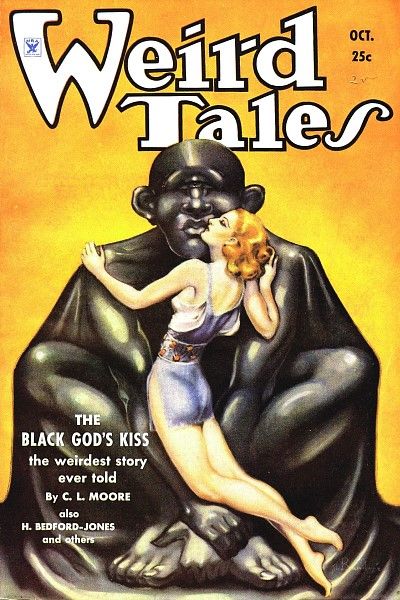
"Black God's Kiss" by C. L. Moore

First appeared in Weird Tales.  Reprinted (in a few genre retrospectives) by L. Sprague de Camp, Robert Silverberg, Martin H. Greenberg, Jessica Yates, Jacob Weisman, David G. Hartwell.

Summary:

Jirel of Joiry, their commander, is brought before Guillaume the conqueror, struggling so fiercely that her captors struggle to hold her despite her ropes.  They remove the commander's mask:  He's a she!

Guillaume forces a kiss on her (presumably of the title).  She bites his neck, and he backhands her.  She awakes in a cell and shrieks.  The guard investigates, and she escapes.

She finds Father Gervase.  She wants a weapon to destroy Guillaume with a weapon from hell.  She descends a circular tunnel.

She encounters a mirror self that tells her to enter, but she refuses.  The mirror self laughs when she seeks a weapon to kill Guillaume. She fights her way out but knows that she must strike or it will strike her.

*Spoiler*

She kills Guillaume with a kiss and immediately regrets it.

Commentary:

This is a surprising one.  The man painted as evil becomes the man of love.  While perhaps intimated somewhat through both of their loves of violence, through the kiss, as a guy it's hard to buy.  On the other hand, there's a long literary history of quarreling lovers--Gone with the Wind, most famously--but usually the two exchange more attempts at love?  Or maybe that's the problem, that she didn't recognize love until it was too late--and the mirror-self knew this unconsciously through the laughter.
"Jirel was... equal in battle to any swashbuckling male hero.... Every male reader loved the story.... [T]he first one remained marginally the best and most original."
--Lester Del Rey,  The Best of C.L. Moore

"If you have read past Shambleau to Jirel, you will probably have noticed what a close relationship the two women bear to one another.... [B]oth were versions of the self I'd like to have been."
--C.L. Moore,  The Best of C.L. Moore

"[H]er work has a texture and emotional intensity[,....] lyrical fluency and the power to evoke a Sense of Wonder in the past-haunted interstellar venues that were her specialty."
--Science Fiction Encyclopedia on C. L. Moore in general.

C. L. Moore on how she constructed stories

Monday, May 5, 2014

"Shambleau" by C. L. Moore

First appeared in Weird Tales.  Reprinted (in several genre retrospectives) by Donald A. Wollheim, Kendell F. Crossen, George Ernsberger, Linda Lovecraft, Wolfgang Jeschke, Alan Ryan, Robert Weinberg, Stefan R. Dziemianowicz, Martin H. Greenberg, A. Susan Williams, Edel Brosnan, Greg Cox, T. K. F. Weisskopf, Leonard Wolf, Garyn G. Roberts, Eric Flint, Jim Baen, David Drake, Rob Latham, Veronica Hollinger, Joan Gordon, Istvan Csicsery-Ronay, Jr., Arthur B. Evans, Carol McGuirk, John Gregory Betancourt, John Pelan.  Online.

Summary:

Northwest Smith rescues Shambleau running from murderous Martians, but murderous in a way he doesn't understand.  He takes responsibility of her and promises not to let her out of his home.  

He sleeps at night, choking in rapture and revulsion until morning.  He tries to feed her but she refuses to eat.  He thinks he sees her hair move beneath her turban.... With the light blocked, she feeds on his psychic energy.  

His buddy, Yarol, checks on Smith, but Smith doesn't want to leave Shambleau. Yarol does what's necessary to free Smith even as Yarol's attacked.  Smith has a hard time shaking himself free.

Commentary:

This isn't just a metaphor for sexuality as Del Rey astutely points out below, but all things that enthrall a man's mind.  He's never the same.  Sexuality, though, is the primary concern.  Moore connects Shambleau to Medusa, the Greek woman who turned men to stone.

"Here for the first time in the field, we find mood, feeling, and color.  Here is an alien who is truly alien.... Here are rounded and well-developed characters.... And--certainly for the first time I can remember in the field--this story presents the sexual drive of humanity in some of its complexity."
--Lester Del Rey on "Shambleau"

"Catherine L. Moore is rightly regarded as one of the most remarkable stylists in the SF field. She once described the basic thread of her fiction as, 'Love is the most dangerous thing.' " 
--David Drake

C. L. Moore on how she constructed stories, "Shambleau" in particular.

Monday, March 24, 2014

"The Dunwich Horror" by H. P. Lovecraft

First appeared in Weird Tales, reprinted by Phyllis Cerf Wagner, Herbert Wise, Betty M. Owen, Robert M. Price, Tom English, Gwendolyn Toynton, John Gregory Betancourt, Colin Azariah-Kribbs, Jeff VanderMeer, and Ann VanderMeer. 

Other Media: 

Online. Audio drama. Recent movie (decent camp for low-budget/acting quality--3.7 out of 10 on IMDB--although I must admit it's not especially faithful and I skimmed parts). Hard to find good images illustrating the story although I left out a semi-accurate if gruesome one.


Summary:

Dunwich recently* had troubles that were hushed up. Satan and his minions have been a close part of the New England community since it was first founded--if you believe the rumors, which the narrator does not, at first.

We focus on the Whatelys, a decadent,** homely, goat-looking lot. In 1913, Lavinia gives birth to Wilbur, who frightens the village. He grows up too quickly and seven-feet tall. The community steer clear of the house where screams and an awful stench emanate. People disappear. Even the mother disappears. The people blame the boy.

Wilbur shows up at the Library, seeking a copy of the Necronomicon, especially page 751 (which adds to the unlucky 13). The librarian says no, but Wilbur returns only to die to a librarian guard dog. Wilbur decays before the villagers' eyes.

No, Lovecraft does not end there. He is a writer of scope. The monster still in the house is famished. It prowls the countryside to abate its hunger.

Commentary:

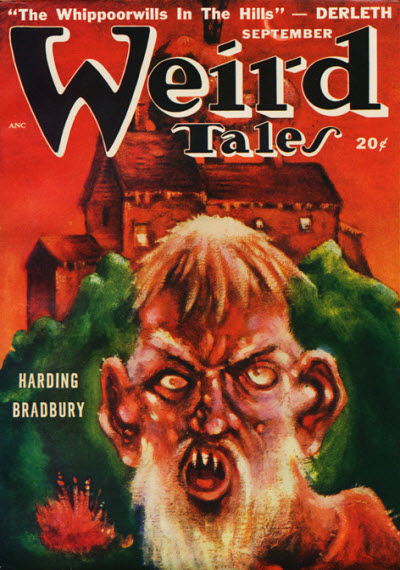
The whippoorwills add a nice touch of creepiness, signaling imminent death. What's cool is that whose death is signaled remains masked until their death.

The monsters themselves are like a scale of creepiness that Lovecraft ascends, which he called "so fiendish" that no one would want to print it. Little wonder. We have the boy who is humanly grotesque--even if his end comes too quickly and undramatically. Far worse, we have the monster, hungry, prowling the countryside in search of food. Nothing can keep it out, and it smashes locked doors, climbs sheer cliffs. S.T. Joshi dismissed the tale as one of good vs. evil, where good triumphs, but Lovecraft implies yet a third entity. The humans have surmounted the brothers, but not their father, whom presumably they cannot surmount.

The key trouble is character, which is not Lovecraft's strong suit. If he'd created personalities of dimension, Joshi would not be able to call it "stock." (I need to revisit "The Hound" which was my favorite at one time--interesting characters, memory says.)

Nonetheless, one character bears fascinating aspects. Professor Henry Armitage--the librarian who refuses Wilbur the book--shares his knowledge of arcane data, takes it seriously, and uses it. This is very different from the standard genre story. I once mentioned in a workshop with James Gunn that astronauts would have read various SF authors. While SF writers pay tribute to the old masters, one was not to reference those works directly--odd considering that the future will involve those who have read such authors. Here, though, Lovecraft references those stories directly. They prepare Armitage, which is a relief for readers familiar with the genre who ask, "Why does everyone have to be so stupid?"


*Okay, 1928, but that's while Lovecraft wrote the tale and a year after it was published. When revisiting Lovecraftian realms, writers tend to return to the twenties. Clearly, Lovecraft flipped back to the past but primarily set his stories in and addressed his day, but to revisit Lovecraft, addressing one's own day may keep with Lovecraft's spirit.

** It's hard to know what Lovecraft means by this term except that it is bad. Like many of his excessive adjectives, it may serve no other purpose than to create atmosphere.

Friday, March 21, 2014

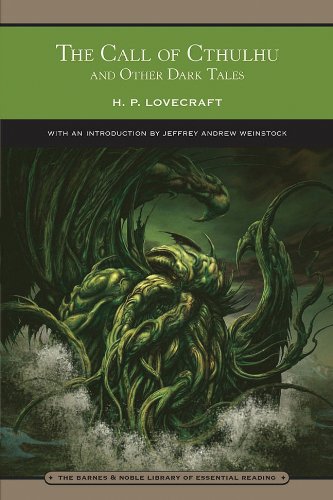
"The Call of Cthulhu" by H. P. Lovecraft

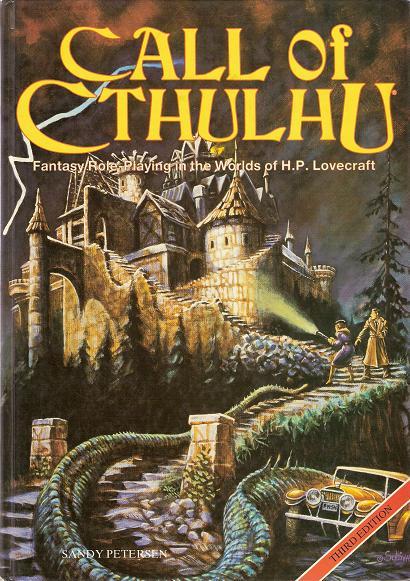
First appeared in Weird Tales, reprinted by T. Everett Harré, August Derleth, Peter Haining, Les Daniels, David G. Hartwell, Robert M. Price, Leslie Pockell, S. T. Joshi, John Gregory Betancourt, Colin Azariah-Kribbs--gaining more import in later years. It has spawned a movie, role-playing games and a radio drama.

Due it's piecemeal construction (a format I'm usually fond of if the sum is more than the parts) and Lovecraft's focus on mood over plot, this story challenges summary--at least, the through-line is tenuous.

I. The Horror In Clay

The narrator finds an evil-looking statuette made by an artist who, like many artists during a certain period in New England, became sensitive to vile dreams and visions. The narrator's uncle had the artist write down what he half-remembered of his dreams, which mostly consisted dripping caves and a half-seen monster.

II. The Tale of Inspector Legrasse

The reason Professor Angell is interested in these dreams is because he'd run into a New Orleans cult, which had a similar sculpture. Their voodoo is more vile than any other.

After deaths and arrests, they find the cult is based around beings who came to Earth and slept, waiting to be revived and bring doom.

The narrator is suspicious of his uncle's death.

III. The Madness from the Sea

After meditating on the confluence of events, the narrator gets a hold of papers to locate this beast on a Pacific island. Cthulhu is awakened. They barely escape with their lives.

Commentary:

While Robert E. Howard and Michel Houellebecq consider this one of Lovecraft's best, E. F. Bleiler called it "a fragmented essay with narrative inclusions". Both views shed insight. The piecemeal effect creates a sense of deep-time, as if this has a long history. The style is much like an essay, but much of Lovecraft has a distancing effect as if it were an essay written more for veracity than for moving the reader. Events are told at a distance both in time and at a remove through secondary narrators. We do not feel the events directly.

In fact, both of these effects are often seen. It's fascinating the amount of effort Lovecraft goes to prove veracity. Whereas if a modern author had a character say, "I am not insane!", we would automatically categorize him as such; with Lovecraft we tend to trust his verification, as events appear to back up testimony. Moreover, it is generally the rational who go insane--lovely paradox--as perhaps they must if they encounter true knowledge of the universe. So why does Lovecraft verify?

Monday, April 29, 2013

Book Briefs: Nina Kiriki Hoffman's Courting Disasters & Author's Choice

Courting Disasters and Other Strange Affinities 
Nina Kiriki Hoffman
Wildside Press

Collection nominated for a Locus award.

"Compandroid" [Science Fiction Review; Second Science Fiction Megapack] is programmed to help a woman's son, but some of her wipe keeps peeking through.  Moving tale of how an almost-person keeps breaking through, forging her own personality despite wipes and changes people try to make to her.

"Little Once" [Weird Tales; Best of Weird Tales] was the little child of the mother protagonist.  She seems a bit off, trying to kill her child, trying to sell it.  When she does manage to pawn it off, we get the sense that maybe it isn't she that's off but the child itself, but then we learn the apple doesn't fall far from the tree.

"Courting Disasters" [Weird Tales; Best of Weird Tales]  Simon has just got out of a car accident.  He lies in a hospital where his girlfriend, to whom he has not been kind.  He has visions of his accident where he sees it from three perspectives: his, his cars and the nearby tree, which not only keep him live, but also possess/haunt him.  He befriends a boy about to lose his life and confronts his old girlfriend.  This is a story of letting go (although Simon hasn't been kind, I'm not sure I understand his reasoning for behaving poorly to begin with nor his renewed spurning--except maybe he's afraid of repeating the past.  Nonetheless, the speculative play is fascinating with a fantastic final line that sums up the tale well:
"Underneath the bandages, he knew there were bones of wood, bones of steel, and safe within, a human heart."

Author’s Choice Monthly Issue 14: Legacy of Fire 
Nina Kiriki Hoffman
Pulphouse

"Savage Breasts" [Pulphouse; Best of Pulphouse; Smart Dragons, Foolish Elves]  Formerly flat-chested, the narrator cuts out a comic-book ad from Charlotte Atlas and starts the exercises.  When her boyfriend tries to befriend them, they knock him out.  At work, her breasts interfere with typing, so her boss says it's okay not to work, but she looks pretty these days.  Her boss introduces her to Mr. Weaver, a big account for the company, but of course, when he tries something...  Humorous.  Probably a classic of its kind.