Search This Blog

Showing posts with label William Wordsworth. Show all posts

Friday, March 6, 2020

Reading William Wordsworth (III)


“Ruth” is a moving poem and would be merely tragic except for this idea of maintaining the wonders of childhood. It draws on the conclusions of “Nuns Fret Not” and “My Heart Leaps up”. It begins in her childhood and skips to her falling for a man from America, who seems to have tamed the wilds of the West, but he abandons her, so that she has to be placed in mental institution, but she gradually regains the practice of her youth of living in Nature. One might argue that she has merely gone insane, but not for Wordsworth. It is a bleak comfort for her and for himself that she who has lost so much can regain comfort in the world outside.

When Ruth was left half desolate,
Her Father took another Mate

It could be that Ruth’s mother took off (which would mirror her spouse’s abandonment), but it sounds like her mother died. Nor does it sound like the child was paid much attention to once the father remarried, calling her “slighted,” so she turns to nature “In thoughtless freedom, bold.” She makes a straw pipe playing sounds that mimicked nature’s winds and floods. She plays there enough until it’s as if she were born there, her natural habitat:  “an infant of the woods.” In her father’s she only “seemed to live” while “Herself he own delight; / Pleased with herself.”

Interestingly, she doesn’t grow to become a woman but “grew to woman’s height” which might be a good thing according to Wordsworth. She marries the American, is abandoned and goes mad in this awful yet wonderfully worded way:

with many a doleful song
Made of wild words, her cup of wrong
She fearfully caroused.

She becomes a vagrant, begging for food, living in nature or in a barn during the winter and, to cheer herself, plays a flute made of hemlock stock (hemlock is a poison, so it’s bittersweet), until

Among the fields she breathed again:
The master current of her brain
Ran permanent and free

The Lucy poems together constitute a lyric sort of narrative that many have found sad yet pleasing as the speaker mourns the death of Lucy. The poems are largely self-explanatory. I’ve seen them arranged differently, so it’s hard to tell their best arrangement. However, “Strange Fits of Passion” seems to suggest the speaker merely imagines her dead: “If Lucy should be dead!” which is the last line which may explain the first: “Strange fits of passion.” He imagines her dead and so the horse quickens its pace. It isn’t clear, though, if the pace quickens because of the speaker, of the horse (eager to get home) or of the horse sensing the speaker’s passion.

Alternately, if Lucy dies prior to the speaker’s being told and he senses it somehow, that would be strange—even supernatural.


Friday, February 28, 2020

Reading William Wordsworth (II)

“I Wandered Lonely As a Cloud” continues the theme of what nature has to teach us. (The title is the first line, so you might see variations on what someone might title the poem.) That first line is so curious and provocative that you’ll hear people quote it as the meaning is layered. Sometimes it’s hard to shake off pondering its meaning. Is it a literal man who compares himself to a cloud? Or is he a literal cloud? What does it mean to be a cloud? Why is the cloud lonely? (Visually solitary, perhaps far from others.) He both is and is not a cloud. Perhaps his thoughts were elsewhere or maybe is surveying the scene below as a cloud: “high o’er hills and vales.” He’s playing this ambiguity up.

In reality, Wordsworth wasn’t alone but with his sister, but the line works for the poem. The loneliness is brought into contrast with a “crowd” or “host” of daffodils. Those words indicate a large number, but they also indicate grouping as well as meaning. At first the daffodils are a crowd, which people often feel left out of, but they soon become a “host” so that the speaker feels invited to join as a guest, which serves the poem. The daffodils dance in a manner that remains with him—long afterwards as he recalls as “wealth the show to had brought” since it transforms melancholy into joy at the recollection.

“My Heart Leaps up” not only aids “Ode: Intimations of Immortality from Recollections of Early Childhood,” which borrows the last three lines but also his long narrative poem, “Ruth.” The opening of “My Heart Leaps up” mirrors “I Wandered Lonely As a Cloud” except at the wonder of rainbows this time. On this occasion, though, he is pointing out how the rainbow had an effect on him as a child (the effect he calls “natural piety” – a kind of religion or respect or reverence of nature—see also Genesis 9. Note the contrast of Nature combined with human intellectual practice of faith as if they belonged together as “natural”). It still affects him as a man and hopefully, as an elderly man, which begets the famous line “The Child is father of the Man.”

“Nuns Fret Not” is one Wordsworth’s best. He details how people can be happy living and working in small rooms at small jobs:

The Hermits are contented with their Cells....
the prison, unto which we doom
Ourselves, no prison is

The only problem—if it is a problem—is that it concludes upon itself: the sonnet. That there is solace in small things. It recommends itself and the form through looking at these other people, things and occasions. As if the sonnet or poetic form were a greater jar. Most would not claim a poem has greater worth than people. But of course a poem can attempt to contain people and this small poem stood in rebellion against previous ideas of what poetry should be. Or maybe it can be reversed or re-versed to suggest the opposite: that the sonnet can be satisfying as small, so can we be.

Friday, February 21, 2020

Reading William Wordsworth


            A good poem to start with may be “Expostulation and Reply.” While not his finest, it establishes his viewpoint and demonstrates some of his strengths. It originated with his “[good friend Matthew] who was unreasonably attached to modern books of moral philosophy.”

It begins and ends with similar phrases but transforms the feeling towards those phrases by the end (Note: the first is spoken by Matthew, the second by William):

“Why, William, on that old grey stone,
Thus for the length of half a day,
Why, William, sit you thus alone
And dream your time away?”

vs.

“Then ask not wherefore, here alone
Conversing as I may,
I sit upon this old grey stone
And dream my time away.”

This frame is simple yet very satisfying: Why do you do this? That’s why I do that. It works so long as the middle carries through on the promise and it does. Matthew gets brilliant turns of phrases put in his mouth:

“Where are your books?—that light bequeathed
To Beings else forlorn and blind!
Up! up! and drink the spirit breathed
From dead men to their kind.

“You look round on your Mother Earth
As if she for no purpose bore you.”

William is wasting his time and not studying great books. “Spirit” is a wonderful pun or double entendre, meaning the spirit of the dead and the spirit of alcohol. Note, too, the contrast of drinking breath and a supernatural existence.

William’s reply:

“Nor less I deem that there are Powers
Which of themselves our minds impress
That we can feed this mind of ours
In a wise passiveness.

“Think you, ‘mid this mighty sum
Of things for ever speaking,
That nothing of itself will come,
But we must still be seeking?

“Then ask not wherefore, here, alone,
Conversing as I may,”

Again, we have contrasts or strange pairings. Passiveness is assumed to have wisdom as an attribute, a phrase which Quakers apparently loved. William is not only listening to nature—“this mighty sum / Of things for ever speaking”—but also talking back in this additional contrast: “alone / Conversing.” Conversing assumes a partner, but he is alone.

A companion poem “The Tables Turned: An Evening on the Same Subject” expands on this. The title and others suggest there is disagreement between the two poems, but to my ear it is simply more deeply exploring the same theme. The turned table may simply be that the philosophically attacked speaker in the first poem becomes the attacker:

hear the woodland linnet,
How sweet his music...
There’s more of wisdom in it....

the throstle sings....
no mean preacher....
Let Nature be your Teacher....

a vernal wood
May teach you more of man...
Than all the sages can....

Nature is our teacher, not men. Here, we get find out what the “mighty sum / Of things for ever speaking” finally is. “Man” is meant to include women especially since women are also his companions and appear in his poems sympathetically. Also the term “woman” includes “man” –perhaps a man with a womb. But this potentiality has been discarded. Again, “the past is a different country.”

Our meddling intellect
Mis-shapes the beauteous forms of things—
We murder to dissect.

Enough of Science and of Art.

We screw things up with thought. It sounds like Wordsworth opposes science and art, but obviously he is writing a poem and in “Composed upon Westminster Bridge, September 3, 1802” he lumps nature with the things of men, perhaps because men are things of nature (more on this poem later).

But he also does so below in this poem:

Close up those barren leaves.

“Leaves” are both a thing of man-made books (which he writes) and things that grow on trees. And obviously to read the poem (at least before computers), one has to read them in a book. But for now, there are times when nature is the teacher, and we must listen.


Thursday, July 11, 2013

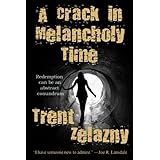
Review: A Crack in Melancholy Time by Trent Zelazny


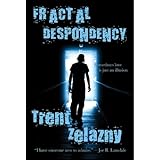
Crack in Melancholy Time (great title) is the sequel novella that began with Fractal Despondency.

Blake Gladstone has lost Sarah, his girlfriend, to suicide and doesn't know if he should join her.  Worse,  he loses another, Denise [Fractal Despondency treats their relationship].  Homeless, jobless, but full of alcoholism and cigarettes, he slinks home to Santa Fe.  Visions and memories of his old girlfriends return as he struggles with survivor guilt. He has to face his miseries and miserable thinking.

Blake gets a second (or third chance) with Laura, an old high school friend who's as lost,  and messed up with alcohol ss he is.  If he can save her, maybe he can save some of what he's lost.

Another reader compared these novellas to Charles Bukowski.  I immediately disagreed until I reread it.  Yes, they differ in humor and tone, but they share a concern for capturing the dark hole some have struggled to climb out of.  The events are a bit discombobulated, mirroring the title and Blake's own mind.

Whether you should read this depends on where you stand on these two aesthetic matters:

  1. If you groove on the opening line: 
  2. "A sad-voiced specter with piercing eyes flitted in the nightime as dewy air filled the malevolent room."
  3. and if you agree with William Wordsworth's idea that art should be "emotion recollected in tranquility" [Preface to Lyrical Ballads William Wordsworth (1800)].  This is a direct feed from the raw, real emotion, written when similar events had just occurred to the author. 
Good line:
  • "Her balance was that of an antique doll."