Search This Blog

Showing posts with label Fredric Brown. Show all posts

Tuesday, May 16, 2017

Star Trek: Season 1, Episode 18. "Arena"

 Summary:
As the officers visit Commodore Travers on Cestus III, Travers request tactical people as he has an interesting problem. When they beam down they find the colony outpost destroyed. After they find life a mile away, they are immediately under attack.

Analysis with spoilers:
Kirk believes the messages he'd received from the Commodore were faked. Red shirt dies. Meanwhile, Enterprise is under attack. If they lower shields to beam up officers, they would be vulnerable to attack, so Kirk orders shields up and retreats.

Kirk dashes and tumbles to an artillery depot. When Sulu's attacks against alien vessel are ineffectual, Kirk advises them warp away. Spock believes, when the aliens are moving, he must join Kirk. They fire a type of grenade that causes aliens to beam away and flee. Kirk decides to search for survivors. Enterprise returns.

Survivor explains ruthlessness of the aliens in battle even though the colonists tried to surrender. He also states that they never sent the Enterprise any messages. Kirk concludes that the Enterprise was lured to be destroyed in order invade their space. The Enterprise pursues.

Spock and Kirk debate over the need for retaliation. Kirk is decided that they must be destroyed. They pass a system that stops them both. The Metrons have stopped both. Federation ship captain must fight the Gorn ship captain. The losing captain's ship will also be destroyed.

The scenario matches the common saying where kings, presidents, and tyrants should fight the wars.

The battle here differs from Brown's. There is no barrier. The Gorn is a lizard (as opposed to a tendriled roller) and stronger if slower than Kirk. Kirk believes he is smarter, but the Gorn listens in as Kirk records his plans. Kirk hunts for weapons while the Gorn builds them. Kirk drops a boulder and thinks he has the Gorn, but it rises. Kirk flees into a trap. Kirk escapes but is exhausted.

The Metrons tell the Enterprise that Kirk is done for and to prepare to die. Nonetheless, Kirk dashes down hill. Meanwhile, the Enterprise watches on screen and suddenly, they understand the Gorn might have been defending their own space against the human invaders.

Meanwhile, Kirk invents gunpowder as the Gorn approaches. Kirk succeeds but decides against killing the Gorn. The Metrons free both parties without killing. Enterprise zapped back toward home.

Quotes:
  1. Spock: "Doctor, you are sensualist."
    McCoy: "You bet your pointed ears I am."
  2. McCoy: "We appeal to you in the name of civilization. Put a stop to this."
    Metron: "Your violent intent and actions demonstrate you are not civilized."
  3. Kirk: "We're a most promising species as predators go."

    Notes:
    1. Red shirt zapped.
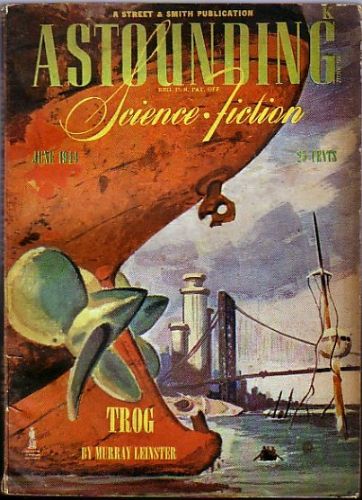
    2. Not only is this episode based on Fredric Brown's "Arena", it also alludes to Murray Leinster's "First Contact" as a kind of framing device with slightly different outcomes (Enterprise instantly transported back into familiar space as opposed to swapping ships.
    3. Sustained Warp speed 7 is dangerous.
    Sunday, May 14, 2017

    "Arena" by Fredric Brown

    First appeared in John W. Campbell, Jr.'s Astounding. Reprinted in several major retrospectives by Groff Conklin, Carol Mason, Patricia Warrick, Anthony Cheetham, Stephen V. Whaley, Stanley J. Cook, Bonnie L. Heintz, Frank Herbert, Donald A. Joos, Jane Agorn McGee, Brian W. Aldiss, Harry Harrison, Edward L. Ferman, Barry N. Malzberg, Robert Silverberg, Isaac Asimov, Martin H. Greenberg, David Drake, Charles G. Waugh, Edel Brosnan, Debbie Notkin, Roger Stewart, Garyn G. Roberts, Winston Engle, John Gregory Betancourt, Ian Watson, Ian Whates. Filmed as a Star Trek episode by the same name.

    Summary:
    After spotting an Outsider scouter beyond Pluto's orbit, Carson almost crashes into a planet. The g-forces cause him to black out. He awakes, naked, on a blue-sand planet--not even a planet, but a hemisphere bordered by force fields.

    A voice enters his mind and tells him he must destroy the alien that is rolling in the sand. Roller, he calls his enemy. Carson makes a telepathic link with the Roller to make peace but fails. The Roller only wants to fight.

    Analysis:
     They cannot get at each other directly, but by the Roller's killing and throwing a lizard, they learn the projectiles work fine. Carson has the stronger throwing arm and forces the Roller back. Carson, already parched, has a gash in his leg. He tries to patch it with local vegetation, but that only seems to make it worse. Meanwhile, the Roller has constructed a catapult. He manages to destroy it, but he is weakening. It makes another.

    Later, he discovers that the Roller's de-legged lizard is actually alive. It was lack of consciousness that allowed through the barrier. Carson uses this information to cross the barrier and hopes the Roller throws a rock at him to revive him through pain. The Roller obliged Carson bides his time to attack.

    Some interesting comparisons/contrasts with the Star Trek episode:

    1. The human is the stronger party in the story, the Roller more agile.
    2. No barrier in the TV episode. This also leaves them nothing but older, primitive technologies; whereas in the story, the barrier becomes a kind of technological tool if not a direct weapon.
    3. The story's lizard who is something of an indirect ally in the story becomes the enemy in Star Trek (although perhaps they are later allies--or at least, no longer enemies).
    4. The Trek episode works better as anti-war theme--both because the captains have a go and because Kirk chooses not to continue the fight to the death.
    5. However, what works better for the story was the importance of the little guy. SF is full of important, epic characters. Here, the little guy gets his chance at the limelight.

    Tuesday, May 12, 2015

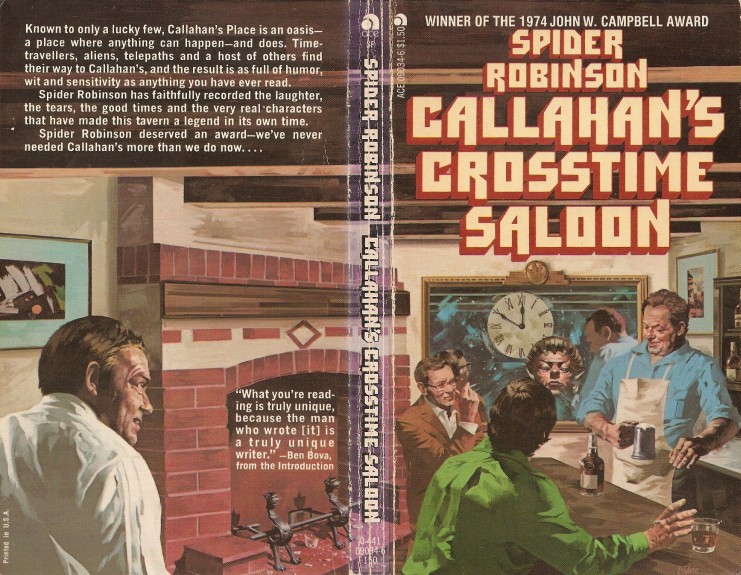
    The Callahan Chronicals: pt 2 Callahan's Crosstime Saloon by Spider Robinson

    Other discussions of The Callahan Chronicals:
    1. pt 1 Callahan's Crosstime Saloon
    2. pt 3 Time Travelers Strictly Cash 
    3. pt 4 Callahan's Secret
    Summaries and Commentaries with spoilers:
    • Law of Conservation of Pain: First appeared in Vertex. The meddler, a real time-traveler from the future [1995] arrives at 1974 Callahan's. He wants to save Bobbie Joy, a painful singer to save her from the destruction of the life, to spare her from future pain, which would also keep her from writing a famous song.
    Commentary: Consequences of his altering time may be that pain shows up. The bar flies come up with a peaceful solution to killing the cop that will rape Bobbie Joy. The time-traveling belt given to bar to destroy... although why he didn't do it himself isn't explained.
    • Just Dessert: Young men drink ungodly amounts of alcohol. Suddenly the ugly one barfs. His buddies eat it. 
    Commentary: Not SF. The barf is beef stew. Apparently, the act angers the barkeep. Doc, who guessed the outcome, happens to have a bottle of ipecac and slipped some to the boys. 
    • "A Voice Is Heard in Ramah...”: First appeared in Analog. A woman, Rachel, shows up at Callahan's. She puns and is accepted by the bar flies. She turns out to have lived 232 years. She weeps when she hears a toast to motherhood.
    Commentary: She says she's more aware of death since she's lived longer. Her case seems hopeless until Eddie offers that she clones via cryonics. This one has a great central conceit that could have used a few more specifics and development.

    The title quote comes from Jeremiah 31:15 and Matthew 2:18: "A voice is heard in Ramah, mourning and great weeping, Rachel weeping for her children and refusing to be comforted, because they are no more." The context of Matthew is Harrod's slaughter of Jewish boys to kill, fulfilling Jeremiah's prophecy. Jeremiah, employing the voice of God, concludes: "Restrain your voice from weeping and your eyes from tears, for your work will be rewarded.... They will return from the land of the enemy."
    • Unnatural Causes: First appeared in Analog. Michael Finn returns, says he's been working in agriculture, using his advanced eyesight, which sees into the IR range. Michael spots an alien like himself. Tony, a Vietnam vet, deals with his past: how he became a cold killer. 
    Commentary: Tony turns around after hearing his pacifist buddy, Steve, had been killed in a military prison. Trancedental meditation and Callahan's turned him around. Meanwhile, the alien asks for absolution for creating dissension among the humans to breed them for chow (humans did the same with their food). Earth is a game preserve. But without actions, without penance, none in Callahan's would forgive him.
    • Wonderful Conspiracy: People come to Callahan's when they need to. The regulars actually pay attention to their families
    Commentary: Not really a story but rather a talk of how different a bar this is. It presents one of two references to Fredric Brown's "The Weapon" [link to discussion].
    Series Commentary:
    Explanations spring up, saying that Callahan's doesn't create alcoholism, but it's opposite: moderation, or even abstinence from drink altogether. Callahan doesn't allow drunkenness, at least not without a cab. One suspects that Robinson might have received complaints about glorifying alcohol and addressed the matter as stated above.

    These stories extend the series' camaraderie. They have a few surprises and unusual circumstances, but they're the nadir apart from "Unnatural Causes" which provides a nice contrast to "The Guy with the Eyes." Other stories have interesting concepts, but don't build them enough. The series improves after this.

    The stories have a rhythm to them. 1) Group shenanigans: jokes, puns, tall tales; 2) newcomer looks bummed and is asked why; 3) newcomer's tale presented; 4) Group resolves problem; 5) Brief joke/pun related to newcomer (sometimes). This might be related to 1) status quo, 2) inciting incident, 3) conflict, 4) resolution, 5) denouement. However, these stories tend to linger on step 1. Expanding the sense of camaraderie is clearly seen as critical as the presenting and solving the problem itself.

    Monday, October 13, 2014

    "The Weapon" by Fredric Brown

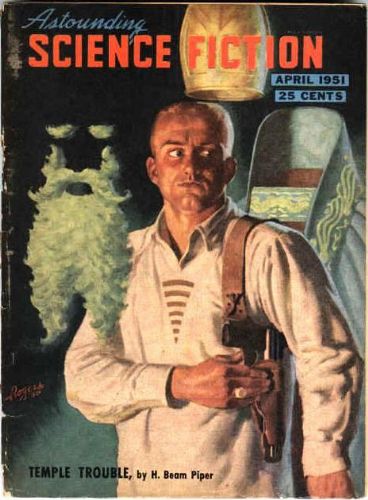
     https://isfdb.org/wiki/images/6/61/ASTAPR1951.jpg

     First appeared in Astounding. Reprinted by Groff Conklin, Michael Sissons, Isaac Asimov, Terry Carr, James Sallis, William F. Goodykoontz, Theodore W. Hipple, Robert G. Wright, J. E. Pournelle, Martin H. Greenberg, and Gregory Benford.

    Summary:
    A stranger named Niemand enters Mr. Graham's house. Niemand has come to get Graham to rethink his weapon, but Graham is uninterested, not to mention annoyed, wondering how to rid himself of the stranger. When Graham fetches a drink, Niemand visits Graham's mentally handicapped son, Harry. He gives Harry a gift. When Graham sees what it is, he sweats.
    Commentary & Spoilers:
    "only a madman would give a loaded revolver to an idiot."
    What Niemand has done is paralleled Graham's action in a cruel way. The gun, of course, is a nuclear weapon, and the idiots whoever is in charge of them. Depending on your perspective, you may or may not agree that the metaphor is perfect, but it provokes thought.

    Brown signals immediately what he's up to:
    "The room was quiet in the dimness of early evening."
    Earth, too--this room we inhabit--is ultimately a limited space. When discharging something so sweeping as a nuclear bomb, the effects spread, making the Earth feel smaller. The dimness also presents a problem in limiting our ability to see. And it is evening, or the death of day, should a grand nuclear war occur.

    Like M.R. James' "Casting of the Runes," we can't be certain who the madman or mad scientist is in this case. Possibly both. Niemand made his point, but his ethics are dubious at best. The same could be said of Graham.

    This is not only one of my favorite Fredric Brown stories but also a favorite in SF. Brilliant execution. Go forth and read.

    Notes:

    1. Niemand means "nobody" in German.
    2. Graham means "gray home."
    3. Harry means "persistently harass." 
    4. Chicken Little -- the chicken who said "The sky is falling" although it was not. Niemand hopes this story is always true.

    Monday, January 27, 2014

    Analyisis of "The Last Question" by Isaac Asimov and "Answer" by Fredric Brown

    Brown's: First appeared in his collection, Angels and Spaceships, 1954. Online. Audio. Reprinted at least seventeen times (including genre retrospectives) by Edmund Crispin, Damon Knight, Brian W. Aldiss, Abbe Mowshowitz, Dennie L. Van Tassel, Isaac Asimov, Martin H. Greenberg, Joseph D. Olander, Herbert Kaußen & Dr. Rudi Renné, Patricia S. Warrick,  T. E. D. Klein, Michael O’Shaughnessy, and Andrew Goodwyn.

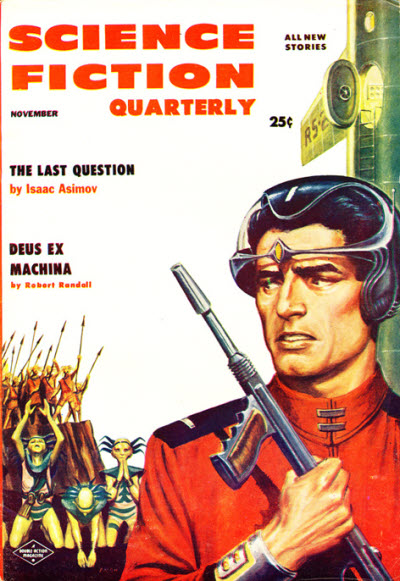
    Asimov's: First appeared in Science Fiction Quarterly, 1956. Online. AudioReprinted at least eleven times (including genre retrospectives) by L. Sprague de Camp, Catherine Crook de Camp, Brian W. Aldiss, Frederik Pohl, Isaac Asimov, Martin H. Greenberg, Joseph D. Olander, Josh Pachter, Thomas F. Monteleone, Andre Norton, Ingrid Zierhut, David G. Hartwell, and Kathryn Cramer.

    Here are two classic stories people tend to confuse. They even appeared together in the same anthology twice, side by side. Jim Baen wrote:
    "I read "Answer" some years after I'd read "The Last Question." My first thought was, "It's the same story!" 
    But it wasn't the same story. It wasn't anything like the same story. It just happened to have the same plot. 
    That realization made me much less concerned by "originality," because I began to see that nothing was really original, and I became much more concerned about story values. Over the years I've built three SF lines on that principle."
    Reading this was a relief because after years of not reading them, I tend to forget which is which although they should more easily distinguished.

    Brown's appeared two years earlier and was reprinted shortly thereafter while Asimov's first reprint was sixteen years after its initial appearance. I find it odd that "Answer" did not find a literary home until his collection. It has a classic feel to it, and it's hard to shake it from your mind.

    Brown's is focused on the humor/horror of it all. Asimov on the cosmic ineffability. Both ask different questions in the far future but arrive at the same answers, if to different effects. Both resonate long after you've read them.

    Spoilers:

    "Answer" tells of two far future guys who ask if there's a god. "There is now!" Zap! The switch to turn off the computer is fused shut (on/open?).

    "The Last Question" is more patient in its unraveling. Over the millennia, as humanity spreads across the universe, people ask can we reverse entropy and start again? The great computer that spans space and time keeps mulling over the question, long after the suns have burned out. Finally, it figures it out and says, "Let there be light!"

    Both are rationalist explanations of how a god could be created. Although Brown's is horrified at the possibility (at least, of a computer god), Asimov's is accepting as part of the natural, cosmological continuum.

    It looks like the tales will last another generation or two more.

    Monday, June 10, 2013

    "Mouse" by Fredric Brown

    First appeared in Thrilling Wonder Stories.  Reprinted in Everett F. Bleiler and T. E. Dikty's Best Science Fiction Stories and in Ellen Datlow's Sci Fiction.

    Bill Wheeler witnesses a cigar-shaped alien ship landing in Central Park.  Inside lies a mouse that has died.  Six days later (enough time to remake the Earth), calamity in various guises strikes different countries.  Bill explains to his cat that whatever inhabited the alien mouse has escaped and is wrecking havoc.  As Bill draws nearer the truth, something unexpected occurs.

    Ironic title that mirrors all of the underestimation that goes on by the humans involved--in how the title relates to the cat and how the cat was at one point favorably compared to a wife.  Serendipitously, this mirrors research showing how cats have an effect on their owners.

    Commentary elsewhere: