Search This Blog

Showing posts with label mystery. Show all posts

Tuesday, April 25, 2023

The British TV Mystery -- Successes, Drawbacks

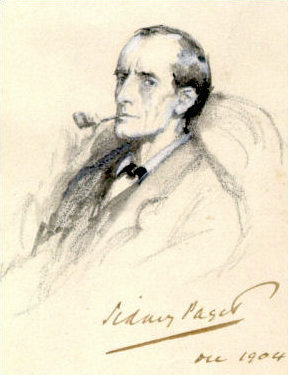
 Sherlock Holmes Portrait Paget.jpg

The British are known not just for their rich literary history but also for their mysteries: Sherlock Holmes, Miss Marple, Hercules Poirot. It's their most common export to American television.

My parents used to stay up to watch British mysteries--a highlight of their Sunday evenings--preferring their intellectual engagement over the American variety although they watched American variety as well. Dad, despite or because of having been in the FBI, never lost his penchant for police investigations.

Mom, however, has become a powerful story-telling barometer. If the story is good enough, she'll stay awake. If not, she sleeps. It's not that she does this intentionally, but a good story will keep her up. Show her a literary adaptation, and she'll remain rapt.

Now why should she still love British mysteries if half lull her to sleep? One thing they're selling is their culture. What is ordinary life in England like? They often will show a pub, a committee meeting, a family home, a school house, a police department. Whatever. How aware they are of this? Keenly? Or not so much? Americans at least recognize it as one sponsor is a cruise line that briefly advertises at the beginning and end of a show. So the mystery is a vicarious travelogue.

Clearly, this alone, however, won't hold one's attention

There's almost always a status quo scene, which American shows may skip. But it plays a vital part of setting up the story. Now if done right, the status quo scene(s) can hold one's attention. An episode of Midsomar Murders Spanish dance scene at a local dance hall that held fairly strong tension as people displayed their attitudes. This led into the first murder. 

These status-quo scenes can be rich and powerful opportunities not just for culture, but also character, which can make the mystery memorable. But sometimes the British mysteries trudge a bit too slowly--I'd qualify this "for American taste" but how is that we remain rapt for the British literary adaptation? 

Beside tension and characters, another powerful draw is the unraveling through-thread that provides a pull throughout the story. It is the scaffolding that allows us to cobble together the story from the investigation. Take the compelling game of the power of attorney in "Sauce for the Goose." While the murder itself may be absurdly improbable, the unraveling of this game of power is riveting.

I'll come back to this topic again later.

Saturday, July 3, 2021

"Common Scents" by Jody Lynn Nye

 Appeared in Unidentified Funny Objects 6. 

Dena Malone, an investigative partner with the muscular Ramos, keeps a wrist bangle that speaks for the alien symbiote in her peritoneum, Dr. K't'ank. The alien is a "straight man" and laughs at jokes at its own expense.

A body is found, reeking. Only Dr. K't'ank appreciates it. It turns out that scents are the bottom of it--playing off aromatherapy, raising it to a science.  

A solid science fiction mystery, which delivers puns and reworking standards for this particular universe she's created. 

Wednesday, February 24, 2021

Resident Alien

SyFy Channel's Resident Alien, so far, seems worth seeking out. After viewing the trailer for this I set the DVR--a little humor, a little SF, a little mystery.


The first episode was chockful of juggled balls . The second dipped, but the third and fourth bobbed back up (IMDB viewers seemed to agree on a slight dip, but they also dipped on #3, which I did not).

Note: If you like zero discussion of shows you haven't seen, stop reading and go watch. No spoilers here, really--well, not exactly.

The amazing thing is how Alan Tudyk had to die again although this death allows him to play his role. He does a good job, usually, of mimicking what his alien counterpart: a crash-landed alien who has to pretend to be a human doctor in order to collect parts while relatively unnoticed. What's well done here is in what directions his expertise might lie. What requires some hand-wavium is his ability to look up what he needs on the internet.

One kid, Judah Prehn's Max, recognizes him for what he is. Given how the alien adapted, this also requires hand-wavium. While their relationship kicks off well and takes a surprising darkly comedic turn, it doesn't really kick in until Max takes action.

Sara Tomko and Alice Wetterlund are highlights--their freewheeling humor. Their characters' daunting task is to make Alan's alien somehow human. Sara's task seems even larger given her closeness to the alien at work and the embarrassment he causes, but her acceptance of him only serves to make her more endearing. The humor went darker than I expected, and the uncovering of a mystery, so far, is limited. It's more SF than mystery. So far. But there's plenty to enjoy. I do worry that they'll set up a second season without ending this one first. So far, it only seems to be enough for one season's drama. Possibly more. Hopefully it will some sense of closure before tacking on a second season. However, maybe by the end, I'll be persuaded otherwise.

Wednesday, February 19, 2020

The Godfather by Mario Puzo -- novel vs. movie (part I)

As always, there will be spoilers; however, I try to limit and minimize them, describing obliquely.

Many have seen the movies. Until I saw Francis Ford Coppola’s movie, I wasn’t particularly drawn to mob movies. But this one etches in the mafia way of thinking. It’s a culture, a way of life that is like living in a foreign country. On my first viewing, I enjoyed the trilogy as a whole although some knock one film or another.
See the source image 
I just read (and reread) the book to compare. When one thinks of a mafia story, one thinks of creative deaths—concrete boots, strange burials—where often the punishment fits the supposed “crime,” blood baths, riches, luxury, women, paid protection, gambling, booze, angry revenge, vendettas, etc.
Puzo does some of this; however, he focuses on the family aspect. Don [Vito] Corleone is not just father to blood sons—one wild and angry, one a little too craven to people outside the family, the other controlled but wanting out of the mafia life—but also father to everyone to whom he does favors. He grants favors like getting washed-up singers back on his feet, and getting revenge for ruining the life of a young woman. He expects favors in return. Moreover, if one loses family, one has to see it as “business” in a way that most mob movies don’t go into.

The author aligns us with Don Corleone’s value system. Sometimes the law is unfair, so one has to take it into his own hands. The justice is less poetic, and more familial and deeply loyal. For instance, a man’s only daughter chooses not to have sex with two men. The men are connected (only explained in the book) so that when convicted, their sentences are suspended. So the father comes to Don Corleone for vengeance—murder—but Corleone points out that murder goes beyond justice. The daughter isn’t dead but maimed for life, beauty lost.

Now Don Corleone is not just an alternate justice system you can suddenly turn to when you need him, but a way of life. Corleone wanted the father to have been respectful before the Godfather is needed and to have used Corleone’s justice first, without ever going to the police. There should have been visits for coffee, etc. He expects a lifetime of friendship and gratitude, which one does by kissing the don’s hand (which the movie may or may not have explained well enough to convey the ending).

Puzo sweeps us through history from the 40s to the 50s (ETA: See addendum post), occasionally telling past stories or revisiting the past, alternately sprinting and leaping through history. Some readers may take issue with exposition as he tries to generate large scope without dipping into every moment. Of course, we become involved with what happens in a moment, but there’s also something pleasant about the scope of time, not having to taste every event. Perhaps the scope is sometimes a crutch for Puzo, but we feel the muscular crossing of time as if we were in seven-league boots.

One advantage the book has over the movie—apart from the obvious ability to explain mafia culture when the movie cannot—is the ability to climb into every character’s head. In a few instances, this adds more scope to the culture that the movie does not explore. For instance, Woltz the movie mogul, after the unexpected appearance of a head in his bed, doesn’t immediately decide to accede to Don Corleone’s wishes. It is a train of thought interesting to follow.

Also, Sonny has an extramarital affair with Lucy Mancini (the extramarital affair in the movie, I suspect, merely portrays Sonny as a ladies’ man, perhaps a man of virility too big for just one woman). Lucy is actually looking for sexual satisfaction (intimated in the movie by the wife’s widening of hands, just as Sonny stands to partake in an affair... although I’m not sure this subtlety is clear except for readers of the book).

However, one has to wonder if Puzo needed all those character minds to that extent. Puzo gives Johnny Fontaine and Lucy a lot of book time. To justify this in this novel, it’d be more interesting if Puzo would have delineated more how these characters came to be who they were only through the mafia system. Yes, it does somewhat already, but to justify their growing space in book, we need more negative/positive impacts and repercussions (direct or indirect). One character is trying to drink himself to death, for example, and it isn’t fully clear why.

[Note: I wrote the above before hearing Coppola’s commentary that Lucy's story was merely sensational. It was, and probably did intrigue readers of his day. Coppola and I agree that her story in the novel is out of proportion but she and the doctor represent outsiders whose lives were affected/protected by the mafia. Still, those story threads lost sight of the novel's big picture and should have been better developed, trimmed or cut.

There is also Fontaine, who has a fascinating transformation from powerless and virulent to powerful and impotent, but how and why? If it’s just his vocal chords, then his story could be trimmed, but what if it has something to do with living in the mafia system—failing to learn or being kept?]

One thing the movie does good to exclude is the violence against women (there is still some, but it’s minimized). If it had appeared, the movie may not have done as well since it would diminish our view of the characters. The book, however, may be more honest about the culture. Despite our greater thirst for violence, the casual violence may be as shocking today as Puzo had intended it to be. Woltz is intended to look lower than he is in the movie. Fontaine is a curious one, though, and it’s hard to say exactly a reader is supposed to feel toward his violence—as it forms a part of his growing impotence.

When Michael got the “thunderbolt” in Sicily and fell in love with another woman, we wonder if he ever loved Kay Adams. Perhaps it was an auctorial opportunity to develop Michael’s time in another land, so we can see what he’s been up to, putting off his return. The thunderbolt is a bit of romantic nonsense and the poor girl is immediately dispatched before he returns to the U.S. The movie does a better job of explaining Michael’s detachment or distancing himself from Kay (because of what he has to do); however, when Michael returns, his interest in her feels less sincere.

In the book, it’s actually Kay who pursues: She is the one who arrives at Michael’s house to learn that, despite her letters, she only just now learns that Michael is back in the States, a year after the fact. She is still in love and is disappointed, but still wants to see him. Michael’s mother approves suddenly, without explanation, makinf it sound as if Kay should have shown up earlier despite the mother’s earlier discouragement (probably when Michael had married). The story thread needs more development, especially considering their later importance.

The relationship is key because both the book and the movie end on it. The movie shows intimations that she is shut out of knowing what’s going on in her husband’s life; in the book she has to accept the reality of what she’d merely agreed to in theory. The movie is visually brilliant although the book may be more realistic—the person who is living with you is bound to learn of your secrets. Better to learn in advance if that person could deal with such news.

Apart from a little too much exposition and a little too much time spent with characters who do not help delve into the mafia culture, the main issue I have is the book’s ending which doesn’t quite capture the spirit of the novel as a whole. It does capture the familial side and justifies itself, but there’s more to the family than this—with the Don’s right hand man explaining life in a mafia family to someone outside it. For a big novel, it needs a bigger scene—not necessarily splashier, but more scope.

A younger viewer found the first movie was too long and slow—a curious remark that got me to study the opening scenes. We have a marriage interrupted by the Don’s hearing of people asking of favors, which he has to do within this culture. It’s a nice contrast, to alternate between the sweetness of marriage and the violence of the mafia culture. The violence is merely talked about, which allows the movie to escalate in later scenes. However, I think today’s culture expects more violence than when the movie was released. I don’t think more violence is necessary, but perhaps increasing our interest in the marriage scenes through moments like the FBI taking license plate numbers and perhaps increasing the significance of Sonny’s affair, etc.

If you enjoyed the movies, you’ll enjoy Puzo’s tour of the mafia world. Despite flaws, it dives into the culture and sweeps across more territory than a movie could hope . A TV series might be able to tap that scope by entering Vito Corleone’s past and journeying with the family to the 50s.

This discussion will continue on Feb 24.

Saturday, August 31, 2019

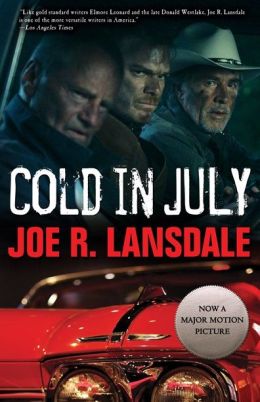
A Man’s Gotta Do: Cold in July by Joe Lansdale


Cold in July 
by Joe R. Lansdale 
Tachyon Publications 
General Fiction (Adult) , Mystery & Thrillers

Ann hears a noise and wakes her husband, a young father, to listen. He hears the sliding glass door open, so he grabs his .38 and ventures downstairs to greet his uninvited guest, who is passing a flashlight over the walls including a cheap landscape painting, which the narrator cover a Picasso (probably a joke since the subject doesn’t come back up).

When the two men meet, face to face, the narrator freezes and the burglar gets the first shot, missing the narrator which finally wakes him to action, putting a bullet in the burglar’s head.

The cops investigate the scene and recognize the burglar as Freddy Russel, who like his father, has been in and out of prison. They take the narrator down to get his and his wife’s statements. They assure him it’s an easy case of self-defense.

Ann and the narrator clean up the mess back home. The narrator struggles with guilt that even the temptation of snuggling with his wife can distract him from.
 
Even through the next day, guilt plagues him, despite the kudos he receives from the locals who all already know. Thinking of the burglar’s sparsely attended funeral, he drives to the cemetery to watch, despite the police chief warning him not to. The burglar’s father is there, none too pleased. He makes veiled threats about the narrator’s son, Jordan, kicking off the next series of crises where the narrator has to do what he can to protect his family.

Joe Lansdale described his novel, Cold in July, as having come from a dream. It doesn't feel exactly dreamlike, but it does have an unusual structure (I described Dan Braum's short novel as having a similar shifting structure over here but this one doubles Braum’s).

It’s a story of manhood: what it is, what a man has to do. By the end, it becomes less and less clear of the necessity of the narrator''s involvement although some might claim that, yes, he needs to be involved, yet the novel has to work to justify this involvement. That, though, may only make the investigation of what makes a man all the more interesting.

To some extent, manhood is always under the microscope in a Lansdale tale, but I have yet to read a more thorough investigation by Lansdale.

#

What follows becomes less of a review than a discussion of the work itself. If you read the novel, consider that a pass key to the rest of the discussion. If you haven’t read the novel, note that the literary police are watching you on your computer cameras and will raid your house if you read on.

Warning: Spoilers (to an extent)

The novel’s structure is unusual. That it works, throws into question structural plots. We open with a thriller, followed by a mystery, and end with a vigilante justice tale. Other plots, such as psychological (guilt about killing, guilt over fatherhood), might be thrown in as well. What holds the novel together is the question of manhood. What is it? This is what I love most about the novel. It isn’t just blind acceptance or total questioning of what manhood is, yet to some extent it expects us to accept some manhood justifications that should be questioned if not necessarily jettisoned.

When they find out Freddy Russel isn’t Freddy Russel, the protagonist has less and less reason to be in the novel. In fact, the novel focuses more and more on the other men. The protagonist does gain a lost father, perhaps finds his own fatherhood (if it was ever in question—which maybe it is since he has taken off, leaving his son, to go on an adventure he doesn’t have to take).

In this regard (not in the excitement department, which doesn't flag), the novel is flawed yet so is manhood. So maybe that’s all right.

#

I didn’t realize at first that this had been made into the movie. The movie departs in that the narrator isn’t justified in shooting an unarmed burglar and he slips on the trigger, which may be a more interesting question—something that could trigger more guilt (although the question of guilt melts away in both book and movie as soon as the narrator has to protect his son).

In both the novel and movie, the narrator discovers that Freddy isn’t Freddy, but the movie lacks motive for literally throwing Russel Sr. on the train tracks. The perpetrators have no call to do so and aren't challenged for doing this (although that does make it easier to make the narrator and Russel Sr. sudden allies, which makes less sense in the novel).

The movie has a more visceral motive to launch the boys into a vigilante story. The protagonist and I had to turn our heads. Still, for the most part, the narrative and themes are intact. Both are worth checking out.

Monday, August 26, 2019

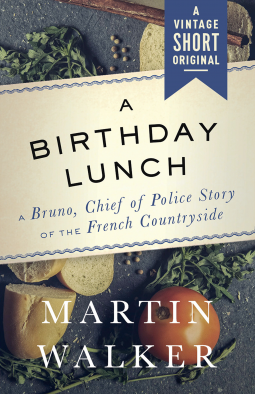
A Birthday Lunch by Martin Walker

A Birthday Lunch 
by Martin Walker 
Knopf Doubleday Publishing Group 
Vintage 
Mystery & Thrillers

"When not solving mysteries in his beloved little town of St. Denis, Bruno, the chief of police, likes to cook and share his meals with local guests and dear friend."

That's opening line to this little ebook, the size of a short story or novelette. By the tags and the word mysteries in the blurb and the police chief protagonist, I thought this would be a mystery, but I guess the dependent clause was a clue that it wan't a mystery. If Walker normally writes mysteries, readers might be disappointed in this offering which is, simply, a man who gets a gift, makes dinner, and gives his gifts.
The dinner is so detailed one imagines that one might be able to recreate them based on their descriptions, so fans who like to cook will enjoy that part.

The readers for this longish vignette is specialized: those who want to learn more about the character Bruno, those into cooking, and those who like French archaeology and culture. 

Saturday, May 11, 2019

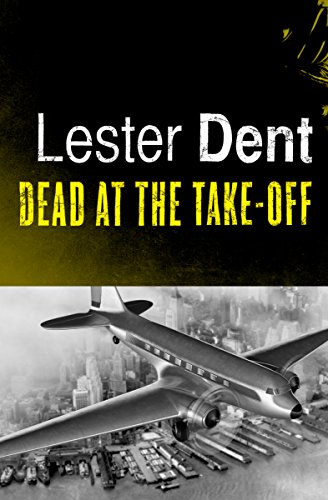
Review: Dead at Take-Off by Lester Dent

Image result for Dead at the Take-Off by Lester Dent MysteriousPress.com/Open Road Mystery & ThrillersDead at the Take-Off 
by Lester Dent 
MysteriousPress.com/Open Road 
Mystery & Thrillers
Lester Dent visits us from the pulp-hero past. He's famous for penning Doc Savage and distilling the pulp formula.

The story dizzingly launches us into Chance Molloy's life who is recognized at the airport, but he immediately denies who he is, to the puzzlement of the man who recognize him. [Read the mesmerizing opening at the end of this post.]

Molloy is traveling as Rand and plans to manipulate Janet Lord by having a man steal her purse and he pretends to beat the man up and rescue her purse. He hopes to get in her confidence so he could investigate her relative, a senator, who shafted Molloy in his airplane business. Molloy suspects something illegal had occurred. Hence, the disguise and investigation.

Meanwhile, Lord recognizes something is fishy about Molloy, but she is drugged by a doctor who is not a doctor, and Molloy's old flame is aboard and could blow Molloy's secret identity. Her love, meanwhile, has the means to expose Molloy in his hands....

Dent is a barrel full of pulpy monkeys, but literary snobs need not waste their time. It might knead their brains into pulp:

"Intensely, honestly, stewardess Mary Rounds hoped that she would like Janet Lord. She believed she would. On the basis, the very thin basis, of observing Miss Lord while she was unconscious, Mary had formed a vague but delicious  liking for Janet, and she was glad she had. Chance Molloy now meant more, in a solidly Gibraltar-like sense, to Mary than she had imagined he would. She was satisfied with this." 

Still, the energy is vibrant string, a deep base thrumming new revelations every chapter. The plot may be overly complex yet possesses a certain joy. The ending is the kind you'd often find in the old black-and-white movies. If you pine for stories like those of yore, you could do worse than read a Lester Dent slam-bang novel.

The opening shows the master pulp writer at the height of his powers (the bastard gets two hooks for one punch):

HE SWUNG HIS HEAD away, tried to pass on. But the man named Fertig saw him and thrust out an enthusiastic hand. "Hello, Mr. Molloy!" Fertig cried. "How are you, Mr. Molloy? ... God-amighty, this is a nice surprise, Mr. Molloy!" 
He felt trapped. He could not ignore Fertig, so he halted, but his attitude made it plain that he had only paused on his way into the terminal. He realized with relief that he barely knew Fertig. He did not so much as know Fertig's other name; therefore, Fertig must scarcely know him. So he gazed at Fertig tolerantly, blankly, without recognition, and waited. And presently Fertig's face became redder than the heat in the street had already made it. "Aren't you Mr. Molloy?" Fertig asked. 
"No," he lied. 
He let his tolerant expression become slightly smiling. But he did not speak again, avoiding the chance that Fertig might become sure of his voice. The heat pressed against him; it reflected up from the sidewalk and hurt his eyes, and it was inside his crisp, medium-gray, tropical-worsted suit. Suddenly he remembered where he had met Fertig, at an executive session where Fertig had presented some dull sketches for the new BETA terminal in Atlanta. Fertig, an architect, had impressed him at the time as being stodgy and without imagination, and he recalled disliking Fertig, resenting the man's callow glad-handing and obvious salesmanship; even Roy Cillinger, vice-president in charge of maintenance, who had no imagination beyond keeping air liners flying, had thought Fertig's ideas stupid, and they had dismissed Fertig as being quite inadequate, then had forgotten about it. Now he felt no qualms at having to stare Fertig down. 
"Aren't you Mr. Molloy?" 
He shook his head. 
"That's funny ... I'd have sworn ..." Fertig was smoking a fat, mink-colored cigar, and he took it from his mouth with a quick grab, leaving a damp flake of tobacco clinging to his moist, full lower lip. "I guess I made a mistake." 
He shrugged. 
"Sorry," Fertig said. 
The taxi driver came across the sidewalk with Molloy's bag. Fertig crowded into the revolving door ahead of the taxi driver and simultaneously a colored porter, wearing gray trousers piped in maroon and a white shirt, hastened for the bag, so that for a moment all three—Fertig, cabby, and porter—seemed to chase each other around in the revolving door, while the door made tired breathing and flapping sounds and emitted gasps of chilly, conditioned air from within. 
He waited. He was shaken. His plans, laid with such meticulous care, now seemed menaced at the very beginning.

Monday, March 11, 2019

Review of Agatha Christie's The ABC Murders (2019, Amazon Prime)

Amazon Prime did it's own version of Agatha Christie's The ABC Murders [link to movie], which is one of her more striking and elaborate mysteries. Thanks to the BBC, viewers have a certain expectations. While one expects murder, gore and the unpleasantries of life are minimized. What is maximized is the puzzle of the murder. This type--the "cozy"--has been so well defined that even Merriam-Webster has an entry for it:
"a light detective story that usually features a well-educated protagonist and little explicit violence"
Image result for Ian McKellen's Mr. HolmesThis definition already contains its critics' own condemnation as "light." A true aficionado would probably bristle at that and suggest that the puzzle is foregrounded, which can be an intellectual if a reader so chooses to match wits with the detective, so that it is not necessarily light. The "light" probably refer to its shrugging off of violence (hence, realism, in some minds) or perhaps of literary pretensions.


It's little wonder that viewers would bristle at an Agatha Christie mystery where violence in presented (if not gruesomely so) as well as the seamier side of life (if not salaciously so). Any fan upon first viewing this three-part series may balk, wondering if the additions are gratuitous moderizations of Christie's work. But if you liked Sherlock Holmes' updated, more personal treatment from Ian McKellen's portrayal in Mr. Holmes, you might well be intrigued by John Malkovich's portrayal of an older Hercule Poirot. They aren't mirror images. This one has a murder mystery at its heart whereas Mr. Holmes has a personal mystery.

Hercule Poirot has no sidekick (no Captain Arthur J. M. Hastings, OBE to bounce ideas off of), which makes sadder and lonelier. Worse, he's lost his ally in the police with only a detective (played surprisingly well by Rupert Grint) who isn't interested or doesn't trust Poirot. Poirot has been receiving taunting letters from "A.B.C." who eventually resorts to murder. The murderer seems to have a personal vendetta against Poirot, forcing him to rake through his brains for someone in his past. Since the police won't help, Poirot has to take on the murderer alone.

Poirot's own past and his ability to detect are called into question and have a bearing on the case. The mystery is not quite well delineated as a puzzle to match wits with the private detective as in most of Christie's work, yet I do believe well worth watching, even if (especially if?) you've seen it before.


Monday, July 3, 2017

Review with Commentary: Never Stop on the Motorway by Jeffrey Archer

Never Stop on the Motorwayby Jeffrey Archer
St. Martin's Press
General Fiction (Adult)
Diana, successful business woman and single parent, feels pressure on multiple fronts. She still feels the sting of the year-old divorce. Yet she chooses to remain single, partially because the single choices left much to be desired. And the men tend to think of her promiscuous after a single mistake:
"[E]very other man on the premises either smirks behind your back or treats your thigh as an extension of the arm on his chair."
 Driving her Audi suburban and jamming out to Gloria Gaynor's "I Will Survive." She does have a good friend, Daniel, who has been married for twelve years with three children, she being the godmother. It is their family she is driving out to visit in the country.

After she accidentally hits a cat and mourns its passing, headlights gleam in her rearview mirror. She tries to let him pass. She slows down. She speeds in excess of a hundred miles an hour, hoping to get pulled over by the cops, but he won't stop tailgating. His bumper won't leave hers, no matter what she chooses to do.

The story leaves one surprise for the end. This pulse-pounder will leave fingernail impressions in the couch. The price for this story is reasonable. If you're into thrillers, you'll want this one. If there's any critique, it's that there feels like we need one more story beat after the surprise--not that it's needed.

END OF REVIEW

Okay, stop reading until you buy and read this for yourself. Commentary with spoilers below for those who like to discuss stories.

Link to Kindle version (available July 4)
Commentary with Spoilers
 You have read the story, yes? It's only a dollar.

Unless there's a nuance I'm missing, the title "Never Stop on the Motorway" suggests this is a thriller, nothing more and nothing less. However, a quarter of the opening text or so deals with the problems women have with men. Yet she goes to a man for help. This may irk some feminists, so I was pondering what more could be meant.

If anything is meant to be said here on the topic of feminism, it may be that men can be allies, not necessarily in the background. And some men only seem to be the problem (you'll have to read the story to know what I'm referring to.

That is an "if"--whether author wanted anything more than to thrill. Nothing wrong with stories that only aim to entertain.

Tuesday, April 18, 2017

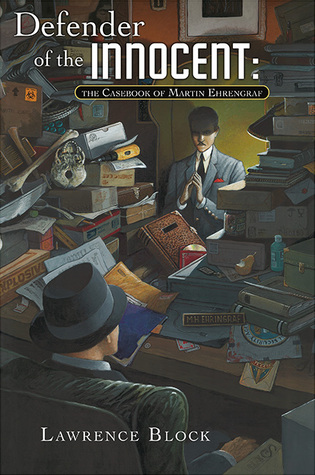
Review: Defender of the Innocent by Lawrence Block

Overview:
Martin H. Ehrengraf is an attorney who almost never sets foot in a courtroom. Instead, clients pay one dollar to retain his services. Should he win, the client pays a steep fee, and it doesn't matter how the client gets cleared: They have to pay. Or they pay in some other way. And Ehrengraf never loses a case. Because his clients are always innocent.

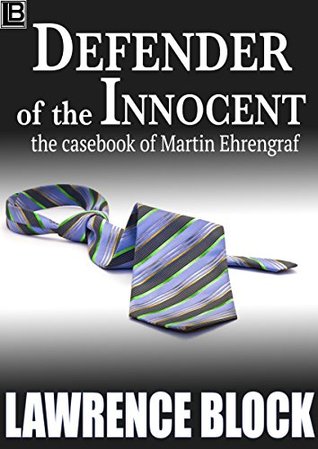
Martin H. Ehrengraf is a well groomed with an eye for tasteful clothing. He has one celebratory tie he wears when certain of victory, and he comes calling for his fee. Sometimes he clients don't want to pay the full amount, which they may later regret.

Often, clients come in knowing they committed a crime, or they had some blackout, which prevents their knowing for certain (but the evidence is certainly stacked against them as if they had done it), and sometimes Ehrengraf himself arranged the case and positioned himself when they do get in trouble--a different kind of ambulance chasing.
Commentary:
Ehrengraf's methods are unorthodox, to say the least. Highly moral readers who don't read mysteries already may be horrified. Ehrengraf's ethics are all his own, and there may be few who would agree with him.

His personality is etched more for his lack of "proper" response than the upkeep of clothes or his desk. He is sharp and unconventional only in that he is the classic detective deducing conventionally but applying this in an unconventional manner.

That's where the series gets interesting. Ehrengraf is an interesting if not dynamic character, but it is his character that pushes up against our sense of justice. In so doing, he becomes a critique of the American criminal justice system and of reading mysteries in themselves. Anyone can be named the true criminal, whether guilty or not. The whole system of reading mysteries to see justice served is flawed in that it is a fabrication. So, by analogy, the reader is forced to question whether justice is ever served.

Now Block shows no hint in his commentary that this may be the case. In fact, he states a few times that Ehrengraf is the only lawyer who works in this manner--evidence can be manufactured and/or stacked in different ways--but it does bring the issue to mind by his existence. This isn't to say this is necessarily my view, but that reading the book highlights the idea: What is innocence but a construct? Who is truly innocent when they exit the courtroom?

Tuesday, February 14, 2017

"Identity Theft" by Robert J. Sawyer

Printed and reprinted by Mike Resnick, it was up for the Hugo, Nebula, Aurora Awards, and won the UPC Award.

Alex Lomax is a hard-boiled detective on Mars. Cassandra Wilkins, jaw-dropping beauty and transfer, steps into his office and asks Alex to investigate the disappearance of her husband, Joshua, who's also a transfer. Due to confidentiality, an investigator can't simply log into people's brains and ID them. The police haven't been helpful, but that's kept him in business. Barely.

Alex finds Joshua rather simply, next to a suicide note and a jack hammer, but the mystery doesn't end there. It's just getting started.

Meanwhile, Lomax picks up a second client to do the job his first client wanted but for a different reason: He fears he's been bootlegged.

Commentary:

Reading Red Planet Blues, I thought it familiar. And, lo, the ebook image said it incorporated "Identity Theft" in it. I checked out the blog and missed putting up commentary here though I was certain I had.

The mystery is well constructed. Sawyer lays the groundwork from the start, so it's worth the reread just for that. It's a little gem worth excavating, but if you're going to read the novel, anyway, the differences are minute. It does work better as a story. Nonetheless, if you're interested in both, you may need to read them separately as the payoffs differ. Maybe you could get by with reading the opening and closing of the story.

The focus of the tale shifts from the novel. Identity is a central theme here: What is it? How are we shaped by it? Do we drop tells of our identity? Sawyer suggests, yes to the last question, or he wouldn't have had much of a story.

The idea of transfer is not completely exhausted here, and it is explored more in the novel. Even then, the idea has more life in it yet.

Tuesday, August 23, 2016

Twin Peaks: Season 1

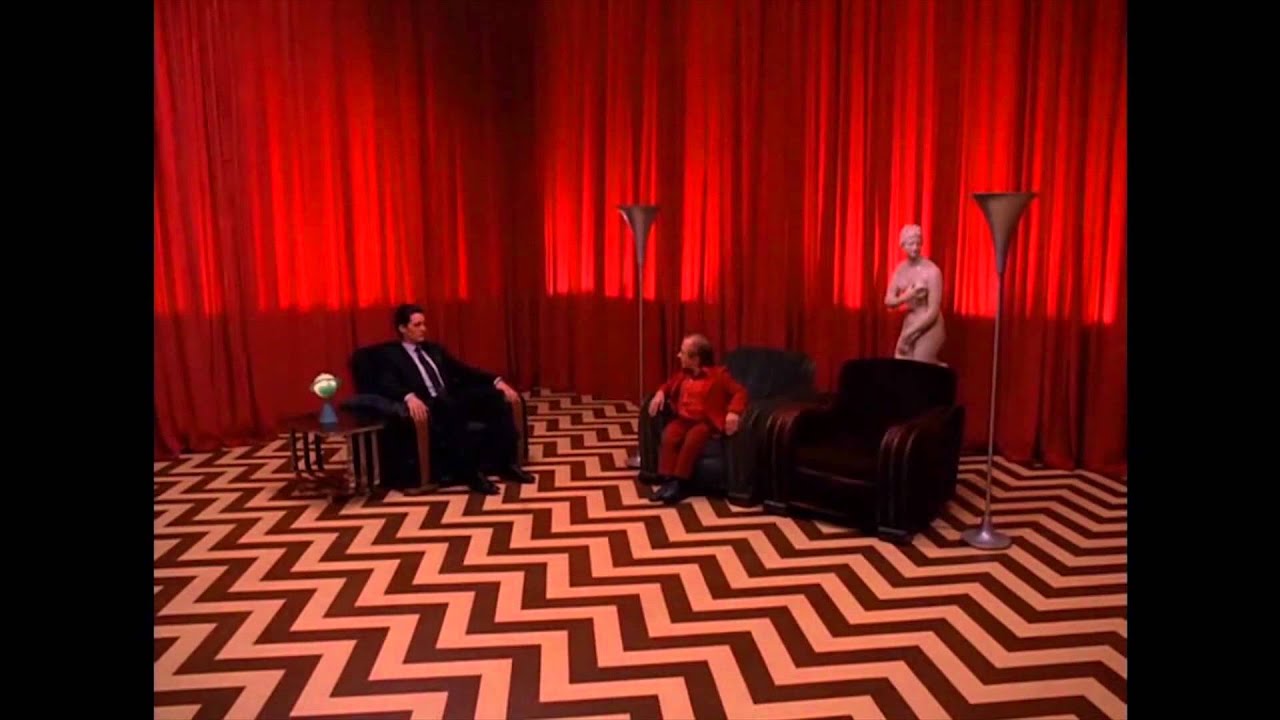
Twin Peaks is two-season TV series, directed by the auteur David Lynch with his characteristic surreal moments set in a small-town murder mystery. The show attained such a cult status--listed in several all-time top fifty tv shows lists--that writers David Lynch and Mark Frost will return to the series for Showtime nearly thirty years later.
Set up:
Twin Peaks, Population 51,201, is a small set inside Washington state on the Canadian border. Pete Martell, who helps run the local sawmill, discovers Laura Palmer, dead, wrapped in plastic tarp on the lakeshore. The local law enforcement, Sheriff Harry S. Truman and his deputies, are immediately on scene.

Ronette Pulaski stumbles into town in a daze, skimpily dressed, with the same twine marks found on her wrists that Laura Palmer had.

FBI Special Agent Dale Cooper arrives, having been on a similar case where other young ladies have died. The letter J is found underneath her fingernail and implicates everyone whose name begins with J, which is nearly every character on screen.

Discussion with Spoilers:
John Gardner in The Forms of Fiction argues that the form helps create meaning. This can be true if with limited utility. I'll start with the "mystery" as a form that shapes what is and isn't going on here.

We have a crime--murder--and typical clues, such as the letter J. But the show veers from the form in its unorthodox methods of detection, primarily in its use of dreams, clairvoyance, and intuition. We accept this, in part, because Sherlock Holmes our founding father of mysteries, worked with such encyclopedic knowledge that it often seemed supernatural. However, one might attribute their use to scientific observations such micro-expressions or body gestures although none of that is specifically used.

Agent Cooper accepts his dreams and hallucinations as a legitimate form of evidence, and investigates on the basis of them, which no one questions. He throws rocks at a bottle to decide whether a person whose name starts with J is related to the murder of Laura Palmer.

The letter J is not only the name of the perpetrator, but also segues into the name of a culpable place. Even clues have double meanings.

Doubles are everywhere. Nearly everyone leads a double-life relationally--a bad one and a good one. If you're blond in Twin Peaks, your primary relationship is bad. Laura Palmer leads a double life as a popular student, but also a destructive one as a professional call girl who has a cocaine habit, which she uses to force her popular, football-playing boyfriend into the double life of dealing the drug. Palmer doubles again when her cousin arrives (played by the same person, except with dark hair). At one point, the actress plays the doubled cousin doubling as her cousin.

Most of the characters have these double relationships, double employments. Benjamin Horne, for instance, not only owns an above-board lodge and department store, but also has plans for the destruction of the sawmill and its owners, not to mention some stake in the prostitution ring in the casino on the other side of the Canadian border. Canada isn't Canada, per se, but that borderland of personality where people aren't who they display on the surface.

The town and its attitudes and limited locales feel more provincial and casual than a town of 50,000. 5,000 may be more accurate. This, too, might be considered a double: plenty of employment opportunity of a larger town but with the casual and intimate relations of a smaller town.

Interestingly, the secondary double assumes the primary role within the narrative in most cases.

I'd be curious to learn what true-form mystery aficionados thought of the series when it aired. One imagines a lot of grumbling consternation.

Sunday, July 31, 2016

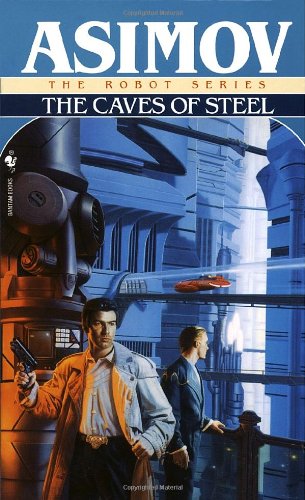
Caves of Steel by Isaac Asimov

Isaac Asimov dabbled in mystery and SF, occasionally combining them. Apparently, the first of these, Caves of Steel, is being written as a movie. The BBC made it into a TV movie by in 1964--of which only excerpts exist.


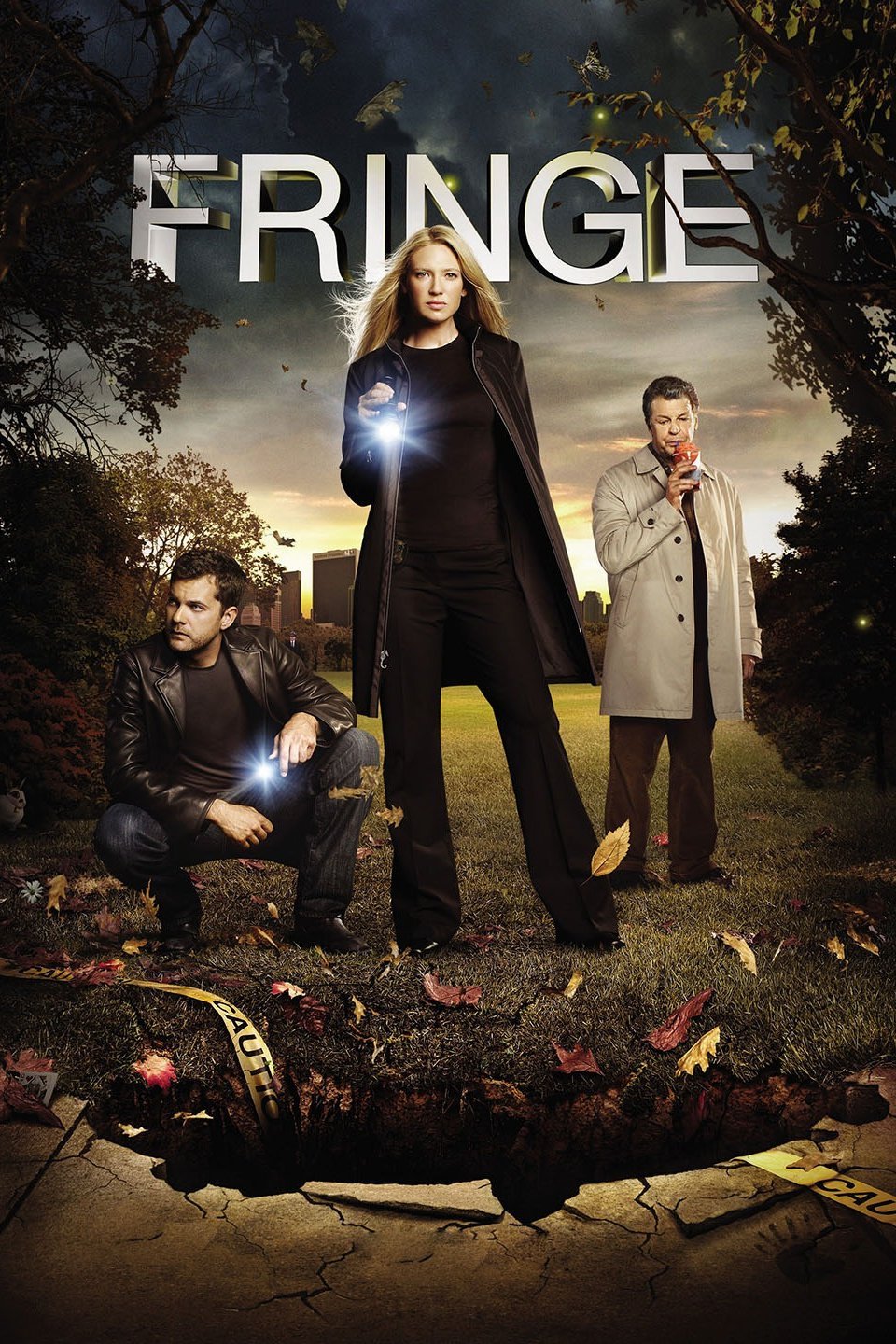
Akiva Goldsman, Oscar winner and screenwriter of I, Robot and Fringe, is slated as the third screenwriter to give it a go for Fox. How many before Fox? It may be difficult to put on the big screen. Another attempt of turning the novel into a "movie"--or, rather, a VCR game:


[Side note: The I-Robot credit will turn off many, but it actually does utilize a number of Asimovian plot turns and verbiage. I, Robot was also a short story, so to fashion a movie out of it is impressive. No, it isn't what Asimov would have written but it keeps and comments on Asimov's ideas--not to mention maintaining Asimov's works in the public eye.  I have only read Ellison's script opening to I, Robot and, though I enjoy the work of both writers, the opening didn't grab me. SF Encyclopedia [John Clute] writes:
"the screenplay itself makes clear how difficult it would have been to translate Asimov's archaic concepts... onto the contemporary screen."
I will try again, later. 
While Goldsman's Batman films and a few others were regrettable, he did a fine job on A Beautiful Mind on other adaptations like I, Legend. Fringe was a romp. Yes, he differs from the original books, but that's okay. They weren't mockeries, but rather interesting deviations. One can always examine the original. One could complain of a Hollywood treatment, but isn't that the point? To sell movie tickets? How many more books were sold because of the movie?]

Summary:
Earth Detective Elijah Baley is told he must work with a humanoid robot, R. Daneel Olivaw (the "R." stands for Robot) to solve a murder of a Spacer. On Earth, by law, robots don't look like people, but Olivaw does not appear robot-like. This gives Olivaw an advantage (Olivaw threatens violence to Earth citizens) until a rumor circulates that Olivaw is a robot. Baley's own wife hears the rumor which worries her about Baley's safety.

The Medievalists is a society of Earthlings who hearken back to a less technological day of wearing glasses or using windows. They seem benign enough: Baley's boss and his wife are members. But when they make signs to one another at a dining hall where Baley and Olivaw eat and pursue after Baley and Olivaw in a chase scene across slidewalks, they seem a lot less benign.

Though Baley tries to prove his partner, Olivaw, is the true murderer, Baley gets no closer to finding out who did it. In fact, evidence seems to point to Baley himself. The Spacers and Olivaw get what they came for--proof that Earth would have citizens willing to go into space--so that Baley appears to be left to pay for a crime he didn't commit.

However, Baley thinks up a loophole that gives him an hour and a half to solve the crime.

Themes and importance:
Asimov extrapolates a few key speculative ideas:

  1. Overpopulation leads to city overgrowth, to the extent that people fear going outside. Agoraphobia. The works well with the mystery, limiting what characters would and would not do.
  2. Technophobia on Earth leads to Earth's phobia of robots, especially robots that look like humans. 
  3. Technophiles are the few who escape Earth and building colonies. These, the Spacers, are the elite. They do not have disease and comparatively long-lived.
  4. Space colonization is so lovely that Spacers are willing to overlook murder if it can achieve a greater aim.
  5. Being long-lived leads to complacency, which ironically a spacer cannot be. Therefore, the Spacers have to recruit from Earth.

The Caves of Steel has its admirers. James Gunn used it to teach SF--one of the major novels shaping SF. It is one of the first major SF novels to treat robots, overpopulation, and mystery in SF. The theme of the importance of space colonization was common if not ubiquitous.

This last, for me, was the Achilles heel--not because I'm against colonization but because it was above questioning. Spacers (only here, not later) are too benevolent and wonderful. They provide an instant contrast that glorifies colonization and berates those rubes who remain on Earth.

Asimov corrects this in The Naked Sun, creating Spacers with their own foibles, which is the better novel for this and for a mystery that plays a little more fairly. The contrast between societal flaws is fascinating. I'd love this one to become a movie, but it does hinge somewhat The Caves of Steel. So maybe it has to be written first.

Wednesday, July 6, 2016

The Devil's Only Friend by Dan Wells (John Cleaver book 4)

The Devil's Only Friend  
by Dan Wells 
Macmillan-Tor/Forge 
Tor Books 
General Fiction (Adult)

John Wayne Cleaver returns... this time with a posse. Of sorts. He's working with a team of special investigators to uncover serial killers who are actually demons in disguise.

I read this prior to reading the first novel in the first trilogy. Like many series mysteries, the books can be read without prior knowledge of earlier novels although it might be better appreciated as a series.

This is the first in a new trilogy for Mr. Cleaver. He's grown up (or getting there at 17) and working for an organization investigating the supernatural, so they can't reveal themselves to the police. Included are Nathan, genius but not well liked; Kelly, their cop in residence; Diana, security specialist from the USAF; Linda, leader of US's secret war against the supernatural; Brooke, possessed by an ancient demon named Nobody, which knows a lot about the demons or the "Withered" they are pursuing.

Their first test is a Withered kidnapping a girl Another kills children. Who is it? And how is it done? But these Withereds are only warm-up acts for a much more powerful one concealed behind others.

What works for the novel are the speculative eye-kicks. Wells develops these demons and their history in surprising ways. A broader sense of the secret world is slowly peeled back. What's not as strong is the narrative voice. The first novel concentrated on the voice with humorous dark edge. Some of that humor is still here, but far more sparse.

To an extent, this is more of a mystery in whodunnit department than the first novel. However, it's hard to say that the novel is intended to "play fair" as far as giving enough clues that the reader might have guessed.

Can you get by reading this novel without the earlier books? Yes, but I'm not sure you'd want to.

The latest novel in the series is Over your Dead Body. Impoverished, Cleaver and Brooke, with the hundred-thousand personalities that her demon Nobody stole over the millennia, head off on a road trip on the trail of another Withered. They hunt demons. On their own.


Monday, July 4, 2016

Review: I Am Not A Serial Killer (John Cleaver Book 1) by Dan Wells

Recently, I've read a few novels that blend the speculative and mystery genres with mixed success. So I wondered what made a good mystery that also scratches the speculative itch.

When it comes SF, Isaac Asimov's The Naked Sun and "The Billiard Ball" both do well--not to omit Larry Niven's Flatlander. Asimov and Niven work the more difficult territories of "whodunnits": displaying a cast of criminals, shifting blame until we land on the criminal at the end. They do not shirk the responsibility of creating speculative societies in the meantime. Niven, if I recall correctly, said he wouldn't write another SF mystery as obeying the two genres was too difficult.

"Howdunnits" explore the criminal's methodology. While you may know who the criminal is, you can't convict him without evidence.

There is also the "whydunnit" which is usually the exploration of a criminal mind--sometimes within the mind of the criminal. A famous example would be Edgar Allan Poe's "The Tell-Tale Heart."

When it comes to recent fantasy mysteries,  I Am Not A Serial Killer by Dan Wells actually melds a few of these. The narrator, John Wayne Cleaver, is a high school student whose mother is a mortician. He helps embalm the bodies. The first part of the narrative, oddly enough, is a description of how this is done. This is a pretty risky step to take, but Wells successfully surmounts the limitations by creating a narrator buoyant with dark humor--a kid so fascinated by serial killers that he fears he might become one himself. His very name mirrors not only John Wayne (All-American hero) but also John Wayne Gacy (notorious serial killer) and, of course, an infamous murder weapon.

He does his best to look "normal" and fit in with most teenagers, but his mother notices a small part of his fascination and sends him to get psychological help. Later, when he thinks he spies the work of a serial killer in their small town, she excludes him from the joys of embalming since he likes it too much. This exacerbates the problem.

There is an element of whodunnit here since the identity of the killer is not immediately known, but we are not privy to an analysis of suspects. Instead, it is more of a howdunnit and whydunnit. First, Cleaver is a serial killer in the bud, trying to nip it, which makes fascinating reading. Next, he shifts to typical serial killer MO's. Once he finds his suspect, he hones in on the how and why of his suspect and how he might stop the killer from killing again.

The ending itself is potent as Wells manages to make us feel two ways about the killer. The main reason the novel as a mystery succeeds is that it redirects our attention from whodunnit to why/howdunnit. The  If you like mysteries and horror, this is a must-read.

Wells deserved more attention for this novel that he got initially. Perhaps that was a function of the risky opening. Still readers can still remedy that. This one should be one of Wells's longer lived works.

Saturday, May 23, 2015

Review: Mystery, Inc. by Joyce Carol Oates

Mystery, Inc.  
Joyce Carol Oates
Open Road Integrated Media
Bibliomysteries are an ongoing mystery series from Open Road and  Mysterious Press (which offers a numbered edition of this book) about books and their places of habitation.

Mystery, Inc. is a fictitious bookstore that the narrator, who bills himself as "Charles Brockden*," is crazy about, jealous that the owner, Aaron Neuhaus, is able to weather bad times and good yet have a section dedicated to art, even. How does it weather tough financial doldrums?

As Brockden has done before, he concocts a murder, a poisoning, to buy the bookstore. But this bookstore has its own mysteries in store.

Mystery, Inc. is a novella, lovingly detailing a clear passion for classic mysteries and bookstores. The narrator is unsympathetic in the tradition of Iago. But Oates has a trick or two to play. First, the narrator sounds like Oates commenting on the writing of the story:
"I am very excited! For at last, after several false starts, I have chosen the setting for my bibliomystery."
It takes the readers a moment to reorient our perspective from reading about the author's production to the narrator's. Perhaps the idea here is that murder, in the eyes of the narrator, is its own creative act. He, too, is a kind of author.

This is less a literary classic to pore over, than a reader's pleasure, an entertainment. But a few games are afoot, including pop culture. Mystery, Inc. is the name of the Scooby Doo Mystery van and bookstore.

* Charles Brockden Brown was an early American novelist.

Sunday, March 2, 2014

Review: The Candidate by Daniel Pembrey

The Candidate  
Luxembourg Thriller  
Daniel Pembrey
Nick Thorneycroft is a British headhunter working in Luxembourg recruiting a Russian his company really wants. The candidate is highly sought after, so he has to act quickly.

We meet Nick as he wakes up with a splitting headache and strange panties on the floor. His memory's a blank. When the landlord asks about his medication, indicating his neck, a red mark--where a drug-patch had been--dumbfounds Nick. The landlord had seen the woman he was with, but only her backside. Foreign, he says. Nick asks if she might be Russian. Yes.

But he cannot be sure it's the same woman. Worse, he finds himself falling for this woman, who may have drugged him for reasons unknown. Worse still, Claire, his old girlfriend shows up at an inopportune time. That's when Russian thugs kidnap him, pound him to a pulp until he tells what he knows about why his company wants to hire the Russian beauty.

This is a powerful spy-thriller, marred only by its last page. While it touches on what may be a good resolution, it feels rushed. It doesn't resonate, either, with what this means for the protagonist. Initially, I wasn't clear on the outcome, but given the time of year, it could only mean one thing. If you agree with Raymond Chandler that a novel should be good, even if the last page were torn out, you should enjoy this one.