Search This Blog

Showing posts with label New Yorker. Show all posts

Saturday, March 4, 2017

Ted Chiang on Philosophy in Fiction

"[I]f abstract philosophical questions were the only thing I was interested in, I’d probably write... speculative essays. [P]hilosophical questions are most interesting when they have significant consequences for a person’s life.... 
"[O]ne of the things that interests me as a writer is finding ways to make philosophical questions storyable [that is, the ability to make certain notions or ideas into stories]."
--Ted Chiang in Electric Literature (interviewed by Meghan McCarron)

"I do want there to be a depth of human feeling in my work, but that’s not my primary goal as a writer.... My primary goal has to do with engaging in philosophical questions and thought experiments, trying to work out the consequences of certain ideas."
-- and in The New Yorker (interviewed by Joshua Rothman)

Monday, October 20, 2014

Manliness and Manitude (pt 2)* in "Along the Frontage Road" by Michael Chabon

"Along the Frontage Road" first appeared in The New Yorker. Reprinted in Best American Short Stories.

Someone said she wouldn't read a book without females. Dave Wolverton suggests you populate your stories with a maximum of character types to maximize your audience. No doubt that's true, but life happens outside mixed groups, and fiction can get interesting when the focus narrows.

Chabon's story examines this from an angle different than Bigelow and Boal's (scheduled for release 10/21)*. Here the narrator seems less preoccupied by death and violence and yet it's there if buried. Mostly, perhaps to his surprise or chagrin (though his emotional response isn't recorded), the Manly Code of Conduct permeates their consciences--consciously or unconsciously--written differently on each "man" (term used loosely). Another difference is that manliness is on this character's mind, which the more pensive men tend to do.

Again there are spoilers, but it's hard to spoil literary stories.

The story opens with the narrator's family tradition: pumpkin selection for Halloween. So the weight of tradition, of generations hangs heavy on this story. There's a brief allusion to an infant child who died. Another gave this the story's full weight. But I don't read it that way. The story spends it's time on men interacting with men. The death (again, death) plays more of a catalyst's role, a way of bringing the men together. 

The Jewish narrator spots a young black boy bored and irritated that he's been left alone in the muscle car while his dad does manly things in the Bait shop (the narrator turns out to be correct). The boy, in other words, is left out of manly discourse. Note all or the manly things mentioned above. 

Meanwhile, the narrator's son selects his pumpkin. It is small, possibly too small to carve. The narrator is disappointed in his son's selection, agrees with the other boy who walks up to offer his commentary. When the other boy's father arrives, disappointed perhaps that his son would consort with Jews or other men?

I choose to follow a non-race interpretation, but yours may be different (after all, the narrator also quickly judged the other man's manhood, guessing him to be a drug dealer with no apparent evidence that I noticed). Instead, I see this as men disappointed in other men's manliness. That disapproval and perhaps guilt over telling his son what kind of pumpkin he should pick, causes him to attempt to erase what he said about picking a larger pumpkin. The boy should pick his own, say, manliness or pumpkin. The boy chooses both--his own, for the sister he'll never have, and a larger "normal" one for carving.

A "frontage road" is a service road, the one off a main road. According to Merriam-Webster, "frontage" can also mean "the act... of facing a given way," which verifies the different direction all of these men are pointing. Possibly, also "affront" is intended, the causing of offense. If so, these affronts are buried, unstated in each man's sense or orientation of what manliness is.

* * *

My point in examining these two works is to show the potency art can attain by limiting its focus. The same goes for women, of course (or any group). As an editor, I recently tried to vote for a wonderful tale set in an all-girls school. I've selected poems about being a woman from women and asked men to do the same. Crickets chirped. No one took the bait.

This isn't to say that literature has to be purposefully segregated or isolationist group--just that it can make for great art.

Those of us interested in humanity are interested art and life in their various manifestations, not limiting art and life to any one kind of ideological interaction. That said, many solely manly or womanly arts may not be to my taste. So it goes. No one is required to like everything.

Some may only want one type of literature--all men, all women, all mixed, all fantastic, no fantastic. That's fine, but please don't limit others in what they like to read/view/etc. Don't deprive others of art's richness. We live in a world of genetic variety. And don't threaten people's lives or livelihoods because you disagree, either, for that matter. Please. Play nice.

* * *

Aside:  Here was an amusing pair of lines, amusing in how Chabon switches tone:
"Toward the end of the year, however, with a regularity that approximates, in its way, the eternal rolling wheel of the seasons, men appear with trailers, straw bales, fence wire, and a desultory assortment of orange-and-black or red-and-green bunting. First they put up polystyrene human skeletons and battery-operated witches, and then, a few weeks later, string colored lights and evergreen swags."
* The point of reversing the order of the essay is so that they may appear in order later (first to post appears below the following post).

Sunday, April 20, 2014

Gabriel Garcia Marquez -- Life, Thought and Work

Stories and Excerpts

The New Yorker


The Modern Word (resources)

Nobel Prize.org


Interviews:

  1. The Paris Review
  2. Pete Hamill at Vanity Fair
  3. Oprah
  4. New York Times
  5. The Atlantic:
Biographies, News and Appreciations:
  1. FT.com: “[W]hat I like about you is the serious way you make up nonsense.”
  2. Time: "And when he died on Thursday in his home in Mexico City, it did not seem impossible that a man could open his mouth and songbirds would fly out." 
  3. Peter Carey
  4. Edwidge Danticat
  5. Edmund White
  6. "Nobel author Gabriel García Márquez wins 17-year legal fight over murder classic: Colombian court rules against man who claimed author used his life story for main character in Chronicle of a Death Foretold."
  7. Wikipedia
  8. Mental Floss
Quotes:

Saturday, April 19, 2014

Summary and Analysis of "The Enormous Radio" by John Cheever

First appeared in The New Yorker.  Reprinted by Ray Bradbury, Harry Harrison, Charles G. Waugh, Martin H. Greenberg, and Joyce Carol Oates.  Audio.

The story opens:
"Jim and Irene Westcott were the kind of people who seem to strike that satisfactory average of income, endeavor, and respectability that is reached by the statistical reports in college alumni bulletins."
In other words, we have an average family.  The story ends with a "suave and noncommittal" radio announcer giving the news:  a train wreck, a hospital fire, and the weather.  While severe and devastating to the people it's happening, likely it's a typical day's news.  This is the frame within which he relates his extraordinary tale.

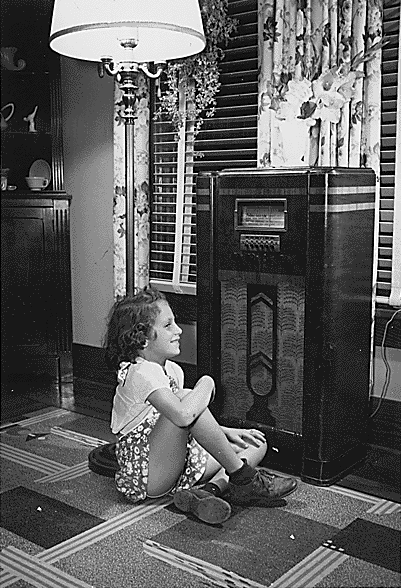
The Westcotts buy a floor radio*.  It initially intimidates if not frightens Irene.  She even hides it away.  Eventually she listens and hears another layer of noise.  They fix it.

Irene hears voices and gets Jim to hear.  Jim yells at the device to see if he can be heard as well.  He cannot.  She recognizes the voices of neighbors.  Some of what they say is scandalous and horrifying.  When they attend parties, Irene cannot see her neighbors the same.  They've lost their gloss, their human decency.

The radio's gossip consumes Irene.  She begs Jim to intervene in other couples' problems.  He won't, but he will fix the radio.  This time the repair works, but the fix is expensive.  Jim confronts Irene over unpaid bills.  They have a spat equivalent to their neighbors'.

Here's where the frame fits in.  With plenty of dirt on each other, they are no better than anyone else, have no justification to feel morally superior.  The Westcott's tale seems more relevant with our radio the internet, flooding the information world with our sins, with many coming to the rescue or condemning their neighbors.

Cheever adds a nice duality of perspective, which is demanded of its readers to have a full understanding:  Some readers will identify more with Jim, some Irene, while other readers will empathize with both.

* This is 1947-ish.  Household radio technology is still shiny even if it had been around for twenty-odd years, as can be seen by a $400 charge to repair the apparatus.  Something about new technologies gives it a paradoxically mythological air.  Twilight Zone did a similar story where a man witnesses, on his television, the future crimes he will commit.

Thursday, June 20, 2013

"She Unnames Them" by Ursula K. Le Guin

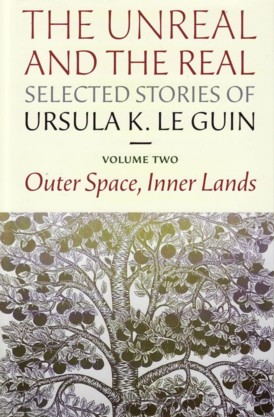
First published in the New Yorker. Reprinted in Leebron, Geyh, Levy's Postmodern American Fiction.  Collected in Outer Space, Inner Lands, from Small Beer Press.

The animals are "unnamed," losing the names given them.  Some are reluctant until they realize that they could be named whatever they wanted.  More food for thought, than a journey for the mind.  Applicable to people and art--true in how we name or label things, often to unthinkingly dismiss them.

Friday, June 7, 2013

Tuesday, February 12, 2013

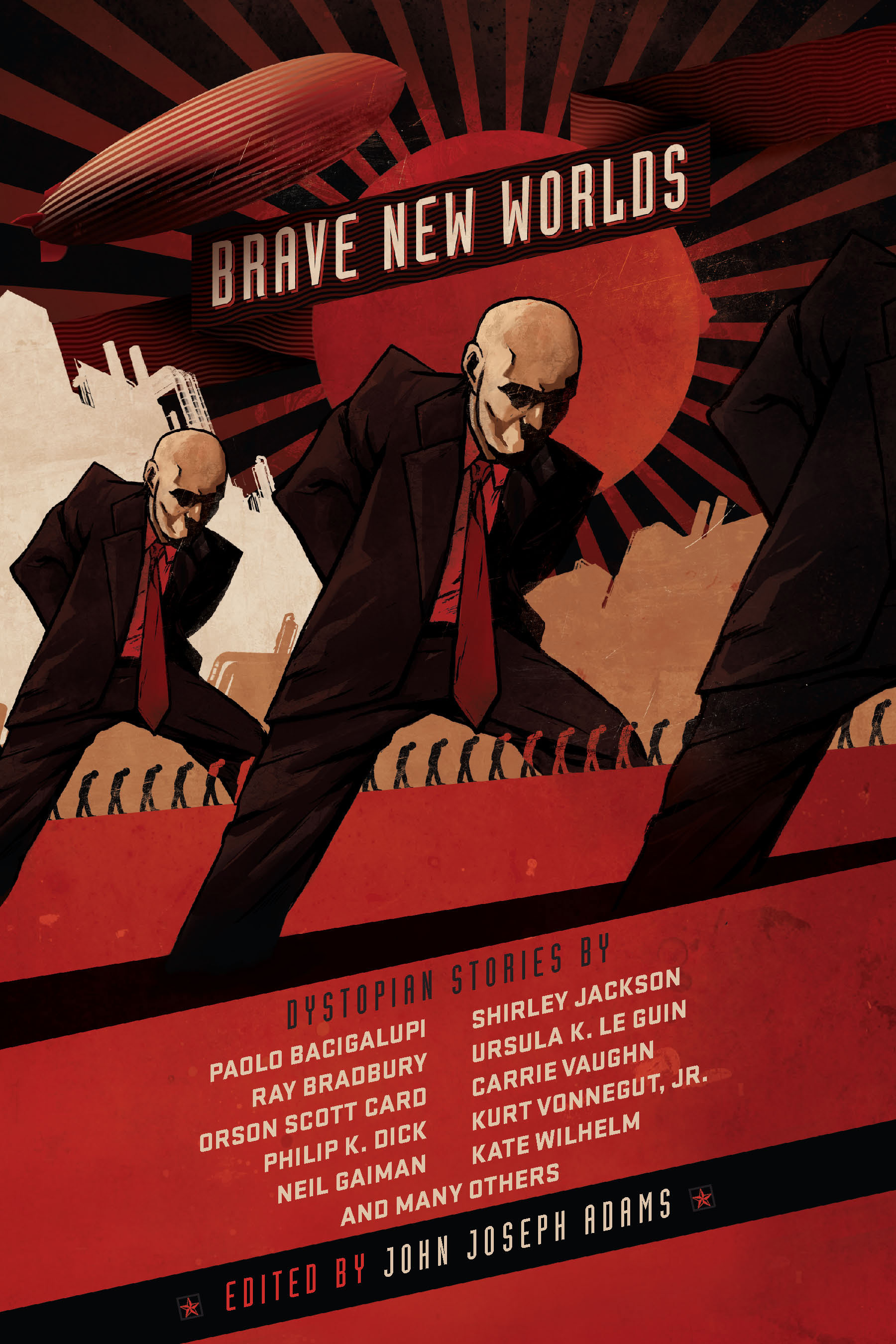
The Lottery by Shirley Jackson (from Brave New Worlds, 2nd edition)

From Brave New Worlds, 2nd edition,  
edited by John Joseph Adams
(Note:  This anthology originally appeared a few years ago but has been re-released with new stories as the first edition didn't get publicized well enough.) 
"The Lottery" originally appeared in the New Yorker

Shirley Jackson paints a small town's seemingly charming habits with well-worn customs and mannerisms toward one another, and then she turns the town on its head--at least for the reader.  Undoubtedly, this captured the seemingly random hate of a small town in Jackson's time--the town's willingness to destroy its citizens, no matter how well the citizens knew one another.  While the story may seem more quaint as small towns disappeared, the internet has become its own map of small towns, some of whose citizens sometimes go around stoning.  However unfortunate, this story may never date as long humans exist.