APB-SAL is a blog about education, science, science education, fiction, science fiction, literature, literary stories, poetry, and anything else that strikes the blogger's fancy.
NOTE: This blog interrogates art. It rarely make moral proclamations. For that attend the church or politician of your choice. This blog concerns aesthetics, not propaganda. Consider this as interviews with books where the interviewer presents interviewees, so you get what you need to do your own thinking.
the material so described is dangerous to some unspecified, susceptible reader. It is interesting that the person applying such standards of censorship rarely feels as if their own physical or moral health is in jeopardy. The desire to censor is not limited, however, to crackpots and bigots. There is in most of us the desire to make the world conform to our own views. And it takes all of the force of our own reason as well as our legal institutions to defy so human an urge.... You will either add to liberal, educating thinking or by your decision you will add fuel to the fire of ignorance.
The above is a quote from the movie Howl, which claims that every word uttered in the movie was uttered by that person in real life, so presumably this monologue was uttered in the courtroom when the book was on trial for obscenity. (There are adult situations in the film and alternative lifestyles, so do with that what you will.)
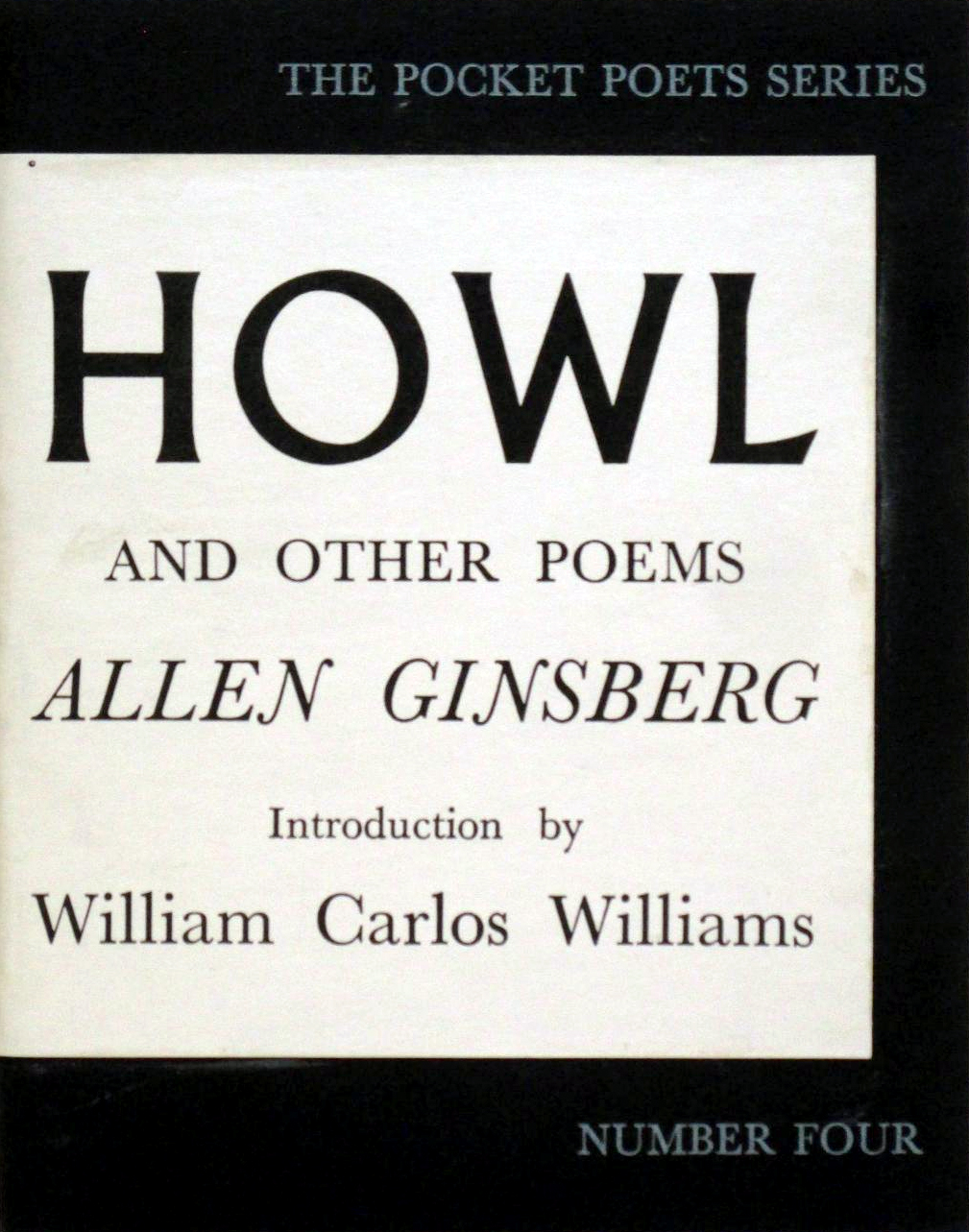
Howl is a poem, is a movie, is a biography. It can be viewed as an explication of the poem itself. It gives readings of the poem, followed by interviews and scenes acted out as described to add historical and biographic context to the work. It also has animations of the surreal imagery described in the poem. In the trial, critics critique and explicate the work with varying degrees of success.
The poem marks a turning point in Allen Ginsberg's life and his art--a time where he clicked from confusion about himself and uncertainty about his art into clarity.
The trial went in Ginsberg's favor (and 90% of the movie does, too), but it's interesting that sometimes the film backs up the opposition’s point of view by having Ginsberg say that sometimes he doesn't know what he meant, as well as having Ginsberg's [recreated] audience revel more in the obscenities. Now one might say they were reveling in the rebelling against the moral authority that calls it obscenity, but even here Ginsberg said he just wanted to write a poem his father wouldn't approve of, with no hope of getting it published.
The movie has fantastic cuts, forcing viewers to pause and think about what’s been said, giving weight to certain lines.
What the film did not address are the main strengths of the poem, which is the bold voice and strong sound (they are working mostly from quotations in that time period—which limits what they can do):
I saw the best minds of my generation destroyed by madness, starving hysterical naked, dragging themselves through the negro streets at dawn looking for an angry fix, angelheaded hipsters burning for the ancient heavenly connection to the starry dynamo in the machinery of night,
First, we have the bold opening salvo, which seems both a proclamation of grandeur (not unlike Whitman's claims) and a political call to action--that this generation is going through something unique in its time although if the movie is to be believed, he’s referring to his friends like the one mentioned in the dedication, who hadn’t had much cultural relevance up to the writing of the poem. But still it’s told with such authority that we buy into its claims.
Rhythm and sound play a major part in the poem’s memorability: all the “n” and “m” consonance and alliterations. The lineation of the poem follows, as the movie pointed out, Walt Whitman, who (as the movie did not point out) was following the Biblical rhythms one might find in the King James Bible.
Also, a big component of the poem’s resonance is the culturally transgressive nature of this outlier generation, which probably rang an even stronger bell with the 60s generation that followed his Beats. The drugs seem a quest for transcendence—religious and otherwise, aids to plumb jazz and their world. It is curious that in 1955-6, there were still [asterisked] words that the poet felt should not be printed.
A closing quote (the opening and closing quotes have past, present and future relevance):
Life is not encased in one formula whereby everyone acts the same and conforms to a particular pattern. No two persons think alike.... An author should be real in treating his subject and be allowed to express his thoughts and ideas in his own words.
I watched a lot of black-and-white movies with my pop growing up. They were his thing. He had a lot of the noirs, and we watched this one. I liked a lot of them, but not this classic noir. This one I hated and I couldn't explain why. I didn't try. I'll discuss it below
That's probably why it took me so long to read Cain's work. When I did, I found the novel a moving if awful kind of tragedy. Moreover, it had made it on Modern Library's Top 100. You can see why in the excerpt below. The novel is packed with energy, each line bursting with suggestion.
The book was apparently banned in Boston for the violence and sex. It is violent, one moment especially, but the sex is largely off stage. Different times.
This has had a ton of covers. My favorite is this first one. It captures all three characters in one shot.
Excerpt
That was when I hit this Twin Oaks Tavern.... I blew in there in a hurry and began looking down the road. When the Greek showed, I asked if a guy had been by in a Cadillac. He was to pick me up here, I said, and we were to have lunch. Not today, said the Greek. He layed a place at one of the tables and asked me what I was going to have. I said orange juice, corn flakes, fried eggs and bacon, enchilada, flapjacks, and coffee.
Pretty soon he came out with the orange juice and the corn flakes.
"Hold on, now. One thing I got to tell you. If this guy don't show up, you'll have to trust me for it. This was to be on him, and I'm kind of short, myself."
"Hokay, fill'm up."
I saw he was on, and quit talking about the guy in the Cadillac. Pretty soon I saw he wanted something.
"What you do, what kind of work, hey?"
"Oh, one thing and another, one thing and another. Why?"
"How old you?"
"Twenty-four."
"Young fellow, hey? I could use young fellow right now. In my business."
"Nice place you got here."
Notice how Frank hides everything about himself from Nick, in every line.
This discussion below will have no easy summary as I'll be spoiling it along the way. Here's a Youtube clip of the radio play adaptation, which is very similar to the movie version. They used to adapt movies for the radio.
Book Version
In the novel, Frank Chambers is tossed off a hay truck. He'd been in Tijuana. He shows up at the Twin Oaks diner, pretending a friend was coming in a Cadillac (i.e. rich), going to spring for dinner, and Nick Papadakis, the owner, cooks and asks if Frank wants a job. He's told immediately that Cora Smith is Nick's wife, which seems to be what keeps Frank there to take the job, fixing tire flats. When Frank compliments her on the burritos they made, she's very keen to dissociate herself from Mexicans and Nick, a Greek, which of course is interesting that she'd marry him. She later calls him greasy. Nick seems indifferent except as a way to get at her so she wouldn't treat his as her servant.
Frank uses a fallen sign to talk Nick into getting a new one. Once Nick leaves, he locks the door to be alone with Cora. He bites her lip at her request and bloodies her. Scene cuts as they head to the bedroom.
Nick is upset that Cora's lip was hurt by the swing door and he makes Frank fix it. He hits Cora in the legs and she seems to like it although she asks how he got that way. They get away every chance they get when Nick leaves. They share their pasts. She calls herself a hellcat except with Frank.
No reason is given for Nick's murder, but they plan it: Her hitting him in the head with a bag of ball bearings while he's in the tub and to hold him under, so it looks like he fell and drowned himself. When they plan the bathtub murder, Frank is to be outside and honk the horn if anyone comes by but he ends up chasing a cat and not being around when a state trooper shows up asking questions. They note the cat going up. The lights went out and she screams.
They feel they have to save Nick's life and rush him into the hospital. As soon as Nick recovers consciousness, Cora talks Nick into the story she wants him to believe. When they get back, they find the potential murder weapon on her. The state cop notes the cat caused the lights going out.
They try to run off, but Cora doesn't want to, so Nick runs off, and tries to make money at pool to get Cora. He bumps into Nick, who cajoles Frank into coming back. Nick seems proud of his accident.
That night Cora has an argument with Nick about bringing Frank back. Frank somehow hears her heartbeat and clicks on the kitchen light to find her holding a knife (whether to kill Frank, herself or Nick is unclear). They come up with a new murder plan.
The men get drunk. Nick yells that Cora, driving, will get them all killed. Foreshadowing. The worst moment is when Frank hits Nick over the head.
Frank rips her blouse and blackens her eye, so she'll pass getting into an accident. It doesn't go as planned though and Frank damages his back and arm. He goes in and out of consciousness as shipped around from mortuary to hospital.
They get interrogated. Nick acts properly confused. He seems convincing to the bald District Attorney is and the reader, but the DA is tough and even catches part of the story in guessing... except the insurance angle. The DA with much cajoling talks Frank into signing a complaint against Cora. The DA seems to know everywhere he'd been jailed.
Cora's lawyer, Katz, knows Cora will be get upset when she hears about Frank's signed complaint, so he hires a former dick to record her confession, so she can get it out of her. And then he has the complaint stuck a safe.
Frank is plagued by dreams of killing Nick, hearing the crack.
The DA crows about his sure win and bets Katz one hundred dollars on the court results. The insurance agent had gone to Nick and he told Nick that injury insurance was needed. Also there were two policies in effect at the same time, and even if they did hang Cora, the insurance companies still had to pay since Frank could sue injuries and the companies would have to pay. He had the insurance companies agree that she had caused the murder because they had a guest clause that if Nick and Cora caused an accident, then the companies had to pay. It's a bit complicated. So Nick put his insurance man on the the stand who said that they didn't think Cora had done it.
Nick decides not to charge Cora for the lawyering. The DA's check was enough.
Frank and Cora have it out. They hold each other responsible (him for the complaint, her for the confession) but seem to have forgiven one another.
They talk of selling the business, but Cora wants to expand it from car repair and hotdogs, to include beer outside under the shade. Frank is upset. He wants to move on.
While Cora's in Iowa, Frank runs into Madge who sells big Central American cats to zoos and movies. So he takes off with her. She asks if he's got "Gypsy blood" in him like she does. A match.
Kennedy, Katz's dick, extorts money out of Frank and Cora to get Cora's confession. Frank uses the sign to blind Kennedy and gets the gun and hands it to Cora to hold while he beats on Kennedy. Kennedy complies and tells his buddies to bring the photostats and original confession.
Cora finds out about Frank and Madge. Madge left a puma kitten to remember her.
Cora and Frank torture each other. He wants to kill Cora and she wants to turn him in. But Frank feels a love-hate. Cora is having Frank's baby and never wanted to hang the kid's father.
Frank dives underwater and finally feels clean, but Cora's sick and he carries her to the car. A truck is blocking the passing lane despite his honking of the horn. Cars are coming on the left, so he tries to go around the right and runs into the culvert wall. The puma kitten hadn't been taken care of so it was mangy and tried to bite Frank. Judge calls Frank a mad dog. He worries about what Cora thinks about him. He asks the reader for prayers for him, Nick and Cora.
Cats are their bad luck. We have the electrocuted cat who foiled their first murder attempt (although I'm not completely sure why), and then the lawyer who helped and now this puma which led him astray and now testified against him.
Movie Version
In the movie, the District Attorney gives Frank a lift to the restaurant, which is interesting. The DA seems to have an interest in the itinerant man's future. And yet, in a cosmic way, he's the one who delivers the doomed man to his fate. Plus we get to see the good-guy antagonist (and the cop who tries to give a ticket to the DA for parking in the road). Frank has apparently called about a job and tells Nick [Smith--they erased the racism for the movie] that he's got itchy feet [he moves a lot]. There's a wonderful sign "Man Wanted"--great triple entendre (for hire, for sex, for murder).
Nick is immediately smitten and picks up her lipstick for her. Did she drop it on purpose? We don't get to see. But she puts out her hand for him to deliver the lipstick as if he's her servant, but he steps back to lean against the counter instead, making her come to him.
Nick thrusts the young couple together when he encourages them to dance when he can't. Cora tries to get out of it, but Nick insists.
Frank uses the outside sign as a way to get in with Cora since she's long been wanting Nick to get a newer sign.
In love, they leave a note in the cash register that she's leaving him, and head out on the road, but Cora is miserable, so she has them turn around. She doesn't want the itinerant life.
After they attempt the bathtub murder, the DA follows in his car and notes the step ladder. Frank blames the cat.
When Nick comes home nearly run off the road, they come up with a plan to run him off the road. Nick has plans to sell the place, as his sister can't walk and he wants Cora to help take care of her. He almost seems to know about their plans. Cora rejects this as she doesn't want to sell the place, but he had her sign a divorce agreement, not knowing what it was, so that she'd get nothing if she left him.
So they come with a plan to kill him. In this accident, she is uninjured and Frank accidentally get caught in the automobile.
They get pressured into marrying. To test him, to let him drown her or save her life, they swim out to where she can't swim any more. He saves her, but his distracted driving runs them into road. He's happy when they can prove he will die not because of Cora but because of his killing Nick.
In jail, Frank explains the title, in part. The postman rings twice, and you always hear the second time.
The Difference
The movie follows the book pretty closely with some ingenious improvements. Love that sign. Simplifying the insurance angle was good. I'm not sure I followed. Keeping the DA around developed his character and added tension and some symbolic weight. The racism angle was probably worth cutting although it did add a layer of characterization, a man proud of his heritage (though his wife was not). Nick isn't necessarily that much older than Cora in the book.
Here's what broke me: In the movie, though older, he seems so sweet, I didn't want to see him hurt. The book had another advantage, perhaps due to not being pressed for time: It would add pressure and take it off. We'd feel the tension, but when it released, we had hope that the characters might improve their behavior. The sexual tension is there in the book, but it takes him a bit to encourage her. Maybe it's in my imagination, but it feels like they can succeed by running away, or by sticking to their (Frank with the DA), or by finally getting together. We get these little breathers that, even if we disapprove, we at least feel they're going to turn their lives around. The movie feels like a relentless road of misery, one bad move after another.
#
I'm catching up on reviews, so it was a surprise that once again my readings coincided with Scott Bradfield's. Here's his discussion on the writer.
I wanted a comparison of Tropic of Cancer (previous commentary) to Black Spring. Is one better than the other? They're both written by the same guy with a similar stylistic verve, yet one can see why one book might be preferred. Tropic of Cancer has a more personal feel, but it is also grimier. Black Spring has subject headings. I read someone call them stories, but I'm not sure they're that. If you take “The dreamers dream" quote below, it is a complete paragraph. It could stand alone, or be lumped with another "story" entirely. I suspect that one inspired another, yet I also suspect a completely new book could have been achieved by reshuffling. Perhaps Tropic of Cancer could have used an organizing principle, even if the organization were arbitrary. I'm sure academics have staked their careers on the organization.
It seems to me my initial impression was correct, in terms of savoring a passage and setting the book down. A movie will never be made out of his books*--or at least not a faithful one based on the events since what are the events? Moreover, this book quotes and structurally a kind of Lewis Carroll's Alice-in-Wonderland surrealist logic. There is a dialogue but it doesn't feel like a real one (see the last quote). No, Miller may best read as a prose poet, as a writer of passages, as etcher of lyric essays. The books may cohere as a poet's as well. Note that Lawrence Ferlinghetti quotes Miller for the famed title of his collection, A Coney Island of the Mind.
Opening a Miller book is like opening a box packed with poets' toys. Karl Shapiro called Miller's work wisdom literature, and in some cases as in some of the quotes below, I believe he's correct.
Cool Quotes:
"I do not have to look in my vest pocket for my soul; it is there all the time bumping against my ribs, swelling, inflated with song."
“The dreamers dream from the neck up, their bodies securely strapped to the electric chair. To imagine a new world is to live it daily, each thought, each glance, each step, each gesture killing and recreating, death always a step in advance. To spit on the past is not enough. To proclaim the future is not enough. One must act as if the past were dead and the future unrealizable. One must act as if the next step were the last, which it is. Each step forward is the last, and with it a world dies, one’s self included. We are here of the earth never to end, the past never ceasing, the future never beginning, the present never ending. The never-never world which we hold in our hands and see and yet is not ourselves. We are that which is never concluded, never shaped to be recognized, all there is and yet not the whole, the parts so much greater than the whole that only God the mathematician can figure it out.”
"She's got millions of them inside her and they're all whirring around in there dying to get out. Whirrrr ... whirrrr. And if you'd just put a needle inside and puncture the bag they'd all come whirring out... imagine it... a great cloud of soul-worms... millions of them... and so thick the swarm we wouldn't be able to see each other.... A fact! No need to write about China. Write about that! About what's inside you..."
* Bold proclamation that has already turned out to be untrue after a few minutes. He's had four or five, but none of them are especially well received. This one for Tropic of Cancer got a 71 tomatoes from critics, 25 from the lay audience, and a 5.7 from IMDb, which rounds out to a so-so movie. The others, linked to here when the post is finished, fared slightly worse, but still within the so-so range. I do think Black Spring would be particularly difficult to film, so I won't edit out the statement. I don't see how a movie can capture Miller's strengths as a writer.
This post is rated PG, but it discusses and links to R-rated material or higher. There's a reason this is listed among the most banned books.
#
When I first read Henry Miller in college, I had no idea he'd been banned in the US and Great Britain. I picked up a volume called The Henry Miller Reader--a volume compiled to get around the ban by leaving out all of the salacious bits, which is the volume I would recommend to those who want to get a taste for his work but don't want their sensibilities offended--and was smitten by the prose. I read what amounted to a feast of food and words and swooned. I read and reread the passage, seeing what he'd done. I bought a metric ton of his books based on that five-page work alone.
#
But I never returned--at least not systematically. Instead, I read him haphazardly. I'd pore over a passage, fall in love, and close the book, feeling no compulsion to read anymore. I thought it a flaw, at the time. South Park creators, Matt Stone and Trey Parker, call this "And, then" writing (see video clip on right), which they consider bad--at least from the standpoint of getting most people to follow your art.
#
I was inspired to revisit Miller thanks to the Bradfield video here (he discusses a book I suspect was never banned and might be a safer exposure to Miller). Bradfield recommends Tropic of Capricorn and Big Sur over Tropic of Cancer. However, others have recommended it over other books--for example, the Modern Library lists as one of the top one hundred books of the 20th century, so why not?
#
The way to view Miller's work is through the lens of a lyric poem. In a narrative poem, we expect to be centered in the world. In Miller's work, we are centered in the mind of the narrator or persona who may or may not give you a map, who may or may not lay out entrances and exits, who may or may not (well probably not) give you transitions in place and time. All he lends the reader is his consciousness and unique voice.
#
I thought I'd hit upon an original perspective of Miller but no, at least not completely. Karl Shapiro suggested this in part in his introduction to Tropic of Cancer:
"I do not call him a poet because he has never written a poem; he even dislikes poetry, I think. But everything he has written is a poem in the best as well as in the broadest sense of the word."
Side note: I am curious if Miller's autobiographical fiction influenced the confessional mode of poetry. Clearly poets like Shapiro were reading him in the 50s before the ban was lifted.
#
There will be those who struggle with Miller's work, not just sexual prudes or narrative prudes, but also moral prudes. He will push all the buttons. He will test readers whether they read for aesthetic purposes or political ones. It's a kind of litmus test. If you don't pass, well, try out his Reader mentioned above. If this had been twenty years ago, I would have been surprised at even the necessity of discussing the distinction between art and morality.
#
I don't find his work as sexy although it is full of sexual situations, rather grimy ones--sometimes repulsive. You can try out the Miller Tropic of Cancer excerpts here. The first one links to the first forty pages. The second is an edited excerpt about Germaine--more of a character portrait than a story. It appears about a page and half after the first excerpt. This one cuts out Claude from the original text, which is a comparison of whores. I felt no arousal but found the description a fascinating perspective.
#
How can I recommend a writer without sharing his values or suggesting that others have to agree with him? How can one be a good reader and not read about people different from him? Sure, we are free to condemn, but that lies outside the scope of aesthetics and art--two separate issues.
The difference might be likened to watching a nude master swimmer in a public pool. You can comment on his skill on the one hand, and talk about the indecency on the other. Sure, you can focus on only the indecency, but you've missed out on much of the experience.
Do you have to read Miller? Should Miller be forced on others? No and no, respectively, but he is worth experiencing. What I notice in complaints is that a sample represents the whole, missing out on the bigger picture. One could say that he missed the boat on some aspects of human experience, but that is the human experience in literature: It is largely filtered by a human being who may be flawed.
#
That said, there are vulgarities that repel me from reading--offensiveness for the sake of being offensive which is not an aesthetic perspective. Maybe if Miller had spent too much time on vulgarity I would not be able to read him [ETA: I just read Quiet Days in Clichy, which did test my resolve. Link will function as soon as I finish writing about it]. It is not even just a matter of quantity but of quality. Miller is an observer, a student of himself, others, and humanity, which is part of what imbues his work with charm. He's a hungry artist, wandering the streets, apartments and brothels of Paris. He is perpetually looking for food and money, perpetually short of both. He is perpetually hungry for words and sex and finding a vitality in both. He is living in Paris after most of the famous literary artists had been there, following footsteps but making his own imprint. He is living in Paris during the Depression and the coming Second World War. His appetites are phenomenal to caress both aurally and on the page.
Since much of the work is within the narrator's consciousness and lacks the kind narrative thread one can follow, I'm not sure if an audio book is the best way to experience Miller, but then his words are also an aural feast, so I'm not sure if even that assessment is correct. There may be multiple paths into Miller's work.
Here's an excerpt that captures much of the elegance and energy and perspective that Miller offers:
As luck would have it I find a ticket in the lavabo for a concert. Light as a feather now I go there to the Salle Gaveau. The usher looks ravaged because I overlook giving him his little tip. Every time he passes me he looks at me inquiringly, as if perhaps I will suddenly remember.
It’s so long since I’ve sat in the company of well-dressed people that I feel a bit panic-stricken. I can still smell the formaldehyde. Perhaps Serge makes deliveries here too. But nobody is scratching himself, thank God. A faint odor of perfume . . . very faint. Even before the music begins there is that bored look on people’s faces. A polite form of self-imposed torture, the concert. For a moment, when the conductor raps with his little wand, there is a tense spasm of concentration followed almost immediately by a general slump, a quiet vegetable sort of repose induced by the steady, uninterrupted drizzle from the orchestra. My mind is curiously alert; it’s as though my skull had a thousand mirrors inside it. My nerves are taut, vibrant! the notes are like glass balls dancing on a million jets of water. I’ve never been to a concert before on such an empty belly. Nothing escapes me, not even the tiniest pin falling. It’s as though I had no clothes on and every pore of my body was a window and all the windows open and the light flooding my gizzards. I can feel the light curving under the vault of my ribs and my ribs hang there over a hollow nave trembling with reverberations. How long this lasts I have no idea; I have lost all sense of time and place.
I discuss (or will discuss shortly) two other Henry Miller novels:


 First, we have the bold opening salvo, which seems both a proclamation of grandeur (not unlike Whitman's claims) and a political call to action--that this generation is going through something unique in its time although if the movie is to be believed, he’s referring to his friends like the one mentioned in the dedication, who hadn’t had much cultural relevance up to the writing of the poem. But still it’s told with such authority that we buy into its claims.


