Search This Blog

Showing posts with label Margaret St. Clair. Show all posts

Thursday, July 15, 2021

"Stolen Sky" by Storm Humbert

Appeared in Writers of the Future 36, edited by David Farland.

A yelvani witnesses the sunsets of other planets on the mezzanine on Earth-Vega. Whichever alien is performing that night seems to get a sky designed to mimick its homeworld. The yelvani goes to interview each alien giving a performance.

Comment with some spoilery bits:
The story draws some of its resonance off what may be Margaret St. Clair's most famous story "Brightness Falls from the Air" (also discussed here). Both mine similar territory.

It might be useful to compare to see where the classic succeeds. In that one, we have a protagonist who has something to learn. Here, the protagonist has something to learn, but not about herself. As the above description suggests, she doesn't have goals. Since it isn't her planet, that they don't capture her sky isn't the real problem. One could say that it is a symbol of the real problem. 

The real problem is that her home world has been taken over. Maybe she's okay with this. Maybe she's cool with living with alien species. She seems attracted to the human aliens, too. But the real problem is not having an identity in herself or in her people. Perhaps she enjoys a mix or prefers the human culture, but she'd still have her own identity. What drew her to this planet? What drew her to interview the aliens? What drew to being attracted to humans? She sounds like an ex-pat--as such, she'd feel like an outsider to all cultures yet be fascinated by them all. We just need to see more of her and her passion, whatever that may be. 

Incidentally, sunsets will be affected by a number of factors: gravity (which dictates how much and how thick the atmosphere is there), air composition (which dictates how light gets bent and absorbed) and objects floating in the air (like clouds which may be lit and/or bend light as well. That humans are unable to correctly simulate sunsets means that they are not a super-advanced civilization. Given the above elements, it would require a major planetary overhaul that couldn't happen overnight--certainly not without disturbing the inhabitants, so the sky likely a simulation--a local light show--so the sky becomes less of an actual problem.

The story has imaginative strength, resonance, and, given the set-up, a good punch in the end. Storm Humbert's work has appeared in Apex and Interzone (see website for links).

Tuesday, May 12, 2020

400,000 hits

This site passed 400,000 hits, so I did a quick scan of my favorites from the past year, plus things I read in the past year but still haven't reviewed yet.

Best novel was Theodore Dreiser's An American Tragedy, discussed here. The recollection of it still wounds. I doubt I'd read it again, but a fine, troubling novel.

"Brenda" by Margaret St. Clair (book reviewed here) -- I can't shake the imagery of this one. St. Clair was firing on all cylinders. You can find it in her collection: The Hole in the Moon. If you read nothing else by St. Clair, read this one although she has a few other well known works.

Bruce Boston’s “The Ruined Library” You can read it online here and my commentary on part of what makes it so successful here.

Best new poetic voice I've read in a while -- Clif Mason's Knocking the Stars Senseless (reviewed beginning here -- interview begins here)

Speaking of new voices, Daniel Braum's is one to read, reminiscent of Lucius Shepherd (short novel reviewed here, He's also published a few story collections), with future work forthcoming in Ellen Datlow's Best Horror.

Best book of poems -- Speech Minus Applause by Jim Peterson -- Catalogs the tipping of a worldview (perhaps). Some poets excel at the poem, some the book. This one does both admirably. Stunning, revelatory, haunting. I'm still writing the review--interrupted by illness and lunar lacunae. Hopefully an interview will follow.

Best series: Peter V. Brett's The Demon Cycle. It begins well  with The Warded Man, but really is most stunning in The Desert Spear. Enthralling. More reviews to follow.

Two of the most thought-provoking if flawed yet highly recommended SF novels: Dark Universe by Daniel Galouye -- fascinating speculation -- is discussed here. Pierre Boulle's brilliantly designed Planet of the Apes is discussed here.

Most attention for written works: David Gerrold's novel The Man Who Folded Himself got the most hits--an eye-popping wonder--although the middle doesn't quite stack up as strongly as the beginning and end (SF readers of the old school might look into his When HARLIE Was One, a thought-provoking, speculatively high-octane work). Joe Lansdale's Cold in July, a fascinating look at the male psyche, was right up there with the hits. Jane Yolen's collection and discussion of such a literary form, How to Fracture a Fairy Tale, trailed by a nose hair.

The #1, biggest hit winner of the year by a landslide: Poet and editor, Sarah O'Brien's interview.

Saturday, May 9, 2020

“Short in the Chest” by Margaret St. Clair


Written under the pen name of Idris Seabright, it first appeared in Leo Margulies's  Fantastic Universe, reprinted in two retrospectives by Martin H. Greenberg, Joseph D. Olander, Pamela Sargent.

Summary:

A female marine undergoes psychotherapy with a huxley, a robot psychologist concerning her lack of interest in her sexual partners from the other military services (Air and Infantry). We gradually learn that the services occupy the solar system and are at odds with one another; hence, the liaisons with members from different military services, and it seems everyone is military.

Commentary with Spoilers:

The huxley eventually points out (though it seems taboo) that she would be interested in a Marine, were it allowed, hypothetically. It talks her into killing her next would-be partner. The huxley has been recommending this course of action with all of its clients.

It isn’t clear what the huxley stands to gain from this scenario. It seems to want to spark a war between the services. Perhaps we are to assume that the huxleys want to take over, for some reason, yet unestablished. The title suggests a contrast. The literal electrical short suggests something is wrong with the huxley’s chest, where we would house our heart. The metaphorical aspect might be that a female would be “tall” in the chest, both physically and emotionally [heart], yet it is those things that the huxley and this society undermines.

As for the military services, there is—and probably always has been—a rivalry between them, but not to this extreme. What the branches are up to in this society seems even less clear. After all, the client, Major Sonya Briggs, is in charge of “piggery” which is trying to maximize pork output by weening piglets too early, but the piglets are dying off. I suspect this is a metaphor for what is happening in their society as well, removing children from parents and putting them in these services, but to what end? More people? The people—at least the women—don’t seem especially interested in the venture.

What must have impressed editors who selected this tale was the high level of semantic invention, the high speculative bar about the society (uncommon in St. Clair’s work), the psychoanalysis (Frederik Pohl uses a similar scenario in his most famed novel, Gateway—was his model this precursor?), the topic of sexuality—a subject that would become a hot topic a decade later—which presumably was hidden from the usual taboo by calling it “dighting.” 

But it has St. Clair's usual problem with talking heads (which tries to avoid by having Briggs do a type of knitting, but to little narrative advantage) and not fully thought-out complexity. This seems to be more important in its influence rather than its effect although it could be argued that influence lends the tale a strong effect.

Thursday, May 7, 2020

“Horrer Howce” by Margaret St. Clair


First appeared in Galaxy, printed and reprinted by Horace L. Gold in one of his magazine’s retrospective anthologies. Also reprinted in major retrospectives by Frederik Pohl, Martin H. Greenberg, and Isaac Asimov.

Summary:

Freeman sells machines that create a realistic horror-house experience. He tries to sell his wares to Dickson-Hawes. Freeman has a creature that lives deep in a well and an unusual highway, hid behind padlocked doors, that looks normal until a black car speeds after another, caroming off the other until it’s forced off the road.

Commentary with Spoilers:

Arms from the black stretch out and reach into the other, ripping the arm off its victim. Freeman had made a big deal about Dickson-Hawes not yelling. He doesn’t and they manage to escape. However, the Voom, the driver of the black car, drives through the wall invading the presumed safety of the room, nabbing Dickson-Hawes. Freeman is disappointed that all of his buyers had been killed. He decides to sell his horror house ideas to the Voom.

It’s hard to say whether this complex tale was fully thought out. Freeman has created creatures and even Earth-like worlds with the help of unnamed higher beings—creatures that exhibit life-like qualities. He says—of course, he may be lying—that these creatures aren’t real, and that those who die aren’t real. Are they machines? Yet he treats them as if they had some sort of natural drive, requiring Dickson-Hawes to be quiet, which he does, but for some reason the Voom still want to kill him. Why him and not Freeman? The text doesn’t say. 

Despite their lack of reality (true? untrue?), Freeman decides he has exhausted all human buyers in a haunted house and decides to go to the Voom. Are the Voom stand-ins for humanity? They are violent, seemingly nonsensically. This is something beyond road rage. Yet do they also desire to be frightened by a horror house? Perhaps they deserve it. But did these horror house buyers deserve their fate, for simply wanting to give to humanity safe thrills, to approach impending death without dying? Perhaps we are all fools, courting death, standing so close to the guard rail that keeps us from tumbling off the Empire State Building.

The misspelling, as seen in the title, is effective when it first appears in the story since it suggests a childlike mind that is nonetheless interested in the macabre. Can a childlike mind safely create a horror house? But it may also suggest either under-education or a different society from a different universe where spellings have altered.

Put this in the maybe column for St. Clair classics. We readers do need to assume that writers meant to do what they do. You also have to admire how much she can cram into a short story that other writers would be hard-pressed to sneak into a novelette. This one does, like “Rocket to Limbo”, beg for a sequel as this ends just as it became most intriguing.

Wednesday, May 6, 2020

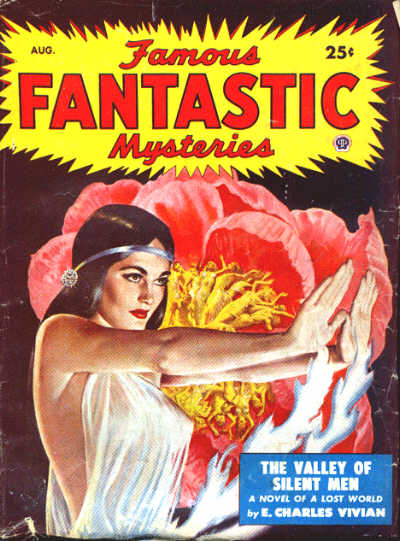
“The Counter Charm” by Margaret St. Clair


First appeared in Famous Fantastic Mysteries, reprinted by Roger Elwood, Vic Ghidalia, Stefan R. Dziemianowicz, Robert E. Weinberg and Martin H. Greenberg.

Summary:

“Sandy” Sanderson, art director, and Mopsa Hansen discuss the horrible art work in Glowing Skull Magazine, their competitor. All that they can appreciate about the work are the long, frightening teeth. Unfortunately, the artist, Jabez Ordway, is soon commissioned to do all further art work for Sanderson’s magazine. Worse, he starts to make passes at all the women who work on the magazine, threatening them with his occult powers if they don’t give in.

Commentary with Spoilers:

At first Sandy goes along with this as Ordway seems tractable and doesn’t often draw the improbable monsters he drew for Glowing Skull. As Ordway seems to have a measure of control over his cousin who owns the magazine, and as Sandy just invested in a cabin, he feels he has to give in. But when Ordway threatens the women, and even Sandy himself if he doesn’t auto-approve Ordway’s suddenly turning in a set of lousy monster pictures.

So Sandy defenestrates Ordway. Mopsa helps support Sandy with an alibi, so that it looks like suicide. Except that Sandy keeps dreaming of Ordway. Sandy doesn’t sleep well, and finally seeks Mopsa’s grandmother who is a white witch and comes up with a counter charm, which might help temporarily, but it might be turned against him. Sandy promises not to use it unless he has to. When he dreams Ordway standing at his bed, Sandy takes the charm, but it backfires, leaves him trapped in one of the worst of Ordway’s drawings, hearing a rustle in the grass pursuing wherever he goes.

This story is interesting in that St. Clair was Wiccan and that the ending, which at first we feel is unfair, turns out to be apropos when pondered. Not the best of her best, but it definitely needs inclusion in her selected works. Apart from the plot shift of killing the antagonist, pushing us into new speculative territory in a short story, this tale is surprisingly simple for St. Clair. But she kept the plot moving into interesting territory when lesser writers might have settled on something easy.

Nonetheless, the story has possibly the worst line in St. Clair’s career: “His Adam’s apple was throbbing incoherently.” Were I to reprint this, I might accidentally leave out this line.

Friday, April 17, 2020

“The Goddess on the Street Corner” by Margaret St. Clair

First appeared in Beyond Fantasy Fiction, reprinted by David G. Hartwell

Summary:

Because a Greek goddess appears, you’d think the result would be humdrum. It isn’t. A man finds her on the street corner, takes her home and recognizes her as a goddess, feeling her transcendence in her touch. He treats with delicacy and brings color to her cheeks with liquor—liquor he won’t touch since she touched it. 

Commentary with Spoilers:

St. Clair holds off on the revelation of which goddess she is until the ending. This is something of a cheat if he’s known all along, but maybe she thought it might cheapen the theme had the reader known in advance that the mystery goddess is Aphrodite. His love for [worship of?] her leads to him spend all he has and sell his blood to keep her in expensive brandy he cannot afford. She rewards him with the gift of love, promising that women fall for him. He goes out and returns with amorous tales of his supposed conquests to please her of her power, but she still wanes, less and less substantial. She feigns the creation of flowers below his window and [he thinks?] he sees a single pink flower. He claims to see a whole street of them. She disappears. 

Is this story about gods? or about love? Possibly both. He despairs at her disappearance, worried who will take care of him, when plainly he was taking care of her. But in a psychological sense she had been taking care of him although the irony of his feeling remains palpable—simultaneously both true and untrue. My one complaint would be--if she is disappearing due to lack of believers--how did she live this long? If her meeting this gentleman makes him a strong adherent (and she's gone this long without adherents), why would she disappear now? 

Not a classic in terms of speculation, but a thought-provoking keeper to file among her best. Contrast this to her most famous tale, “The Man Who Sold Rope to the Gnoles” (my first, briefer response to the story) which is the inverse: speculatively rich but not nearly so thought provoking.

Wednesday, April 15, 2020

“The Man Who Sold Rope to the Gnoles” by Margaret St. Clair

My first, briefer response (and with a slightly different perspective) I recorded here.

Written under the pen name of Idris Seabright, it first appeared in F&SF and was reprinted in a few major retrospectives by Isaac Asimov, Terry Carr, Martin H. Greenberg, David G. Hartwell and Robert Silverberg.

Summary

A salesman, new at his trade, having just finished reading his manual (the narrator warns us that he fails to pay attention to the sales rule concerning “tact and keen power of observation”), goes to sell rope to gnoles, a people who live at the end of Terra Cognita. The senior gnole, with multifaceted jewels for eyes, indicates that he doesn’t understand spoken languages, so through pantomime, they make a promising agreement about a purchase.

Commentary with Spoilers

In the nineties, SFWA writers considered this one of the top thirty fantasy stories in a fifty-odd year period. Hartwell included it as a “masterpiece” (according to the title of his collection). Who am I to disagree? I will say I’d recommend swapping this with “Brenda” [see discussion in this review. Page to second story. Whenever my mind reels back to this story, all of her other works pale--wonderful character, wonderful speculation, and a thoughtful piece].

It’s a simple classic story of cultural misunderstanding. It isn’t greed that is our salesman’s fatal flaw, but simple ignorance. In fact, "tact and keen power of observation" is a bit of distraction, as if he'd failed what we see, but we only see it because the narrator tells us (the narrator, after all, stated that that "may be" the salesman's problem).

He turns down a too-valuable jewel for trade in order to go for two smaller jewels which happen to be the gnole’s alternate pair of eyes, which offends the creature enough to tie up, fatten and slaughter the salesman without torture to be eaten. Was the story selected as one of the best because the victim was a salesman? Or simply for the cultural faux pas so easy for anyone to make?

Martin Greenberg pointed out the correlation between this story and St. Clair’s former occupation in horticulture. Under that lens, this story makes an interesting comparison to her tale “The Gardener” (which is superior in execution if not speculation--I discussed it in this review. Page down) but remains one of her best works, especially at such length, capturing a culture with compact dexterity.

Tuesday, April 14, 2020

"Brightness Falls from the Air" by Margaret St. Clair (plus Thomas Nashe's "A Litany in Time of Plague")

First appeared in F&SF as a contest story, reprinted by J. Francis McComas and David Hartwell, the latter a major retrospective. I commented more succinctly, but with slightly different insight here

Summary:

On occasion Kerr watched the bird people fight, who left luminous trails in their wake, until he met Rhysha, face to face—her plumage glowing. She came to Kerr’s identification bureau to identify her brother, dead from a bird people fight—fights that the Earth people put on after forcing them to migrate. The bird people join the fights that used to be rituals, but now are a means to exit this life. The Earth people despise all extraterrestrials—even the beggars. Kerr befriends her and goes to speak for her people to give them a new planet to populate.

Commentary with Spoilers:

The hearing doesn’t go well. Kerr gets Rhysha to promise her people will stop fighting, but when Kerr gets sick, she fights anyway, leaving a note behind of how she had tried to get to him.

The title comes from a famous poem (one of the top one hundred most printed poems in the English language) by Thomas Nashe, called sometimes by "A Litany in Time of Plague" or by its first line "Adieu, farewell, earth’s bliss" (which might be recognized as the title to D.G. Compton's Mars novel). James Tiptree, Jr. also used the title "Brightness Falls from the Air" for one of her novels. 

Thomas Nashe sounds like something of a impish troublemaker, which may help in interpreting his poem (see Nashe's Wikipedia page and the image of him in chains, which seems to have been more wishful thinking, but not for people's lack of trying).

See the source imageThe poem originates from the comedy "Summer's Last Will and Testament" about a plague that hits earth--not unlike our own time of Covid-19 although with more devastating results--where everyone is bound to die and nothing can avail us. It sounds rather somber; however, note that it is a litany, recited in church where a lay reader or preacher would read a passage, and the congregation would recite the chorus ("I am sick, I must die"--a pair of seemingly linked statements which would have had no actual religious significance in Nashe's day and region). That might create bleak humor if one is expecting some grander purpose or optimism from their church. Also, the chorus doesn't really show one's actions as contributing to one's destiny. It sounds like more of an apocalyptic prayer. I haven't read the play to see how it's used.

Just as Nashe's poem may read differently divorced from its source, so does St. Clair's title. In the poem, "Brightness falls from the air" is something of a non-sequitur, perhaps merely denoting sunlight (perhaps it is linked with youth which precedes it, or with royalty which follows, but these semicolons seem to suggest separate statements building up to the chorus].

St. Clair's tale is meant to be neither humorous nor, I think, resigned to death, necessarily, as a plague outside human control decimates Nashe's population. Instead, she takes her title literally, and her readers are meant to witness an injustice: the mistreatment of outsiders. 

Clair’s tale is simple, moving and worthy of her best, capturing strange, colliding cultures in a few deft strokes. Hartwell writes that her story accomplishes her goal to “develop a global consciousness” by dealing with “beauty, death, and colonialism.” The tale doesn’t make clear the connection with Kerr’s amateur singing, but perhaps it is an irony that he would try to impress the bird people with his singing although the text isn’t explicit about the bird people’s abilities in this matter.*

* Interestingly, I'd mentioned this in the first explanation. Not recalling my first analysis (lacking internet when I wrote this up), I mentioned it again, thinking it just occurred to me. 

Tuesday, March 31, 2020

Review: The Hole in the Moon and Other Tales by Margaret St. Clair (3 of 3)


 [This is part three of a review begun here and continued here.]

“The Continued Story” is rambling, rollicking conspiracy story. A man turns himself in to the police to get locked up, to escape from his alien hunter. The cop won’t do it, at first, because he doesn’t believe the man stole assembly kits from a toy store that disappears the next day—not to mention kits that create hallucinatory episodes like a Lunar Experience, a diamond mask, and so on. The story switches points of view and the alien pursuer’s target, but it doesn’t explain why this should be since the hunter was supposedly interested in the stealer of kits.

“Brenda” [Weird Tales, also appears in Greenberg’s edition of her Best-of and is reprinted by Groff Conklin, Eric Protter, Roger Elwood, Vic Ghidalia, Carol Serling, Martin H. Greenberg, Charles G. Waugh, Stefan R. Dziemianowicz, and Robert Weinberg] is a classic. Like “The Hole in the Moon” it hasn’t been reprinted enough, despite half a dozen appearances. Brenda is a well-behaved, good little girl that none of the kids seems to like. One day she’s pursued by a gray man, stinking of rot. Through a bit of cleverness, she captures the man. But when no one else is interested in seeing her find, she lets him loose. She strangely identifies with (loves?) the creature and the ending is creepy and open-ended.

“Stawdust” starts at a crisis moment—a man and a woman face off on a ship, surrounded by dummies, kidskin stuffed with sawdust of what used to be passengers, with both remaining suspects claiming to be innocent—and then reverses to the beginning when it all started. You’d think you were in a contemporary fantasy mystery, but no. We learn that the ship is a starship (leaping history and genres), and that soon enough the culprit was always known. The initial drama was false. When I was learning the field, I was told never to mix SF and magic, and it seems that St. Clair loves to do this. The title is both a clever and awful pun. The ending does turn the story into a minor irony although a more emotionally powerful ending should have been available.

“The Invested Libido” and “The Autumn After Next” are two slightly humorous and thoroughly competent tales. The first immediately constructs a strange world and the man who chose to use Martian psycho-pharmaceuticals to cure his ills only to find it changing him. Literally. To a squid. He sneaks into an aquarium only to get caught. Under psychiatric supervision, he conforms to other shapes. [This story makes one wonder if it has a meta-fictional purpose of explaining why St. Clair switches point of view so often.]

The next tale tells of a wizard who tries to get a village to do spells properly, but they are lazy and don’t listen. Trying should be their reward, the villagers think. Finally, he comes up with a plan that will get them to do spells right, but the best laid plans....  This is fun and well told, but not among her more ambitious works. It’s available to read for free here.

The final story, “The Sorrows of Witches,” tells of a witch queen who loses her lover and tries to revive him through necromancy. Because she needs an heir, she needs a living lover who will become a stumbling block between herself and her lover. Over time, her writing style seemed to improve with solid entertainments although her scope, imagination and ambitions shrank.

How does St. Clair compare to her contemporaries? Was she short-changed? She was better than Isaac Asimov when it comes to technique, but Asimov had a soaring, large-scale, methodical imagination that benefitted most from accumulated effects (his robot stories and the early Foundation books). Both writers suffered from talking heads.

I dipped into C. M. Kornbluth to prepare for this and for future examinations (namely Mark Rich’s biography, C. M. Kornbluth: The Life and Works of a Science Fiction Visionary). One story of Kornbluth’s troubles me, but he has a strong, immediate evocation of main character and place (even in his worst, early stories)—his non-Earth societies are rich, lived-in. The one story where she rivals Kornbluth in this is “The Invested Libido”. Where St. Clair outdoes Kornbluth is her better ability to stick the endings and her rare use of dialogue tags and adverbs (“Stop using tags and adverbs to describe your dialogue!” the reader growled at Kornbluth menacingly).

Ray Bradbury, whom Campbell compared St. Clair to, was a better writer in nearly every regard except Bradbury’s later work, which seemed less significant although sometimes he stitched together slight stories to greater effects.

How does she compare? She numbers among the era’s better writers, especially if you like that era’s spare writing style—but only a handful of tales here showcase her talents to their best effects.

Since St. Clair passed in 1995 and her work can no longer be edited with her approval without use of a time machine, what she needs is a Selected Stories, St. Clair Reader or Best collection to highlight her work to best effect. Martin Greenberg edited one, but it’s probably time for another. Three here deserve readers and inclusion: “The Gardener”, “The Hole in the Moon” and “Brenda”. A few cases could be made for the importance of others in this collection.

This collection inspired me to read and reread St. Clair. To follow my progress, look here to see the results of my search to hunt down some of her best work.


Sunday, March 29, 2020

Review: The Hole in the Moon and Other Tales by Margaret St. Clair (2 of 3)


“The World of Arlesia” [first appearing in F&SF] is another too-complex story that requires rereading to get what has actually happened. (I do love complex stories, but they require more set up.) A couple attend a double-header [Didn’t they called them double features? Perhaps she means to highlight the sports-like nature of what they are attending] “movie” [anticipating virtual reality?] where they go to an underwater world. However, the wife witnesses an entirely different world.

One example of writing infelicity [the guide is trying to con our narrator into becoming one of many recumbent women, although what is happening to the women is never clear—perhaps something Matrix-like]:

“I won’t,” I said. “You’re trying to do something to me, something to my mind. I won’t go in there.”

“Ah, well,” she said. She dropped my wrist and was silent.

So we have a vague menace [“something”] that is easily dispatched. The next time a mad scientist has a vague evil plan or a cut-throat thief tries to steal something he’s not sure about, just say, “I won’t let you” and that will take care of everything. Despite this, it’s still worth a gander.

“The Little Red Owl” first appeared in Weird Tales and was reprinted by Peter Haining. Uncle Charles tells frightening stories to his nephew and niece—a story where the little red owl, their hero, dies. The children, aghast, deny this has happened. The uncle is forbid from telling new stories, but he plans revenge, having professionally made a sweet coloring book that tells the same story.

It is a little spooky, adding a necessary change in point of view that some will take issue with, which also takes the key dramatic moment off-stage. It would probably work best on the screen—an anthology of horror stories like Cat’s Eye or Tales from the Crypt—the trick being to make an owl look both sweet, heroic, and terrifying.

A rather moving and ambiguous piece, “The Hole in the Moon” [first appeared in F&SF—printed and reprinted by Anthony Boucher and J. Francis McComas], is simple yet ambitious. Men have been destroyed by a disease that sits dormant in women, but kills men although one can tell a woman who is diseased by her pitted skin. A machine or robot woman arrives (at least, she suggests this in her description of her “sisters”) and she can only be made real if this man loves her. He is conflicted by wanting to love her and drive her away, threatening violence. She leaves. A narrative gap allows a few different events to have happened—intriguing possibilities. And his decision may lead to a few different consequences—none of which exclude his final, moving decision. The editor, Ramsay Campbell, points out the ambiguity that the protagonist could be insane, but that’s not the most interesting of possibilities. The minor flaw in this tale is that his loneliness and desire should have been set up immediately—not to mention nigh magical nature of her construction (via his desire—see this discussion of genre romance). Still, it’s surprising that this tale has not been reprinted more often.

In yet another genre bar story, “The Causes” [first appeared in F&SF, also appears in Greenber’s edition of her Best-of, and reprinted Darrell Schweitzer, George H. Scithers (an SF bar anthology) and Robert P. Mills] has one character after another describe why the world seems apocalyptic to the “main” character, George—going through Greek, Christian, and other causes. The ending saves the story, but if you aren’t a fan of world apocalypses, it’s skippable. Maybe read the first tale and skip to the ending to get the gist. However, Robert P. Mills seems to beg to differ in the tale’s quality by collecting it in a ten-year retrospective for F&SF. Introducing the tale, he wrote, “No collection of fantasy and science fiction can be considered representative if it fails to include a superior example of the bar-fantasy.” In other words, the above editors all included it because it was a bar story. It is a decent example, but what about superior examples of the Rana pipiens fantasy?

From the pages of Weird Tales, “The Island of the Hands” has an intriguing premise about seeking his wife’s lost ship. His plane goes down at her last coordinates and he wakes from unconsciousness. The island was invented to recreate things lost, so they find people dancing with simulated partners, simulated babies, simulated gems—none of which have much reality. He goes down to the mists to create the wife he lost.... The tale is stirring up until he wanders the mist, and it seems to lose itself there, wandering too long, which seems an unusual lapse for St. Clair. The tale finds itself—or a version of itself—but it becomes something else, ambiguous in a bad sense. Campbell, in the introduction, latches on to secondary characters for what the tale is up to. I also suspect that the true protagonist is not the main character but not the one he selected. If true, it’s a more interesting, ambitious and ambiguous in a good sense although that would mean that island doesn’t have the rules it was said to have (even in a straight reading, where the main character is the protagonist, the island breaks the rule of what it said about the mist).


Friday, March 27, 2020

Review: The Hole in the Moon and Other Tales by Margaret St. Clair (1 of 3)


Like many SF writers from previous generations, Margaret St. Clair is overlooked. Even all-consuming critics like John Clute miss out on some of St. Clair’s strengths (see his commentary at SFE) although he astutely points out her “work was at times daringly subversive of some of the central impulses of Genre SF.”

See the source image
In the past, I’ve taken a look at a few classic story by Margaret St. Clair and hope to do so in the future. She is a writer of economy, rarely overwriting—often writing her best work at the short-short or short-story length, a length that is sadly underestimated in the field, baring just enough ice to suggest the berg below. Reading The Hole in the Moon and Other Tales, one realizes that she can cram in that finite space a fine imagination to boot. She may take the germ of an idea for a lesser story and then takes it into several new directions, sometimes implying world’s from mere suggestions. If that doesn’t impress you, her endings tend to stick although the complexity and ambiguities sometimes tangle with too much to wrestle. Occasionally, she could have used a good editor to hash out the ideas.

Not too too long after St. Clair started published, James Blish initiated his critical article series as William Atheling (see The Issue in Hand). He said that the market was flooded with thirty magazines, publishing a lot of stories without “technique.” This was what he aimed to correct in his series. On the other hand, this created a fine training ground for many writers to grow up in. Undoubtedly, bad writers forever wrote badly, but some improved over time.

St. Clair, in her introduction to her Best of collection—a very humble if too brief recollection of a rough home life highlighted only by two kind uncles (if only she’d shared more so we could compare and contrast her life with her story “The Little Red Owl”)—wrote that the market did not support “humor and characterization,” which may go some length in explaining story defects. But her writing did “mature” through this magazine system.

Her first two stories demonstrate the training-wheels program: “Rocket to Limbo” and “Piety.” The first anticipates the tradition of Galaxy magazine (see also radio programs like X-Minus-One and the popular TV show The Twilight Zone)—projecting the present into the near future in a fun, semi-realistic manner—a now uncommon trend. “Rocket to Limbo” unintentionally photographs its time period more than future, which is most of the story’s pleasure. A woman gets an ad—for her eyes only—that she can get rid of her husband if she follows her instructions. The story begs for a sequel. In fact, despite the ending suggesting something final, it is only starting to get interesting. Observe how the characters behave toward one another. Their response is not the expected one. There’s something intriguing going on between them that is worth investigating in a second tale (plus, we’d learn about this new place). If only I’d been her editor...

“Piety” has a wonderful ending which you may or may not guess, but it goes on too long (despite its brevity) with “human” talking heads who try to pry the secret of immortality out of an alien. You may well guess both endings, which are somewhat satisfying, quelled by a less than stellar technique.

The second pair of stories show promise. “The Gardener” [reprinted by August Derleth and Michael Parry] feels modern. If I supply the initial scenario, you’ll guess the outcome: A gardener chops down one of fifty rare and ancient trees. No one knows why there have always been just fifty. Still, the ending is killer.

“Child of Void” [reprinted by Groff Conklin and Isaac Asimov] has a strong child-like voice about a single-parent family that moves to an area where the laws of physics don’t apply, and the boys find a talking egg. You cannot guess this ending, which explains the problem to a degree. As the story has a too-rich complexity that doesn’t gel, so the ending cannot resonate. It’s interesting, nonetheless, and demonstrates St. Clair’s fertile imagination. Both stories were collected in St. Clair’s Best of.

Some readers may like “Hathor’s Pets” [reprinted by Groff Conklin] because the premise is well set up: In a society where women have lost ground societally, a husband and wife have been transported elsewhere (another dimension?). They see themselves as pets, so they come up with plans that will allow them to return to their home. However, the alien treats them as unruly pets.... But it’s hard to distinguish any of the characters. The intriguing set-up resonates with the ending only thematically since one idea does not flow naturally from the other. “Good” politics may not equate to “good” stories, but it’s interesting, nonetheless.


[This is part one of a three-part review. Part two appears here and part three here.]


Sunday, May 4, 2014

"The Man Who Sold Rope to the Gnoles" by Margaret St. Clair

First appeared in Fantasy and Science Fiction.  Reprinted (a few of which are genre retrospectives) by Judith Merril, Alfred Hitchcock, Helen Hoke, Martin H. Greenberg, Terry Carr, Isaac Asimov, David G. Hartwell, Kathryn Cramer, Robert Silverberg, Jeff VanderMeer, Ann VanderMeer, Betty M. Owen.

Mortensen is an excellent salesman.  He goes out to the gnoles--an unpleasant, rarely visited people who live among the trees on the edge of Terra Cognita--and sells them rope, which no one has before.   They may not even need rope.  But he makes a faux pas.

*Spoiler*

 The key to this tale appears early on when he reviews his book on salesmanship:

"[I]t may be that his failure to put 'tact and keen power of observation' on a even footing with the other attributes of a salesman was responsible for what happened to him."

Being a man of conscience, he doesn't accept the jewel given as payment.  Instead he grabs something that appears of lesser value off a shelf.  But they are the eyes of the gnole, so they eat him.

Like "Brightness Falls from the Air", the story deals with St. Clair's preoccupation with global connectivity and consciousness.  In this case, pay attention to the signals those of another culture are giving off.

Saturday, May 3, 2014

"Brightness Falls from the Air" by Margaret St. Clair

First appeared in Fantasy and Science Fiction.  Reprinted (a few of which are genre retrospectives) by Everett F. Bleiler, T. E. Dikty, J. Francis McComas, Brian W. Aldiss, David G. Hartwell.


Kerr meets Rhysha of the bird people, the Nyagir, one of a number aliens on human-colonized worlds when she came to collect one of her dead.  The Nyagir exist because humans like to watch the bird people fight each other, but they are vanishing.  The Nyagir fought before, yes, but only as a ritual.  Kerr feels for Rhysha's peoples' plight and applies for their placement on a new colony.

* Spoilers *

The application is turned down, with some vehemence.  What was Kerr thinking?  Bird people?

When Kerr returns, Rhysha has killed herself (presumably by fighting in one of the battles for human amusement).  An intrusive ad, blaring through the window, points out the practice will continue..

There is some irony in that Kerr sings and the bird people do not--irony since terrestrial birds are known for their songs.  If you recognize the irony, this may accentuate the Nyagir people's plight.

I have more in-depth summary and analysis here.

Like "The Man Who Sold Rope to the Gnoles", the story deals with St. Clair's preoccupation with global connectivity and consciousness.  In this case, unconscionably, some humans are only interested in another culture in so far as they see of a use for it.