Search This Blog

Showing posts with label science fantasy. Show all posts

Sunday, January 23, 2022

The Art of Golden Queen by David Farland / Dave Wolverton

The Golden Queen (The Golden Queen, #1) by Dave Wolverton

Dave Wolverton passed away on January 14, 2022. This is just a tribute to one of my favorite novels of his. 

I recently commented on what I think was one my favorite stories, "After a Lean Winter," and what made it so brilliant.

The Golden Queen is a science fantasy. It would be easy for a long-time reader of fantasy just to accept this as a somewhat traditional fantasy with some of the usual oddities such as a talking bear, but then we have two moons. The novel opens this way

"Veriasse could taste the scent of vanquishers in the crsip mountain air. Beneath the sweaty odor of the horses, lying deep below the aroma of pine needles and leaf mold, he could barely detect the acrid scent of dronon vanquisher's stomach acids. This was the third time he had caught that scent in as many days, but this time it was closer than in the past."

Really, this could go either way in reading it: fantasy or science fiction. But the heavy emphasis on scents has a distinct odor of biology. Straddling the divide between science and fantasy creates a beautiful friction, a paradox of sorts, a broad palette of samples to taste. We inhabit two genres simultaneously. Just when you settle into the fantasy of it, the text will either imply or call up the science of what's happening.

But the most powerful aspect is the characters themselves. And the story takes off in the inn in Clere, the characters giving one another a hard time in a playful manner (notice how the barbs fly off at everyone, sometimes multiple people at once):

"Nooo, no!" Father Heany threw up his hands as if to ward off a blow. "You can't go trying to unload your ugly niece onto the boy," the priest said. "That would be a sin. She's a nice enough girl, but with those buck teeth--"

"You don't say!" Seamus frowned in mock horror. "You daren't talk about my niece that way."

"I will," the priest said. "God agrees with me on this point, I'm sure. The girl has tusks as dangerous as any wild boar's. Now, if Gallen is looking for a nice young woman, I'm sure others could  be found."
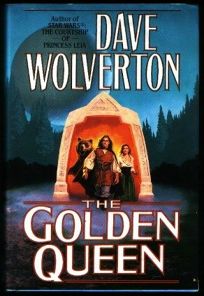
Fiction Book Review: The Golden Queen by Dave Wolverton, Author Tor Books  $22.95 (318p) ISBN 978-0-312-85656-4

Maggie got up from her churn. The cream had hardened to butter, and she could no longer turn the crank. Her face and arms were covered with perspiration. Gallen figured it must be midnight, yet she'd been working since before sunrise. She stood wearily, put a heavy log into the fire, then sat at a nearby table with a sigh that said, "Ah, to hell with it."

"Well, there is Maggie here," Seamus said with a wink, and Gallen saw that he'd been planning this all along. With Gallen and Maggie sitting so close together, it was a perfect opportunity to torment them both. No one in town could have missed the glances they exchanged, and Gallen had just about decided that Maggie was the one for him. "Now, Maggie has it all--she has her wit, she's a charmer, and she works as hard as three people."

Maggie also gives Gallen a hard time of it, too. However, the playfulness gets challenged when the beautiful Golden Queen herself arrives to send our heroes off on a journey, looking for a guide or an armed escort who can also defend. However, though Gallen shows himself worthy as a guide, he's rebuffed when he inquires about her name. An act not lost on Maggie.

Forgive me. I love Orrick the bear, too, but I can be less specific about that. Perhaps it is just our innate desire to befriend animals, but Farland does seem to capture some of the beariness of Orrick in a few deft gestures such as his voracious appetite, lapping milk from a bowl, and mysterious behavior like this: 

"God be with you, for I shall not," the bear said.... Gallen shivered at the sound of Orick's cryptic farewell.

There's much to love. It's almost as wonderful as knowing the man himself.

Monday, October 11, 2021

The Sword of Rhiannon or The Sea-Kings of Mars by Leigh Brackett

http://www.philsp.com/data/images/t/thrilling_wonder_stories_194906.jpg

First appeared in Sam Merwin, Jr.'s June 1949 issue of Thrilling Wonder Stories. Reprinted (first three chapters) by Brian Aldiss. Recommended by Stephen E. Andrews, Nick Rennison, T. A. Shippey, A. J. Sobczak, David Pringle, James Cawthorn, Michael Moorcock. 

You can read  an extensive excerpt through Baen (and purchase the book or ebook) although it's unclear if it's the full novel or just the original publication--or if those are exactly the same. I did some comparison and so far it seems to be the novel.

 "As an archaeologist, Matthew Carse was in search of the ancient Martian past. He did not find it--but it found him, and in no time he was fighting for his very life!"

The above quote may have come from this issue or perhaps Brian Aldiss who, in his Space Opera anthology, said he tried to use the original quotes when possible to give the anthology that Space Opera feel.

Carse is a former archaeologist who seems be resting on his laurels at age thirty-five, living on his non-native Mars for most of his life. He seems to be retired, living the good life--presumably dealing in antiquities, finding adventure where he chooses, traveling through the shady part of town and finding said adventure.

A thief is tailing him, for an unnamed reason, and Carse catches him. We never learn the truth, but the thief claims he has a treasure that he wants Carse to sell for him back on Earth because he'd get in trouble if he sold it on Mars. Carse realizes the only way the thief came across the treasure was to have found the Tomb of Rhiannon. He demands the thief take him there.

They go, but the thief has something else in mind, and thrusts Carse a million years into the past.

#

What traits give this brief novel its power?

One has to be the mixture of genres found in science fantasy. It draws from the same well that George Lucas drew upon when he wrote, "Long time ago in a galaxy far, far away" bringing us to worlds impossible for our experiences to map on. It draws on Edgar Rice Burroughs' Mars, a planetary romance--no doubt a powerful influence--but Brackett does something more with it. We begin in the future where travel between Earth and Mars is common.

Aldiss said he chose this as space opera because it dealt with the issue of exile. That seems an odd definition. Is Robinson Crusoe a space opera? Or was it simply a trait he found among stories he wanted to select? Perhaps Aldiss means being an outsider--one who eventually finds his place in a world not his own? If there were a theme here, that may be it.

But the exile theme doesn't capture the power of the work--at least not fully. In fact the story seems not to hold to any one particular theme or especially complex characters. There does seem to be a potent statement made about the treatment of one's enemies, post-war (the novel appeared shortly after WWII) but it isn't a theme the novel builds toward.

No, the charm of this novel depends largely on its romance in the sense of its transporting readers on an adventure to another place and two other times, to gods, spirits and possession. The wildness of its speculation is a definitive draw.

Another draw is the language. You can sense this in the different titles. The first listed above (the revised title) captures what may best unite the text. However, the second (and original) captures more of the romantic spirit of the tale--The Sea-Kings of Mars--the mellifluous sound, the mysterious image of a thing that is never fully explained.

Here's an example of both the romance and the fluid language:

"Carse walked beside the still black waters in their ancient channel, cut in the dead sea-bottom. He watched the dry wind shake the torches that never went out and listened to the broken music of the harps that were never stilled. Lean lithe men and women passed him in the shadowy streets, silent as cats except for the chime and whisper of the tiny bells the women wear, a sound as delicate as rain, distillate of all the sweet wickedness of the world."

Note the flow. But there's a slight, stilted awkwardness to "that were never stilled." Brackett drops these in infrequently, but just enough. These tiny strange arrangements of language may not be accidental but may be meant to evoke another time and place. It seems quite possible that the language was inspired by the King James Bible--a version that was once considered the best in terms of language and was still used in the pulpit. It was also the language of poetry. You can hear it in the Romantic poets although when you look at the dialogue of novels from the same era, the language appears closer to modern speech than to the King James. So the unusual cadence also captures both the poetry and the language of God (or gods). Lovecraft and company overdo this. Brackett does it so gently as to be almost subliminal.

To our ears, it doesn't sound so natural since we are farther from the Romantic poets and the pulpits that relied on King James Bibles, but it might still work for those with training in older forms of English. Brackett's usage is so subtle, though, that few will note her language shifts--whether in cadence of older word choices like "daren't."

One thing that might trip up contemporary readers is the opposing ideas of what people now consider romance (in our current usage of the term) versus Brackett's age. One character forces a kiss on his prisoner. Brackett means for her readers to see the helpless attraction despite frustration about the other's behavior. 

But perhaps contemporary readers will consider it toxic. Why would either be attracted to the other? A valid question. A progressive case could be made that one or both do not deserve love. Maybe this idea of love of this kind is too dangerous to entertain, however fleeting, so such readers might steer clear. 

On the other hand, why not? Are the ways of love beyond our ken? It'd be interesting to hear Brackett's take.

Her best characters are the conniving side-kicks: 

"Even through the fear[,] a note of cunning crept into the voice. 'I have a gift....

" 'First,' said the Martian, 'I am Pankawr of Barrakesh. You may have heard of me.' He strutted at the sound of his own name like a shabby bantam rooster.

" 'No,' said Carse. 'I haven't.' "

 So many lovely charms in so small a container, this novel brings a thrill of wonder.

Thursday, January 4, 2018

Outerscope I (Episode 12 - 16)

Episode 12:

The kids discover oranges with sparkly hair who speak like they're tough 1940s Hollywood gangsters. They have the secret to happiness. The youngest Outerscope kids don't trust the oranges so they plan to stand guard by the ship while the others go to find out about the secret to happiness. The promise to take the kids to the Yun-yun theater.

The set-up could shortened and less repetitious.


# 13

The Yun-yun theater stars none other than stinky... onions. They seem to be the butt of their own jokes. Clearly, the secret to happiness is laughing at someone else's expense. If you didn't get this, they reinforce it with a direct explanation. The oranges (or tree treats) subjugate the Yun-yuns and force them to tell jokes about themselves, so that oranges feel beautiful and powerful. No subtelty here.


# 14

The older kids thought the show was funny until they see Yun-yuns coerced to put on a show.


#15

The Outerscope kids want to turn the tables and make fun of the Tree Treats instead. The Outerscope kids play on the vanity of Tree Treats to make them pretend to be Yun-yuns and plan to put on a better show.


#16

The Yunyuns boo and laugh although some Yunyuns don't care for the turned tables. Meanwhile, the Tree Treats have learned their lesson about making fun of Yunyuns. They discover that either way is wrong. Celebration!


#17

If you didn't get the moral of the story the first time, they expound it again as they travel to another planet.

They hit a bouncy object but it is too dark to tell what they hit. Eleanor decides to go on a space walk without a space suit and has lots of fun. They have to talk her into investigating. What looked like a keyhole from the spaceship turns out to be...

a keyhole! Eleanor swims through space to look for a doorknob.

Am I exaggerating by calling this a science fantasy? They've dropped the ball on wondering to what extent if any they are living in reality.

To be continued...

It strikes me that these episodes are way to short to convey much. Due to their brevity, they had to make certain aspects redundant. If you could recut them to eliminate the pedantic aspects and redundancy they might retain some of the fondness and mystery of the brief glimpses I had as a child. I do like the "To be continued..." but maybe right before an episode where one ends on this kind of mysterious wonder. But until these get trimmed, they are rather tedious. I wonder how many episodes a kid would sit through. Certainly most adults might accidentally lose the disc before getting to the end.

Saturday, December 16, 2017

Outerscope I (episodes 5-11)

Welcome to Sani-land, where scrub brushes, mops, sponges, soap, and scissors clean and polish all the time. They conclude the Outerscope kids dirty.

The scene begins promising enough: white stone and a surreal black and white tile path. They are surrounded by cleaning utensils--the scissors presenting the only menace, though--and herded toward the King and Queen of Sani-land. The King and Queen are duds, though. They flatten the estrangement into something banal. But maybe cleanliness is an issue that troubles kids when they feel they are clean. Moreover, there's the racial epithet of being dirty if not one of their kind. It does have resonance. However, they kill whatever ambiance it's built by singing, accompanied by shrill pipes. Edit that out.

When they exit Sani-land they have a brow-beating discussion that the viewer can guess. Cut? They do bring up the idea that space is like a dream, returning to the idea that their journey is not one of reality but of imagination.

Next we enter Technovek, a land of living machines (living?) with a Papavek, Mamavek, and Babyvek. They seem a bit arrogant about their intelligence while the kids seem to have prejudices/preconceptions to overcome. The kids get directions back home, but don't trust them, so they're going to go in the opposite direction. They are rather odd directions, requiring loops--maybe they're celestial slingshots, but if so, you can't simply reverse them.

The repetition was no doubt necessary for the episodic series since there may have been time between viewing episodes when they first appeared, but now it is tedious. There's a smidgen of charm in the "To be continued" and the recaps, but they are too frequent and exhausting to watch in one sitting. Plus, even within an episode there's unnecessary reinforcement of ideas--maybe in an effort to make sure each kid had something to say and pound home the lesson to be learned.

At this point, the show has something to offer, but it is labored perhaps under the limitations of its original format. When viewing individual episodes, they capture some of home-spun wonder that I recalled. But the repetition bogs it down. Can the show be edited into something worthwhile?

One might argue that it's a kid show, but does that mean it can't be done a little more artfully? Education does require repetition, but 1) the educational value is only in its education of cohesive social values among so many varieties of people, and 2) making it watchable will make people want to watch it once and maybe again.

Time to put this show on pause.

#5


#6


#7


#8


#9


# 10


# 11


Thursday, December 14, 2017

Outerscope I (series continued and reviewed--episodes 2-4)

I have to admit that these need serious editing. One gets the feeling that the writers were either uncertain where the story was headed or they wanted to streeeetch out the moments they thought were wonderful. Still with careful splicing (jettisoning up to half) and perhaps even cheap CGI, this series could be cool.

Cynthia comes up with the bright idea of using yeast, (which raises dough, right? so why not a spaceship?) to lift their scrapyard craft. She questions whether this is imagination or reality they were dealing with. The older kids treat everything matter-of-fact. Still there are moments of steering in space with bicycle handle bars (with what rudder? against what medium?) or getting the ship off earth, for that matter, (ethanol won't cut it as it is 644 times more dense than air) that makes the reality of what they're doing an intriguing question. If it is eventually addressed, then maybe the series has some small heft.

Other intriguing aspects of the series--then and now--include 1) the fragility of their craft, so rickety, cobbled together with scrap boards, hope, and imagination and 2) the nagging desire of going home, if they ever can.

Why CGI? Part of the charm of these is the awful special effects, much as early Doctor Who episodes relied on the audience's willing suspension of disbelief. But staring into space to see white blobby stars is not quite as enthralling as they seem to believe. Maybe it can be done on the cheap. You don't want to lose the obvious green-screen effect here.

#2


#3


#4


Outerscope

Every now and again, I hunt down this old educational series that piqued my imagination: Outerscope. Kids--er, small puppets with largely frozen expressions juxtaposed against adult human hands that move with human grace--build a clubhouse out of scraps and go flying off to other worlds. The episodes came in tantalizing bits--tasty morsels but you'd never get any closure. Did they ever get to where they were going? Where did they escape? Will they ever get home? Was it as good as my memory said? Why did I like it?

In the past, I haunted Youtube and Amazon for the collected episodes with no success. It came up again, and this time I found the first episode, and yes, I enjoyed it as much as I did as a kid.

Nick Sagan and others have called it creepy. The puppets are somewhat lifelike, somewhat not, so maybe a little creepy, but you just have to use your imagination, suspend disbelief as you did when you were a child. Even then, I didn't believe they could survive in space with what little they had, but that they did anyway stimulated the gray cells.

Finally, here is the first episode, cued up for you:


I'll see if I can hunt others down.

Here are Nick Sagan's comments on the show:
"[M]ost disturbing of all: the "Outerscope" segments. "Outerscope" was a serialized puppet show about a multicultural group of kids who turn their clubhouse (or maybe just a bunch of old junk) into a rocketship and explore the universe with it. They meet aliens, have all kinds of adventures, and along the way they learn lessons about tolerance, friendship, etc. Not a bad premise for a kids' show. Just two problems with the idea. 
"First, the puppet children were incredible creepy. They had a certain "dead mannequin" quality, with weird, oversized hands. "Man hands" some might say. 
"Second problem: These segments are frightening just in their tone. Again, imagine you're six years old. You watch these dead-eyed big-handed (but otherwise likeable) puppet kids fly off into outer space and get lost. They try to get home, but each episode they just get further and further away. Everything goes wrong, one puppet kid sadly looks at the other and says, "I guess we're never going home." End of episode. Sleep tight, kids. 
"Vegetable Soup scared me silly when I saw it, and yet I couldn't turn away. Why did I keep watching it? And why do I remember it fondly today, nightmarishly weird though it was?"

Sunday, November 25, 2012

"If the Stars Reverse their Courses, If the Rivers Run Back from the Sea" by Alter S. Reiss

Fantasy and Science Fiction, November 2012

Another strong parallel universe story, albeit one with roots in fantasy.  The narrator travels to a basement where he does some conjuration so he can visit a nexus where the formerly dead gather.  In some universes they live on, while in others they are reincarnated, living again and again.  The narrator is determined to right wrongs, to kill Cainder who has started a war in every universe--no matter how many times the narrator has to kill Cainder.   

This one feels like part of a novel or novella, especially since we travel through part of one universe without accomplishing much except setting up the travesty Cainder has caused (vital but perhaps more could have occurred).  It captures a nice tone matching the narrative.