Search This Blog

Showing posts with label Elizabeth Bishop. Show all posts

Saturday, August 21, 2021

A Wake with Lawrence Ferlinghetti on Green Street

https://upload.wikimedia.org/wikipedia/commons/a/a6/Lawrence-ferlinghetti-by-elsa-dorfman_%28cropped%29.jpg 

Lawrence Ferlinghetti passed away this year on February 22, 2021, one month shy of reaching 102. He seems to have been producing new material for quite a while. He published a novel in 2019. While it could have been a trunk novel, it's still interesting that a man was capable of producing work that people would publish over a century of living. Apparently, not so much today, but that's another story.

The poem in question (posted online here) is untitled although this website calls it "Green Street"; however, note the formatting does not match the one I read.

My interest in it is how parallels other genres like science fiction. Also, my interest in it was how difficult it was to read it. I had a book of poems to read in spare moments, and for some reason my mind kept slipping off the poem. Probably I was distracted, not ready to focus. I don't blame the writer until I hunker down and focus.

This happens in most genres. There are moments in narrative when your concentration has to be 100% there. In science fiction, usually that's weighted at the front, the steep learning curve for learning how the world works. In mysteries, it's at the end when shifts and surprises can come fast. In poetry, it can be the whole poem. In literary fiction, it's similar, but it's often more nuanced although some experimental stuff may require most of your attention.

Here's the opening line:

The Green Street Mortuary Marching Band

What's tricky here is this pile up of nouns and adjectives, and what modifies what. "Green" is, in some senses, the most ordinary of these words. It most likely modifies "Street", but that doesn't help much because it could have been named because all the houses were green, or maybe it was covered vegetation, or maybe it was named after someone named Green, and have nothing to do with the color at all. It could also refer to being young, inexperienced, naive or unripe. It's also possible that Green could modify "Mortuary" or "Marching Band" or the whole. Alternately, or in addition, Wallace Stevens added on (at least within the field of poetry) a sense of spice, of creativity, and of color in "Disillusionment of Ten O'Clock" (excerpted here, see link for full poem):

The houses are haunted
By white night-gowns.
None are green,
Or purple with green rings,
Or green with yellow rings,

"Street" could mean just a paved avenue, or someone or something raised on or near the street as in "street kids" or "street dogs"--a sense of looking down one's nose can be heard in that. It could also refer to homelessness.

"Mortuary" adds the actual place but also the sense of death and passing on. "Marching" is interesting in that it could serve as part of a verb team (was marching) or a verbal clause (marching in place), but here it's an adjective like "Green," sort of.

"Band" unites the whole--in both definition and action.

Now that's a lot of information to process in one line. You might come up with more. It could be that mortuary marching bands have a place in our society. Maybe this famous one comes to mind:

But for most of us it lies outside our experience. And that jarring sensation between mourning (often the passing of elderly) in a mortuary and celebrating in a marching band (often composed of youth) creates the energy in this poem and in the above movie clip.

It's this energy that drives SF, too. When Elizabeth Bishop misread "mammoth" as "man moth," she wrote a poem. Jack Vance took that strange combination of words and tried to create a different reality.

I recommend reading the whole poem at the link.


Monday, November 16, 2020

Elizabeth Bishop's Later Early Drafts of "One Art"

Bishop is still exploring in these drafts 

The art of losing not so hard to master:

so many things seem really to be meant

As Bishop earlier pared master/disaster opposites in union, so she does again with "seem" and "really." The first confirms appearance, the latter expresses actuality. Also the phrase "to be meant" gives will or intention to the inanimate, or perhaps the person or thing that lost them had designs.

Start slowly will you, keep, a face, a gesture

Once again, we enter recipe territory with the first two. But we gain the speaker in the second two "will you" as if the "you" is in a hurry to lose things and the speaker is trying to slow the person down. This could also be the speaker addressing itself.

With extra commas, it isn't clear what she means by "keep." It may be an accident, a path she intended to head down, or a way of keeping something in play, maximizing possibilities she may put the word to use. It appears that she might be trying to introduce the lost loved one early, advising the listener to keep the things that memory is losing "a face, a gesture"  

Stood with your glasses

Reading-glasses, car–keys, you can master

easy things.

Here Bishop again reaches for the casual tone, returns to the simple, the easy, the natural. The images, all common. She seems to want the opening to feel as as normal or universal as possible. 

Look! I myself have lost or

next to last, at least, houses and

Although this part occurs later than the next, it repeats some of what I said. The common parlance of "Look!" and "I myself have," trying to ally the reader in her cause, empathizing. The following phrases would seem at first glance to be stutterings, unsure where to go but maybe the where is dependent largely on the connecting phrases, so she is trying each one on as different garments before a mirror. What she wears may dictate where she goes next. Although it seems she has been working with the same general concept, she is still keeping her options open.

The practice brings losses, lose them faster,

forget the faster-money, home, intent,

the mastered art of losing’s no disaster.

"The practice" makes this a game we're preparing for, a clinical occupation, a way to prepare, a way to master. She likes "practice" well enough to try it again in the next draft but without finishing the phrase, hoping it would come to her later (most of the next "draft" is a sketching of the end word of the poem):  "Practicing my... / and possibly will end disaster." As you can see, she dwells in possibilities, doesn't nail things down. 

She flips "lose them faster" on its head. She wonder if she or the reader should "forget the faster." Considering Bishop's penchant for erasing or honing as she writes, these become the reader, the writer and the poem become one and the same. What may be a note to herself may just as well become a line of the poem. It's almost as if she brings the reader into the making of the work.

Friday, October 2, 2020

Elizabeth Bishop's "One Art": First Draft

This post continues from this one discussing an early, journal-like entry about the poem.


The first draft opens:

THE ART OF LOSING THINGS

The thing to do is to begin by “mislaying”.
Mostly, one begins by “mislaying”:

The title has evolved from a recipe, to becoming a gift/talent, to ending up as an art--an idea that flows naturally from the last. The title will move to the first line--a line so memorable that we remember it more than the final title. The recipe is still here: "The thing to do is to begin by." 


The text is strewn with colloquial phrases like "The thing to do" perhaps Bishop is striving for natural speech, or maybe she is just letting what comes naturally to flow out. The phrase suggests etiquette, but it is loose. These two lines may be two failed attempts at beginning the poem and they may serve as much to get one's self to start writing--"The thing to do is to begin"--to get words on the page. The second line may be a rewrite of the first. While the adverb is weak, it's an interesting reminder of Bishop's penchant for qualifying. Why "mostly"? It may just be a marker reminding herself to revise or qualify within the text.


She puts "mislaying" in quotes, calling attention to the term--for herself or a future reader cannot be determined. It is a real term (first use in 1614), but perhaps it feels awkward. Perhaps it is sexual. It may just be part of a kitchen-sink method of getting ideas on the page, throwing things at the wall to see what sticks.

keys, reading-glasses, fountain pens

– these are almost too easy to be mentioned,
and “mislaying” means that they usually turn up
in the most obvious place, although when one
is making progress, the places grow more unlikely

The banal list of common things lost grows with "keys." She turns them into a list instead of ballooning them out with an instance or explanation. Note the next comments on the previous line's banality "almost too easy"--almost, another qualifier. She tries out mislaying again--clearly fascinated by the term and follows that with an observation, humorous if not common, so she adds a line about places growing more likely. The places we search, or the place the keys end up?


– This is by way of introduction.
I really want to introduce myself – I am such a
fantastic lly good at losing things
I think everyone shd. profit from my experiences.

These are ways of introductions--an inflation deflated by self deprecation. The tone here seems to be one of self-help or perhaps an essay.


You may find it hard to believe, but I have actually lost

I mean lost, and forever two whole houses,
one a very big one. A third house, also big, is
at present, I think, “mislaid” – but
Maybe it’s lost too. I won’t know for sure for some time.
I have lost one long (crossed out) peninsula and one island.
I have lost – it can never be has never been found –
a small-sized town on that same island.
I’ve lost smaller bits of geography, like
a splendid beach, and a good-sized bay.
Two whole cities, two of the
world’s biggest cities (two of the most beautiful
although that’s beside the point)
A piece of one continent –
and one entire continent. All gone, gone forever and ever.

The hyperbolic self-agrandizement is blown out into ever larger proportion. What started as simple and small has become absurd. The way the text shoots over it, one might miss the power of losing a "house" although one might claim that losing a continent has power (never visiting again?), but the house is more intimate. Over-shooting the important stuff occurs in the next section as well. There's a lot of repetition in these that one suspects that she is looking for the best way to phrase a thing.

One might think this would have prepared me

for losing one averaged-sized not especially——— exceptionally
beautiful or dazzlingly intelligent person
(except for blue eyes) (only the eyes were exceptionally beautiful and
But it doesn’t seem to have, at all … the hands looked intelligent)
the fine hands<

Here it is: the reason for writing--a loved one lost--appears in the first draft. She appears to search for good descriptors. One suspects this was the reason for writing all along, but the way to telling it slant took several drafts. Here it is mostly baldly told. The final draft hardly mentions a person at all--someone suggested that one might claim isn't present in the final text.  

a good piece of one continent
and another continent – the whole damned thing!
He who loseth his life, etc… – but he who
loses his love – neever, no never never never again –

This seems to overshoot the reason for writing, but perhaps it is just revising the continent and plays with a famous if uncommon Biblical quote. The poem is still searching for its way of saying.

Thursday, October 1, 2020

Elizabeth Bishop's "One Art": From Conception

 I'll be looking at drafts of "One Art" by Elizabeth Bishop. Due to time constraints, I'll do it over a few posts. Beth on Bluedragonfly10 has interesting comments on the matter and shows several drafts

HOW TO LOSE THINGS/?/THE GIFT OF LOSING THINGS

One might begin by losing one’s reading glasses
oh 2 or 3 times a day–or one’s favorite pen.

I don't consider this a draft. It's a scrap scribbled on a cocktail napkin or grocery store receipt while waiting at the doctor's office. It's a poet's notebook that may prove fruitful with the right tool. It's a concept--no more.

But it's interesting what she does with the concept. She writes a few rather banal losses, but common ones, ones readers might identify with. She is trying to make a quick catalog of ideas of where to go and perhaps came up short. 

The most fascinating aspects are her titles. The first suggests that we need help with her expert guidance. The second suggests it requires a kind of talent to lose things. 

What inspired this idea? This could have been initiated in at least three different ways.
  1. She recognizes she loses objects. Then she tries to find a unique way of looking at this (titles), turning this common occurrence to have a curious spin, tries to show us the common inside a new, unusual frame.
  2. She begins with a humorous observation with an unusual frame and starts to list common misplaced things.  
  3. She has a loss in mind already, a human one, and tries to reframe that experience, coming up with a list of commonly lost objects. 
The human element appears in the first full draft, so it's possible she knew what she wanted to address and was only sketching out supporting details. Or conversely, the human element suggested itself after sketching out the concept. 

However, it occurred we have 1) something common, 2) made strange, and 3) the human or emotional element to be added soon.

Thursday, March 23, 2017

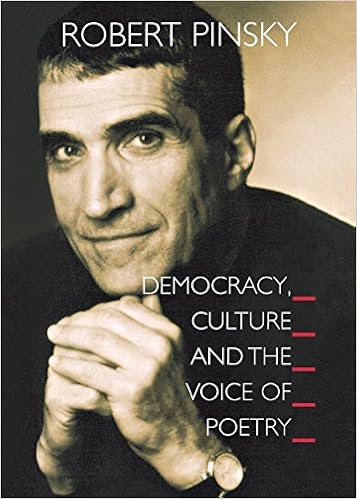
Democracy, Culture and the Voice of Poetry by Robert Pinsky

Robert Pinsky tackles Democracy, Culture and the Voice of Poetry, which seems a rather daunting task, especially for the book's modest size. A subtitle might ask what poetry's current role is in America. During his tenure as U.S. Poet Laureate, one of his self-appointed tasks was to get average Americans to comment on favorite poems. An immigrant from Laos, Pov Chin, here comments on how much Langston Hughes's "Minstrel Man" means to her. A critic apparently took the approach to task, saying it illustrated American narcissism. Pinsky, on the other hand, seems to admire the poem's strength through its adaptability, to fit someone's circumstances in a wholly different cultural context. I tend to lean in Pinsky's favor.

Pinsky opens the brief book by distinguishing wrong-headed impetuses that can damage a democracy: 1) colon, that is the tendency to all the same within a culture, and 2) cult, the tendency to divide and fragment a culture. In opening with this, he lends special weight to the idea but never comes back to it--at least not explicitly. Maybe he means to suggest that these are twin ditches ("keeping it between the ditches") or Scylla and Charybdis that the wary poet has to sail his ship between. In referring to the above critic, maybe Pinsky means to suggest the critic fell prey to one ditch or the other.

Pinsky quotes Alexis DeTocqueville (from Chapter XVII OF "SOME SOURCES OF POETRY AMONG DEMOCRATIC NATIONS" of DEMOCRACY IN AMERICA) as saying
"I am persuaded that in the end democracy diverts the imagination from all that is external to man [such as Nature] and fixes it on man alone."
Pinsky makes no direct connections, but maybe he means to suggest a specific meaning to this. He refers to a handful of poems without ever explicitly what his point in analysis is. These are "Home Burial" by Robert Frost, T. S. Eliot's "The Love Song of J. Alfred Prufrock", Elizabeth Bishop's "In the Waiting Room", and Edward Arlington Robinson's "Eros Turannos". This last Pinsky contrasts with the Carl Sandberg's Chicago poems which appeared that same issue and won poetry's then biggest award*. Sandberg's is probably more ostentatiously American--broad, sweeping, encompassing--but Pinsky calls on the voice of an anonymous American wife for whom the Robinson poem took on special meaning because her husband was away on business all the time and got hooked on drugs and alcohol.

It may be that Pinsky agrees and disagrees with his critic. Yes, people do take in poems and make it their own--not for narcissistic reasons but personal ones. That a poem can be absorbed by average human beings must be part of the appeal of doing a project that has "Americans [say] poems they love." Truly, that must be the democratic appeal of such an unofficial survey.

* Pinsky doesn't quite dismiss the Sandberg poems, but he does suggest that Robinson's poem is superior from this vantage in the future. His argument mirrors David Orr's in favor of Bishop over the ambitious Robert Lowell. This seems to represent a shift in predominant thought about poetry in the twentieth century. In Sandberg's poems, the voices of Walt Whitman and Allen Ginsberg echo although in general I am probably in agreement with Pinsky and Orr.