Search This Blog

Showing posts with label Jack Vance. Show all posts

Saturday, August 21, 2021

A Wake with Lawrence Ferlinghetti on Green Street

https://upload.wikimedia.org/wikipedia/commons/a/a6/Lawrence-ferlinghetti-by-elsa-dorfman_%28cropped%29.jpg 

Lawrence Ferlinghetti passed away this year on February 22, 2021, one month shy of reaching 102. He seems to have been producing new material for quite a while. He published a novel in 2019. While it could have been a trunk novel, it's still interesting that a man was capable of producing work that people would publish over a century of living. Apparently, not so much today, but that's another story.

The poem in question (posted online here) is untitled although this website calls it "Green Street"; however, note the formatting does not match the one I read.

My interest in it is how parallels other genres like science fiction. Also, my interest in it was how difficult it was to read it. I had a book of poems to read in spare moments, and for some reason my mind kept slipping off the poem. Probably I was distracted, not ready to focus. I don't blame the writer until I hunker down and focus.

This happens in most genres. There are moments in narrative when your concentration has to be 100% there. In science fiction, usually that's weighted at the front, the steep learning curve for learning how the world works. In mysteries, it's at the end when shifts and surprises can come fast. In poetry, it can be the whole poem. In literary fiction, it's similar, but it's often more nuanced although some experimental stuff may require most of your attention.

Here's the opening line:

The Green Street Mortuary Marching Band

What's tricky here is this pile up of nouns and adjectives, and what modifies what. "Green" is, in some senses, the most ordinary of these words. It most likely modifies "Street", but that doesn't help much because it could have been named because all the houses were green, or maybe it was covered vegetation, or maybe it was named after someone named Green, and have nothing to do with the color at all. It could also refer to being young, inexperienced, naive or unripe. It's also possible that Green could modify "Mortuary" or "Marching Band" or the whole. Alternately, or in addition, Wallace Stevens added on (at least within the field of poetry) a sense of spice, of creativity, and of color in "Disillusionment of Ten O'Clock" (excerpted here, see link for full poem):

The houses are haunted
By white night-gowns.
None are green,
Or purple with green rings,
Or green with yellow rings,

"Street" could mean just a paved avenue, or someone or something raised on or near the street as in "street kids" or "street dogs"--a sense of looking down one's nose can be heard in that. It could also refer to homelessness.

"Mortuary" adds the actual place but also the sense of death and passing on. "Marching" is interesting in that it could serve as part of a verb team (was marching) or a verbal clause (marching in place), but here it's an adjective like "Green," sort of.

"Band" unites the whole--in both definition and action.

Now that's a lot of information to process in one line. You might come up with more. It could be that mortuary marching bands have a place in our society. Maybe this famous one comes to mind:

But for most of us it lies outside our experience. And that jarring sensation between mourning (often the passing of elderly) in a mortuary and celebrating in a marching band (often composed of youth) creates the energy in this poem and in the above movie clip.

It's this energy that drives SF, too. When Elizabeth Bishop misread "mammoth" as "man moth," she wrote a poem. Jack Vance took that strange combination of words and tried to create a different reality.

I recommend reading the whole poem at the link.


Tuesday, May 5, 2020

Careers Subsidize Science-Fiction Addiction


"I see [acting] as subsidizing my used-book career, my book buying" [and book sniffing] -- Paul Giamatti

SF Writers mentioned: Avram Davidson, C. L. Moore, Henry Kuttner, Jack Vance, Keith Laumer, Larry Niven.

#

Audio: Four Stories by Melanie Tem:


1. Come Live with Me
2. Cousins
3. Margaret's 'Possums
4. Siguanaba y Sombreron

Tuesday, April 29, 2014

The Dying Earth or Mazirian the Magician


Interesting series of semi-related stories.  Had the series not had similar characters, I'd have been hard-pressed or surprised to learn that they were connected.  They don't elevate one another on a plot level and very little on the character level.  They do share commonalities in tone, mood, style, and theme.

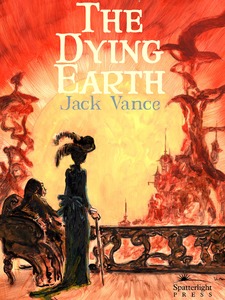
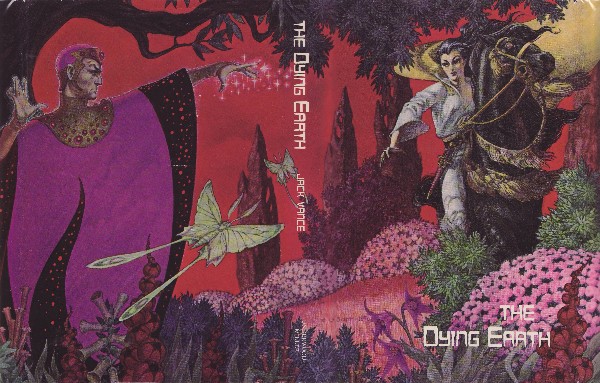
The title The Dying Earth fits the overall theme or mood of the series better than Mazirian the Magician, who is an unlikeable protagonist in one tale.  I'm not sure sure why it was retitled although the book cover that depicts a scene from that tale (see above link) best depicts Jack Vance's stylistic flavor.

An overall decadence unites the series which the original title captures, giving into amorality or perhaps a self morality.  Moreover, although the unseen underpinning of this world is technology, the abandonment of such and knowledge may have led to its "dying."

Later books have accentuated the baroque flavor and stylistic tendencies.


Analysis of “Guyal of Sfere” from The Dying Earth by Jack Vance

First appeared in The Dying Earth.  Reprinted by Robert Silverberg.

The novel ends on a coming-of-age story, "Guyal of Sfere"--a young lad so fond of knowledge he pesters his dad to death (figuratively) with questions.  Finally the father suggests the boy goes to the Curator [at the Museum of Man], in such a way as to suggest to the reader "Creator"--some all-powerful Oz.

The key, however, is the title and character's name, which might be pronounced "guy-al."  This leads us to "guile" and the dictionary:  guile: "the use of clever and usually dishonest methods to achieve something." --Webster's.  Now Guyal is initially guileless.  A couple of people suggest he ask the Curator, but it's as if with a wink or smirk.  What do they know?  We don't know how Guyal reacts except he takes on the sojourn or quest, anyway, presumably with some naïveté.

This doesn't last long.

The father arms his son with blessings so long as the boy doesn't depart from the trail.  This is not the hero's journey--not yet formulated at this time (at least not in storytelling terms)--but a traditional quest, and a pretty clever one:  a guileless quest for knowledge [a MacGuffin], which is transformed into something else.

First stop, he finds one who claims to know all but cannot prove it, encounters oasts--which are like but different from his horse.  A young girl and her uncle invite him to tarry awhile.  Guyal senses oddness but cannot put his finger on it.  She wants him to play her uncle's flute, but Guyal says no thanks.  The uncle appears dejected, but she says he's just hard of hearing.  The uncle plays instead, and the niece still insists Guyal play her uncle's flute even though Guyal has one of his own.  He plays his, joining the uncle, and the music escalates.  The niece dances and dances until she no longer looks young, dances to her death.

What did it mean that she wanted Guyal to play?  It's not clear.  No knowledge is gained.  Guyal is no more enlightened than when he arrived, but perhaps he's lost a little guilelessness when faced with the guile of the young lady.

Next, he meets men on the road whom he tells about a ghost he's seen.  Through connivance and a "domesticated" monster that spooks his horse, the men force Guyal to be penalized for having broken a law, but the penance seems minor.  He has to judge a beauty contest, and none of the ladies act particularly enthused.  That's because the winner and Guyal will be forced to go the Museum of Man (which many act as if this means death.  Presumably others do not return.  Why?  They learn their society is not worth returning to?   It's unclear).  Again, Guyal faces guile, unbeknownst to him until later, but this time he loses and is forced on this journey.  Yet the loss is a gain because he gets to go where he intended.

They encounter malign ghosts, who would stop Guyal's knowledge quest, but they're banished by light (i.e. enlightenment):
"Behind the ghost formed itself—a tall white thing in white robes, and the dark eye-holes stared like outlets into non-imagination." [emphasis mine]
Even the Curator is senile or insane, which is restored by a machine (i.e. technology).  Only through guile in the museum against Blikdak and the Curator himself will Guyal achieve what he wants.

But has he gained knowledge?  As a person, not really, but he has gained guile.  Also, in theory, he's gained all knowledge that humanity has gained, stored in computers.

Where to now, Jeeves?  The novel ends this way:
" 'Knowledge is ours, Shierl—all of knowing to our call. And what shall we do?' Together they looked up to the white stars. 'What shall we do ...' "
 What does this mean?  Two possibilities, at least.  Humanity is headed to something or somewhere of which they don't have knowledge in order to gain the more--a continual renewal of learning.  Or is the final question humorously rhetorical, and Guyal really doesn't know?

Monday, April 28, 2014

“Ulan Dhor" or “Ulan Dhor Ends a Dream” from The Dying Earth by Jack Vance

First appeared in The Dying Earth.

Ulan Dhor, nephew of Prince Kandive the Golden, is sent on a mission to collect tablets from the lost city of.Ampridatvir.  Both desire to become more powerful magicians.  They read a scroll about the legend, explaining what had happened to the city:
"Ampridatvir now is lost. My people have forsaken the doctrine of strength and discipline and concern themselves only with superstition and theology. Unending is the bicker: Is Pansiu the excellent principle and Cazdal depraved, or is Cazdal the virtuous god, and Pansiu the essential evil? " 
"These questions are debated with fire and steel."
Ulan Dhor finds the city and encounters two groups--one that will wear green and not gray, and another vice versa.  Ulan Dhor fruitlessly argues that you can wear any color you want.  He discovers that the two groups are unable to see each other (until he unites the tablets).  He meets and falls for Elai, a young lady of the grays.  They fly about in a flying car, grab the tablets, unite them and...

*SPOILERS HERE ON*

...they release the people to see one another so that they attack.

When Ulan Dhor unleashes the knowledge, he didn't realize the high priest of these religions would still be alive (at least the nervous system of it).  The priest thought he'd only be asleep for a generation before the different religions created peace, but it was 5000 years--and not even an adherent did it.  So he's bent on destroying everyone and saving only Ulan Dhor and Elai to repopulate the religion... except neither wants a part of this. Ulan Dhor thrusts his sword at the brain and flees.  He prays to his flying car, that it help him escape.

Although this hasn't been reprinted, this for me was the highlight of the collection--a thought-provoking meditation on perceived differences between peoples of color or religious groups.  Clearly, differences exist, but they do not justify hate.

The author goes beyond just this.  The prophet-god (?) destroys.  Ulan considers it mad, tries to destroy it, and prays to technology instead.  The scroll reading above basically tells the story.  See esp.: "[The believers] concern themselves only with superstition and theology."  Due to the nature of "and," the last two nouns may be conflated.

Note: I do not have to agree with something to admire its aesthetics.  The over-simplification could read as an insult to religions and their adherents.  There's no need to boycott Jack Vance (I don't know his religious affiliation or politics, if any).  Rather, it's better to engage in dialogue.

Sunday, April 27, 2014

“Liane the Wayfarer” or “The Loom of Darkness” from The Dying Earth by Jack Vance

First appeared in Worlds Beyond. Reprinted in a few major genre retrospectives by Lin Carter, Tom Shippey, Terry Carr, Martin H. Greenberg, and Robert Silverberg.  Online.

Eric Flint on Vance:
"Vance and his unique style of storytelling has been one of the inseparable aspects of the genre's orchestral coloration."
Dave Drake:
"Vance's prose is remarkably colorful and inventive. His plots are complex, he creates neologisms which must be understood from context, and he better than any other writer I'm familiar with makes figments of his imagination concrete on the page." 
"[H]e writes with a flat affect. Neither the narrator nor the internal dialogue of characters in a Jack Vance story explains how the reader should feel about what's being described. Liane, the viewpoint character in this story, is a sociopath, but Vance to a greater or lesser extent uses the same technique in all his fiction. I was drawn to that tendency in the first Vance story I read ("The Moon Moth").... [S]ome people believe that because a writer doesn't tell readers how to feel, the writer himself feels nothing about the horrors he describes. That's not true of me; I very much doubt it's true of Vance."
Liane the Wayfarer finds a ring that allows to him to go to another land.  He encounters an attractive witch, Lith, whom he wants amorously but also as a servant.  First he must serve her, she says.  Chun the Unavoidable has the other half of her golden tapestry and she wants it back.

So Liane sets off, ready to give her what-for once he’s returned with the tapestry.  To stay at an inn, he pays with an object from a far away land while wizards pay with magic.  This sets the stage for when Liane announces his goal to get tapestry, and earns the fear of all wizards there--all, mightier than he, fear Chun the Unavoidable.  The innkeeper points out all the warriors done in.  In regular tale, this just raises the stakes as opposed to a rascal character for whom we are to feel for his foolishness (at least in retrospect).

Undaunted, Liane sets off for the Place of Whispers, abode of Chun.  Through cracks in the hall, he spies the tapestry but no Chun.  Again through another crack, no Chun.  He grabs the tapestry.

*SPOILERS HERE ON* Chun appears.  Everywhere he goes, so Liane ducks into magic place with his ring.  Effective moment that.

Lith, alas, has honestly misled Liane to his place in the world.

Once more, like “Mazirian the Magician”, Vance hands the primary POV position to the antagonist, perhaps undermining the traditional fantasy hero's position although it's generally clear who's good and who's not.

Chun's pursuit and surprise and Lith's ending make this piece effective.  While other parts show promise of Vance's talent--innkeeper moment mentioned above and not-so-subtle badness of Liane--the best of these stories is yet to come.

“T'sais” from The Dying Earth by Jack Vance

First appeared in The Dying Earth.

T'sais fights her desire to destroy things (their sight offends her).  She visits Pandelume to visit Earth in order to see beauty.  He grants her wish with a few protective spells and a live sword that attacks of its own.

She watches Liane the Wayfarer as he prods a couple he has bound.  He will torture them until the man reveals where his brother is.  She decides the Liane is evil and attacks, releases the couple--the wife now dead.

Three moor-men capture her and plan to show her “love”.  She is able to get her sword eventually, but only escapes to a deodand.  Finally, a hooded man, Etarr, rescues and cares for her wounds.  T'sais is disillusioned, but Etarr, her savior, has been scarred due to a lover, Javanne.  She gave him the face that most disgusted him.  He wants to find her at the Black Sabbath to return his face but doesn’t revenge.  He still sees beauty in the world.

The Black Sabbath is interrupted.  "The Green Legion of Valdaran the Just arrives to vanquish the demons.

*SPOILERS HERE ON*  Javanne escapes but Etarr captures her, learns that his face was destroyed in the attack.  They launch spells each other into immobility.  T’sais aids Etarr, so that they are able to fly to the God of the past who restores justice.

Characters take on dimension here, complexity, a little shading here and there.  Etarr, with his scarred past, desires a straight future. T'sais, formerly a caricature of her hate, seeks love and finds it in a difficult place.  Likely, what kept this from having as frequent reprintings as others in the novel was the difficult subject matter.  The novel's first cover draws its image from this tale.

Saturday, April 26, 2014

“Mazirian the Magician” from The Dying Earth by Jack Vance

First appeared in The Dying Earth.  Reprinted in a few major genre retrospectives by L. Sprague de Camp, Isaac Asimov, Martin H. Greenberg & Charles G. Waugh, Robert Silverberg, and Margaret Weis.

Mazirian is a rather unpleasant magician, watches creatures die for pleasure.  A woman who enchants him, evades his spells.  He keeps Turjan in a trap beneath his feet because he will not disclose how to make creatures.  Turjan is in glass box, almost relentlessly pursued by a dragon, kept until he discloses his secrets.  Mazirian makes a creature, but it immediately attacks; later it calms.  Turjan intimates he’d help Mazirian catch if released:  He’d wear live boots and hold a headful of spells.

So Mazirian locks Turjan away but follows his advice.  Mazirian spies, gives chase, but his live boots run out of juice.  He discovers the horse, but not the girl.  He runs across a deodand and a thrang, which he dispatches with two spells in his head.  The girl runs out of spells herself so that its brawn and wit against brawn.

I read this tale separately, earlier.  As a stand-alone work, it loses power from not having been read after “Turjan of Miir” which supplies a modicum of Turjan’s personality.  Read alone, readers cannot know if one magician is any better than another.  Read as a series, we know beforehand which characters care  for one another (so the reader may guess who the woman is).

Part of the pleasure is that we know things that the POV person does not (Vance departs briefly from Mazirian’s POV into a Twk-man riding a dragonfly, in order to show us that the woman has planned that the Twk-man give her position away). In this way, by tale rubbing against tale and by revealing things that the POV does not know, the series gains strength.

Like  “Liane the Wayfarer”, Vance hands the primary POV position to the antagonist.

“Turjan of Miir” from The Dying Earth by Jack Vance

First appeared in The Dying Earth.  Reprinted by Lin Carter.

This is the first story of Vance’s acclaimed Dying Earth series--a magical far future, fulfilling Arthur C. Clarke’s dictum, “Any sufficiently advanced technology is indistinguishable from magic.”  The  novel/collection was voted 16th in the Locus All-Time Best Fantasy Novel and for a Retro Hugo.

Word of warning:  Do not expect a true short story, nor a novel but a curious combination.  These are like short stories without end, one tacked on another.  Rather, luxuriate in the imagination as Vance experiments in exploring this far future, and the characters slowly accrete in development.

Turjan creates humans in his vats but fails.  He seeks wisdom from Sage who says Turjan needs to go to Pandelume, who has the knowledge needed.  There Turjan meets T’sais, a beautiful woman who tries to kill Turjan.  She is a creature of Pandelume’s, grown in his vats although she was made with a flaw.  To gain knowledge, Turjan must find Prince Kandive the Golden, of Kaiin, remove his amulet and give it to Pandelume.  This is done with some ease.  Pandelume fights off an unknown creature and is grateful without being grateful, taking Turjan under his wing to build creatures.  The first is killed by T’sais.  The second is her twin, T’sain, except mentally unflawed, stable.  T’sain partially  convinces T’sais to find beauty and love on Earth, and Turjan not to kill .

The tale’s semi-circularity brings some satisfaction: Turjan can’t make humans, jumps through hoops, fails, succeeds, but it doesn’t quite flesh out or utilize Turjan as a character.  It feels like more of an origin story or mythic underpinning.

Wednesday, December 18, 2013

Interesting ebooks newly released and/or on sale

Fantastic fantasist Brandon Sanderson has two ebooks on sale:  Infinity Blade: Awakening and Infinity Blade: Redemption.

I've read two of his novellas so far (not these yet)--both imaginative, potent works.  One of which went on to win a Hugo.

***

Good prices (less than $5) on two massive and massively cool collections (not literally massive since they're ebooks, but they're full of energy which Einstein tells us is the same):

The Jack Vance Treasury

The Greatship by Robert Reed