Search This Blog

Showing posts with label Ursula K. Le Guin. Show all posts

Wednesday, May 10, 2023

Ursula K. Le Guin on Novels and Good Novels

 "In reading a novel, any novel, we have to know perfectly well that the whole thing is nonsense, and then, while reading, believe every word of it. Finally, when we’re done with it, we may find—if it’s a good novel—that we’re a bit different from what we were before we read it, that we have been changed a little, as if by having met a new face."

--Ursula K. Le Guin, "Introduction to The Left Hand of Darkness"

Friday, August 28, 2020

Free to Watch Ursula K. Le Guin Video through Aug 30


Worlds of Ursula K. Le Guin is free to watch in the United States through August 30. It's a discussion of her work and thematic preoccupations.

Writers were quoting her saying stories make their own rules that you cannot break.

Another good quote:
See the source image"Imaginative fiction trained people to be aware that there are other ways to do things and other ways to be, that there is not just one civilization, and it is good, and it is the way we have to be."

How true is this of speculative literature today?

Saturday, May 24, 2014

"The Rule of Names" by Ursula K. Le Guin

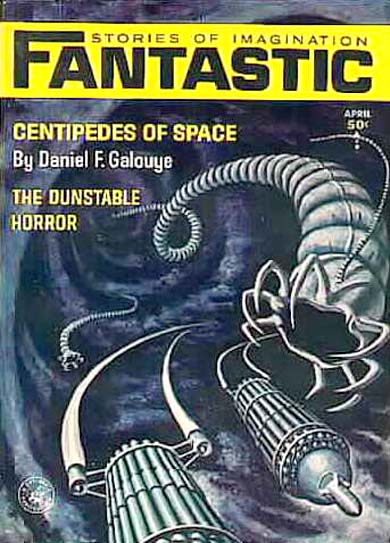
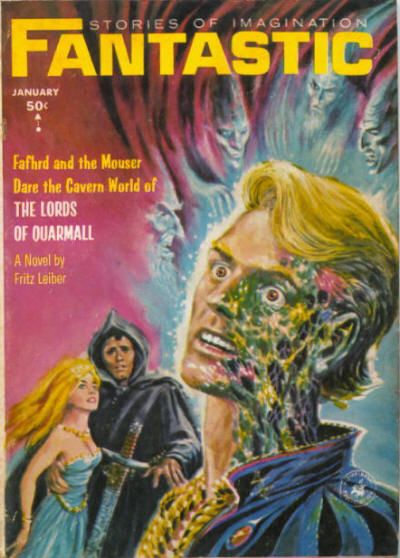
First appeared in Fantastic.  Reprinted by The Most Thrilling Science Fiction Ever Told, Andrew Porter, Jane Mobley, Robert H. Boyer, Kenneth J. Zahorski, Cary Wilkins, Jack Dann, Gardner Dozois, Martin H. Greenberg, Patrick L. Price, David G. Hartwell, Kathryn Cramer, Keith R. A. DeCandido, John Betancourt, Byron Preiss, Peter Haining, Jonathan Strahan, Marianne S. Jablon.


Summary:

This is one of Ursula Le Guin's more cleverly plotted tales.  Mr. Underhill, a fifty-ish bumbling wizard, serves a small village.  His spells don't often work and he hides under his hill when strangers arrive, but he's the best they have.

A new man, Blackbeard the Sealord of Pendor, comes to town and tells his tale:  A dragon had his people's treasure, and seven mages arrived to destroy him.  However, he's fled.  They track him again to find dragon bones, presumably killed by an unknown wizard, who has made off with the treasure.

Blackbeard had followed the green glow of his oaken staff to this island and wishes to reclaim his treasure. Via black magic, he knows Mr. Underhill's true name, which gives him power over Mr. Underhill.  They battle, and he forces Mr. Underhill to assume his true form.

Commentary:

Mr. Underhill's true form is foreshadowed in the opening:
"Mr. Underhill came out from under his hill, smiling and breathing hard.  Each breath shot out of his nostrils as a double puff of steam, snow-white in the morning sunshine...."
and after he's revealed the controlling nature of truenames:
"Somehow the minute spent watching Palani and the children had made him very hungry."
Mr. Underhill's a dragon.  Readers might guess, but guessing doesn't rob the story of its pleasure since it is well constructed.

The idea of truenames is curious:
"When you children are through school and go through the Passage, you'll leave your child-names behind and keep only your truenames, which you must never ask for and never give away.  Why is that the rule?"
"To speak the name is to control the thing." 
Where is this true?  I didn't buy it the first time I read this, eons ago.  As an idealistic youth, I thought we could understand and deal with each other better if we knew one another's true nature.

But there is truth behind Le Guin's truenames.  Young people leave the nest to discover themselves, but often if we allow labels, peoples will flatten the label, flatten labeled people into strawmen to knock down.  Hand people your label and people can knock down straw-man likeness of yourself, which pleases observers that they've won.  It doesn't matter if they're no where near the target.  It's a triumph.

You'll see this in any tried-and-true political faction.  "X is a democrat/republican/communist, etc, and all such love [insert vile crime or often a misconstrued event that the audience is sure to hate].  Therefore, X is to be loathed."  Often this construction involves logical fallacies, which no one pays attention to.

Because Blackbeard did not understand Mr. Underhill's true nature, the true name failed.  So Le Guin flouts the idea of labels we slap on people.  Labels are not enough.  Mr. Underhill seems a mysterious and secretive yet bumbling, talentless old fool. This conceals his true, devouring/greedy nature.  I don't think readers are meant to despise Mr. Underhill.  Rather, we've been made to sympathize as he's invited people over for dinner, helped people, socialized, and he's only defending himself.  On the other hand, he does devour the village (which he probably would have done whether they highly esteemed him or not).

The POV of this tale is also curious.  It seems to be omniscient.

Friday, May 23, 2014

"The Word of Unbinding" by Ursula K. Le Guin

First appeared in Fantastic.  Reprinted (in a few genre retrospectives) by Strange Fantasy, Damon Knight, Ellen Kushner, Jack Dann, Gardner Dozois, Margaret Weis, John Joseph Adams.

Summary:

Festin, an unoffensive wizard who desires to learn patience, is knocked from behind by a rival wizard, left without his staff, guarded by magic and a troll.  He escapes as a gas, liquid, an eagle, and fish, but only gets caught and more battered and bruised than before. His enemy is Voll, an undead wizard.

Commentary:

Festin only escapes when he "unbinds" himself from himself (perhaps needing to lose the sense of himself he had) and drives Voll back into his own, dead, old-man body.  Festin means "banquet and "Voll" means "full"--likely intended ironically in this barren land where they end up together.

This is an early work by Le Guin.  From my research, her work hadn't been anthologized until the 1970s, after The Left Hand of Darkness and her two award-nominated stories the same year.  This work brought her earlier work attention, even though some of it was when she was still learning her craft.

Usually her Earthsea works are a kind of subtle wisdom literature, imparting life lessons for youth.  This story's unique strength is its ending and its plot--various attempts to escape a magic prison.  It has little characterization or development.

However, the final moment/image is potent, poignant, where the protagonist is left, alone in a desert land, trying to guard his undead enemy from ever arising and attacking the wizard again.  The remainder of his existence is this defensive yet lifeless position.  Is he better off?  In a sense, yes, he is not the prisoner and has learned the patience he desired; but as the jailer, he's living a miserable, dry existence.  As his rival is never named and the protagonist himself is not characterized and he has no enemies, there's a pervading sense that Festin is guarding himself against some aspect of his own self, perhaps his own future, his mortality which haunts his present.

Wednesday, January 29, 2014

Slow Down + Blog Assessment + Writer Interviews + Posts You May Have Missed

Slow Down
Too many posts consume time. I must slow down. I have stories to write and submit, so enjoy what's here.

Blog Assessment
The last assessment was in December of 2012. I've been at this since Dec 2009--a little over four years (although I also blogged at s1ngularity:criticism and Mundane SF blogs before this). With nearly a thousand posts, that's about two posts for every three days. When I get bogged down at school, I post less frequently.

For two and half years, page visits have grown ten percent or so per month, which amounts to a twenty-fold increase. The per post view-rate has grown since last year from 35 to 55 or so, not quite a sixty percent increase. This is more dramatic when you consider the early posts with few hits are factored in (the hits were probably my mama who accidentally hit the refresh button a few times.

A year ago, one post--"Girl" by Jamaica Kincaid--outstripped all other posts and accounted for ten percent of the traffic (it's now five). I guess it's a good one. Fifty to a hundred folks stop by each month to take a look. Trent Zelazny's interview posts may have been the only posts that overtook her monthly lead.

Interesting to see which classic stories people are still fascinated by. Theodore Sturgeon's "Microcosmic Gods" and "Thunder and Roses" have drawn hundreds of readers in less than a year, but the other Sturgeon stories only about two dozen each.  I'll  be interested to see which stories of the big three--Arthur C. Clarle's, Isaac Asimov's and Robert Heinlein's--people are still fascinated by.  William Gibson and Ursula K. LeGuin drew less attention than I would have supposed although I need to do more or theirs..

In retrospect, part of the blog's growth was not only the quantity of posts but also the quality of their presentation. I changed presentation when I reviewed and interviewed. Take note if you blog.

Popular posts can be viewed on the right.

Writer Interviews
On file are the following:
  1. Loralee Leavitt
  2. Christopher Barzak
  3. Trent Zelazny
  4. Kenneth W. Cain
  5. I have upcoming interviews with G.O. Clark and Dustin Lavalley.

Posts You May Have Missed
These are posts I thought there might be more interest than they've received: 
  1. A Scene-by-Scene Analysis of the Movie, 2001: A Space Odyssey*
  2. Analysis of Flatland: A Romance of Many Dimensions by Edwin A. Abbott*
  3. A number of James Patrick Kelly posts--one of the best writers of speculative fiction in the 90s and 00s. I didn't put much time into pretty-fying them, focusing on content. Maybe I'll revise them one day.
* These two might make a nice contrast, treating religion from opposite ends of the spectrum.

Saturday, June 22, 2013

"Buffalo Gals, Won't You Come Out Tonight" by Ursula K. Le Guin

Appeared in
  1. Fantasy & Science Fiction, 
  2. Gardner Dozois' Year's Best Science Fiction, 
  3. Ellen Datlow and Terry Windling's Year's Best Fantasy, 
  4. Arthur W. Saha's Year's Best Fantasy Stories, 
  5. Gardner Dozois's Modern Classics of Fantasy, 
  6. Robert Silverberg's A Century of Fantasy 1980-1989, 
  7. Robert Silverberg's The Fantasy Hall of Fame, 
  8. American Fantasy Tradition, (Sep 2002, ed. Brian M. Thomsen,
Honors
  1. Hugo
  2. World Fantasy
  3. Locus nominee
  4. Sturgeon nominee
  5. Nebula nominee
Clearly, this story is highly respected, deservedly so.  Its charm begins almost immediately.  A young girl has fallen from an airplane and protects one eye:
"Did you lose an eye?" the coyote asked, interested.
"I don't know," the child said....
"I'll help you look for it....  I knew a trick once where I could throw my eyes way up into a tree and see everything from up there, and then whistle, and they'd come back into my head. But that goddam bluejay stole them, and wen I whistled nothing came.  I had to stick lumps of pine pitch into my head so I could see anything.  You could try that. But you've got one eye that's OK, what do you need two for?  re you coming or are you dying there?"
 The child follows various animals-as-humans around (who behave much like native American gods). Since she has little background, probably she is our surrogate witness:  Perhaps some of our "civilized" hang-ups, such as where we relieve ourselves, are unnecessary.  The primary key, though, is our relationship with nature, in particular animals--the environment:  how we impinge their world.

Thursday, June 20, 2013

"May's Lion" by Ursula K. Le Guin

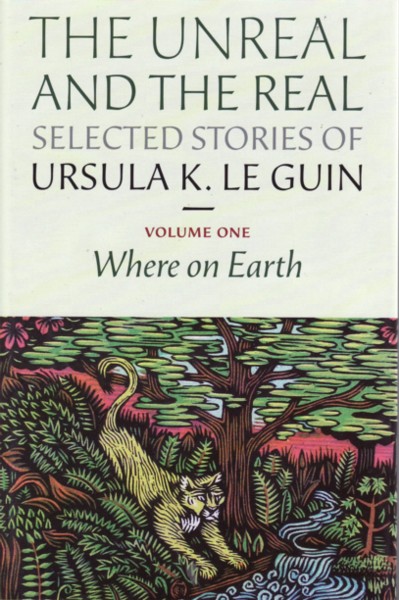
First appeared in The Little Magazine, reprinted in Dann and Dozois' Magicats II, and collected in Where on Earth from Small Beer Press.

A supposedly true story about an older woman's encounter with a sick mountain lion is transformed into a story, illustrating how facts are transformed through fiction (and perhaps other eyewitness accounts) into something more fitting to our belief systems or perspectives.

"She Unnames Them" by Ursula K. Le Guin

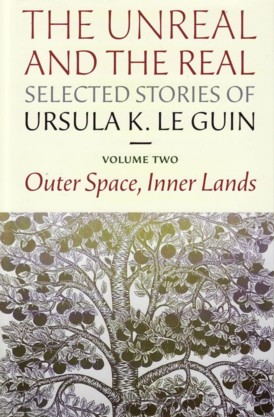
First published in the New Yorker. Reprinted in Leebron, Geyh, Levy's Postmodern American Fiction.  Collected in Outer Space, Inner Lands, from Small Beer Press.

The animals are "unnamed," losing the names given them.  Some are reluctant until they realize that they could be named whatever they wanted.  More food for thought, than a journey for the mind.  Applicable to people and art--true in how we name or label things, often to unthinkingly dismiss them.

Wednesday, June 19, 2013

Close Reading of " 'The Author of the Acacia Seeds' and Other Extracts from the Journal of the Association of Therolinguistics" by Ursula K. Le Guin

First appeared in Terry Carr's Fellowship of the Stars. Reprinted in Silverberg and Greenberg's The Arbor House Treasury of Science Fiction Masterpieces, and in Hartwell and Cramer's The Ascent of Wonder: The Evolution of Hard SF.


Like "Schrödinger's Cat", "The Author of the Acacia Seeds" examines what we actually know from scientific research.  The first extract examines the language of ants written on acacia seeds, but it is necessarily full of uncertainties due to the gulf of differences in how we understand language.  This is followed by the penguin language which is complicated by its being a bird in the sea.  Its author is even less certain what to glean from it.  The editor also extrapolates further difficulties--out to plants and even rocks.

Because of the story's scholarly tone, the story may be taken at face value--what do we truly know of science--or its final point indicates it may also be read as an idea taken out to its absurd conclusion.  However, as "Schrödinger's Cat" indicates, scientific absurdities may be true as well--if not stranger than we currently imagine.

Wednesday, December 5, 2012

Le Guin's Real, Imagined Country


"[W]hen I finally began getting stories published, I was quite certain that reality is often best represented slantwise, backwards, or as if it were an imaginary country."