Search This Blog

Showing posts with label SF writing resources. Show all posts

Saturday, November 27, 2021

Realistic Portrayals of Religion

See the source image

 A group of us were discussing religion, science and science fiction, and Andy Dibble came up with some excellent rules for portrayal of religion, using Ursula LeGuin's The Telling as an example.

I'd also add one weird aspect to religion. It picks up whatever's around it like Silly Putty--sometimes not contradictory necessarily, but sometimes it is. Christmas trees, Ptolmeic solar system, holidays, etc. 

I forget which illustrated coffee table book it was, but Joseph Campbell pointed Hebrew coins where God had the feet of serpents. This would seem to contradict their religion due to the serpent in Eden. Campbell listed one reason for their inclusion as the bronze serpents they had to kiss thanks to Moses, but other interpretations might be possible. Still did the image seem to conflate the two contradictory images? Or was one trodding on the other? A nuanced view is preferable to the uncharitable.

We have names for things in the culture that are supposedly forbidden, but that isn't quite what happened. Some things are clearly verbotten in religions although contextual clues give a nuanced interpretation. Other times they're a verbal tradition, based on an interpretation that's difficult to pin down.

Within any religion, though, there are selective interpretations that suit believers, and sometimes don't suit them, so that they wrestle with passages trying to understand. This isn't not usually good guy vs. bad guy scenario, although it can be an interpretation that suits one's worldview. Perhaps the aforementioned Silly Putty analogy is the desire not to conform to the text, but to unite with those around them.

This may be perhaps too nuanced for a short story to handle well or a cursory examination of a religion. And my placing this here does not constitute approval or disapproval--merely an observation.

Sunday, July 21, 2013

Orson Scott Card on ideas

"[N]othing is sillier than a story that provokes only one response from society."
--Orson Scott Card, How to Write Science Fiction and Fantasy  

 Note:  I've never read a better book on generating ideas and turning them into stories.  This needs an ebook edition.

Saturday, July 20, 2013

Orson Scott Card on ideas

"[In] stories that are any good at all, ... [e]very event has more than one cause and more than one result."
--Orson Scott Card, How to Write Science Fiction and Fantasy  

 Note:  I've never read a better book on generating ideas and turning them into stories.  This needs an ebook edition.

Friday, July 19, 2013

Orson Scott Card on ideas

"[T]he idea net consists of three questions: 'Why?' 'How?' and 'What result?' "
--Orson Scott Card, How to Write Science Fiction and Fantasy  

 Note:  I've never read a better book on generating ideas and turning them into stories.  This needs an ebook edition.

Thursday, July 18, 2013

Orson Scott Card on ideas

"[O]utlines and sketches, maps and histories, jotted scenes and scraps of dialogue [are] the writer's equivalent of what a composer does when he plinks out a new theme on the piano, just to hear it.  He doesn't immediately score and orchestrate the theme.  First, he has to play it over and over, varying it, changing rhythms, pitches, key, imagining different harmonies and countermelodies.  By the time the composer... arrange[s] and orchestrate[s] the piece, the theme will have been transformed many times over."
--Orson Scott Card, How to Write Science Fiction and Fantasy 
Note:  I've never read a better book on generating ideas and turning them into stories.  This needs an ebook edition.

Wednesday, July 17, 2013

Orson Scott Card on ideas

"[T]hink of everything as a potential story."
--Orson Scott Card, How to Write Science Fiction and Fantasy 
Note:  I've never read a better book on generating ideas and turning them into stories.  This needs an ebook edition.

Tuesday, July 16, 2013

Orson Scott Card on ideas

"[H]elp an idea ripen... [by] writing a draft."
--Orson Scott Card, How to Write Science Fiction and Fantasy 
Note:  I've never read a better book on generating ideas and turning them into stories.  This needs an ebook edition.

Monday, July 15, 2013

Orson Scott Card on ideas

"[H]elp an idea ripen... [by] writing a draft."
--Orson Scott Card, How to Write Science Fiction and Fantasy 
Note:  I've never read a better book on generating ideas and turning them into stories.  This needs an ebook edition.

Sunday, July 14, 2013

Orson Scott Card on ideas

"[H]elp an idea ripen... [by] writing a draft."
--Orson Scott Card, How to Write Science Fiction and Fantasy 
Note:  I've never read a better book on generating ideas and turning them into stories.  This needs an ebook edition.

Saturday, July 13, 2013

Orson Scott Card on ideas

"[G]ood stories don't come from trying to write a story the moment I think of the first idea... [rather] from combining two completely unrelated ideas that have been following their own tracks through my imagination."
--Orson Scott Card, How to Write Science Fiction and Fantasy 
Note:  I've never read a better book on generating ideas and turning them into stories.  This needs an ebook edition.

Friday, July 12, 2013

Orson Scott Card on ideas

"[I]mpromptu additions would not have been possible had I not laid down many strata of creation before I started that draft."
--Orson Scott Card, How to Write Science Fiction and Fantasy 
Note:  I've never read a better book on generating ideas and turning them into stories.  This needs an ebook edition.

Thursday, July 11, 2013

Orson Scott Card on ideas

"There have to be strict limits on magic... [A] price has to be paid for every... magical power."
--Orson Scott Card, How to Write Science Fiction and Fantasy 
Note:  I've never read a better book on generating ideas and turning them into stories.  This needs an ebook edition.

Wednesday, July 10, 2013

Orson Scott Card on ideas

"[SF] and fantasy ideas are ridiculously easy to come up with.  [Ask] questions."
--Orson Scott Card, How to Write Science Fiction and Fantasy 
Note:  I've never read a better book on generating ideas and turning them into stories.  This needs an ebook edition.

Tuesday, July 9, 2013

Orson Scott Card on ideas

"[I]magine what could be worse.  Not more life-threatening--simply worse to see.  Worse to live through."
--Orson Scott Card, How to Write Science Fiction and Fantasy 
Note:  I've never read a better book on generating ideas and turning them into stories.  This needs an ebook edition.

Monday, July 8, 2013

Orson Scott Card on ideas

"[T]hink of a reason why the [unplanned] mistake isn't a mistake at all."
--Orson Scott Card, How to Write Science Fiction and Fantasy 
Note:  I've never read a better book on generating ideas and turning them into stories.  This needs an ebook edition.

Sunday, July 7, 2013

Orson Scott Card on ideas

"[M]aking by maps of imaginary lands is a kind of story telling."
--Orson Scott Card, How to Write Science Fiction and Fantasy 
Note:  I've never read a better book on generating ideas and turning them into stories.  This needs an ebook edition.

Wednesday, April 10, 2013

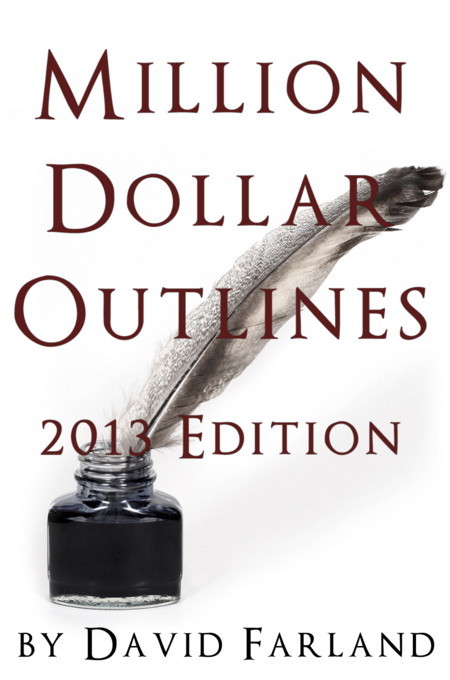
Review: Million Dollar Outlines

Note:  Don't forget today's "book bomb" to help support Dave Wolverton's son, Ben, who is in a coma.

Amazon for Million Dollar Outlines
Amazon for Nightingale

Review note: Although Farland reuses some parts of his nonfiction writing in other book where applicable, I believe this is rewritten from Write That Novel!  At least, I recall similarities.  

Farland begins by pointing out who will not be helped by this book:  those who do not want to outline.  One might also add the other part of the title "Million Dollar" which alludes to popular interest.  That is where the book leads next:  What makes something popular?  Farland does broad analysis of fifty movies (and books) to conclude what viewers are looking for.

Farland convincingly pop-hypothesizes, using actual science research, what makes the kind of story that humans can benefit from--a kind of sympathetic damage-and-repair theory (this is probably the essay that concludes his story collection, 22 Tall Tales).  What story-shapes reinforce such benefits?  Packing an emotional punch and expanding your audience help solidify Farland's thoughts on what makes a bestselling story.

Next, Farland moves on to the importance of setting, characters, and plot.  He concludes with tips--jam-packed with juicy ideas for milking the most drama from your narrative--and exercises to increase your productivity.  This is a fascinating analysis of what makes a popular story and often quite a practical how-to writing manual (one item--the emotional Richter scale--was a little vague.  He leaves the research to the reader).  I've read a fair number of how-to writing manuals, and Farland's approach is novel and worth investigating if the title intrigues you--maybe even if it doesn't.

One of the best of its kind--so profound and persuasive, in fact, I'd half-worry that some writers would see this as the only way to dismantle and reassemble stories.  But Farland and his acolytes do prove his methods, time and again.

Monday, December 10, 2012

Writing links with unicorns

Literary Science:  fMRI and other studies show a similar connection between reading and real-life experiences.  A correlation exists between reading and empathy.

More Lit Sci:  activating brain.

Turkey City:  Lewis Shiner and Bruce Sterling relate classic problems with speculative works.

Sheryl Hoyt:  Self-publishing article.

New writing podcast:  Hide and Create with David Dalglish, Diana Rowland, Jordan Ellinger and Joshua Essoe

TED Hour:  Getting Ideas

Lab lit -- fiction and essays about science

North Korea says unicorns are real.

Thursday, January 20, 2011

Orson Scott Card's How to Write SF & Fantasy

Orson Scott Card's How to Write SF & Fantasy

It's been some time since I first read this one.T he character advice was intriguing in how to play with who the protagonist and main character are--who do not have to be the same--and what makes a character effective. I'll leave it to readers to investigate, but some intriguing bits about Octavia Butler's Wild Seed, Darth Vader, and detective sidekicks.

Familiar Character questions:
  1. Who was the most to lose?
  2. Who has the power and freedom to act? (Nelson Algren's National Book Award-winning The Man with the Golden Arm is an interesting counter example although its antithesis is depressing and probably proves Card's rule.)
He also mentions the benefits of awe and mystery in a character.

***

His discussion of the story types (MICE--Milieu, Idea, Character and Event--one not necessarily better than another) is essential to genre writing: "End the story that you begin." The reason prologues fail (Event), he says, is that writer is that we haven't been given a reason yet to care about the characters, who can take us slowly through the world and see what the event is wrecking upon the world.

***

This one is worth rereading. I may have gotten more from the book now than when I first started out many eons ago.