Search This Blog

Showing posts with label David Brin. Show all posts

Tuesday, March 5, 2024

"Fermi and Frost" by Frederik Pohl

https://www.isfdb.org/wiki/images/c/c5/IAS_1985_01_Potter.jpg
First appeared in Shawna McCarthy's Asimov's. It won the Hugo and was up for the Locus and SF Chronicle awards. Reprinted in several retrospectives, by Gardner Dozois, Arthur W. Saha, Donald A. Wollheim, Isaac Asimov, Sheila Williams, Martin H Greenberg, James Frenkel, Jack Dann, Mike Ashley.


Summary:

Nuclear war wipes out most of humanity and friends, including their supper. A small remnant escapes to Iceland.


Discussion (Spoilers):

When this appeared, nuclear holocaust stories had been appearing since the bombing of Hiroshima (see Pohl's earlier "Let the Ants Try" which provides an interesting contrast--optimistic about surviving nuclear bombing, but not so lucky about what might follow). Many worried about not just about the survival of themselves, but also human species. Some may have more optimistic than they ought to have been.

While not a difficult story, it can be read too hastily. One might miss choices of tone and word choice. In a sense, there is no story. There is, but it is subverted, short changed. If someone insists there is a story, ask them to summarize it.

There's a boy, but he's sentimentalized, orphaned, helpless, wet. We're told he's nine then reminded he's young. The opening line: "On Timothy Clary's ninth birthday he got no cake."

We have an omniscient narrator who drops into the minds of many. Then we switch to Harry Malibert, a scientist who runs a radio telescope in Arecibo. We think we've finally got our protagonist. But not exactly. We're given the nigh impossibility of survival. Probably it is set in Iceland for its geothermal activity so there is a remote chance of survival, a source heat and energy that is not reliant on the sun.

Then there's the issue of tone: "Get away! Climb the highest mountain! Drop yourself splat, spang, right in the middle of the widest desert! Run! Hide!" 

All of those exclamation marks. Due to juxtaposition, it suggests that some leap off the mountain. But "splat?" 

A few paragraphs later, it suggest that Timothy "might have wound up in the plane of refugees that reached Pittsburgh just it time to become plasma." Just in time? Plasma? There's a dark humor here at work. It discusses all of the likely outcomes where he'd die, but then writes:

"he might have been given medicine, and oufnd somebody to protect him, and take him to a refuge, and live...

"But that is in fact what did happen!"

At this point, we doubt that any kind of survival will happen, and that last line, a little glib, remarking on the improbable chance that something good would happen. That last line is repeated at the end, where we have even less faith. But he adds, "At least, one would like to think so." This final sentence rubs a little of the dark humor off. It feels more honest in its feigned hope even though it has provided ample evidence that it won't.

This wasn't the only nuclear-worry story to catch the Hugo's eye that year. David Brin's The Postman also took home a trophy. This was probably part of the zeitgeist, worrying over the arms race build-up. See the cover story in the image above.

At any rate, what makes this story successful is knowledge of the subgenre (post nuclear war stories), knowing the common tropes found in such stories. "Let the Ants Try" subverts the subgenre as well with the thwarting of hope for human survival, but part of the success of that is also knowledge of other stories. But this one takes a hard, realistic look at our optimism. It is the Uber-story, paradoxically superseding all others yet entirely depending on knowledge and existence of that subgenre.

Thursday, May 23, 2019

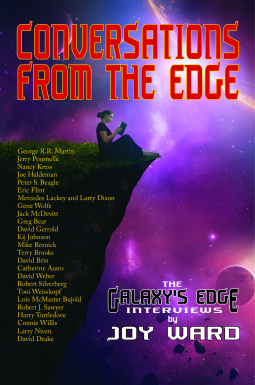
Review: Conversations From the Edge: The Galaxy's Edge Interviews by Joy Ward

Conversations From the Edge: The Galaxy's Edge Interviews 
Image result for Conversations From the Edge: The Galaxy's Edge Interviews by Joy Wardby Joy Ward (interviewer) 
Arc Manor 
Independent Book Publishers Association (IBPA), Members' Titles 
Biographies & Memoirs , Sci Fi & Fantasy

Joy Ward is a veteran journalist and has been doing interviews for Galaxy’s Edge since the beginning. These are the interviews collected here: a long list of major science fiction and fantasy writers and editors (see below).

Ward's best ability is to get at the personal side of the authors, although she does manage to coax out good writing tips from some. Some of the interviews--if you've read about the authors before--will be familiar, George R. R. Martin, for instance. But some writers have evolved, so that the Kij Johnson I interviewed a decade and a half earlier differs from the Kij Johnson that Joy Ward interviewed.

Some interviews are touching simply because the writers are no longer with us: Jerry Pournelle and Gene Wolfe. The Pournelle interview gains new interest following the interview with his friend and collaborator, Larry Niven. Some older writers like Terry Brooks, Robert Silverberg, Lois McMaster Bujold, and Joe Haldeman seem to feel outside the field at present.

Speaking of Niven and Pournelle collaborations, a substantial number of writers discuss their collaborations: Mercedes Lackey, Larry Dixon, Eric Flint, and David Gerrold.

The most revealing interview is last one: David Drake. He shares a rather stunning, personal story that I was unfamiliar with, so my interest in his work is now piqued. Most readers, I suspect, will be writer wannabees, but Drake's intimate revelation makes me wonder if interviewees have been missing out on not making themselves as interesting as the work itself.

Some interviews have been expanded from the original publication. There is some redundancy in reintroducing the author: with new and original introductions. One introduction might prove sufficient.

Interviews include the following writers and editors and something of what you will find:

  1. George R.R. Martin (turns a dead end into a superhighway)
  2. Jerry Pournelle (his politics, his path to publication and collaborations with Niven)
  3. Nancy Kress (her initial introduction to the field)
  4. Joe Haldeman (tried to maintain involvement in several genres: poetry, literary, SF, adventure)
  5. Peter S. Beagle (the importance being recognized)
  6. Eric Flint (his politics, and his collaborations)
  7. Mercedes Lackey (collaborations and indifference to art as opposed to craft)
  8. Larry Dixon (collaborations and indifference to art as opposed to craft)
  9. Gene Wolfe (how new writers don't pay attention to advice)
  10. Jack McDevitt (the importance of SF & curiosity)
  11. Greg Bear (his personal motivations)
  12. David Gerrold (perhaps the most writerly--modeling stories, voice, showing/having reader experience the story as i
  13. Kij Johnson (her interest in experimental structures and her tapping into flow)
  14. Mike Resnick (his beginnings in pornography and interest in new writers)
  15. Terry Brooks (the importance of putting in hard work) 
  16. David Brin (the science in science fiction and the destruction of dystopias)
  17. Catherine Asaro (women as lead characters)
  18. David Weber (advantage of plot and character over style)
  19. Robert Silverberg (the history of the field)
  20. Toni Weisskopf (the importance of healthy discussion within the genre)
  21. Lois McMaster Bujold (the importance of short fiction to selling novels, talk with editor generating Falling Free)
  22. Robert J. Sawyer (the importance of research, dislike of endless series)
  23. Harry Turtledove (read and write)
  24. Connie Willis (importance of having good manners and of having m.s.s. out and comforting self when rejections come in that a better story is circulating)
  25. Larry Niven (collaboration)
  26. David Drake (how experience can feed one's muse)

Thursday, September 4, 2014

Politics makes us dumber

“Divergent” and “Hunger Games” as capitalist agitprop: 
"We're all told we're "Divergent," all the time -- behind the bogus dystopia lies a panegyric to consumer society."
The horror!

YA dystopias teach children to submit to the free market, not fight authority 
"The Hunger Games, The Giver and Divergent all depict rebellions against the state, and promote a tacit right-wing libertarianism."
And I take it that this is evil as it goes against everything the article writers believe in. I agree. In fact, I've got an idea. Let's only write a certain kind of story! One kind only! With one theme. One theme only! It will never get old. Nor will the exclamation marks!

We'll check with the proper authorities to make sure it has the proper theme. I can't wait to dive into this dystopian future we're creating. I will chair the committee. All stories must be pre-approved by me or it cannot be published.  We will only publish stories that slant toward a certain political party. All unapproved published works will be burned (and their authors).*

Related, but less shocking:

Project Hieroglyph: Fighting society's dystopian future

Thought Experiments:Tomorrow Through the Past by Allen M. Steele

Here, the authors advocate positive futures.  That's great.  In fact, I'd like to get the anthology when the price goes down. Advocate whatever you want, so long as you don't say what writers can and can't write about.

Let's allow people to tell whatever story they want. If you disagree with the theme, say so. As a reviewer, I used to post the author's comments if I disagreed. Why? To give authors a voice, not to bash them. I could be wrong. I was not out to silence anyone.

Let's not create some moral imperative that any theme can or cannot be read. Open your mind. Look at negative possibilities, look at the positive. Allow yourself to read things you don't agree with. Avoid telling people not to read things.

Some scientific evidence to back this up:

David Brin discusses how self-righteous indignation gives you a high.  Self-righteous indignation is a major component of politics. (Perhaps, as self-righteous indignation gives political addicts a high, the FDA should regulate its use.)

Science confirms: Politics wrecks your ability to do math.  That's right.  Both parties got dumber. (A left-wing article reported only the right-wing problems.)

Political Diversity Will Improve Social Psychological Science: Bias can skew data.

If you want to get smarter, you have to challenge yourself. Read something you don't agree with. Excluding what can and can't be read and discussed makes you and the people you encouraged to become dumber. No, you don't have to read everything, but don't tell people not to.

You might ask, "Weren't you part of the Mundane SF lot?" Yep. Not because I was against any type of SF, but that it represented a type of SF not being voiced.

* By the way, this is satire.

Monday, August 19, 2013

Science and Technology links

 What happens when you step into a black hole, revisited?
"If the firewall argument was right, one of three ideas that lie at the heart and soul of modern physics, had to be wrong. Either information can be lost after all; Einstein’s principle of equivalence is wrong; or quantum field theory, which describes how elementary particles and forces interact, is wrong and needs fixing. Abandoning any one of these would be revolutionary or appalling or both."
Locations for future cities

New habitable planets

Inspirational terraforming clip

Inspirational clip about trash into treasure in Paraguay

David Brin's positive view of technology changing the world (environmentally)

The "Hyperloop" -- 800-mile-per-hour travel  (or 4000mph)

Standing/walking on the job:
"What you need as well, the latest research suggests, is constant low-level activity."
Artificial Chromosomes (enthusiastic article that could use a few more words  of caution)

Jo Walton points to John Brunner as at forefront of the internet SF, but Gregory Benford points out his own predecessor story although he allows it may not be the best.

Flattening ebook sales growth
Fails to point out (as one reader says, that this is growth; moreover, no mention is made of the decision to get rid of low-cost books at Amazon (<$2.99) because of their lucrative lack for authors/publishers.
Ian R. MacLeod titles out in ebook formats


Friday, January 25, 2013

Science Stories Prize fighters Support

Science
What it's like on an orbiting space station lab:


Russia to the moon

DNA information-storage


Anti-aging baby

Coughing duration

David Brin revisits his idea of following prophesies to find who's prophetic (as well as what, when, where, why)

We are still stuck in high school:
[T]he prefrontal cortex has not yet finished developing in adolescents.... This explains why adolescents are such notoriously poor models of self-­regulation, and why they’re so much more dramatic.... [E]verything an adolescent does... [and] feels—is just a little bit more intense. And you never get back to that intensity.... Puberty... is everyone’s first experience of a sentient madness.
Why older brains don't remember

5 Historic Misconceptions
Stories to read or hear

Flannery O'Conner's "A Good Man Is Hard to Find" read by ol' Flannery herself.


Small Beer podcast of Kij Johnson's story

Online story from Richard Parks


Prize fighters future and present
Story Prize finalists

Philip K. Dick Award finalists

Books to look for in 2013

More books to look for (same year, different site: IO9)

Support
Glitter and Madness anthology

World SF Travel Fund


Saturday, June 30, 2012

Where's ET?

Carl Sagan's old saw was that because of the innumerable planets, there had to innumerable intelligent aliens out there somewhere. SETI has been looking for years. So why haven't we found them?

Sunday, May 16, 2010

More Resources to peruse

David Brin has a list of webpages to explore (movies, catch-all, even his own stories). We adults tend to forget 1) the step-wise transition from child to adult, 2) classroom time comes at a premium--a precious commodity--and 3) the specific science covered in a science course. These three ideas are often inextricable. For example, combining #1 and #3, one does not leap too far ahead of where the students are. Nonetheless, I look forward to exploring all that Brin has to offer science teachers.

Meanwhile, I have read Geoffrey A. Landis' "Approaching Perimelasma" mentioned in the last post concerning Mike Brotherton's anthology of science fiction stories about astronomy, Diamonds in the Sky. It is perfect for the discussion of black holes. However, 1) it may be longer than students are willing to put up with, which means this should be given to upper-level students or at least not required, 2) it requires some background knowledge that Landis assumes readers will already know. I'll try to prep this into something more usable next weekend (weekends never seem long enough).