Search This Blog

Showing posts with label Wyman Guin. Show all posts

Tuesday, April 8, 2014

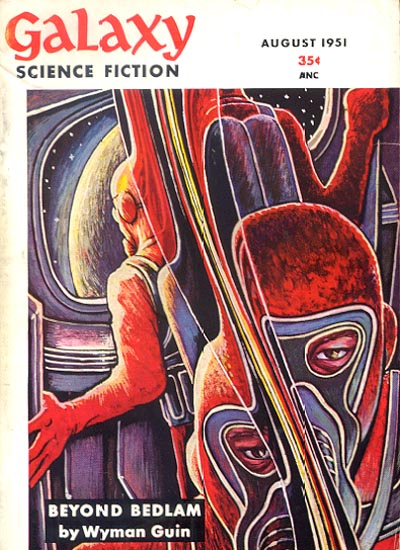
"Beyond Bedlam" by Wyman Guin

First appeared in H.L. Gold's Galaxy. Reprinted by H. L. Gold, Kingsley Amis, Robert Conquest, Robert Silverberg, Martin H. Greenberg--Silverberg especially collected it in various genre retrospectives. 

In 2013, Wyman Guin was awarded the Cordwainer Smith Rediscovery Award "to honour notable sf and fantasy authors who in the view of the judging panel did not receive or no longer receive the attention they deserve."  --SFE

Humans are divided into two personalities [Note: What's called schizophrenia in the text is actually Multiple Personality Disorder--two mental disorder often confused.  Oddly, no one's pointed that out yet, but it doesn't really undermine the text], where each manifests for two days at a time.  In the past--our present--people lived with the personalities together, personalities which would undermine each.  In fact, we are all naturally schizophrenic (2nd meaning) and the latest drugs help us deal with these warring sides of our personalities.  This supposedly has the added effect of stopping all wars.

They also each administered a "hypothalamic block" to prevent subconscious thoughts and actions.  Everything is above board.  No hidden secrets remain hidden beneath to cause wars.  This is also said to make people more logical.

Within this scenario is an unusual family, unusual because both personalities of a person (Conrad and Bill) are married to both personalities of another person (Helena and Clara).  Normally they only see the one wife, but Bill wanted to see what the other personality was like and falls madly in love with her. They both suppress shifting in order to see each.  They are sinning since these personalities aren't married.  Slowly the cogs of society catch on to what the couple is up to.

Mary, daughter of one couple, feels unloved by the other couple, so she skips her drugs so she can find love from the other set.  However, this set is cold.  Mary isn't even genetically related.  Nobody keeps their own children.  Society decides whom the best match should be.

This is likely Guin's best work.  John Clute calls it "brilliant" -- "ideally designed for Galaxy, with its focus (< Medicine; Identity; Psychology; Sociology) on the human implications involved in enduring the future."

Clute's not whistling Dixie.  This is a tour de force--as every character has a twin, often very different.  They do not see each other as two personalities living in the same person but as two separate entities, making the text a rich reading experience. One personality of a person you may be in love with, but the other no.

When compared to other works in Guin's oevre, a theme arises where couples tend to bump up against difficulties in their marriage.  Some speculative element tends to intervene until the couple reestablishes themselves.  It's more fascinating since one personality of a person may be far more attractive than another--for parent and child.  It shades a whole new meaning on the phrase "My evil twin did it."

Mary behaves younger than a thirteen year old, but she is said to be immature for her age.  What created the society seems implausible, but what a triptych once you arrive.  This should be part of the SF canon.  The final line is genius (said by one of the top officers in the society, Major Grey):
"It was a pretty wonderful society he lived in, he realized.  How wouldn't trade it for the kind Bill Walden had wanted.  Nobody in his right mind would."
Note protagonist's last name, Walden.  The title plays on two double meanings: bedlam (confusion or insane asylum) and beyond (as in past that point, or exceeding, at a higher degree).  In other words, are we past insanity or increasing it?  Are we past confusion or increasing it?

This story may require multiple readings to pick up all that's going on.

Edition:  Beyond Bedlam and Other Stories by Wyman Guin

Sunday, April 6, 2014

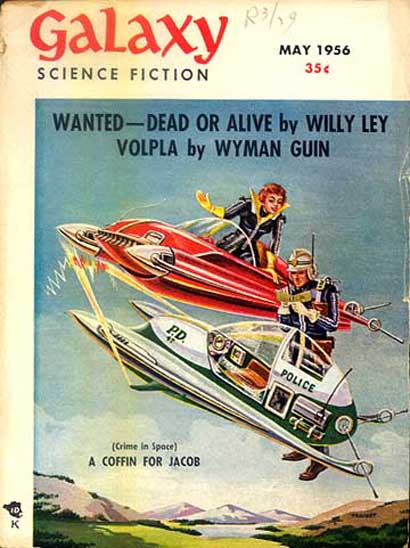
"Volpla" by Wyman Guin

First appeared in Galaxy. Reprinted by H. L. Gold, and Groff Conklin, and the radio program, X-Minus One. If X-Minus One did a program on it, you can trust it will be fun if not thought-provokingAudio dramatization.  

In 2013, Wyman Guin was awarded the Cordwainer Smith Rediscovery Award "to honour notable sf and fantasy authors who in the view of the judging panel did not receive or no longer receive the attention they deserve."  --SFE

A man genetically creates new creatures, which he hides from his family.  He wants to create a grand practical joke where he fools not only  the creatures but also, primarily, the humans into thinking a race of being existed on Earth long before the humans.  However, his kids find the creatures and play with them, and his wife spills the beans about this being a joke.  The creatures learn of this but don't hold it against him.  Instead, they hitch a ride to Mars, and the protagonist wants to join them.


Much of the character interaction is reminiscent of Nancy Kress's work.  However, she would unlikely have left it as a practical joke.  The story might have gained significance had it supplied a motivation for the joke, i.e. "The scientific establishment/Communist pinkos/Capitalist pigs won't laugh at me anymore. We'll see who gets the last laugh." or whatever to infuse his actions with more meaning than an elaborate joke.

Edition:  Beyond Bedlam and Other Stories by Wyman Guin


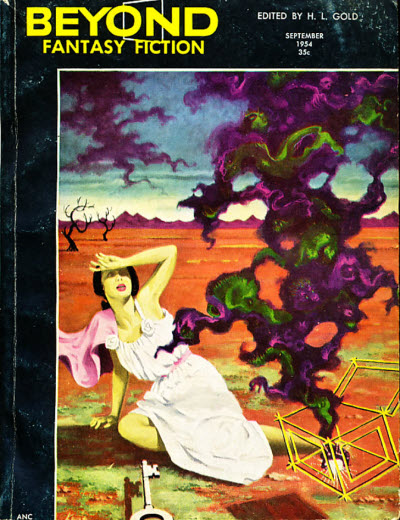
"The Root and the Ring" by Wyman Guin

First appeared in H.L. Gold's Beyond Fantasy Fiction. Reprinted by Thomas A. Dardis ,Kathryn Cramer, and David Hartwell. 

In 2013, Wyman Guin was awarded the Cordwainer Smith Rediscovery Award "to honour notable sf and fantasy authors who in the view of the judging panel did not receive or no longer receive the attention they deserve."  --SFE


After the unemployed narrator marries, his employed wife wants children, so he has to get a job.  They marry without him having a wedding ring.  When employed, he has glimmers of ideas that might get himself promoted.  He suppresses these ideas because he does not want to be promoted and be forced to spend more time away from home and have to go in debt buying more things.

His wife finally gives him a ring, in the shape of a moebius strip, that gives its wearer the heightened powers of mathematics. His brain does scale the heights of mathematics.  Again the narrator fears being promoted.  Lucky for him, he loses his wedding ring while working beside an apple tree.

However, soon the entire family becomes mathematical geniuses. The husband creates a figure the disappear.  The wife becomes an investing guru.  The husband is not pleased, plots to destroy the ring while the wife disagrees.

An otherwise useful review on Amazon lumps "My Darling Hecate" and "The Root and the Ring" together.  While I don't agree (the first does not have to be a witch and this one certainly is not), they do have interesting resonances:

  1. Beyond Fantasy Fiction followed the John W. Campbell's Unknown, which was to apply the rigor SF to fantasy.  In both this and "My Darling Hecate" hangs at the less plausible end of SF--at least SF standards at the time, which could include telekinesis usually from an evolved superman.
  2. Both written in first person narratives from a male perspective about married life.  Both are positive.
  3.  Both men introduce problems or challenges to the marriage.
  4. The woman introduces the speculative or magic element.  The woman brings the literal/figurative magic to the relationship.

Edition:  Beyond Bedlam and Other Stories by Wyman Guin
Saturday, April 5, 2014

"My Darling Hecate" by Wyman Guin

First appeared in H.L. Gold's Beyond Fantasy Fiction. Reprinted by Joseph D. Olander, Martin Harry Greenberg, and Barry N. Malzberg.  

In 2013, Wyman Guin was awarded the Cordwainer Smith Rediscovery Award "to honour notable sf and fantasy authors who in the view of the judging panel did not receive or no longer receive the attention they deserve."  --SFE

This appeared in a conceptually interesting anthology, Neglected Visions, which highlights under-highlighted writers.  It honed me in on writers I might not have otherwise.

Before the TV program, Bewitched, was "My Darling Hecate".  Like many boys unable to express their attraction, the narrator throws a snowball at his future wife.  It veers and breaks a school window, which he has to pay for.  After this happens a second time, he suspects he's got a wicked curve-ball.

After he's married, he starts driving a young lady with him to and from work (at his wife's suggestion).  Some initial messing-around but they knock it off.  The town of Clearview gossips, embarrassing the wife, particularly.  When she decides the pair have done nothing she decides it's the town that has to go.  Twilight Zone moments follow--not only the missing town, but what it's replaced with.  A satisfying and somewhat surprising if undramatic ending.  An overall strong tale although a few moments wane in power.

This might be an interesting tale for gender studies.  On the one hand, it seems pretty well grounded in its culture.  On the other, it suggests acceptance of more contemporary mores (anticipating 60s counter-culture).  On the third hand (you have more than two, right?), nothing is laid at the Hecate's feet.  It's all the protagonist's fault.

Edition:  Beyond Bedlam and Other Stories by Wyman Guin
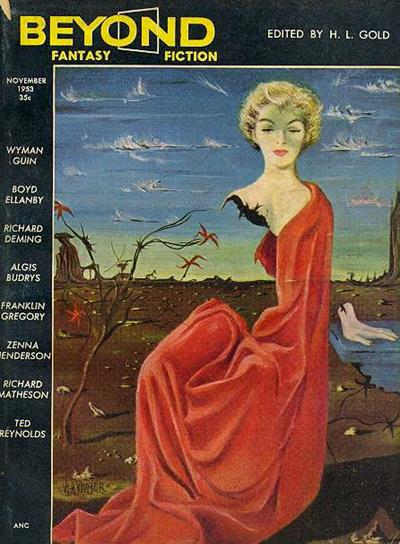
"Trigger Tide" by Wyman Guin

First appeared in Astounding.  Reprinted by Groff Conklin, Eric Flint, Jim Baen, David Drake.  Online.

Protagonist awakes on a foreign planet, left for dead.  He returns to the society that had damaged him--even putting out an eye.  The protagonist has to figure out how to survive the planet before the tides return.

This has the energy and plotting verve of Alfred Bester's best fiction, with touches of Asimov's mysterious psychohistory.

David Drake writes:
"[When] I first read ["Trigger Tide"].... I didn't understand it, but I almost understood it. The work stood on its own as an action/adventure story, but it held an assumption about how the world, the universe, worked that I couldn't quite grasp. I've reread the story a number of times since then.... but I still don't think I quite understand it. Neither have I ever gotten 'Trigger Tide' out of my mind. That's why it's here."
 This is quite true.  While you almost feel you understand it, it slips out from under you.  But it seems to be about fighting to live on changing/changeable planet, where society is unafraid to sacrifice/slit your throat.  Being able to take a beating is admired; however, allowing people seems problematic.  At least, that's my tentative assessment.  The protagonist is a foreigner--a political tug-of-war whose ethical ramifications are hidden from the reader.