Search This Blog

Showing posts with label Vonda N. McIntyre. Show all posts

Friday, January 28, 2022

Review: The King's Daughter

 Almost two and half years ago, I ended a review of Vonda N. McIntyre's The Moon and the Sun, writing about the "lost" movie:

"The movie, starring Pierce Brosnan, has been filmed but remains unreleased pending special effects, four years later.

Maybe something went wrong elsewhere, but you'd think they'd try to recoup some financial losses by releasing it as straight-to-video, or have a limited release first. Surely, book fans would flock."

 The movie is now released and has grossed about a million so far in the first week (#10). 

Here's a clip of a scene paired with the trailer:


The trailer doesn't give a good sense of the story, which is mirrored in this strange review from The Guardian, which says the movie's good--I would agree--but obsesses over the problem of the title. However, the reviewer may not have pondered long enough. The title is rather thematically potent, and in a few other regards.

The problem of the trailer and the review may be the movie's failing to nail its identity at the start. The movie opens as a story book, which would be useful as a children's story, a comedy, or a fairy tale. The closest the movie approaches is the lattermost, but the focus isn't on a fairy tale nature. Perhaps it would have been better done without the storybook and skipped straight to the daughter's arrival in the castle. Or perhaps better still, would be to establish the previous life and her desire to exit that life. A leisurely opening would have worked fine--or at least better. Perhaps they hadn't enough film footage for it to flow.

The main body of the film is solid, tightly woven and seems quite aware that it is a historical fantasy with strong elements of romance--perhaps "love" is the better operative word, in a broader sense than romance that only concerns a couple. 

Without the opening, I'd have said the movie deserved an 8 or so out of 10. Solid entertainment with some thought.

The opening should only drop the movie to a seven, not to a five, which is where it is at the moment, unfortunately, but people were probably confused about what kind of movie they were seeing. I had the advantage, having read the book first. Hopefully, the numbers go up as it progresses. 

It should be popular with the female type holding some measure of history, court, and adventure. A good date or family movie? Maybe go buy popcorn while the storybook unfolds.

The director, Sean McNamara, talks about the movie here:


Thursday, May 16, 2019

Update On Vonda N. McIntyre commentary: Dreamsnake + "Of Mist, Grass and Sand" (+ reduced ebook lunch)


This continues the discussion started in "Of Mist, Grass and Sand" and expanded in Dreamsnake.

As promised, this is an update when I got the SFRA anthology. The discussion is rather spare--mostly biography and a cursory paragraph about the work in question. It refers to James Gunn's theory about subtle feminism, role-reversal and telepathy, which I don't remember happening (it was very subtle if so). Apparently, according to John Clute at SF Encyclopedia, it occurs in the first novel, Exile in Waiting, which takes place in the city that is only seen in passing in Dreamsnake. So I have more reading ahead. But none of that is especially useful, except to explain why we readers aren't led inside a city to explain the planet fully.

I also picked up Jo Walton's An Informal History of the Hugos: A Personal Look Back at the Hugo Awards, 1953-2000 which is presently discounted to $2.99). She seems to cast about for a better SF novel that year.

I wondered what would I recommend if I were the book's editor. The book doesn't quite gel. If she'd dug deeper into the biology of the snakes--how they came to be that way (especially dream snakes since they seem the critical piece, not to mention playing a critical role) and how they figure into the world's new ecology--the novel might have been stronger. She was a geneticist, after all. But maybe her first novel already explained it all. I'd also suggest expanding the mythic motifs, too if she found any useful connections.

I'd also suggest either cutting or streamlining the love-interest subplot. I'm not sure what it adds, and it doesn't make sense the first guy's chasing her around--his interest or hers. She could have also expanded the subplot, but then he'd need to play more of a consequential role in the ending instead of just chasing her.

Of course, McIntyre is no longer with us; this is all just a what-if speculation the genre is famed for.

Thursday, May 9, 2019

Dreamsnake by Vonda N. McIntyre

Dreamsnake won the Hugo, Nebula and Locus awards and was up for American Book, Ditmar and Tiptree awards.

Summary
This is a novel about Snake, a healer who, while healing a child, loses her dream snake to an ignorant, fearful tribe. Dream snakes are rare, so she can't go home and grab another. But what else can she do? On her way home, she is grabbed by various people to heal although she is crippled by how much she can do with just two snakes. Like Dorothy on her way to Oz, she picks up motley companions en route. They pursue rumors of dream snakes to resolve not only Snake's loss but also the rarity of dream snakes among healers.

It is truly an enjoyable novel. But it's difficult to pinpoint why. (See below.)


Discussion with Minor Spoilers
I spoke at some length about the opening here which was released as the Nebula-winning story "Of Mist, Grass, and Sand." I discussed three interpretive lenses of varying utility: 1) technology, 2) feminism, and 3) mythic motifs. While relevant, these seem to have less utility as the novel progresses but remain pertinent.

In the story, questions lingered about what kind of world this was. The novel answers that: It's a post-nuclear holocaust where snakes have somehow been bestowed with healing powers. It may be best to squint; however, there are significant changes, with variable levels of technology--between the haves and have-nots, and no mixing allowed.


The mysticism involving the snakes melts away. We have a man who hungers for their bites as might a drug addict. The snakes' use and need seem more biological than mystery. Biology plays a role in the interaction with the technological haves, but it's also laden with fear. Biology also describes the problem that the healers had in having so few. (Writing this, it strikes me that of the three interpretive models in describing the opening story, Terry Carr's seemed the weakest, but his lens has gained most relevance in the novel overall.)

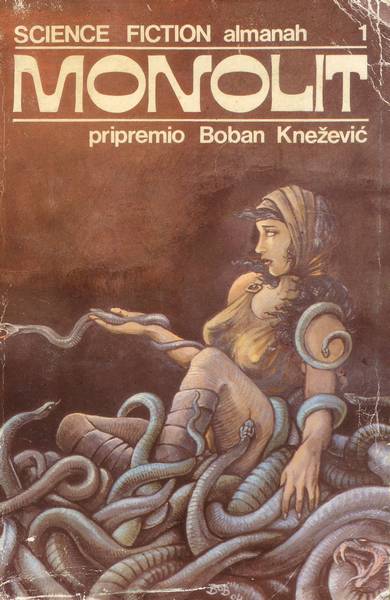
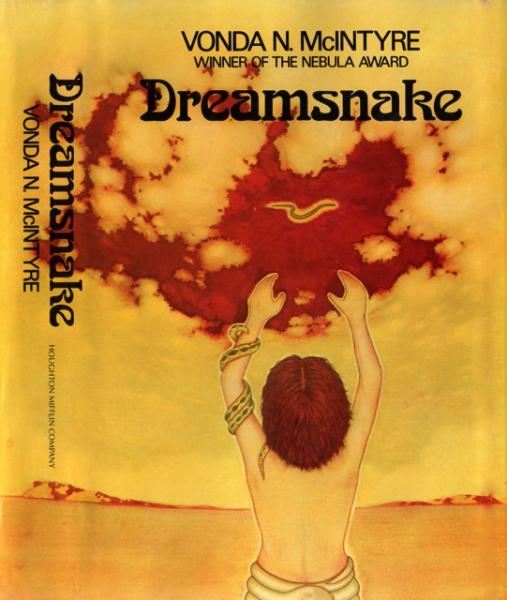
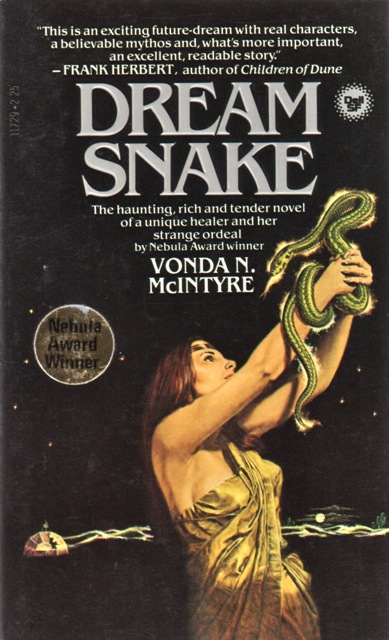
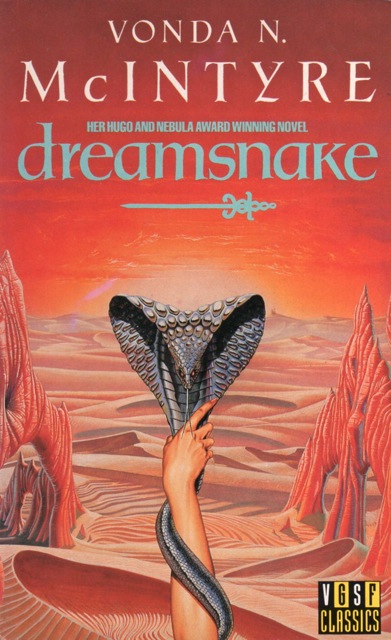
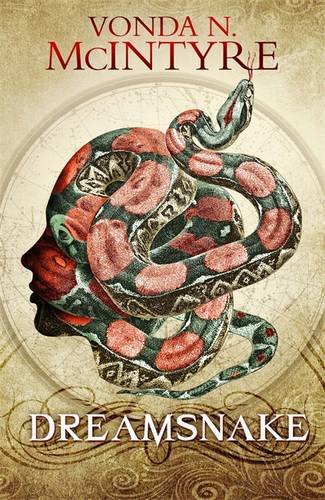
I've gathered all of the relevant book covers, minus the salacious. Few if any really capture the book's spirit. The best is the recent top one. Her hair and body seem to be in motion until you look at the horse. It is a bit of a travelogue and a bit adventurous, but it doesn't hint at even a snake or what might be done with them. Others hint at a cyberpunk snake or primitive mystical religious rites. The "Monolit" one actually illustrates a scene toward the end, if leaving out a few details (in particular a child), but it still doesn't suggest the whole.

What is the whole? In some sense, it is the hole left by the absence of the dream snake. But that doesn't answer the question of what makes the novel tick.

It shouldn't work for two reasons: 1) It's episodic. It was released as short stories (which appeared in Ben Bova's Analog), cobbled together into a novel. 2) It's scope is small. This is the story of one woman on a modest mission to heal a few disadvantaged poor, not to save the world.


On the other hand, Charles Dickens wrote semi-episodic or serial novels for the newspaper and those hung together well. McIntyre does cinch the novel tohether. Moreover, We glimpse images of the wider world.

I do recommend it.

Tuesday, May 7, 2019

"Of Mist, and Grass, and Sand" by Vonda N. McIntyre

First appeared in Ben Bova's Analog. This won a Nebula, was up for Hugo, Locus and Jupiter awards, and was reprinted by Kate Wilhelm, Terry Carr, Dick Allen, Lori Allen, Pamela Sargent, Robert Silverberg, Ben Bova, Malcolm Edwards, Martin H. Greenberg, Stanley Schmidt, James E. Gunn, Patricia S. Warrick, Charles G. Waugh, Sheila Williams, and Connie Willis.
Summary
A woman, a healer named Snake, has three snakes named Mist, Grass, and Sand, and uses them to heal the sick. She enters a hut to heal a child but comes into conflict with some members of the tribe who fear snakes.
Analysis (with minor spoilers)
This makes a great opening to a novel (Dreamsnake, which is discussed here). It doesn't feel like a short story, though. There is no character arc or speculative problem solving. Healer heals, a tribe kills one of her snakes, she feels like hurting but doesn't, and a man wants to get with her but can't. I love that Snake doesn't seek revenge. There's nothing inherently wrong with the narrative, but it doesn't give shape to a story. Maybe it was always intended as a novel.

Still despite the lack of an arc, it captured people's attention. Why? A number of possibilities crop up.

First, the paradoxical style of vague specificity has a mysterious power that is estranging. It draws some readers batty while it entrances others. Consider even the name of "Snake" who is not a snake and snakes named after non-snake (not even animal) things. As Terry Carr points out in his introduction to the story, we don't even know where or when the story takes place: "The setting may be another planet, a far future Earth, or perhaps an alternate time-stream."

[Curiously, that is not the end of the sentence. Carr finishes, saying, "but the story is clearly about the problems of scientific knowledge--and the kind of person who must use such knowledge." Maybe, but not so clearly as the next two interpretative possibilities suggest.]

Second is McIntyre's quiet, non-confrontational feminism, as James Gunn points out in his introduction to the story. Usually, feminism displays a dominant male or female, privileging one group over another. Here a woman is put in power without comment, without having tear someone else down. Unobtrusive.

Third is the snake motif. Kate Wilhelm quotes Joseph Campbell: "where the serpent is cursed, all nature is devaluated." She goes on: "the serpent appears, and is not cursed.... Within us, modern, civilized humankind, there is something that recognizes and responds to the ancient symbols. Something that answers, yes, I am still here."

While these three ideas are all interesting and productive, they may be doomed to failure (or contrarily, be equally good) due to a problematic structure (at this level, that is). The first isn't necessarily the main narrative although it explains a major scene and not the ending. The second is more subliminal than overt but it might explain the ending, not the major scene Carr's does. Kate Wilhelm's, while it also fails to explain the ending, is an interesting case.

For an SF encyclopedia, I was assigned "snakes and worms," and of course, read McIntyre's work in preparation for the article. I don't believe I happened to read Wilhelm's remark. I dug into myths and religions, trying to get at how they were used. The Bible had two main uses: the snake 1) deceives/destroys, and 2) heals (Israelis were attacked by fiery serpents and they had to look upon a bronze snake to get healed [Numbers 21]). Each speculative story I happened to read fell neatly under those two motifs. McIntyre's fell under #2 although it hinted at #1 as well--perhaps each meaning in dialogue.

The article came back, revised, so that McIntyre's use of the motif was unique, the first to ever use the snake as healing. Needing money and wanting a copy of the encyclopedia, I didn't protest. Whatever rubric/interpretive schemata McIntyre devised the story/novel excerpt, the interpretative possibilities remain in the air. I recently ordered the SFRA book to see how they decided to discuss it. If it's interesting, I may revisit and revise this article.

Sunday, May 5, 2019

The Moon and the Sun by Vonda N. McIntyre

The Moon and the Sun won a Nebula and was up for the Tiptree and Locus awards.

Father Yves de la Croix--Jesuit priest, natural philosopher, and explorer--has returned to King Louis XIV bearing a gift of two sea monsters: one alive, one dead. Little by little, Yves does the autopsy with the assistance of his sister, Mademoiselle Marie-Josèphe de la Croix.

Marie tries to train or domesticate the sea monster as a pet, but slowly learns that there is more to the sea monster than she first supposed.

Eventually they communicate, and Marie gets a fuller understanding of this race or species. Unfortunately, the sea monster's flesh is rumored to give immortality, so they want to dine on its flesh. Marie has to come up with a way to prevent this.

Minor spoilers:

The main plot could be guessed as soon as the conflict is established. Of course, humans once again underestimate another species. The victims must be rescued. In fact, much of the basic scenario mirrors Guillermo del Toro's The Shape of Water: the capture and abuse of, and experimentation on a humanoid sea creature.

The sea "monster's" name is Sherzad--a nifty nod to 1,001 Arabian Nights. After all, Sherzad (like Scheherazade) has a story to tell to save her own life.

The first two-thirds is well written but pales in comparison to the last third except for the scene establishing communication and the autopsy which is a well-sketched painful moment. The real power comes in the last third when the court intrigue unfolds, and we learn more about this sea-person.

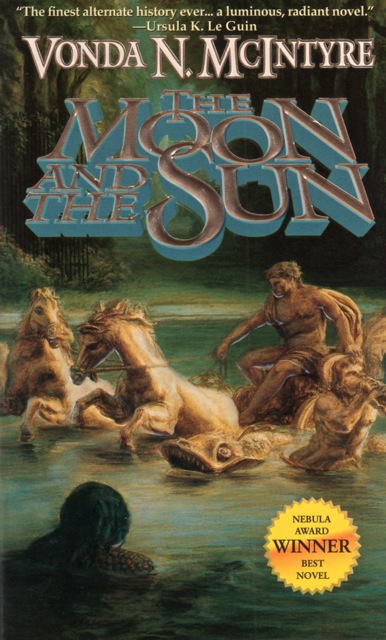
The speculation is rather limited, so maybe it is like LeGuin suggests above the illustration that this is an alternate history. Apparently, McIntyre did much research to capture the period, and it was convincingly captured. A historian might need to explain the departures and their ramifications.  I'm just a science dude.

When word got around Vonda N. McIntyre was ill, I decided to pull down this novel and give it a read. If I have McIntyre's ordering right, the novel began as a faux encyclopedia article, which she had to restrain from becoming a story with characters.

She took a script-writing class and wrote an earlier version of this story, which she later expanded into a novel. However, publishers move faster than the movie industry, apparently, and she published her novel well before they started shooting. The movie, starring Pierce Brosnan, has been filmed but remains unreleased pending special effects, four years later.

Maybe something went wrong elsewhere, but you'd think they'd try to recoup some financial losses by releasing it as straight-to-video, or have a limited release first. Surely, book fans would flock.

UPDATE: The movie was just released. See discussion here.