Search This Blog

Showing posts with label H. P. Lovecraft. Show all posts

Friday, April 7, 2023

The Art of Telling --> [Case Histories: Olaf Stapledon, Molly Bloom, Jack Williamson, H. P. Lovecraft]

Star Maker by Olaf Stapledon | LibraryThing

Sometimes the explanation, the As-you-know-Bob is the jewel most worthy of study

Of course, we have the famed "Show, Don't Tell" phrase--a useful tool for writers to remember.

And then people say, "No, we need both!" and proceed to show when showing is useful (in the moment) and telling is useful (summarizing).

But sometimes the telling is the only only thing. Take Olaf Stapledon. Here's a guy whose ideas remain fresh a full century after he shed them like a dog's fur coat in the spring. What he writes in one sentence, others would whittle out a whole novel about.

The problem with Stapledon is that he's a chore to wade through--if you want narrative. One cannot read it as fiction but as a highly concentrated dose of speculation. Here's an interesting example, if not his most remarkable [from The Starmaker]:

The universe in which fate had set me was no spangled chamber, but a perceived vortex of star-streams. No! It was more. Peering between the stars into the outer darkness, I saw also, as mere flecks and points of light, other such vortices, such galaxies, sparsely scattered in the void, depth beyond depth, so far afield that even the eye of imagination could find no limits to the cosmical, the all-embracing galaxy of galaxies. The universe now appeared to me as a void wherein floated rare flakes of snow, each flake a universe.

The final sentence is the icing that the cake has been building up to, layer by layer, sentence by sentence. What does it mean? Since a universe is a universe, it's probably metaphorical, not unlike the phrase "worlds within worlds": a droplet of pond water containing an abundance of microbiological variety. Here, though, what looks like a star is an entire galaxy, full of star systems.

Clearly, though, whatever's said in telling has to be interesting. Interesting to whom? There's some subjectivity, of course, especially for those seeking confirmation bias. But to those who seek it, novel syntheses. Accumulating ideas and building something intriguing about them.

#

The opening to Molly's Game is a mini-essay within a larger narrative essay. Does it belong to the larger essay? 

Sort of--one could argue against it--but it's characterizing and setting the stage, not to mention delivering the best part of the movie. The character voice-overs analyzing the situation is actually some of the best stuff in the movie--as well as the final delicious morsel, which circles back to the opening if only to touch base. 

Note the similarity between the Molly's Game opening monologue and the above quote from Olaf Stapledon:


#

Addendum:

I forgot to add two other key examples of telling, that lift what might be ordinary tales to another level. One is Jack Williamson's Darker Than You Think, an admirable cross-contamination of the horror novel and the SF novel. There's a chapter about 3/4s of the way in, that makes the novel remarkable, out of the ordinary, unforgettable. And it's all done in telling.

Likewise, the best part of H. P. Lovecraft's At the Mountain of Madness is another explanation also located about 3/4s of the way in (rough guessitmate). In the above link, I mostly discuss style for some reason, probably meaning to discuss Olaf Stapledon comparison but forgetting to do so. So this is my belated rectification. Here's a link to the actual story.

Wednesday, June 16, 2021

BOOM: A Lovecraftian Urban Fantasy Thriller Kindle Edition by Ben Farthing

Reminder: Ben Farthing's ebook, The Piper's Graveyard: A Small-Town Cult Horror Thriller Suspense, is on sale at 99 cents. I haven't yet read it.

Ben Farthing demonstrated his worth as a writer by having a story come in second in the Baen Fantasy Adventure Award. 

Last year, I encountered Farthing's first book, Boom--extremely strange, in the best sense of the term. If you like weird, chances are you'll like it. Read the excerpt first. If you're enchanted, then buy the ebook. Its speculative invention starts strong and barrels toward the finish. 

The story follows Everard Harrison, a resident of the D.C. metro area, pulls his truck to a stop to help a woman who appears to be in distress. He is presently unaware of his latent supernatural abilities until they fall upon him when threatened by others who have long been using theirs:

She breathed in deep gasps. Not crying--hyperventilating. 
"Hey, are you all right?" A stupid question.

He spotted a scrap of paper next to her that she must have dropped. He picked it up and touched her shoulder. She looked up. Her expression wasn't panic, but exhaustion, like she'd just run a marathon. Sweat beaded on her skin and glistened in her hair. She was slender, slightly older than Everard--probably mid-thirties--and gorgeous despite the blemishes across her cheek....

It wasn't acne, or age spots, or scars. It was a swarm of holes, moving both together and independently like a school of fish. Each deep enough to show teeth or bone, but instead only revealing pink flesh descending into shadow....

The holes glided over her face, over--oh, God--over her eyes, her open eyes, tiny fleshy pits slipping along whites and blues and irises. He should run. That what he should do, and he would, as soon as he could figure out what was going on with her skin.

It's interesting the author slapped a lot of labels on to clue readers into what they'd be in for: Lovecratian, thriller, urban fantasy, horror. He removed the label, but it did have a super-hero label as well. They are all useful guide posts to what's inside, but still inadequate. If you like non-stop break-neck thrillers that make it hard for you to catch your breath, this could be a good fit. 

I'd offer Roger Zelazny as a stronger comparison, more so than Lovecraft (though the design of the creatures that populate this realm share something of the Lovecraftian spirit). We have a protagonist who has forgotten, had his memory wiped, or somehow never knew of his connection to the strange inner world that operates beneath our own.

Because of its pacing, I almost failed to notice the deeper political significance of the work, situated as it is in the Washington D.C. vicinity. So it also offers some intellectual entertainment for those who like that sort of thing, but obviously without overbearing or overwhelming the work--subtly done.


Sunday, February 14, 2021

Is Horror Good for You?

 This is an older article that someone directed me to: 

Why Horror is Good For You (and Even Better for Your Kids) by Greg Ruth

Ruth provides six reasons which, as you can see by the titles, aren't backed up by science. He may be right or wrong, but the article title seems to promise that:

  1. CHILDHOOD IS SCARY, 
  2. POWER TO THE POWERLESS
  3. HORROR IS ANCIENT AND REAL AND CAN TEACH US MUCH, 
  4. HORROR CONFIRMS SECRET TRUTHS, 
  5. SHARING SCARY STORIES BRINGS PEOPLE TOGETHER, 
  6. HIDDEN INSIDE HORROR ARE THE FACTS OF LIFE

The most interesting one is the second one, especially in light of how contemporary horror disempowers everyone due to a Lovecraftian vision (although there is horror that does that what #2 describes).

There are plenty of plots on the planet. I am not enumerating them here, but here's one way of looking at them from most positive to most depressing:

1) Popular, bestselling plot: Protagonist Wins! but learns nothing (at least nothing of consequence)
2) Character learns something (although he might win, lose, or draw)
3) Character learns nothing (whether he wins, loses, or draws) but the reader learns from that failure.
4) Character learns that his actions to improve his lot are futile in a corrupt bureaucratic, impersonal atmosphere). See Kafka.
5) Character learns that all actions (himself, society, planet, etc.) in the face of the universe which is at best indifferent, at worst bent on your destruction. (See Lovecraft)

Hopefully, it's clear how Lovecraft one-ups Kafka from just the society level to the universe. We are all doomed because the universe hates us. Kafka probably wouldn't believe in a perfect government due to it being run by people. Lovecraft says life sucks because the basic nature of the universe is carnivorous. This type of plot seems to be a popular one among contemporary writers.

How healthy can this be? It's interesting that both Lovecraft and Kafka died from problems involving the food tube. On the other hand, some lap this up for supper. If for some readers a steady diet of these tales would lead to depression, what stirs these people to get out of bed in the morning? Surely, that would be a provocative study. 

This isn't to say that only one type should be read or should not be read, but perhaps a balance might be struck. However, an unbiased scientific study might find the opposite--only the doom of the universe produces the psychologically resilient--or conversely, only #1 produces healthy, productive humans. 

Moreover, there's nothing definitive about the above categories. They are meant to spur thought, not to circumscribe it. After all, one can go about subverting the above types and create new sub-categories--something that, no doubt, has already been done.

On the other hand, it's possible that a scientific study, which has the possibility of bias, might select only one type as healthy and allow readers to band together to drum out other types.

Sunday, May 24, 2020

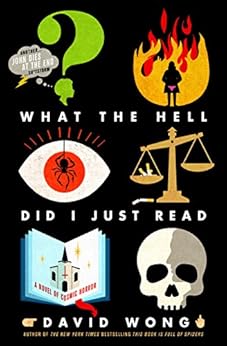
What the Hell Did I Just Read by David Wong

See the source image
David Wong, pen name for Cracked editor Jason Pargin but also the protagonist of the novel, has been launched on a third supernatural adventure. I somehow missed that this was part of a series and started with this novel because it was "cosmic horror." The previous novels did not seem relevant until I got closer to the end when "familiar" characters appeared that I was unfamiliar with, so I suspect the previous novels would have helped to a degree.

The novel begins simply enough. Three private investigators of the supernatural (David, John and Amy, who tend not to receive compensation for their work) look into the case of an abducted child. A stranger had threatened to take the man's daughter and seems to have done so. The abductor is a shape changer and leads the investigators on a wild chase, finding a child's faux cell phone that one can talk into and see photos on. The novel grows increasingly complex due to the nature of the horror getting our heroes to question the reality of what they are witnessing. While I may not be fully convinced that ending follows, the novel is highly readable.

I've perused definitions of cosmic horror, but few satisfy. For me it's where SF meets horror: wild speculation explains the crazy horror that's been loosed on the page. Usually, these are the most fascinating passages in Lovecraft's longer pieces, such as in The Mountains of Madness (I thought I had mentioned my favorite passage in the link, but mostly I critique Lovecraft's style).

Wong's novel isn't quite cosmic or quite horror by my estimate. The horror is dispelled in part by humor and situations that don't nail the dread and despair. The protagonist narrator does have his own philosophy, which is fascinating as it intersects existentialism and pop culture. A few samples (in the first, Wong discusses a painting of a clown who slowly mouths something):
as far as I'm concerned, if the object isn't killing anybody, it isn't "cursed." I've had it in the junk room for four months and it hasn't inconvenienced me once.
and
Let me tell you what's bullshit about every supernatural horror movie. Whenever the monster or angry ghost lady turns up, everyone is skeptical for at least the first third of the running time. It's usually between forty and fifty minutes in that the protagonists begrudgingly admit that the ominous Latin chants emanating from the walls aren't a plumbing issue. In real life, the very second Mom sees something red oozing from the ceiling, she thinks "blood" not "water from a rusty old pipe." I wish people were as skeptical as they are in the movies.
Much as the protagonist reflects on the events in an interesting manner, the horror never comes with escalated speculative explanation that piques one's imagination.

The style is immediately compelling. He (author and protagonist) is fluent in pop culture and its flaying. Much of the humor is male adolescent bathroom or locker-room humor, which Wong gets away with by putting it mostly in the mouth of another character and critiquing it. One running gag the appearance of asses. Other examples:
I finally found the phone sitting atop a bookcase, next to a VHS box set of a series of 90s action movies starring Bruce Willis (The Ticking Man, The Ticking Man 2, The Ticking Man: The Final Chapter, Ticking Man Resurrection) that as far as I could tell, did not exist in this universe. We never watched them, nobody has a VCR, and they looked kind of shitty.

and
The last such call I had gotten from him was two weeks ago. It was just a few seconds of ambient party noise, before I heard John's voice say, "What's that sound? Everybody quiet, I — Ha! Hey Munch, check it out! I farted so hard it dialed my phone!"
That last illustrates something that may be a flaw. We could not have overheard that whole speech if he farted once. He may have farted twice, though.

One interesting aspect is that Amy, Wong's girlfriend, sees Wong's doppelganger. Its actions surprise and beg for an advance of one character or another. When we find out the antagonist's modus operandi, it seems almost imperative that this issue be resolved. But it never plays out. Perhaps this is a long-term character development over the novel series.

Because of Wong narrative voice and compelling narrative, I do plan to read more of his work. I may backtrack and read the earlier novels in the series.

Monday, December 14, 2015

Ex Machina, a film review and discussion from three perspectives

Summary: 
A young programmer, Caleb Smith, wins a chance to not only visit a billionaire technology genius, Nathan Bateman, but also determine if Bateman has invented a machine, Ava, that passes the Turing test: Is it sentient? Ava enlists the Smith's aid in attempting to free it from its confines.

The film may not expand your thoughts on AI, but it may challenge your ethics. It's a simple film though that belies some of its complexity. Worth a watch to decide what you think. Avoid reading on if you don't like your movies spoiled.

Discussion:
Smith undermines Bateman's security system so Ava can get out. The electricity goes down, and Ava escapes. She has a conversation with another AI which may be to premediate murder. The Kyoko AI carries a knife. Ava attacks first. When Bateman gets the upper hand, breaking its arm., Kyoko stabs Bateman in the back. After he strikes off Kyoko's jaw, Ava stabs Bateman in the heart.

Ava tells Smith to wait for her. Since she has told him that she wanted to be with him, he waits. However, after she dresses in other machine's parts to make her look more human, she leaves Smith locked up and makes her escape without him or Kyoko or Bateman. 

Apparently, some critics love the movie as they deem it about feminism. This interpretation is problematic in at least three regards: 1) Ava is a machine. Most women would not choose to be considered machines. 2) Ava is a killer without conscience. Ava has doomed three beings to their deaths or imprisonment, without regard as to whether each deserves this fate: Smith, Bateman, and Kyoko. 3) Ava is created, rather than a creator.

A second interpretation is that Ava is successfully sentient and deserves freedom. We leave Ava on the street watching people as it has most desired. While it may be sentient, it has little or no regard for sentience other than its own. Plenty of sentient humans have chosen a similar path: "Destroy lives/careers of anyone in my path."

One might debate whether Bateman deserved death. Perhaps he was unaware of his machines' sentience. Yet he does have an ethos. He did not kill Smith or Ava or Kyoko. Rather, he disabled them. This may seem minor since he had destroyed earlier models. But what if they were problematic, such as AI models who lacked an ethical framework, unable to view other sentience as having as much right to exist as itself? In fact, Bateman's locking up and destroying his models seems to have some ethical backing, especially in light of Ava's behavior. Whether he ought to have destroyed their consciousnesses completely is one question, but maybe he did the world a favor. These AI were not ready for general circulation among humans.

This leads us to the third interpretation:  This is a horror story. What seems a kind and gentle AI is freed by a do-gooder. The only problem is that the machine lacks a conscience--something left out of Smith's equation. In fact, it smiles when Bateman has his back to Kyoko, perhaps anticipating a knife in the back with some relish. The story does not build up atmosphere like a horror story, but the implied doom of the world is there like any classic Lovecraftian fiction.

The movie title perhaps suggests the second interpretation: "Ex machina" (formerly a machine). It might refer to the Latin Deus ex machina as gods comes from machines although this possibility seems a little more remote as there is little discussion of gods. The British subtitle--"There is nothing more human than the will to survive"--points to the second interpretation, giving away the game entirely, if the director, Alex Garland, had a hand in writing or okaying this subtitle.

On the other hand, a great deal of time is spent on Ava's stripping old models of their human features to wear as its own. It seems unconcerned about stripping other models of their humanity (the third interpretation). Or possibly it is its moment to become human (second interpretation). But that begs the question of what it was before.

On the other other hand, the film's last moment seems to be a glorying in freedom, suggesting nothing in visuals or soundtrack that anything is awry, but maybe that is an intentional contrast. We do witness the world upside down, looking at shadows rather than human bodies. There is still a glass between the viewers and Ava... although no glass between itself and humans walking by. Perhaps we, too, are helpless to change events, trapped on the other side of the glass.

Tuesday, May 19, 2015

At the Mountains of Madness by H. P. Lovecraft

First appeared in F. Orlin Tremaine's Astounding (now Analog). Reprinted by August Derleth, David G. Hartwell, Robert M. Price, John Gregory Betancourt, Colin Azariah-Kribbs. The following reading lists recommend the novel: Anatomy of Wonder, The 5-Parsec Shelf, Fantasy: The 100 Best Books. Read online.


Summary
The narrator, Dr. William Dyer of a geology professor at Miskatonic University, treks with several men and dogs to the Antarctic. They discover a stone with unusual striations and see strange mirages. They uncover the bodies of the Old Ones and try to dissect. When the narrator and Danforth investigate what happened to one camp, their own camp is destroyed.
Commentary
They discover a mountain range catacombed with tunnels and cave carvings. They read the history of the Precambrian aliens who lived there. They had their own animals brought during a time when Earth was thought only to have unicellular life. The Old Ones fought the Cthulhu lost--some moving undersea--and later won. The narrator and Danforth encounter giant albino penguins and other strange monstrosities. A greater evil lies just beyond. Danforth may have witnessed it.

The narrator and Danforth's goal is to steer away a new expedition headed down here--not to mention saying that humans are nothing in the cosmos.

Michael Chabon writes of At the Mountains of Madness as “One of the greatest short novels in American literature, and a key text in my own understanding of what that literature can do.”

When editors like David Hartwell, trying to capture the foundations of the horror field, reprint a short novel this long, it's got to be good. The chief rewards for those who admire sense of wonder come as the explorers enter the labyrinth of caves and examine the cave paintings around chapter six.  It gives some of the best description of Lovecraft's cosmology.

Reading his work, one appreciates a few literary attributes: brooding atmosphere and imagination. Lovecraft slammed Henry James's works of horror because of their lack of horrific atmosphere. James, though, was a master of character--something that Lovecraft runs low on. What do we know about our protagonist? How is his life shaped, transformed by events and other characters? Well, he's horrified, just as his companion Danforth and most of Lovecraft's characters.

What about plot? The shape is fairly simple. One encounters the strange; horrifying strangenesses pile up until the universe irrevocably horrifies the narrator. One reads Lovecraft for the same reason that readers read Olaf Stapledon: The writers are good at a few narrative traits--good enough that readers overlook flaws.

In his introduction to the Modern Library edition of the novel, China Miéville writes, "Genre writers, it is often claimed are uninterested in characterization, theme, or nuance, and instead vulgarly subordinate everything to the exigences of plot. This, of course, is nonsense. In fact many writers don't do plot either."

Miéville's point, besides humor, is that the genre has something unique outside of plot and character. In this field, writers like Lovecraft and Stapledon reap a bountiful harvest.

Miéville also claims that Lovecraft was on the cutting edge of science, pointing out his mentions of continental drift. Unfortunately, as S. T. Joshi points out in his annotations, continental drift had no proof at the time. Moreover, Lovecraft also mentioned ether, a hypothetical medium that light supposedly propagated through. The Michelson–Morley experiment decades earlier had proved this hypothesis false. Besides, Lovecraft's real point was to lower our estimation of human science and to suggest that universe contained more than puny humans can know.

And that's okay. Humans do sometimes overestimate their understanding of the universe. Moreover, Lovecraft's mind grasped onto the unusual, the stranger fictions--reality be damned. In fact, he treated his own, Edgar Allan Poe's and Clark Ashton Smith's fictional works as true within the fiction.

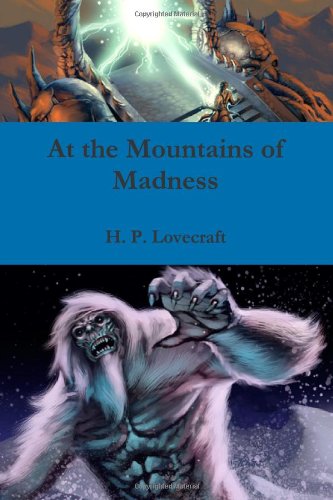
This is one of Lovecraft's cleaner works, told in a semi-academic style. Still, though many Lovecraft narrators are educated, they fail at words as soon as they confront the horrifying ineffable. Nonetheless, the writing is dotted with "things" difficult to see or experience. Note all the very different monsters illustrators created based on this novel (it may be, however, that the illustrators did not read the text in question).

Lovecraft often employs archaic spellings and words--not to mention neologisms--meant perhaps to create a dark, brooding atmosphere of the unknown. It not only makes for tough slogging, but also makes one wonder.

Miéville notes that "Lovecraft has... the transmogrifying vision of hysterical nihilism, from which his racism is inextricable."

Isn't Lovecraft's penchant of strange words, spellings like a foreign language, used to conjure horror--not unlike the speech of a foreigner? Now that I've stated the conjecture, someone will latch on to it as truth without further evidence, but it is a possibility worth considering.

Even when his writing seems concrete, we may still not know what he means. For example, what does a "tempest-scarred plateau" look like?

I analyzed this text for adverbs (actually, the "-ly" ending) versus Mary Shelley's Frankenstein, and versus Ernest Hemingway's (roughly a contemporary of Lovecraft) "The Snows of Kilimanjaro". I chose the comparisons since Hemingway is roughly a contemporary of Lovecraft and Shelley is about a hundred years older than Lovecraft and writes in a similar genre as Lovecraft. Also, Lovecraft tries to write in an antiquary style, so it'd be interesting to see how closely he resembles the thing he imitates.

In terms of percentages, Lovecraft doubled Shelley's output and quadrupled Hemingway's (who also used his within quotes). I searched for the vague noun "things," and Lovecraft doubled Hemingway's output (also found in dialogue) and had fifteen times as many as Shelley. To an extent, this is what Lovecraft intended. The unknown and foreign are terrible (variants of "vague" appears twenty times in the text):
  1. "The effect of the monstrous sight was indescribable, for some fiendish violation of known natural law seemed certain at the outset."
  2. "[S]omething about the ridgy, barrel-shaped designs stirred up oddly vague, hateful, and confusing semi-remembrances in both Danforth and me."
  3. "[T]here was something vaguely but deeply unhuman in all the contours, dimensions, proportions, decorations, and constructional nuances of the blasphemously archaic stonework."
  4. "[T]he revived memories and vague impressions acting in conjunction with his general sensitiveness and with that final supposed horror-glimpse whose essence he will not reveal even to me - which has been the immediate source of Danforth’s present breakdown."
  5. "Something about this whole place, with its polished and almost glistening floor, struck us as more vaguely baffling and horrible than any of the monstrous things we had previously encountered." 
  6. "For a second we gasped in admiration of the scene’s unearthly cosmic beauty, and then vague horror began to creep into our souls."

Brian Aldiss parodies the style as swollen by adjectivitis in "The Adjectives of Erich Zann, A Horror Story":
"I was aware of fear welling up inside me in a cascade of adjectives."
Lovecraft's style has its defenders. Nick Mamatas, whose eloquent defense is worth reading, is buried somewhere in his blog. I cannot find the article at present. Indeed, Lovecraft does have his poetic moments, but usually when his prose solidifies in the concrete.

My only point, though, is that Lovecraft's prose strives to create a literary past that never existed. His prose reads nothing like Shelley's. His protagonists, too, were his contemporaries. So why were their writing and speech patterns antiquated? True that even into 19th century, some folks cultivated a King James speech pattern, especially when it came to piety and churches that used the King James Bible as their text, possibly even into the twentieth century. But Lovecraft does not follow King James. Who his antiquary literary antecedents are, remains unclear. Perhaps creating a literary past that never existed is his point. But for readers who prefer a smoother style or character or plot, it might make for challenging reading. If possible, one has to park one's notions of narrative at the book cover's front door.

Wednesday, December 24, 2014

"The Gruesome Affair of the Electric Blue Lightning" by Joe R. Lansdale

First appeared in Paul Kane and Charles Prepolec's Beyond Rue Morgue. Reprinted by Paula Guran.

Synopsis:
Dupin and the anonymous narrator look into a blue-fire lightning bolt. Dupin is an Archie Goodwin who does Dupin's footwork into the investigation. He misses things that Dupin does not from simply reading a newspaper article about the same event, such as the lightning starts from the ground and goes up.

Little by little, the story gets stranger. An ape and a decaying man procure body parts and spill some on the streets. The ape was formerly a man who has been in dabbling in powers he ought not to...
Discussion With an Oblique Spoiler:
Of the Auguste Dupin stories in this anthology, this one captures more of Poe's original voice, flavored with a dash of Arthur Conan Doyle and a splash of Nero Wolfe. The characters (Dupin and the anonymous narrator) have a bit more personality Poe's originals. It also plays in ideas from the original stories. It folds in basic Lovecraftian tropes to add a little cosmic horror.

It begins with a well-controlled Dupin tribute, and interesting ratiocination, and ends up in Lovecraftian territory. The ape from the original is a stroke of imaginative genius--a nod to Poe's "Murder in the Rue Morgue" with a new twist. One might hope for a resolution derived a bit more from Dupin's reasoning brain than Lovecraft's overpowering cosmic horror. The two universes would seem to come to conflict: Dupin's "There's a method behind this madness." vs. Lovecraft's "We're doomed! Everyone, run for your lives!"

Strangely, the story ends on a note that feels more Lovecraftian in tone:
"...a bright badge of normalcy, that from here on out I knew was a lie."

Friday, October 10, 2014

"Cool Air" by H. P. Lovecraft

First appeared in Tales of Magic and Mystery. Reprinted by Farnsworth Wright, Elizabeth Lee, Alden H. Norton, Seon Manley, Gogo Lewis, Don Ward, Gerry Goldberg, Stephen Storoschuk, Fred Corbett, Stuart David Schiff, Helen Hoke, Carol Serling, Charles G. Waugh, Martin H. Greenberg, Robert Weinberg, Stefan R. Dziemianowicz, and Stephen Jones.
Summary:
The plot is simple. A man seeks lodging, finds it and visits his mad-scientist upstairs neighbor, who does not mind mixing science with the occult. The scientist or "benevolent fanatic" keeps his room cool. Nonetheless, the narrator feels repulsion.
Commentary & Spoilers
The cooler breaks down and the man dies. In fact, the man had died long ago, and only keeping himself cool extended his "life."

This scientist does seem mad--strange inventions, quirky personality, and general creepiness. But he isn't without human scruples--as far as we see, anyway. We do not see experiments with little to no ethical structure.

Lovecraft, like Poe, depends almost solely on effect--a deranged creepy, horror with its potent final image--as opposed to plot or character.
Notes: (from S.T. Joshi and Peter Canon)

  1. Apparently, Lovecraft couldn't write below 73 degrees, fainted at 20 degrees. He loathed the cold.
  2. Air conditioners only occurred in factories, not homes until WWII.
  3. The above editors point out that the ending letter written by a dying man is a common technique for Lovecraft.

Tuesday, May 13, 2014

"Pickman's Modem" by Lawrence Watt-Evans

First appeared in Asimov's.  Reprinted (perhaps the most frequent) by Gardner Dozois, Jim Turner, Sheila Williams, John Gregory Betancourt, and Colin Azariah-Kribbs.

The title indicates it is a play off of H.P. Lovecraft's "Pickman's Model" where the narrator learns that a talented artist on the outs with his artist community because of his grotesque drawing has truly been seeing such visions.

Although the story states it explicitly, Watt-Evans' Pickman is anything but talented.  He'd bought a second-hand Miskatonic Data System modem and it changed his poor grammar/spelling into something more elegant if archaic.  Whereas Pickman tells a person to do something crude, the modem phrases it in a less direct manner.  Pickman is disturbed but not enough to get a new modem....

Maybe you can guess what happens next.  How else can a Cthulhu story end?  This tale gains humor/power when compared to its original.

Thursday, May 8, 2014

On Reading part 2: Reading Protocols, or I can't believe you don't read / think / see the world like I do

Will Self's interest in the serious novel and Chuck Windig's retort also sparked this half of the essay--from a different slant of light.

Upon request, I collected links to my online writings, often experimental back then (some good, some so-so), and bumped into old reviews of earlier stories.  I found one review angrily (why angry?) slammed me regarding a story whose style/structure I borrowed from Paul Auster and Charles Dickens.  Mostly the insinuated complaint was that I made them think in ways they weren't accustomed to.  I've since realized SF isn't a genre for difficult stories and books.  Look at Philip K. Dick's and Harlan Ellison's reaction to Samuel Delany's Dhalgren (Wikipedia):
"By contrast, fellow writers such as Philip K. Dick and Harlan Ellison hated the novel. When the book appeared, Ellison in the L. A. Times (Sunday, February 23, 1975, p. 64) wrote: 'I must be honest. I gave up after 361 pages. I could not permit myself to be gulled or bored any further.' In an interview 27 years later, he said: 'When Dhalgren came out, I thought it was awful, still do ... I ... threw it against a wall.' Dick called Dhalgren 'a terrible book' that 'should have been marketed as trash. ... I just started reading it and said this is the worst trash I've ever read. And I threw it away.' "
Why did they react angrily?  It wasn't a game they wanted to play.  Unfortunately, that's what people do.  They trash things they don't like reading.  Some people dislike SF.  I quit dating someone who said, "So you like reading SF?" and laughed (not that that was the only reason, but a constellation of similar symptoms*).

Each book, each genre plays its own games.  You have to be versed in the game, familiarize yourself to the rules.  Delany speaks of SF reading protocols [summarized here--Heloise Merlin, very sharp gal whoever she is].  So, too, do James Gunn and Jo Walton.

But it confuses people as well.   H. P. Lovecraft's 1927 essay “Supernatural Horror in Literature” trashes Henry James because he doesn't focus on what Lovecraft does--the singular lens of fear.  I find James a more rewarding experience in terms of style, character, and thought, but your mileage may be different.  Maybe fear is your only criterion for evaluating literature.

Here's the Scratch Interview with Jonathan Franzen by Manjula Martin [registration required].  Not a Franzen hater myself (I don't know why people hate him and don't care), I found this curious:
"MM: Define 'serious novel.' 
"JF: Read the first five pages. Count clichés. If you find one, the buzzer goes off: it’s not a serious novel. A serious novelist notices clichés and eliminates them. The serious novelist doesn’t write 'quiet as a mouse' or paint the world in clichéd moral terms. You could almost just substitute the adjective 'cliché-free' for 'serious.' "
So Franzen's singular lens is the cliché.  Clichés are not admirable, of course, but literary artists have used them, sometimes purposefully.**  Here's Aaron Sorkin, Academy and Emmy-award winning American screenwriter, producer, and playwright who reused a few lines.  (Even better is this Slate parody with Josh Charles and Amy Schumer .)

Here's Junot Diaz's complaint of his MFA experience and Karin Gillespie, a self-professed Chick-Lit writer, on hers.  Again they both seek people who write what they're interested in.  No shame in that.  But neither should what they do be the only reading/writing protocol that exists.  It surprises me why more readers and writers haven't glommed on to this.  Anyway, I am glad Diaz has created an MFA program for what he sees as the proper lens for literature.  The more lenses, the merrier.  Find what fits for you, but do try on different lenses.  See what it looks like inside someone else's spectacles.

Side notes on the cliché:

* a cliché from medicine applied to different circumstances.

**Like word choice, clichés can lend a character a certain voice, depending on the type deployed.  No character or person is cliché-free unless you were able to write and revise everything you said before you said it.  Not that a cliché  should be any writer's first choice, but that there may be legitimate reason to use one, sparingly.  However, I can imagine some writers/readers where this is the only point of writing--being cliché-free.  Someday, technology will uncover just how many phrases writers have borrowed from other writers.  It may be higher than we suppose.  Maybe we'll be able to quantify the tolerable number of cliches--or the uses of a phrase which makes it a cliché, or how those clichés are deployed.***

*** I'll give examples of how clichés used well in the article, " 'A Dozen of Everything' by Marion Zimmer Bradley (or cliches can characterize)" clichés also used by Penelope Fitzgerald, Booker Prize winner, and Garry Wills, Pulitzer and National Book Critics Circle winner, who probably consider themselves serious).

Thursday, May 1, 2014

"Malice Aforethought" by Donald A. Wollheim

First appeared in Fantasy and Science Fiction.  Reprinted by Judith Merril, Martin H. Greenberg, Terry Carr, Isaac Asimov.

Clever story about writers and where their ideas come from. Writers Allen San Sebastian and Marvin Dane are often confused by fans as they wrote similar material.  Trouble grew worse for Sebastian because Dane was the faster writer. The editor at Grimoire rejected his stories when Dane turned in something very similar, earlier.  The editor insinuates that Sebastian has been seeing Dane's work. Sebastian is furious, but there's no way that either could have seen the other's work.  He toys with the theory that writers pluck ideas from a common ether.  Since Dane is the faster writer, Dane will always have the drop on Sebastian. How can he take out his rival?  Not murder but...

*spoiler* by copying a famous horror story by H.P.Lovecraft:  "The Rats in the Walls".  The editor, who isn't as well read as his readers, publishes it and hears an outcry against plagiarism.  Dane never writes again and Sebastian can pull ideas from the ether without worry of Dane's competition.

Monday, April 28, 2014

Sales + State of the genre

20% off all Mad Scientist Journal Quarterlies with these coupon codes.

2 ebooks 
by Cassandra Rose Clarke
-- finalist for Philip K. Dick award for The Mad Scientist’s Daughter
$1.99

Horror 101: The Way Forward 
by Steve Rasnic Tem, Graham Masterton, Edward Lee, Jack Ketchum, Harry Shannon, Ellen Datlow, Iain Rob Wright, Ramsey Campbell, Joe Mynhardt, Mort Castle 
$0.99

State of the Genre:

How America’s Leading Science Fiction Authors Are Shaping Your Future By Eileen Gunn at Smithsonian Magazine
"The literary genre isn’t meant to predict the future, but implausible ideas that fire inventors’ imaginations often, amazingly, come true"
Why Today's Inventors Need to Read More Science Fiction by Rebecca J. Rosen
"MIT researchers Dan Novy and Sophia Brueckner argue that the mind-bending worlds of authors such as Philip K. Dick and Arthur C. Clarke can help us not just come up with ideas for new gadgets, but anticipate their consequences."

The Underrated, Universal Appeal of Science Fiction by Chris Beckett
"Why do so many readers still look down on the genre of Orwell and Atwood?" 

The genre debate: Science fiction travels farther than literary fiction*
"In the second of our series on literary definitions, novelist Juliet McKenna argues that far from being inferior to literary fiction, science fiction and fantasy can create debate around the most complex political issues"

* -- clearly an article of bias, especially as it's written by a speculative author.  Each genre has its merits and probably should not be compared, lest lines be drawn and someone do an actual comparison and show similar lacks because, say, the speculative field does not concern itself with such topics.  H.P. Lovecraft trashed Henry James because Lovecraft examined James through a single lens: Does James evoke fear powerfully enough? Still the article's worth checking out.

Tuesday, March 25, 2014

Story/Plot Pattern in H. P. Lovecraft stories: Five-act structure


  1. Narrator announces general state of fear and inexplicable, nefarious background events. He's not a believer, but he soon will be.
  2. Mystery clues. More evil (blasphemous cult or others dabbling in cult, yadda, yadda)
  3. First fruits of clues. This will be vanquished (or disappear on own).
  4. But that's not all, folks. A deeper evil lurks, which may or may not be vanquished.
  5. Maybe a deeper (deepest) evil surges below this. It hasn't attacked but will one day. Nothing  you can do. You're doomed. Humanity is doomed. All you can do is wait for the inevitable demise of our corrupt culture.

Monday, March 24, 2014

"The Dunwich Horror" by H. P. Lovecraft

First appeared in Weird Tales, reprinted by Phyllis Cerf Wagner, Herbert Wise, Betty M. Owen, Robert M. Price, Tom English, Gwendolyn Toynton, John Gregory Betancourt, Colin Azariah-Kribbs, Jeff VanderMeer, and Ann VanderMeer. 

Other Media: 

Online. Audio drama. Recent movie (decent camp for low-budget/acting quality--3.7 out of 10 on IMDB--although I must admit it's not especially faithful and I skimmed parts). Hard to find good images illustrating the story although I left out a semi-accurate if gruesome one.


Summary:

Dunwich recently* had troubles that were hushed up. Satan and his minions have been a close part of the New England community since it was first founded--if you believe the rumors, which the narrator does not, at first.

We focus on the Whatelys, a decadent,** homely, goat-looking lot. In 1913, Lavinia gives birth to Wilbur, who frightens the village. He grows up too quickly and seven-feet tall. The community steer clear of the house where screams and an awful stench emanate. People disappear. Even the mother disappears. The people blame the boy.

Wilbur shows up at the Library, seeking a copy of the Necronomicon, especially page 751 (which adds to the unlucky 13). The librarian says no, but Wilbur returns only to die to a librarian guard dog. Wilbur decays before the villagers' eyes.

No, Lovecraft does not end there. He is a writer of scope. The monster still in the house is famished. It prowls the countryside to abate its hunger.

Commentary:

The whippoorwills add a nice touch of creepiness, signaling imminent death. What's cool is that whose death is signaled remains masked until their death.

The monsters themselves are like a scale of creepiness that Lovecraft ascends, which he called "so fiendish" that no one would want to print it. Little wonder. We have the boy who is humanly grotesque--even if his end comes too quickly and undramatically. Far worse, we have the monster, hungry, prowling the countryside in search of food. Nothing can keep it out, and it smashes locked doors, climbs sheer cliffs. S.T. Joshi dismissed the tale as one of good vs. evil, where good triumphs, but Lovecraft implies yet a third entity. The humans have surmounted the brothers, but not their father, whom presumably they cannot surmount.

The key trouble is character, which is not Lovecraft's strong suit. If he'd created personalities of dimension, Joshi would not be able to call it "stock." (I need to revisit "The Hound" which was my favorite at one time--interesting characters, memory says.)

Nonetheless, one character bears fascinating aspects. Professor Henry Armitage--the librarian who refuses Wilbur the book--shares his knowledge of arcane data, takes it seriously, and uses it. This is very different from the standard genre story. I once mentioned in a workshop with James Gunn that astronauts would have read various SF authors. While SF writers pay tribute to the old masters, one was not to reference those works directly--odd considering that the future will involve those who have read such authors. Here, though, Lovecraft references those stories directly. They prepare Armitage, which is a relief for readers familiar with the genre who ask, "Why does everyone have to be so stupid?"


*Okay, 1928, but that's while Lovecraft wrote the tale and a year after it was published. When revisiting Lovecraftian realms, writers tend to return to the twenties. Clearly, Lovecraft flipped back to the past but primarily set his stories in and addressed his day, but to revisit Lovecraft, addressing one's own day may keep with Lovecraft's spirit.

** It's hard to know what Lovecraft means by this term except that it is bad. Like many of his excessive adjectives, it may serve no other purpose than to create atmosphere.

Friday, March 21, 2014

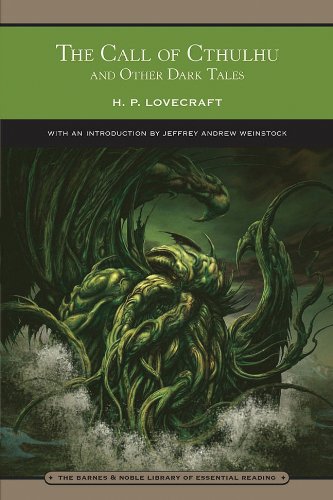
"The Call of Cthulhu" by H. P. Lovecraft

First appeared in Weird Tales, reprinted by T. Everett Harré, August Derleth, Peter Haining, Les Daniels, David G. Hartwell, Robert M. Price, Leslie Pockell, S. T. Joshi, John Gregory Betancourt, Colin Azariah-Kribbs--gaining more import in later years. It has spawned a movie, role-playing games and a radio drama.

Due it's piecemeal construction (a format I'm usually fond of if the sum is more than the parts) and Lovecraft's focus on mood over plot, this story challenges summary--at least, the through-line is tenuous.

I. The Horror In Clay

The narrator finds an evil-looking statuette made by an artist who, like many artists during a certain period in New England, became sensitive to vile dreams and visions. The narrator's uncle had the artist write down what he half-remembered of his dreams, which mostly consisted dripping caves and a half-seen monster.

II. The Tale of Inspector Legrasse

The reason Professor Angell is interested in these dreams is because he'd run into a New Orleans cult, which had a similar sculpture. Their voodoo is more vile than any other.

After deaths and arrests, they find the cult is based around beings who came to Earth and slept, waiting to be revived and bring doom.

The narrator is suspicious of his uncle's death.

III. The Madness from the Sea

After meditating on the confluence of events, the narrator gets a hold of papers to locate this beast on a Pacific island. Cthulhu is awakened. They barely escape with their lives.

Commentary:

While Robert E. Howard and Michel Houellebecq consider this one of Lovecraft's best, E. F. Bleiler called it "a fragmented essay with narrative inclusions". Both views shed insight. The piecemeal effect creates a sense of deep-time, as if this has a long history. The style is much like an essay, but much of Lovecraft has a distancing effect as if it were an essay written more for veracity than for moving the reader. Events are told at a distance both in time and at a remove through secondary narrators. We do not feel the events directly.

In fact, both of these effects are often seen. It's fascinating the amount of effort Lovecraft goes to prove veracity. Whereas if a modern author had a character say, "I am not insane!", we would automatically categorize him as such; with Lovecraft we tend to trust his verification, as events appear to back up testimony. Moreover, it is generally the rational who go insane--lovely paradox--as perhaps they must if they encounter true knowledge of the universe. So why does Lovecraft verify?

Monday, March 17, 2014

"The Colour Out of Space" by H. P. Lovecraft -- More keys to understanding Lovecraft

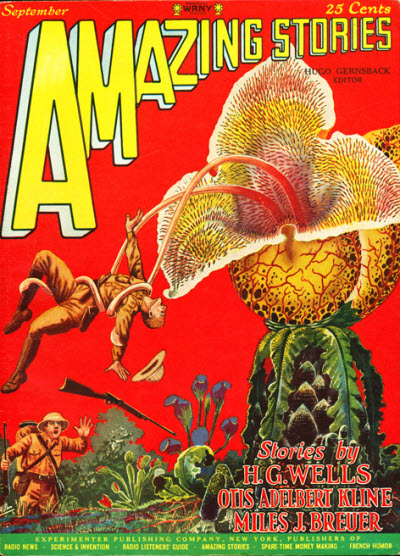
First appeared in Amazing Stories, reprinted by August Derleth, Mary Gnaedinger, Groff Conklin, Sam Moskowitz, Bryan A. Netherwood, Leslie A. Fiedler, Peter Haining, Martin H. Greenberg, Robert Weinberg, Stefan Dziemianowicz, Mike Baker, Garyn G. Roberts, Michael Kelahan, Guy Anthony De Marco, John Gregory Betancourt, Colin Azariah-Kribbs--a few of which were genre retrospectives. A movie (see trailer below) and radio dramas have sprouted from this tale.

This one of Lovecraft's more straightforward tales. A meteorite lands in a farmer's yard. Scientists are unable to analyze it. After a storm where lightning strikes the meteorite six times in an hour, it disappears... as does the samples the scientists took.

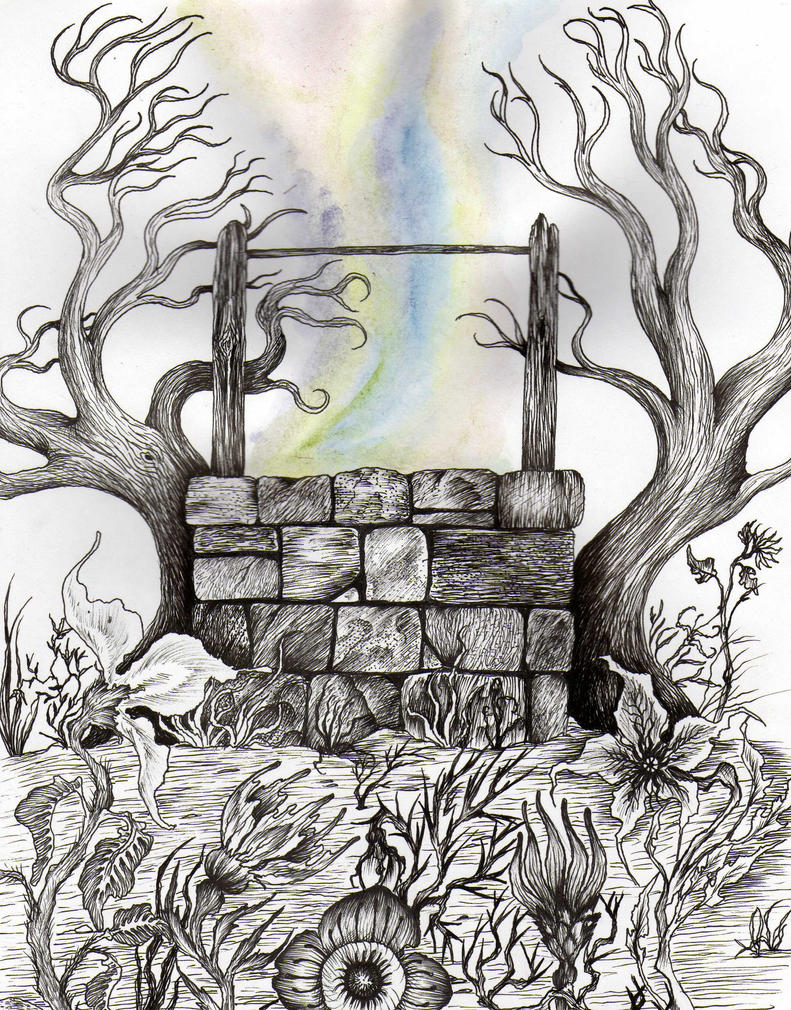
The crops look exceedingly large and tasty, but they are laced with bitterness. The family moves the cows far from the home, so their milk isn't tainted. The grass and plants turn grey and brittle. The family gradually grows insane. Sons throw themselves into the well. When a family friend stops by, the family is gone, only scuttling creatures that decay remain. The property glows.

As a straight-forward piece, unlaced by cumbersome, fulsome, fearsome, and other over-complicated "Cyclopean" adjectives--so many adjectives that you forget what the sentence was about--this work has more energy than others.

It culminates not with the family, though, an ending that would satisfy other writers, but it would not fulfill Lovecraft's vision of the cosmos. Rather, others investigate the place and witness the  above well vision to the right. Something escapes to the cosmos, and something yet stays behind. The witnesses should leave but cannot--just as Nahum warned.

As an ending that informs the rest of the work, it repeats the same, Lovecraftian notes over and over, reminding me why I cannot stomach more than a few Lovecraft tales at a time. For those tired of Hollywood triumph-over-tragedy type stories, Lovecraft must come as a non-relieving relief. The endings readers prefer could become a new psychological pessimist/optimist-spectrum indicator that psychologists could name after Lovecraft.


Sunday, March 16, 2014

"The Horror at Red Hook" by H. P. Lovecraft -- Keys to understanding Lovecraft's work

First published by Weird Tales, reprinted by Christine Campbell Thomson, Herbert Asbury, Charles M. Collins, August Derleth, and Barry J. Gillis. Free online.

The impoverished children of New York are disappearing and Thomas F. Malone is on the case. Robert Suydam, who gets younger and more invigorated, comes under suspicion when a child's face is spotted in one of Suydam's basement windows. Malone stops by various properties and finds fleeing foreigners, charnel stench, mysterious instruments, and blood spatters.

Lovecraft wrote of the tale's origin:
"The idea that black magic exists in secret today, or that hellish antique rites still exist in obscurity, is one that I have used and shall use again. When you see my new tale "The Horror at Red Hook", you will see what use I make of the idea in connexion with the gangs of young loafers & herds of evil-looking foreigners that one sees everywhere in New York." 
From our twenty-first-century perspective, the tale's origin is an embarrassment of racism, yet Lovecraft's influence permeates the genre and wider culture. We need to understand where we've come from. Plus, it's too easy to be dismissive of times other than one's own. As Roger Luckhurst points out in his introduction to Oxford University Press's The Classic Horror Stories by H. P. Lovecraft, following the millions devastated by W.W.I and the Spanish flu, western civilization was felt to be on the decline. Moreover, social Darwinism gave racism an intellectual justification, with such prominent proponents as Jack London. Lovecraft likely considered himself an intellectual studying myth and even penning a chemistry textbook.

Lovecraft's racism comes from a slightly different place. Tragedy filled his personal life: a father who went insane from syphilis; the loss of the grandfather, his fortune, and displacement from his home so that Lovecraft felt like a wanderer; his mother's insanity; and Lovecraft's own financial instability. No wonder he felt the imminent, inexorable collapse, the encroaching horror that has no respite, no escape. This describes not only Lovecraft's key story elements but also his plot structures. The evil of the foreigner is inextricably linked to the uncaring and amoral gods--rather beings from another plane.

The story opens with the protagonist's madness ("Malone was content to keep unshared the secret of what could reduce a dauntless fighter to a quivering neurotic"--a term that Lovecraft, according to Lockhurst, once used to describe himself), and the opening quote from Arthur Machen discusses evolution:
"It is possible that man may sometimes return on the track of evolution, and it is my belief that an awful lore is not yet dead.”
So we witness the typical, inevitable doom of the Lovecraftian tale. His life mirrored civilization, and his fiction mirrored both. While many critics are dismissive of this tale, Lockhurst sets the story in a primary position, and it does appear to illuminate Lovecraft's work.

Saturday, March 8, 2014

"Copping Squid" by Michael Shea -- Analysis

This originally appeared as the title story in his 2009 collection (pictured) and was reprinted three other times in major retrospectives by S.T. Joshi, Paula Guran, and Joe R. Lansdale.

This must be one of Shea's most fun to ponder stories. The events are pretty simple. Ricky Deuce, a young late-night clerk of Irish heritage working at a small market, has gone three years trying to clean up his act: going sober and avoiding fights. A young black man with a knife, Andre, demands Ricky's money. Ricky laughs at first, but when he dodges the blade, he gets out his own knife and slices Andre's arm.

That appears to be exactly what Andre wants. He threatens to call the cops if Ricky doesn't give up ten dollars and a ride to where Andre wants to go. Ricky's incredulous: Ten dollars? But Ricky relents.

On the ride into Andre's territory, Andre explains his motives--he wants immortality--and he needs blood money (the ten dollars) and a witness to his actions (Ricky).

The ending reveals, as many readers have also probably questioned, that Ricky could have left at any time but, staying, he sold out for a lot less than many others would have.

The events are pretty typical of Cthulhu stories. Andre's description of the god, capitalizes it as "Him" equating (or remaking or conflating) gods. This and the description of immortality make not only this but also all Cthulhu stories feel like stories about religion--an odd statement considering that Lovecraft was atheist. But maybe this is a way for an atheist to wrestle with the "religion demon," so to speak:  often as the outsider looking in, and often horrified by the amoral acts that these cosmic gods commit.

Why a black man? Possibly a doorway to another world, foreign to the narrator (racial doorway, not racist because there appears to be no condescension), to stand at the threshold of a far stranger one. Also, Ricky's last name is Deuce, which in tennis means a tie score (add this to Ricky's low economic position--doubled by a last name the indicates the lowest standing in the deck and two dollars--and his ownership of a Mustang. In other words, Ricky's an average Schmo. Other definitions of "deuce" that may be in play here:  bad luck, the devil, extreme example, reprimand), so we may deduce the characters are equivalent. This equality can also be seen in the next paragraph.

Why is the narrator so willing to follow Andre? After all, Andre's motives are initially strange and incomprehensible. Even Ricky's suspicious. Like the reader who's followed Ricky through these worlds, Ricky realizes he is a willing participant (even abandoning his job to see where this adventure leads). We readers actually paid to follow them, albeit at a safe remove. Ricky is a "witness," which not only has religious overtones but also suggests an accomplice in a crime.

The name Ricky suggests a hard ruler. Andre misunderstands Ricky's name as Richie (connotations of riches, which he does not have except in the end as a semi-literal but mostly metaphorical sense). But in a sense this isn't misunderstanding but a renaming. Ricky and Richie can both derive from Richard, meaning brave, hardy ruler. Andre also calls him Rocky, which will lead most readers to think of the fictitious boxer, a fighter like Ricky. Rocky denotes hardness, connoting stubbornness and insensitivity (no doubt due to the term "rock"), but also shakiness, proneness to failure, and dizziness due to inebriation. However, we don't witness much of this hard and failure behavior except for the knife incident (and a scarcely mentioned past). Perhaps this is meant to foretell what happens in an otherwise ambiguous narrative that refuses to show what the narrator chooses to do next.

Lastly, the title itself is a fascinating onion of meaning. "Squid" can probably only refer to one thing--Cthulhu (although slang may also be at play: slowness or ineptitude from CA, which is where the author was from; and Urban Dictionary's overestimating one's abilities, which may refer to Cthulhu, Andre or Ricky).

"Copping" is far more complex. It could an adjective describing the squid or a verbial describing the act upon on the squid. Perhaps the squid is becoming a cop of sorts. The verb form fits the narrative a little better as the verb "cop" may mean catching, stealing, adopting, taking unwanted sexual advances, admitting, but also contrarily getting something wanted or unwanted. Andre, in his CTHULHU RULES T-shirt, certainly believes he's gaining something greater:

"I have gone up to see Him, and have looked through His eyes, and I have been where He is, time without end! An I'm here to tell you, all you dearly beloved mongrel dogs of mine, I'm here to tell you that it's consumed me! My flesh and my time, have been blown off my bones, by the searing wings of His breath! I'm not far off now from eternity!"
and
"I'm more alive than you will ever be, and when I'm all consumed, I'll be far more alive, and I will live forever!"
Most people may want a longer--even immortal--life. How you feel about being consumed may be another story. Again, the story or Ricky's next decision is left ambiguous, but his past impulsive actions and the meaning of names might suggest where the story's headed next.

Monday, December 23, 2013

Bigger, Better

Aliens vs. Predator 2 earned a 12% among critics, 31% among viewers, which is pretty amazing considering there really is no human protagonist.  What did the viewers respond to?  It's a very visceral movie--a slightly updated slasher movie with aliens instead of maniacs with knives or chainsaws--with lines that, while expected, still get you.  When Molly sees an alien through the window with her night-vision binocs, she screams, bringing in her parents [quote from IMDB]:
Kelly O'Brien: You know, when I was your age, I used to have these awful nightmares.
Molly: It was real.
Tim: [walks up to window] See? No monster.
[an Alien jumps through the window and attacks Tim]
What would have happened had the daughter been wrong?  We, the viewers, would have been disappointed.  We identify with the girl because we saw the monster, too.  We want the monster.  That's why a hefty third of the viewers enjoyed the movie despite drawbacks--we want something bigger and better than us.  This may be a similar audience to H.P. Lovecraft's universe where the universe, yes, has monsters and yes, they are bigger and badder than you.  Prepare to die.

Here's another example, Darksiders, a video game where heaven battles hell and there appear to be few good guys except the four horsemen of the apocalypse.  Note the size of the enemies to the horseman hero:
Although the hero has incredible size and muscles (not to mention a massive blade), his enemies are all bigger and muscly-er.  Now this only goes to show what prowess he has when he defeats his enemies, but it's the idea that there's always something bigger and better out there.  This is essentially the premise of most comic books in fact, but usually the good guys win.

This bear's a case that shows Lovecraft's not always right--at least many humans are enchanted by a bear that could maul us but instead does this:
Adorable, no?  In part because he could maul but instead waves hello--at least that's what we're trying to attribute to it anthropomorphically.  And it's our response I'm interested in.  What fascinates us?