Search This Blog

Showing posts with label Robert Heinlein. Show all posts

Friday, November 8, 2019

The Man Who Folded Himself by David Gerrold

This was up for the Hugo, Nebula, Locus and Jupiter awards


This is a novel that may be exhilarate and disturb. For some, it may disgust. For others, they may see precursors as having covered this before, but the novel’s target audience will be those who delight in the bizarre “sexcapades” and time paradoxes. If you are only into the latter, read the first half and the ending.

Imagine expanding the world’s greatest time-travel story (Robert A. Heinlein’s “All You Zombies”) to novel length. It might look something like David Gerrold’s The Man Who Folded Himself. There are differences, which I’ll discuss below. If you haven’t read Heinlein’s story, do so.

In Gerrold’s novel, Danny, our narrator, has inherited what he believes to be 143 million dollars since his Uncle Jim had suggested as much. So Danny is living off the fat of the land. Except it turns out, after Uncle Jim dies, that he has been living on the last of the fortune. All that is left is a belt.

The belt, though, is a time machine, which allows him to change his life.

Discussion (Spoilers Galore)

Some argue this novel should have won the major awards. The winner, Rendezvous with Rama, seems to be controversial—a mysterious, alien ship floats through space with little characterization—but others have argued for completely different novels (Lethem in favor of Thomas Pynchon's Gravity's Rainbow), so perhaps that is why Clarke's novel won. Other reasons may exist.


It’s similarity to Heinlein’s work may have marred the work in some eyes, but it takes different narrative, tonal, and philosophical paths. The narrative changes (the time skip, the expansion into the sexual nature) aren’t especially significant in terms of meaning but the other two are.

In the sixties, sex seemed to have lost its taboo nature. A lot of books tried to exploit and explore the new boundaries of decency when court cases like Allen Ginsberg’s Howl won. Harlan Ellison’s Dangerous Visions, mined this vein. It is into this atmosphere the novel is released.

Danny and his future self go to the races and bet on horses. They win handsomely, knowing the outcome of events. They invest and become rich. But at some point (midway into the novel), Danny is warned by one future self that another future self will seduce him because being himself, the future selves understands his needs better than anyone.

Now the narrative is somewhat sly. The events may or may not have or will have happened. He is, after all, reading the diary of a future self, and he may or may not choose to fulfill these things, which is an intriguing concept in itself. It prevents the protagonist from actually committing acts he may but hasn’t yet committed.

Another interesting aspect is the textual assumption that one will be attracted to one’s self. Narcissism is usually a metaphorical abstraction, but here it’s literal—a physical reality. But not everyone is attracted to himself. So the text for those, will at best be strange, foreign angle, much as the text justifies itself.

A third aspect that differentiates this and makes it stand out is its tonal difference from Heinlein’s story. In Heinlein, the narrative is as epic and inescapable as Oedipus Rex. But here, flux and uncertainty about the future is the name of the game. What’s interesting about this is the narrator’s attempts to avoid this flux by remaining near his “home time” or his era since other eras become too foreign the further away he is from what he knows. Also, just as he maintains the livelihood of his own future, he tries to keep the present past aligned with his own memory of events since that might change his present.

The narrator is preoccupied with his own inevitable death, his failure at love outside himself (or even with himself) and this maintaining of his present. These and speculative inventions like the Time Skim (although not fully utilized) sets this tale at least a little distance from Heinlein’s.

It's a little surprising that this and Heinlein's story haven't been named for a Retro-Tiptree award.

Thursday, September 25, 2014

New Heinlein trailer + short film

Predestination, based on Heinlein's story "By His Bootstraps" (story summary & commentary), stars Ethan Hawke. Looks fun.


Also, a 15-min short film, Entangled. Cool but I don't see the need for obfuscation. The science itself is mystery enough.

Tuesday, March 25, 2014

Dylan Thomas, Robert Heinlein and Flannery O'Connor Speak from the Grave

Robert Heinlein hasn't much to say (they briefly speak with him 13 min in), but it's interesting to hear his voice from his hey-day
Interview focuses on people involved with Destination Moon. It's early in TV's career as the reporters waste too much time boggling at their own wonder--either of being on TV or of being on a movie set.
"Flannery O’Connor on Why the Grotesque Appeals to Us, Plus a Rare Recording of Her Reading"

Dylan Thomas photo animated -- very strange:
"In My Craft or Sullen Art" by Dylan Thomas:

Wednesday, January 29, 2014

Slow Down + Blog Assessment + Writer Interviews + Posts You May Have Missed

Slow Down
Too many posts consume time. I must slow down. I have stories to write and submit, so enjoy what's here.

Blog Assessment
The last assessment was in December of 2012. I've been at this since Dec 2009--a little over four years (although I also blogged at s1ngularity:criticism and Mundane SF blogs before this). With nearly a thousand posts, that's about two posts for every three days. When I get bogged down at school, I post less frequently.

For two and half years, page visits have grown ten percent or so per month, which amounts to a twenty-fold increase. The per post view-rate has grown since last year from 35 to 55 or so, not quite a sixty percent increase. This is more dramatic when you consider the early posts with few hits are factored in (the hits were probably my mama who accidentally hit the refresh button a few times.

A year ago, one post--"Girl" by Jamaica Kincaid--outstripped all other posts and accounted for ten percent of the traffic (it's now five). I guess it's a good one. Fifty to a hundred folks stop by each month to take a look. Trent Zelazny's interview posts may have been the only posts that overtook her monthly lead.

Interesting to see which classic stories people are still fascinated by. Theodore Sturgeon's "Microcosmic Gods" and "Thunder and Roses" have drawn hundreds of readers in less than a year, but the other Sturgeon stories only about two dozen each.  I'll  be interested to see which stories of the big three--Arthur C. Clarle's, Isaac Asimov's and Robert Heinlein's--people are still fascinated by.  William Gibson and Ursula K. LeGuin drew less attention than I would have supposed although I need to do more or theirs..

In retrospect, part of the blog's growth was not only the quantity of posts but also the quality of their presentation. I changed presentation when I reviewed and interviewed. Take note if you blog.

Popular posts can be viewed on the right.

Writer Interviews
On file are the following:
  1. Loralee Leavitt
  2. Christopher Barzak
  3. Trent Zelazny
  4. Kenneth W. Cain
  5. I have upcoming interviews with G.O. Clark and Dustin Lavalley.

Posts You May Have Missed
These are posts I thought there might be more interest than they've received: 
  1. A Scene-by-Scene Analysis of the Movie, 2001: A Space Odyssey*
  2. Analysis of Flatland: A Romance of Many Dimensions by Edwin A. Abbott*
  3. A number of James Patrick Kelly posts--one of the best writers of speculative fiction in the 90s and 00s. I didn't put much time into pretty-fying them, focusing on content. Maybe I'll revise them one day.
* These two might make a nice contrast, treating religion from opposite ends of the spectrum.

Monday, December 9, 2013

Reading Update: Fiction

-- Rereading Anne McCaffrey's 1st award-winning Pern stories that made up the first of the novels. Still potent.

--Kim Stanley Robinson's Shaman (actually was reading it when my Kindle died)-- survival among the early hominids.

--Dan Krokos' Planet Thieves -- finished awhile ago and was in the writing throes of a review when a triptych of tech woes steered me off course.  The book's a fun YA romp with "alien" baddies.


--Scott Nicholson's Transparent Lovers, a PS Publishing noir-flavored novella about a detective coming back to life to find his murderer and stopping another in process.

--Cate Gardner -- short stories mostly.  Often takes a situation--sometimes common trope, sometimes not--and milks out the emotion of such a scenario.  This and her sometimes startling imagery are her strengths.

--J Kathleen Cheney's The Golden City -- approaching 1/2 way mark.  A cross between Tim Powers, Jane Austen, and a mystery--an original confection set in early 20th century Portugal--both familiar and sufficiently strange.  The love story's kicking in.


--Robert Heinlein (finished Menace from Earth collection -- I just need a stretch of time to write.

--Mark Twain's Tom Sawyer.  Loved as a boy.  Still delightful.  It begins as a picaresque tale, but slowly events shape others.  Wonderful studying how Twain twists his turns.  I still remember thinking, "Man, if Tom's this ornery, imagine Huck's Adventures!"  And then Huck wasn't near so bad.  His was still a good story, but for different reasons.

Wednesday, November 13, 2013

Analysis of "Goldfish Bowl" by Robert A. Heinlein


This first appeared in Astounding, reprinted by the following editors: Groff Conklin, Damon Knight,  Leon E. Stover, Harry Harrison, Bonnie L. Heintz, Frank Herbert, Donald A. Joos, Jane Agorn McGee, Ric Alexander.

Summary:
Two scientists investigate a pair of water columns on the Pacific Ocean--one climbs up, the other down.  One scientist's an icthyologist and carries a pair goldfish with him.  His heart is failing, so everyone refuses to allow him to travel up the column to see where it leads. His companion makes the journey but fails to return, so they allow the geezer to follow him up.

They indirectly encounter unsuspected higher intelligence where they least expected it.  They are trapped in the typical alien nowhere-land--a small, enclosed space where the characters have to hatch their way to escape.  They see themselves like goldfish, trapped in a bowl.  Unfortunately, the only way out is death.  To spread knowledge, the last living scientist carves on his own flesh, "Beware. Creation took eight days," to let those below know that other creatures exist.  They find him but fail to understand the message.

Discussion:
The extended metaphor comparing humans to fish felt fresh:  Both physically in the shape of their prison and their treatment and intellectually in that the humans are trapped like pets without any communication to their alien owners, aside from a feeble attempt to attack their owner.

The theme is foreshadowed in the old man's name ("Graves") and his inability to see the water pillars with a spyglass. Only with two eyes--binoculars--can Graves make out the pillars.  Also, the men cannot communicate when the loud speakers yell, "Range one.  Man and cast loose"--doubly meaningful in terms communication, limited range, and humanity being set adrift.

When Bill's body is discovered by Portuguese fisherman, they are no more able to understand the message than native speakers of English.  Since the message comes from Genesis, a religious interpretation may be allowed although it may not be an entirely positive one.

Relationship to other stories:
 Other writers such as Frederik Pohl, Nancy Kress, among others have tackled this challenging SF scenario.  What if you're intellectually nothing to your alien captors without any means to communicate?

This also connects to the two prior stories in the collection, The Menace from Earth--"The Menace from Earth" and "Sky Lift"--stories of ascending sacrifices.  What happens if your sacrifice is meaningless, though? Your life and life's work has been for naught.  While depressing, it is meant to be a thorough and honest look at sacrifice, rather than a rosy one.  Humbling, too:  There may be aspects of the universe humanity may not be able to comprehend.

Tuesday, November 12, 2013

Huge Book Bundle

Bookbale.com  has six books for the price you name ($2.99+), with a 2-book bonus if you pay $10.  Authors included:
Andre Norton, Bill Ransom, Frank Herbert, Joe Haldeman, Kevin J. Anderson, Mercedes Lackey, Mike Resnick, Nancy Kress, Robert A. Heinlein, and Robert J. Sawyer

Saturday, November 9, 2013

Analysis of "Sky Lift" by Robert A. Heinlein

This first appeared in Galaxy, reprinted in A Century of Science Fiction, (1962 by Damon Knight) and Sentinels In Honor of Arthur C. Clarke (2010 by Gregory Benford, George Zebrowski for Hadley Rille Books).

A fine and moving story.  It's too bad only Damon Knight, Gregory Benford, and George Zebrowski had the insight to show it to more readers.

Summary:
Joe Appleby is one of several military pilots qualified to fly blood needed by colonists infected by Larkin's disease, but it will require more than 3g's of constant acceleration to get it there in time.  Appleby is eligible to go back to Earth to meet up with a girl, but finds himself selected for duty, which of course he fulfills.

On the flight the primary pilot senses the flight is killing him, so he tries to talk Appleby into saying they couldn't make it.  The flight confuses Appleby's senses and doesn't understand what the other pilot is saying... until the ship has been shut down.  He restores the acceleration and turns off the primary pilot's controls.  The pilot is killed, but they arrive in time, with Joe cognitively damaged for the rest of his life.

Relationship to other stories:
Imagine you wrote Tom Godwin's classic "The Cold Equations" about the sacrifice of a guy instead of a girl.  That's "Skylift".  The scenarios are similar:  People are dying.  The only way they can be rescued is if someone unknowingly gives up his/her life.  Both have people they care about and would like to visit.  Godwin's is a controversial classic, read and argued over. This tale, just as moving for the sad sacrifice the character unknowingly made, hasn't been but should mentioned in the same breath "The Cold Equations".  Why don't people complain?  The answer to that is personal, but should reveal bias, get people to examine what they truly think.


The difference, though, is that Heinlein's story focuses on the sacrifice, the greater good.  Okay, you're in pain; okay, you're dead; okay, you're mentally maimed for the rest of your life; okay, you have something you'd rather do than save lives; okay, you'd rather live the sacrifice your life.  But you do what you have to do to save lives.  As for us, the living, our hearts break for you.

Joe Appleby is perhaps the same character--or a relative of--from "Columbus Was a Dope", who was Chief Engineer of the Starship Pegasus.  He may be a relative as they are still working out faster starships in the "Columbus" story.

So far, "Sky Lift" is the only story without a clearly ironic title in the The Menace from Earth collection although one could point out that the tale isn't about skies, per se, or about anything uplifting. "The Menace from Earth" is also a tale of sacrifice, but it's voluntary.  Here there the choices aren't left to the individual.  Also, another sacrifice takes place in the following story, "Goldfish Bowl", another sacrifice in the name of something whose underlying purpose is not truly understood.

Wednesday, October 23, 2013

Free pdf ebook sampler of Robert Heinlein

Free ebook

Includes

  • advice to Larry Niven and Jerry Pournelle concerning The Mote in God's Eye
  • other letters
  • essays
  • the short-story classic, perhaps greatest time-travel story ever written,  "All You Zombies"

Analysis of "The Menace from Earth" by Robert A. Heinlein


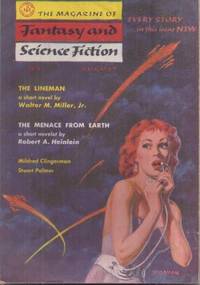
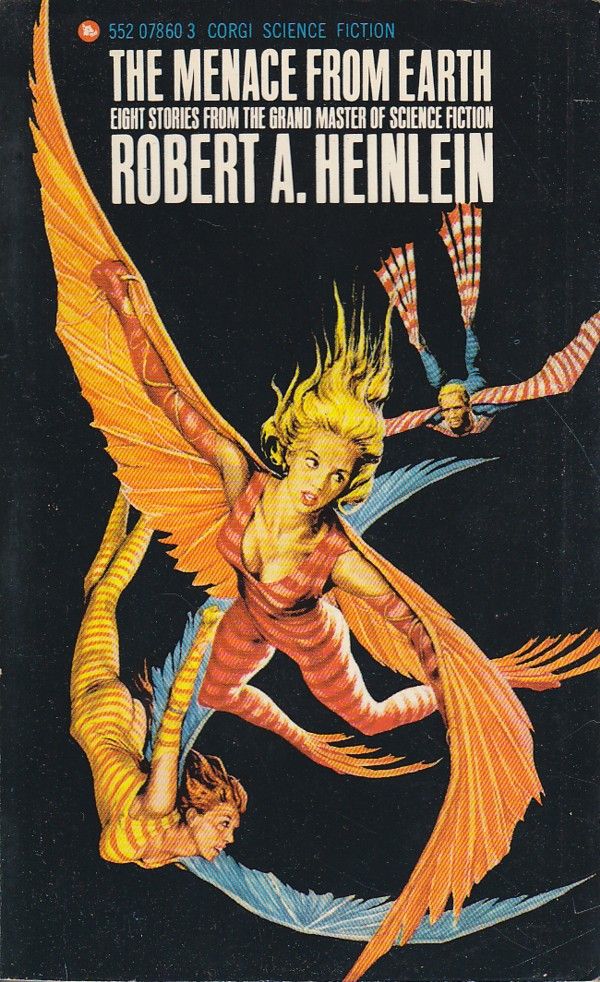
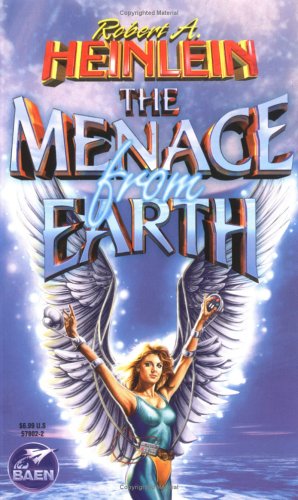
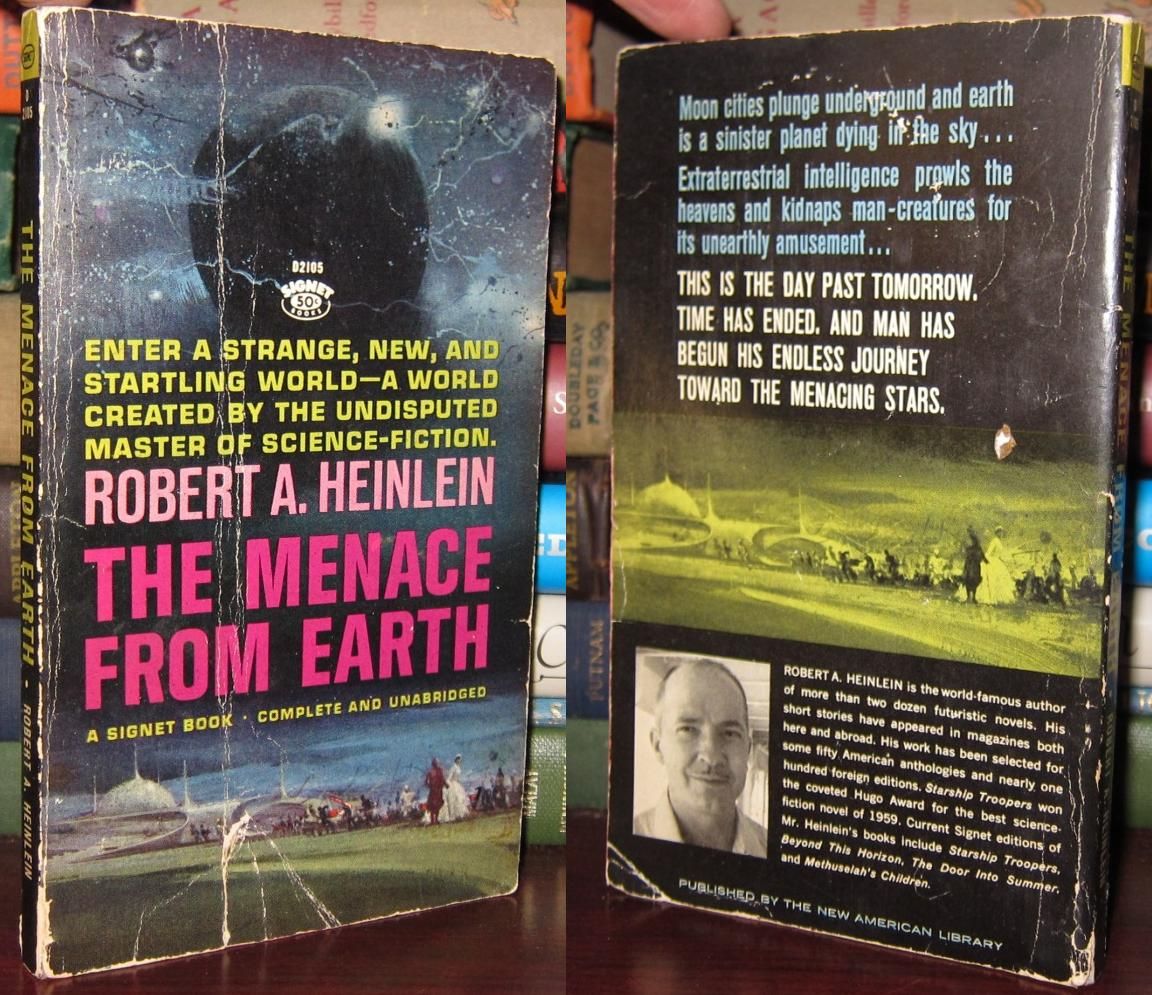
This first appeared in The Magazine of Fantasy and Science Fiction, reprinted by Isaac Asimov, Georgess McHargue, Eric Flint, Jim Baen, David Drake.  Available online.  It is also available in a double-collection ebook (pictured below).


An effective love story:  Interesting structurally, it opens with an admirably executed unacknowledged jealousy, makes an uneasy peace with it, shows the other side of jealousy, and walks away from the love story before returning.  This may be more of a guy's style of love story, but it would be interesting to hear what women thought of it.

Fifteen-year-old Holly Jones envisions herself a business woman who wants to build starships with her friend and partner, Jeff Hardesty.  Meanwhile, she picks up work as a tourist guide for the predictable "ground hogs" or Earthlings.  When she hands over the tourist, she learns that Jeff is infatuated.  She's disappointed, but frames this only as it impacts their business relationship.  The reader and other characters see it differently.

Jeff finally returns to Holly--they exchange affectionate if slightly demeaning apellations--but only to have her teach her own rival to fly.  This would seem the ultimate slap in the face, but Holly takes it well, accepting the job.

However, the job goes awry and Holly has to save her rival's life.  After everything, the rival has to point out what's been obvious to everyone else.  However, charmingly, Holly accepts Jeff's love only framing it as it will help out their business relationship.

Her disarming sacrifice here becomes a true sacrifice in the next tale, "Sky Lift", with the consequence of life and intellect lost.  It is the latter we readers mourn the most.  Next to "Columbus Was a Dope", we have a pair of pro-exploration tales--in life and in space.

Tuesday, October 22, 2013

Analysis of "Columbus Was a Dope" by Robert A. Heinlein

First appeared in Startling Stories, reprinted by Isaac Asimov, Groff Conklin, Frederik Pohl, Carol Pohl, Peter Haining, Martin Greenberg.

A short tale with an effective gut-punch for a finale.

At a bar, Barnes, a "fat man" who drinks old-fashioneds, harangues a starship builder for this hair-brained multi-generational scheme, doomed to fail.  Heinlein gives him a convincing if sketchy argument (it could have used a few more supporting details).  He suggests Columbus was a dope for leaving home.

The bartender says the world needs explorers--naysayers of Kitty Hawk are dragged out on the table as evidence for fools against progress--and (spoiler) the bartender's happy to live on the moon.

Fools against progress have been numerous throughout history, and the story does a fine job convincing the reader of the desire if not the necessity of humanity's next steps.

The naysayer here is fat--perhaps too easy a target--but the old-fashioneds are a nice touch.  Rubbing shoulders with "By His Bootstraps", the frictional energy might lead us to think the future presses on, with or without us.  In "The Menace of Earth", more of the moon's technology is on display, making Barnes look more the fool in the reader's eyes.  The title, like many stories here, are meant the opposite of what they say.

Monday, October 21, 2013

Analysis of "By His Bootstraps" by Robert A. Heinlein

This first appeared in Astounding, reprinted a dozen times or so by many famous editors in their day:  Kingsley Amis, Brian W. Aldiss, Harry Harrison, Terry Carr, Robert Silverberg, Martin H. Greenberg, Robert Conquest, Raymond J. Healy, J. Francis McComas, Leo Margulies, Oscar J. Friend.  It is available in a double-collection ebook (pictured below).

Too clever by half--but thank goodness for such cleverness.  When I'd first read this, I'd already Heinlein's "All You Zombies," so I half of this was expected.  I read it too hastily then.  In fact, this has a lot of charm.

After locking himself alone in his apartment, Bob Wilson works on his doctoral thesis the night before it's due.  He anticipates finishing.  However, a familiar-looking stranger in the room tells him it's all hogwash.  The stranger tries to convince Bob to go through the gate.  Despite getting liquored up, Bob remains unconvinced until another stranger tries to stop him from going through.  A fistfight ensues, and Bob plunges through the portal...

30,000 years into the future.  And a lovely future it seems, with beautiful women aplenty, but before Bob can enjoy this new future, he must go back through the portal and convince the man on the other side to enter. The man on the other side--you guessed it--is himself from earlier.  Here's where the charm comes:  Bob (or Joe, as he now calls himself so as to confuse his first self) is annoyed with arrogant, stubborn self.  Who of us has not been annoyed with ourselves?  But what a zinger of self-recrimination.

The second return is repetitious, but thankfully shorter.  Although the charm here is the new introspection:

"His first response was the illogical but quite human and common feeling of look-what-you-made-me-do. 'Now you've done it!' he said angrily."  
Who had done it?  Humans are quick to shift blame, but who's guilty?

Finally (or maybe not finally), Bob remains in the future to chase down this mysterious Diktor [Dictator?  The books he retrieves--Mein Kampf and The Prince--suggest that this interpretation may be viable.]  However, Diktor remains illusive

The title and conclusion may be ambiguous.  "By His Bootstraps" alludes to pulling one's self up by one's bootstraps--i.e. your success depends only on you.  One could say that Bob helps himself, on the one hand; on the other, he has the help of other individuals.  The ending sounds clearly hopefully:
" 'There is a great future in store for you and me, my boy--a great future!' 
"A great future."
Why does the narrator (possibly we are in the mind of the protagonist) or author repeat the phrase, and why is it not as emphasized with an exclamation?  It may be the narrator does not believe this.

The key or the ending may come nearer to the beginning when Bob's girlfriend calls and natters to him about his proposal of marriage, which he rejects immediately, especially after he meets the exceptionally beautiful future women. But it sounds like the mature Bob returns for the present girlfriend as opposed to the mindless of the future.  In fact, the future sounds like a kind of bland if grand and wonderful prison.  Diktor's perspective does sound more mature toward the end of his time in the future, suggesting perhaps that we need to find ourselves before we are ready for the next step.

Heinlein introduces two impossible paradoxes, which he brushes off with a philosophical, "Which came first, the chicken or the egg?":  How did the first self get to the future initially and who first taught him the language?

Interestingly, in the collection The Menace from Earth, this is paired with "The Year of a Jackpot"--a tale of Armageddon, which this tale alludes to as well, including the name of the woman who serves Bob in the future.  Following this tale is "Columbus Was a Dope", a pro-exploration tale.  The frictional energy this tale gains with that might be a comparison of explorer types:  Some should stay home, some move on, some move on only because they were told they shouldn't.  Sometimes you have to walk away from a thing to appreciate what you have (this also comes up in "The Menace from Earth").

Sunday, October 20, 2013

Analysis of "The Year of the Jackpot" by Robert A. Heinlein

This first appeared in Galaxy, reprinted about a dozen times by several major editors of the 50s-70s:  Frederik Pohl, H. L. Gold, Donald A. Wollheim, Damon Knight, Terry Carr, Robert Silverberg, Dick Allen, Lori Allen, James Frenkel.  It is available in a double-collection ebook (pictured below) or as a single (pictured to the right).  [Note: the cover illustration has nothing to do with the story.]

In the ebook of the same name, Paul Di Filippo astutely correlates this story to Heinlein's Future History timeline's "The Crazy Years" although the technological progress is minimal, the societal social fabric rips apart at the seams.  Heinlein's remarks on the period are:
"Considerable technical advance during this period, accompanied by a gradual deterioration of mores, orientation and social institutions, terminating in mass psychoses in the sixth decade and the Interregnum.
"The Interregnum was followed by a period of reconstruction."
Interestingly, although Heinlein is maligned for how he handles social mores (comparing him to contemporary mores rather than the common mores of his day), he constantly breaks the rules even when he seems to be flaunting a more conservative perspective.  Nailing Heinlein's social perspective is problematic as, at his characters' most staunch perspective, it often appears under the guise of banter.  If one were to summarize his socio-political perspective, it might be "Let it go" or "Take it easy,"* a phrase from the tale itself,  to either political persuasion.  Let people be whoever they want to be.


Potiphar Breen is a statistician who has been anticipating human cycles of insanity, "lemming"-like suicidal behavior among the human species.  Social mores are being shed, just as literally as Meade, a young woman, sheds her clothes in public but has no understanding of why she's doing it.  Potiphar happens to have a raincoat on him to put around her just as the cop had intended to arrest her.  The tale suggests, but does not say, that Potiphar had statistically anticipated someone stripping there.  To Potiphar, she's an interesting statistic.  He wants to know why she does, but she has no inkling.  

He anticipated a complete breakdown of humanity before it recollects its insanity.  When both lose their jobs and the insanity reaches a peak--just as strange earthquakes, weather, and nuclear weapons strike--they high-tail it out of Los Angeles.  None to soon. 

They make it to a rural area to wait out humanity's inhumanity.  Just as it looks better for humanity.  Disaster from the sun strikes.  I didn't make much of the ending--not taking the sun going nova seriously--thinking that sun sent a barrage of high energy particles to Earth.  As it was sunset, with more atmosphere to travel through, I figured they should have been safe.  Maybe they should have ducked into the shadow of a hill.  But no, the idea of which stars go nova had apparently not been codified, according to Wikipedia.

The title plays an ironic role.  "Jackpot" connoting good luck although the protagonists make the best of their short-term situation.

* From "Skylift" comes this declaration:  "The ideal pilot is relaxed and unworried. Sanguine in temperament, he never borrows trouble."

Monday, July 8, 2013

The Idea of Ideas and IO9's interest in Avatar

From the article titles alone, IO9 appears to like Avatar with a desire to have it shell out money to certain parties.


The authors seem semi-unbiased--Charlie Jane Anders appeared to place little stock in the claims in the comment section: "you could easily do a list like this for Star Wars. It's just funny how eager people have been to point out what sources Avatar 'ripped off.' "  But the titles as a group do accidentally lead us to the subtext that Cameron is guilty.

This brings up a slew of questions:  Where's the demarcation?  What is plagiarism?  What's coincidence?  What's homage?  What's wrestling with other people's ideas?  The waters get murky because if you've studied genre history and/or studied with James Gunn, you learn authors actually responded to one another's ideas.  For example, Tom Godwin's "The Cold Equations" still has writers arguing with him.  As does Robert Heinlein's Starship Troopers, which has some of the biggest names in the business respond:   Joe Haldeman, Orson Scott Card, and John Scalzi.

With Robert Sheckley, I discussed the similarities between Stephen King's Running Man and Sheckley's "The Prize of Peril".  Sheckley said he had called up King and asked about that.  King admitted he'd read the story and admired it, but it had been awhile.  Essentially, grist for the mill.  Sheckley accepted the answer.  What a generous heart that man had.

Most likely the articles are intended to provoke thought and discussion although I can't help but feel some sympathy for the artist and wonder what's next for art, especially as copyrights keep getting extended indefinitely.