Search This Blog

Showing posts with label Richard Parks. Show all posts

Thursday, February 2, 2017

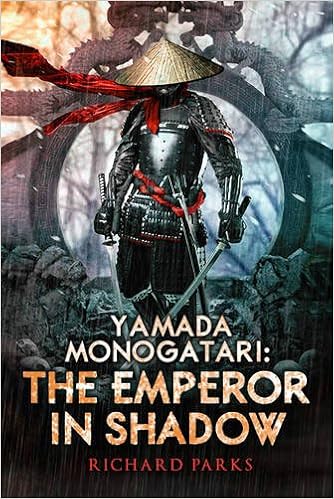
Review: Yamada Monogatari: Emperor in Shadow by Richard Parks

Yamada Monogatari: 
The Emperor in Shadow 
by Richard Parks 
Diamond Book Distributors 
Prime Books

The Emperor is dying. Once again Lord Yamada is called with Kenji to ensure the next emperor is peacefully transitioned to the throne. An onibe directs Yamada to protect Princess Tagako (as she is told the same in dreams--or is she warned away from him?). There are multiple attempts on the life Princess, due to being promised in marriage to a mysterious suitor, and Yamada must find a way to protect her life and get to the bottom of these plots against her life.

This novel deserves brings the series to a satisfying close; however, it doesn't stand alone. It stands on the shoulders of its predecessors. The B story, or the secondary narrative, is strong, but the A story is difficult to tease out.

Yamada's mission isn't clear. He runs into characters from the early stories--the fox demon, his ghostly former lover--who hint and feint at his goal but it remains ever elusive ("I promise to enlighten you, but not just yet." and later, "Why? I haven't the faintest idea"). The narrator sometimes tips his hands to the missing A story in dialogue exchanges like "I'm bored." The narrative quickly shifts into action as the author seems to realize these words. This doesn't indicate a boring narrative, but one that merely escapes a definitive goal. It is understandable to hide major plot movements outside Yamada and his companions, but we do need characters who desire--as Kurt Vonnegut put it--"a glass of water."

The story's narrative arch doesn't get fully assembled until toward the last tenth of the novel, some of which the readers will have guessed since the primary story didn't distract us readers enough. Moreover, the master skills Yamada had in the first book seem to have eroded.

If you've read the first three, then definitely read this one. It completes the series and Yamada's journey--one he might not have realized he was on.

Sunday, December 25, 2016

Longevity: What Makes a Writer Worth Remembering?

Someone at Wikipedia has questioned whether a writer's [Richard Parks's] entry deserves to exist. At first, it seems outrageous to suggest erasing a writer's and his work's existence. But when you look at the actual discussion, they define it as the following:
"The person has received a well-known and significant award or honor, or has been nominated for one several times."
I am going to assume that Magnolia677 is just playing by the rules and not someone with an axe to grind.

Interesting questions arise: "What is significant?" "What makes a writer and his work worth remembering?" One can apply the same questions to Wikipedia itself: Who cares if an article is deleted from them or not? Who are they?

However, it is a go-to, community fount of information, which academics tend to discredit, but let's say it is worth keeping because the above quote makes fascinating dissection.

  1. Why does someone need to win an award? I'm guessing it isn't the only measurement that Wikipedia uses when deciding to include or exclude. 
    1. Bestsellerdom or popularity will also be a measure (see Eric Flint below). 
    2. Likewise, Shakespeare and John Milton didn't win awards, yet they are included. There, the measure is academic appreciation (which, one might say, is what the Mythopoeic award is). 
    3. Moreover, even Wikipedia acknowledges that William Faulkner is not known for his award-winning works. Therefore, despite the above quoted claim, this really is not a selection criteria for inclusion in Wikipedia for authors.
  2. Richard Parks has been nominated for five awards, won one. How many is several? Is five not several? (See below for further discussion of what even means to be nominated for the best.)
  3. What is well-known? What is significant? The Hugo award is probably the most famous genre award. The award is exclusive to a group of those who pay to vote and/or attend a convention [World Con]. Last year, they had ~4200 attend and ~7000 with voting privileges. The convention supporters are probably more likely to vote than not. However, voters won't vote for every category. So for any category, let's guess that there's a 50-75% involvement. Let's say 5,000 vote. Let's compare that to the Science Fiction Age poll. Let's say of a 50-60,000 subscriber base, only ten percent vote. In terms of voter numbers, the awards may be roughly equivalent. 
    1. Caveat not in Parks's favor: Note, however, that SF Age Reader's Poll has only one magazine that is up for an award, so the selection/competition is narrower. 
    2. Caveats in Parks's favor: 90%+ of the World Con voters did not read every story in every magazine. Therefore, it is probably safe to call the winner of an SF Age poll, comparatively, as significant as, say, a Hugo award nomination. 
    3. I've read the story in question. It is good but not a major story. It is better than some stories that won major awards.
  4. Not including his award-nominated stories and novellas, Richard Parks has had fourteen stories included in various genre retrospective and year's best anthologies. These are selected by respected writers or editors of the field. Let's call these selected stories, long-listed "award" stories. Let's assign them the worth of half a nomination. That would give Parks seven more nominations (if you prefer a third, then it would be five more nominations). So we end up with the equivalence of ten to twelve award nominations. Is that enough for significance?
  5. Related to #4, if you [who question a writer's significance] agree that someone is significant enough to have a Wikipedia page, and that person says that the writer is significant (whether via book blurb or collecting that author's work or somehow stating that Parks's works stand among the best released in the past, then you must agree the writer in question has significance. (This, of course, leaves out all the Wikified editors like Shawna McCarthy who printed Parks multiple times.) Writers or editors who fit that bill:
    1. Kathryn Cramer (four reprints)
    2. David G. Hartwell (four reprints)
    3. Margaret Weis (one)
    4. Eric Flint (one--who has, by the way, not won as significant award or been nominated  as often as Parks)
    5. Mike Resnick (one)
    6. Jonathan Strahan (one)
    7. Sean Wallace (two)
    8. Rachel Swirsky (two)
The discussion, however, is academic. His collection, Yamada Monogatari: Demon Hunter (see review), is significant--not the best of its year but among the best. This marks him as a writer worth reading and having a Wikipedia entry (were I to vote on this). Put another way: If Sir Arthur Conan Doyle deserves an entry on the basis of literary merit, then so does Parks.

His novel/collection was not well known enough that people turned to it for award nominations, which is a shame. Like Faulkner's best, sometimes good works do not get the awards nod. Still, people will be reading and passing on via word of mouth that Yamada will probably continue to sell beyond some award winners.

The author should gather his reprinted, award-winning and nominated shorter works into one massive "Selected Works" collection to see if that doesn't help tip the scale toward significance.

Monday, October 24, 2016

Review: Yamada Monogatari: Demon Hunter by Richard Parks

Yamada Monogatari: Demon Hunter 
by Richard Parks  
Diamond Book Distributors  
Prime Books
Richard Parks has been scribbling speculative fiction for decades with fiction nominated for the World Fantasy, Locus, and Mythopoeic Awards, not to mention short fiction appearing in multiple year's best anthologies. Yamada Monogatari may be one of his crowning achievements.

These tales originally appeared in Shawna McCarthy's Realms of Fantasy and Scott H. Andrews's Beneath Ceaseless Skies, reprinted by Scott H. Andrews, Eric Flint, Paula Guran, Rich Horton, Mike Resnick, Rachel Swirsky, and Sean Wallace. For some reason, I thought the stories were all original and was surprised that they had not drawn more attention, but clearly, hawk-eyed editors spotted the strength of these works.

As the collection title suggests, Yamada Monogatari is a demon hunter, or any supernatural creature menacing the people of Japan. He is a nobleman, but not high enough to be embroiled in messy politics--an outsider with swordsmanship that makes him an excellent hire to investigate awkward family troubles.

Along the way, Lord Yamada picks up a sidekick: Kenji, a priest who drinks too much, neglects bathing, and takes too much interest in the fairer sex. None of which recommends his companionship except his willingness to accompany Lord Yamada on these journeys and ability to create wards and spells when needed.

The duo occupy the same literary ambiance of Sherlock Holmes and Dr. Watson with similar charms--except the present company investigate supernatural troubles in Japan, rather than crimes in England. They both present fascinating literary riddles and resolve them, if without providing enough clues for readers to unravel the knots themselves. We are just along for the thrill of the ride. And what a ride.

Here are teasers for the ten stories:
  1. A fox woman seems to have run off with her son. The father wants his son back....
  2. Lord Yamada's former lover, now empress, has been implicated in a scandal....
  3. An ogre menaces wayfarers wandering the countryside; however, she seems uninterested in harming any of them except....
  4. Lord Yamada is kidnapped by his friends and the prince in order to dodge a goddess who sends tsunami of boiling water who seeks devoted follower who abandoned her....
  5. The daughter of a ghost bandit won't allow Lord Yamada and Kenji to exorcise the ghost....
  6. A dead child's bride doll is stolen--it is meant to accompany the child as a companion in the afterlife. Is a rival family trying to stir things up? or something more sinister causing the upheaval?
  7. The bones of would-be robbers lie outside a mansion, left by the ghosts who guard it....
  8. The seven-foot tall corpse of a demon has been stolen, taken from the family of famous demon hunters.... (especially good--perhaps for its implications)
  9. A faceless ghost haunts the walls of a nobleman's compound, but this is no ordinary ghost....
  10. Finally in a fitting finale, characters from earlier stories come together. The fox woman, the ghost of a princess join Lord Yamada, Kenji, and others to protect the upcoming emperor from a plot against him....
I'd have given this five out of five stars but for a few small matters. Two of stories are minor. This alone wouldn't be fair to downgrade a collection since the rest have a curious "dimensionality," thanks to narrative events that seem initially arbitrary but later take on new meaning. The main drawback is that the stories could have built toward a more novel-like experience. Characters do recur, and there are some changes in character. Lord Yamada shows he has loved and slows his heavy drinking. But the changes are minor--little more than one finds in Arthur Conan Doyle stories. 

Still, we read Sherlock Holmes nearly a century and a half later. It wouldn't surprise me if Yamada Monogatari scratches that same itch. I am surprised it was not nominated for awards the year it appeared.

Friday, April 5, 2013

Mostly Literary Links

Accepting poetry book submissions:


Solaris Rising 2 released

Awards


All of these posts about the Clarke awards are worth reading.  The first responds to this editorial about the gender of the writers.

Hugh Howey


Dean Wesley Smith on Agents

Kristine Kathryn Rusch on


Swarming robots

Cellular map of the fountain of youth

Nathaniel Williams on teaching Steampunk

On reading ebooks -- how we do it

Richard Parks answers critics -- on writing historical fiction

This article on Robert Silverberg's "Good News from the Vatican" received a bump when a new pope was chosen.  It's out as an ebook recently, but expensively.  Perhaps a collection a more affordable option.

Gate to "Hell" -- poison fumes steaming Pluto's gate found based on documentation

David Farland


Nightshade


Cat Rambo on rewriting novels

Friday, January 25, 2013

Science Stories Prize fighters Support

Science
What it's like on an orbiting space station lab:


Russia to the moon

DNA information-storage


Anti-aging baby

Coughing duration

David Brin revisits his idea of following prophesies to find who's prophetic (as well as what, when, where, why)

We are still stuck in high school:
[T]he prefrontal cortex has not yet finished developing in adolescents.... This explains why adolescents are such notoriously poor models of self-­regulation, and why they’re so much more dramatic.... [E]verything an adolescent does... [and] feels—is just a little bit more intense. And you never get back to that intensity.... Puberty... is everyone’s first experience of a sentient madness.
Why older brains don't remember

5 Historic Misconceptions
Stories to read or hear

Flannery O'Conner's "A Good Man Is Hard to Find" read by ol' Flannery herself.


Small Beer podcast of Kij Johnson's story

Online story from Richard Parks


Prize fighters future and present
Story Prize finalists

Philip K. Dick Award finalists

Books to look for in 2013

More books to look for (same year, different site: IO9)

Support
Glitter and Madness anthology

World SF Travel Fund