Search This Blog

Showing posts with label aliens. Show all posts

Thursday, February 6, 2025

"Feather Tigers" by Gene Wolfe

Bruce McAllister [Editor] – EDGE Autumn/Winter 1973 – Science Fiction - Picture 1 of 13

First appeared in Bruce McAllister's Edge. Reprinted by Terry Carr, Brian Attebery, Ursula K. Le Guin.


Summary:

 Quoquo, a blue alien the shape of a "child-sized" bunny, is investigating Earth after a catastrophe has wipe most life other than plants which have grown wild and thick.

Humanity has left behind intelligent machines, but Quoquo doesn't find them all that useful, saying that they lie.

Proudly, Dondiil, another blue alien, has been breeding domestic cats for 40 orbits of their home world, so that they now approximate the kind that would have existed in the area [Vietnam].


Discussion (Spoilers):

Quoquo takes a blaster into the jungle and clears a path for himself. However, Dondiil has let his genetically modified tigers to escape. Quoquo blasts them until he realizes he's been hallucinating at least some of them. Finally, at his death understanding some human concepts.

Quoquo--whose name approximates "whichever" or "whatever"--has a hard time believing human culture. He's trying to be objective but failing. His name in his own language may be an intensifier: "Quo" now with even more "quo."

Humans do things that don't make sense like having a "Paris, Texas" that has nothing to do with "Paris, France" and what the aliens think they know about the species such as cannibalism, is applied over a time and circumstance and in a way that distorts understanding. Perhaps this is why Quoquo thinks the skyacht lies to him. The history is too complex, too broad and too thick to be easily understood. 

"Feather tigers" is another of those strange humans topics where humans see something where there is nothing. Only when exposed to a similar environment is Quoquo able to understand--albeit too late.

The ship is described by some unnamed narrator as being like the phoenix, and so too is the environment returning to what it once was--even if using animals different from the ones before.

This is a solid story. But Wolfe has others, better. The more I read The Norton Book of Science Fiction, the more I sense they are the B-sides of SF: These stories deserved more attention, which is great, but the book has a grander title with a presumed grander scope. No doubt the old reviews still exist. I do know some professors of the time professed their appreciation of the book. 

I've been reading the opening essays, which are informative, and establish the parameters of selection, and perhaps this urgency to get on the right side of politics held the book back from being something closer to what the book title proclaims. There's nothing wrong with what they're wanting to do, but it requires a different title: Forgotten or Neglected Stories of an Ethically Kind SF. At least that seems to be the best title for the moment. Maybe I'll have another later.


Monday, April 29, 2024

The Day the Martians Came (novel) by Frederik Pohl

https://m.media-amazon.com/images/I/4151KKANA7L.jpg

Up for the Locus award. This book could be considered a loose novel, story collection, or fix-up/suite.


We were wrong to think nothing was up on Mars. Aliens are found in a small pocket inside Mars's crust. To survive, they need a new place to stay. Earth, it is. While we're waiting for this arrival, anticipation stirs up a number of consequences.

A minor novel, this has good moments. It tosses out a nuts of our familiarity with aliens and gives them a quick twist, reinvigorating the genre with a light but shifting perspective. James Frenkel recommends it. Aliens seem to be a lens to refocus our understanding of ourselves. Nothing earth shaking. Just tiny shifts. Tremors beneath one's feet.

It's an unusual book. It may be his attempt at writing the SF literary story, connected like the first stories in Ray Bradbury's The Martian Chronicles, which feels closely if loosely connected (Bradbury's later stories seem to have less in common with the first group). In Pohl's story suite, imagine the connections continue. Pohl's collection is better connected but not better written. 
 
While I've heard his speeches and interviews and exchanged a handful of words with him, I don't recall ever hearing Pohl talk about stories in a way that unveils more about his or any writing process or dissects how story works or doesn't. He was a well-respected editor and penned some fantastic stories But his talks and writing about writing seem not all that useful. For instance, he wrote about "style" in some stories that do have a strong sense of style, but his comments seemed to have little bearing on the issue at hand. He must have been a gut writer--one whose understanding of stories was more intuitive than explicit.
 
Although none of the stories are power houses, several are subtle, minor masterworks worth reading.

Probably if one did not want to read the whole novel, one could dip into a few sections. Probably taking in the first two and last two sections, and a handful between. The only must-reads are the last two, but one should have at least a little context. Perhaps because of the small shifts, the shorter tales seem to be the more effective.


One possible list of stories to linger on:

• Extract From the Congressional Record • (1988) • (for the set-up)

• A Martian Christmas • (1987) •

• Sad Screenwriter Sam • (1972) •

• Saucery • (1986) •

• The Day After the Day the Martians Came • (1967) •

• Huddling • (1988) • (see comment below)


Ending with Spoilers:

"Huddling" provides a new facet by Pohl's forever focusing on the shape of aliens casting a shadow on our own humanity. In this case, the aliens, which some humans have been looking down on, feel sorry for humans not being able to huddle and communicate like they do. A rich irony.


Thursday, April 25, 2024

"Adeste Fideles" or "A Martian Christmas" by Frederik Pohl

Book page image

First appeared in Ellen Datlow's Omni. Up for a Locus. Reprinted by Datlow and David Hartwell. The title is Latin for “O Come, All Ye Faithful.”


Summary:

 Henry Steegman is a construction engineer--that is, he drove tractors that bore holes through the deep rock of Mars. He and the Mars colonists have accidentally imbibed water contaminated with radioactive products so that they are all dying off. Meanwhile, it's Christmas and the inhabitants are celebrating. Steegman drives off on his tractor to make a number of discoveries.


Discussion with Spoilers and analysis:

 The first discovery is what appears to be a department store. Of course, everyone back on Earth is excited about Mars again. After people try to take credit and keep Henry from exploring his discovery for himself, presumably due to the advanced state of his illness, he goes on a second expedition, this time presumably finding the Martians himself where no one else can take credit.

The story defies any wisdom about writing I've heard. First, the character's goal is submerged (not fully conscious) and, if anything, is more ours than his. Second, the plot doesn't follow anything that plotters would say is a good plot--following no real established patterns that I can see. I can't see any literary writers finding it a knockout--and the majority of SF readers probably wouldn't either. It is a kind of literary SF, thought-provoking in a subtle manner. The thought provoked (or theme) is actually far outside whatever goals or conclusion the character himself may have come up with.

But it satisfies, in a few ways that stories have--one of the best of that collection. If I had to throw it against most SF stories, it would be at least in the top 10%. We need a definition of story the encompasses this kind of work.

There is, what may be, a flaw here in the main plot. Why a department store? Maybe because humanity at least used to flock to department stores during Christmas? Or is it because these aliens are just pets of another species? This is a minor blemish and doesn't much distract from the work as a whole.

My own idea about how the story satisfies: 1) mystery. Pohl has mined this territory in the Heechee series. 2) We are affronted on the character's behalf since he doesn't seem to care himself, but clearly Pohl knew we'd feel that way and had a road named after him.

Now the theme--the third way the story satisfies--is weird in that it is not so much connected to the character or our feelings about the character. This theme comes from the title--at least this is my reading. It's the opening story in the collection and the final vignette "The Huddling" (discussed here in a week, more or less) seem to confirm this (the two most important spots in any fiction): We now have a new savior whose ways are superior to ours. We need to learn their ways.

That may be, to wrestle with Pohl's theme, but if one savior failed to convert the masses toward his superior ways, why should we suspect these aliens to be any better at improving humanity?


 For links to other stories in this series/novel and comments on the novel they make, follow this link.

Tuesday, April 23, 2024

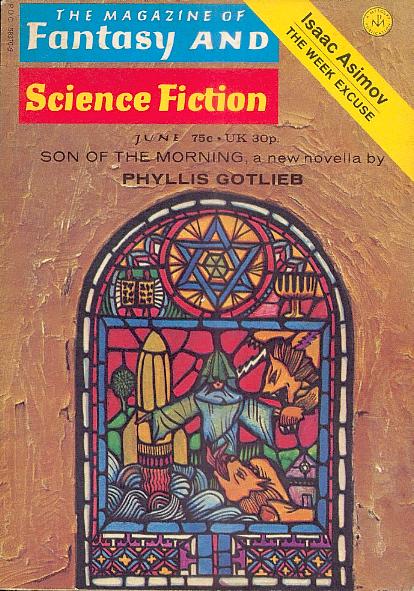
"Sad Screenwriter Sam" vs. "Sad Solarian Screenwriter Sam" by Frederik Pohl

https://www.isfdb.org/wiki/images/b/b1/FSFJUN72.jpg

First appeared in Edward L. Ferman's F&SF.

Summary:

Sam is a screenwriter. After the discovery of the Martians, he wants to capitalize on this and make a new movie, which is essentially Edgar Rice Burroughs' Mars. He has to get past his agent's and director's reluctance to sell it.


Discussion with Spoilers:

All is for naught. The aliens look nothing like those of the real Martians once the photos come out--more like seals. They can't even be made sexy.

Like Pohl's tribute to Doc Smith in "The High Test" or to Jack Williamson in "The Mayor of Mare Tranq," here is a tribute here to Burroughs--the popular appeal, its power. But also it bears a critique to the aliens in Burroughs' Mars, their realistic possibilities (perceived, of course, since we have no aliens to compare to).

Side-bar: This story may prove interesting to compare and contrast against Geoff Ryman's "The Film-makers of Mars" (audio link).

What's interesting about the story's appearance in the novel, The Day the Martians Came, is that the story is streamlined just to this bit of narrative, which is interesting but not necessarily profound. What it loses in profundity, it gains in a smoother narrative that works better in this novel atmosphere.

This spurred me to speculate that this may have been Pohl's original core of the story--a narrative he found compelling, but missing the necessary piece to elevate it from the ordinary. Here it is one example among several of the impact of species of creatures that impacts without ever having set foot on planet Earth, as yet. A rather intriguing prospect in that light.

While we don't other possibilities that Pohl may have tried, we do have the original publication, which has our protagonist, Sam, being studied by aliens who will use his character to decide whether humans are worth saving or destroying. Once our alien protagonist knows Sam and his fellow Earth inhabitants are doomed, he wants a different Earthling to examine, but he cannot. Earth is doomed. 

But the interesting bit is that the death ray won't arrive for 64,000 years. (If that information that was beamed to them also took 64,000 years, then that would mean Earth has 128,000 years to prepare after Sam's departure. So a story that began, announcing humanity's doom actually ends in the possibility of hope. This is fascinating, but it does bog the narrative down.

One suspects that this core of the story was looking for another part to give it significance. The original is in some sense the more powerful, but also perhaps a swamp of narrative.

While the great-aliens (who seem to be in the same galaxy but maybe on the opposite side) part of the story seems not to be wholly lost. It survives in a few conspiratorial mentions. See the comments on the story "Saucery" for more on this.


For links to other stories in this series/novel and comments on the novel they make, follow this link. 

Wednesday, April 17, 2024

"The Day After the Day the Martians Came" or "The Day the Martians Came" by Frederik Pohl

https://www.isfdb.org/wiki/images/7/76/DAVI1967.jpg

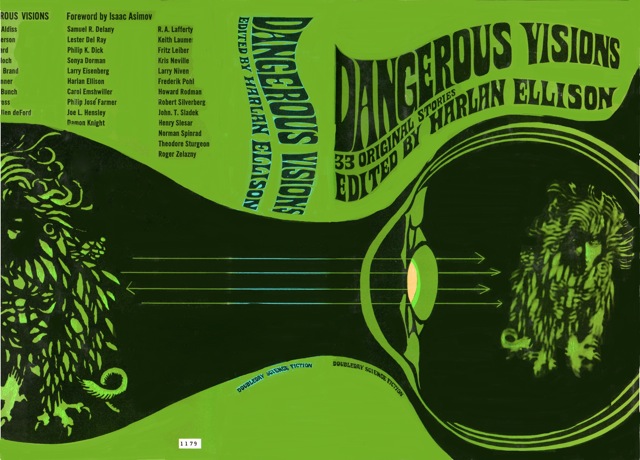
First appeared in Harlan Ellison's Dangerous Visions. Reprinted by Rich Jones, Richard L. Roe. Both Lester del Rey and James Frenkel thought this one of Pohl's best.


Summary:

A deceptively simple tale of a hotel manager, Mandala, and Ernest, the bell captain on the day after the aliens came as people joke about the arrival of the new aliens found on Mars.


Discussion:
Ernest, an African American, is grateful for the jokes about the aliens so that he's no longer the target.

While not speculatively inventive, the story may be one of Pohl's better velocity exercises as the length supports the story told here.

While this works as a short story, it may come as some surprise that it spawned a story-suite/fix-up, The Day the Martians Came. The second title seems to be what the story goes by after the first appearance. But the first may be the better selection. It suggests the after effects of a big event. The ripples of such an event. This latter choice emphasizes the theme here, so it's a bit of surprise that the story takes on the lesser secondary title. Perhaps it has something to do with capturing the "novel" or story collection, but I suspect that readers would still connect this tale as the cornerstone of the larger work.


For links to other stories in this series/novel and comments on the novel they make, follow this link.

Saturday, April 13, 2024

"Creation Myths of the Recently Extinct" by Frederik Pohl

http://www.philsp.com/visco/Magazines/ASF/ASF_0771.jpg

 First appeared in Stanley Schmidt's Analog in the Probability Zero section. James Frenkel considered it one of Pohl's best.


Summary:

Aliens see a planet they want to get rid of all life. How do they manage to do it.


Discussion:

Where the story goes is predictable. More for the completist reader of Frederik Pohl.

The title is fantastic but strange. Whose myth is it? The aliens'? The humans'? 

If humans, it's not a creation myth but a destruction one, but how would they write it? If aliens, it's not really a creation of the species. A creation of one particular planet, true, but that's not what we generally consider a creation myth--the start of everything, usually. There's also a problem of this not feeling anything like a myth.

Perhaps even our idea of a myth will change, but that seems hard to believe if the original myths remain.

Friday, April 12, 2024

"The High Test" by Frederik Pohl

https://www.isfdb.org/wiki/images/6/63/IAS_1983_06_Burleson.jpg

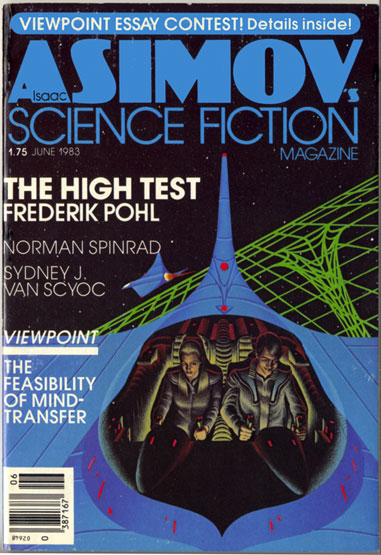
First appeared in Shawna McCarthy's Asimov's. Reprinted by Cynthia Manson and Sheila Williams. Selected by James Frenkel as one of Pohl's best.

Summary: 
Jim Paul has a doctorate, but instead of working on a planet with 80% unemployment (his degree didn't help gain employment, anyway), he goes off planet to teach the rich how to navigate their spacecraft--one a rich, spoiled brat; the other a Fomalhautian who seemed the more reasonable of the two. It turns out Jim Paul's initial readings of both students were incorrect.


Discussion:
This pairs well with Pohl's "The Mayor of Mare Tranq" and his "Sad Solarian Screenwriter Sam"--both referring to other writers as tributes, which elevate the stories somehow. Here Pohl channels E.E. "Doc" Smith, remotely--even composed Doc's own typewriter. 

It has touches of Doc with the mundane love story and the aliens injected into this larger scope that feels significant yet light and domestic at the same time. Pohl makes it his own--leaning on the informal voice in these letters to home and the lighter aspects of the narrative so the significance is buried. 

While not a major story, it has charm.

Friday, February 24, 2023

"Beyond Lies the Wub" by Philip K. Dick

https://www.isfdb.org/wiki/images/b/bf/PLANETJUL1952.jpg

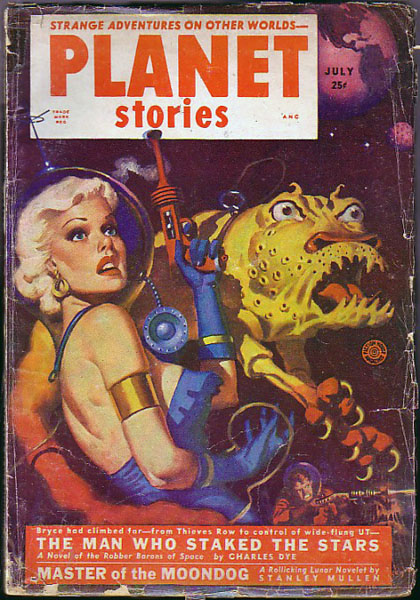
First appeared in Jack O'Sullivan's Planet Stories, reprinted by Robert Silverberg, Malcolm Edwards, Martin H. Greenberg, Damon Knight, Joseph D. Olander, Peter Davison, Susan Price, Stefan Dziemianowicz, Robert Weinberg, D. E. Wittkower, John Gregory Betancourt,  Ann VanderMeer, Jeff VanderMeer, Peter Ross.

A human crew collect their things readying to exit the planet. One has purchased a 400 lb. wub, a creature which  looks like a pig, presumably larger than a man at that mass. The natives respect the creature, but the humans--at least some of them--see it as a source of food. Even finding out the wub can read minds does not seem to deter the ship captain's appetite.

Analysis (with Spoilers)

The first reprinting of this story nearly two decades later was in Dick's own collection, The Preserving Machine. Perhaps an apt title. No one seems to have thought it demanded a second look when it first arrived. 

Robert Silverberg was the first editor to reprint it, twenty years later for his Alpha anthology, aimed at showcasing what SF he considered "literary"--a term which seems to mean different things to different people. Since Dick's story isn't necessarily highly evocative prose or rich characterizations, he must mean stories that provoke thought, which this certainly does do.

Dick's comment on "Roog" would probably apply here: "each creature view[s] the world differently from all other creatures." I will add more of his comment after I find my copy of Dick's collection.

What happens at the end of the penultimate section is vaguely worded and a little unclear. One possibility lies in the the wub's allusions to two major works of literature: the Bible (Jesus driving out demons that have possessed a herd of pigs) and the Odyssey (Circe transforming sailors into pigs)--the parentheticals are presumably the parts of the story Dick's is alluding to.

This possibility suggests that when the captain looks into the wub's eyes, he becomes the wub and vice versa. Or maybe, as the Vandermeers suggest, eating the wub makes one the "wub." This seems a strong possibility due to the allusions.

However, the other possibility is that the wub controls the captain as it did earlier, freezing the captain. So that the captain shoots himself. The wub assumes the role of captain and serves the former captain as dinner. This seems a good possibility because of the wub's early mind-control, the wub's discussion of sacrificing other members of the crew to eat, the vaguely worded "meat," and the reactions of the crew not wanting to eat the meat, due to cannibalism. Presumably if eating the meat made them "wub," at least a few others would have dug into the wub meat for supper becoming wub. But would they treat the pig as captain? Or is it controlling them to make them think of his as captain? The thing is that if the wub transfers from one creature to another, the alien probably wouldn't be a wub, but some other creature, originally, and there'd be no reason to "respect" the wub, necessarily.

The title seems to suggest that the wub is or will exist in the future or their future--physically or otherwise. Whatever's going on, the captain or the wub seems perfectly affable and chatty about the situation. In rereading, one wonders about what the native "respect" for the wub entails.

Wednesday, February 15, 2023

"Roog" by Philip K. Dick

https://www.isfdb.org/wiki/images/2/26/FSFFeb1953.jpg

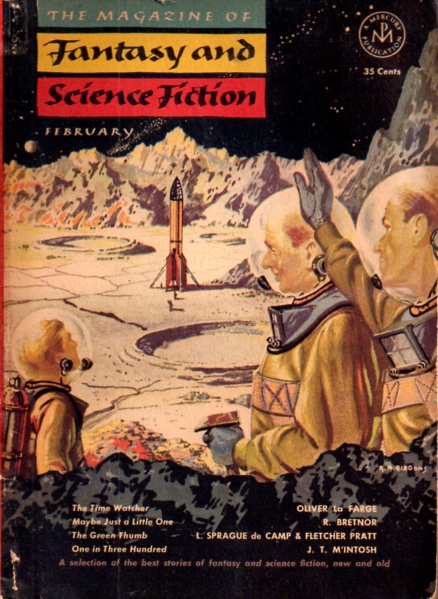
First appeared in F&SF. Reprinted by Anthony Boucher, J. Francis McComas,  Robert Silverberg, John M. Landsberg, Jonathan Ostrowsky-Lantz, Jack Dann, Gardner Dozois, Stefan Dziemianowicz, Martin H. Greenberg, Robert Weinberg.

This was Philip K. Dick's first accepted story, but not his first published. It tells of a dog who can see aliens as garbage men.

Discussion (with minor spoilers):

While not a classic, this is utterly charming. Part of it is the perfect name for the alien which sounds a bit like how a dog might sound, barking.

What's fascinating is a debate with the famed editor Judith Merrill over the story (a debate which you cam read about over here). She thought that the description of the aliens did not match the garbage-men she'd seen. This is the kind of debate that sidetracks a lot of literal-minded fans and editors and critics. Myself included. 

Even Dick is mostly persuaded by Merrill's argument that he have lost sight of his own story. He calls it a fantasy through the dog's point of view. It could be. A realistic tale of a dog who thinks garbage men are aliens. But there are other possibilities--more interesting ones.

That's the key: Whose POV is it? It's probably not the dog's. Maybe, but probably not. Was the dog there to witness all events? Maybe? Certainly not the humans--at least not these humans since they don't seem to know what's going on (perhaps humans in a post-human-Earth era?). Maybe the aliens, but they don't seem to be there to witness everything as well.

Perhaps it is simply an omniscient narrator. The aliens, if real, admit what they're doing. They're making the dogs or Guardians seem like deluded creatures. Maybe they are. 

Or maybe the aliens are deluded into thinking the dog see them. Maybe the dogs don't see the aliens as aliens at all.

But again maybe the dogs do. Maybe they are masked and dogs can see through the disguise.

What the aliens are up to, isn't clear. Are they just after trash? Why is it an "offering urn" and why do they eat it? Do they consider themselves gods? Or do they offer it to other gods, carrying it in a blanket? Whatever is going on, it sounds sinister. And once they clear out the dogs, they will be able to execute that plan.

Thursday, July 15, 2021

"Stolen Sky" by Storm Humbert

Appeared in Writers of the Future 36, edited by David Farland.

A yelvani witnesses the sunsets of other planets on the mezzanine on Earth-Vega. Whichever alien is performing that night seems to get a sky designed to mimick its homeworld. The yelvani goes to interview each alien giving a performance.

Comment with some spoilery bits:
The story draws some of its resonance off what may be Margaret St. Clair's most famous story "Brightness Falls from the Air" (also discussed here). Both mine similar territory.

It might be useful to compare to see where the classic succeeds. In that one, we have a protagonist who has something to learn. Here, the protagonist has something to learn, but not about herself. As the above description suggests, she doesn't have goals. Since it isn't her planet, that they don't capture her sky isn't the real problem. One could say that it is a symbol of the real problem. 

The real problem is that her home world has been taken over. Maybe she's okay with this. Maybe she's cool with living with alien species. She seems attracted to the human aliens, too. But the real problem is not having an identity in herself or in her people. Perhaps she enjoys a mix or prefers the human culture, but she'd still have her own identity. What drew her to this planet? What drew her to interview the aliens? What drew to being attracted to humans? She sounds like an ex-pat--as such, she'd feel like an outsider to all cultures yet be fascinated by them all. We just need to see more of her and her passion, whatever that may be. 

Incidentally, sunsets will be affected by a number of factors: gravity (which dictates how much and how thick the atmosphere is there), air composition (which dictates how light gets bent and absorbed) and objects floating in the air (like clouds which may be lit and/or bend light as well. That humans are unable to correctly simulate sunsets means that they are not a super-advanced civilization. Given the above elements, it would require a major planetary overhaul that couldn't happen overnight--certainly not without disturbing the inhabitants, so the sky likely a simulation--a local light show--so the sky becomes less of an actual problem.

The story has imaginative strength, resonance, and, given the set-up, a good punch in the end. Storm Humbert's work has appeared in Apex and Interzone (see website for links).

Wednesday, June 23, 2021

A Word That Means Everything by Andy Dibble

Appeared in Writers of the Future 36, edited by David Farland.

On the planet Murk, Pius is trying to translate scripture into a language for the Thulhu, aliens with tentacles and vestigial wings--aliens that look a lot like Lovecraft's creatures of Cthulhu. His first challenge is even to get them to respond to him. Translating the Judeo-Christian scripture into something these creatures can understand is proving nigh impossible.

Suddenly, Pius's slow and modest success is interrupted by a famous translator, David Nestor, sent to replace Pius.


Comment with some spoilery bits:

This tale of religion and language treads similar ground as Ted Chiang, James Blish and Mary Doria Russell--some august company to keep.

It's hard to tell what what Dibble's theological perspective might be, but he is clearly knowledgeable of his subject matter. People think they can deviate anywhere with a theology and proceed to make rookie mistakes, but deviations within a theology occurs within certain boundaries and Dibble seems keenly aware of those boundaries, aware of where he can play. It's stunning. Even on a second read, I'm just as hooked as the first. 

The language issues seem very genuine as if Dibble is equally skilled at languages, too, although I suspect it would be hard to begin the process of any language if your alien won't communicate (an issue I didn't think about until I was combing over it on a third read to pick at the story with a lens and tweezers).

Least probable are the aliens. I suppose one could say, given the vastness of the universe, anything is likely to occur. But a creature whose primary locomotion is water based (water propulsion and tentacles) is probably not going to have vestigial wings. Of course, there are flying fish, but these occurred with fish who leap out of the water, which an octopus is unlikely to do.

Of course, the whole point of the story is to ask what it would be like to communicate the concept God to a Lovecraftian creature. So in a sense, this alien biology critique is nitpicking.

Dibble's style is very Asimovian and it works well at this length. The density of philosophical or linguistic discussion--while almost pure joy--is a workout, and might tire out a reader at novel length unless it were specifically designed as a novel of short stories or novelettes, so that the reader can exercise, then rest on the side of the pool before leaping forward.

With impeccable timing Dibble throws the monkey wrench of David Nestor into the story which enriches and gives Pius a new challenge.

While all of these writers are a pleasure to discover, Dibble provides an old-school (or a Ted Chiang sensibility, if you prefer), uncommon level of speculation  As Dibble's craft improves, this writer might be the discovery of the decade.

The author has appeared multiple times in Sci Phi Journal

Sunday, June 13, 2021

Alien III by William Gibson

What happens when you cross a popular SF movie franchise with a popular SF writer? That's the question here when William Gibson was handed the writing reins of the second sequel--a version ultimately abandoned by the moviemakers. Apparently, Gibson gave this two runs, styling each draft after the first and second movies. Neither accepted.. 

It was floating around the Internet for decades and you can still find it. The popularity of both writer and franchise has created the unusual phenomenon of having a script that was rejected having been made into a comic, an audio drama, and even a novelization by Pat Cadigan.

Another reason this version appeals to fans is that it offers an alternative to the actual Alien3. The first three movies are ranked by IMDB fans as 8.4, 8.3 and 6.5, respectively--a substantial drop. 

This post is more of a place-holder I hope to revisit the series and compare the two versions. My feeling upon listening to the Audible drama is that it is firmly a part of the series. Most series, for me, melt into one another. Individually, some movies may surpass others, but they have an overall leavening. 

For instance, some feel that Aliens was superior to Alien, but any achievement that the second movie had rested, in part, on the inventiveness of its predecessor. It seems a strong addition to the series, but again the invention was in prior films. The movies are hitched. Perhaps as separate entities, the movies might have been greater success or failures, but together they become somewhat uniform like a thematic or sonic concept album like Pink Floyd's The Wall or The Cure's Disintegration. Though some songs may be better than others, the album succeeds or fails based more on its entirety. Likewise, a series like Star Wars has weathered failures due to the initial successful movies pulling the franchise and fans into new iterations.

This offering did not seem exceptionally more inventive than other offerings, but I'd need to rewatch the first and second, and then compare. Perhaps it would have been the boost the series needed. After all, IMDB lists the audio as ranking with the second film.

If you're a fan of the series, you owe it to yourself to check it out.

Wednesday, February 24, 2021

Resident Alien

SyFy Channel's Resident Alien, so far, seems worth seeking out. After viewing the trailer for this I set the DVR--a little humor, a little SF, a little mystery.


The first episode was chockful of juggled balls . The second dipped, but the third and fourth bobbed back up (IMDB viewers seemed to agree on a slight dip, but they also dipped on #3, which I did not).

Note: If you like zero discussion of shows you haven't seen, stop reading and go watch. No spoilers here, really--well, not exactly.

The amazing thing is how Alan Tudyk had to die again although this death allows him to play his role. He does a good job, usually, of mimicking what his alien counterpart: a crash-landed alien who has to pretend to be a human doctor in order to collect parts while relatively unnoticed. What's well done here is in what directions his expertise might lie. What requires some hand-wavium is his ability to look up what he needs on the internet.

One kid, Judah Prehn's Max, recognizes him for what he is. Given how the alien adapted, this also requires hand-wavium. While their relationship kicks off well and takes a surprising darkly comedic turn, it doesn't really kick in until Max takes action.

Sara Tomko and Alice Wetterlund are highlights--their freewheeling humor. Their characters' daunting task is to make Alan's alien somehow human. Sara's task seems even larger given her closeness to the alien at work and the embarrassment he causes, but her acceptance of him only serves to make her more endearing. The humor went darker than I expected, and the uncovering of a mystery, so far, is limited. It's more SF than mystery. So far. But there's plenty to enjoy. I do worry that they'll set up a second season without ending this one first. So far, it only seems to be enough for one season's drama. Possibly more. Hopefully it will some sense of closure before tacking on a second season. However, maybe by the end, I'll be persuaded otherwise.

Wednesday, February 12, 2020

“The Fellow who Married the Maxill Girl” by Ward Moor

First appeared in F&SF and was reprinted by Judith Merril, Robert P. Mills, Isaac Asimov & Martin H. Greenberg,  and Ellen Datlow. Read online here.

Summary:
 “The Fellow who Married the Maxill Girl” is a great folksy title summarizing how Nan’s town, Henryton, might have summarized it: Some unknown chap marries into THE Maxill clan. Nan is considered wild (caught necking in two different cars with two different boys though she hadn’t been caught with the others) and she later considers her young self to have been something similar. Maxill name carried some notoriety since the father, Malcolm Maxill, bought a lousy farm to be a bootlegger. None respect him or his farm.

One day a man with eight fingers, Ash, visits and can only hum—his only means of communication. The girls want to keep. He doesn’t eat much although he seems incapable of doing chores. What he can do is heal birthmarks, orchard trees, and crops so that suddenly people start paying attention to Malcolm.

Commentary with Spoilers:

Nan and Ash learn each other’s language and marry and even have a child although she want more. Malcolm schemes for greater things but dies in a freeway accident. They decide to let Ash and Nan continue to run the farm and raise the rest of the girls and their own son. The farm continues to prosper. As Nan ages she notices Ash does not, and she worries. When his people call him back as he is needed, he goes although a word from her would have stopped him. She is sure that the farm will collapse but she suddenly seems to have acquired Ash’s skill.


A disappointing ending since it wasn’t prepared for, but otherwise a strong piece. Moore can compress time admirably when it comes to events, but when he tries to relate many emotions or convey imaginings about what her society might do (which may be true but no evidence is provided), it falls flat. 

Worth reading, especially since it carries more voice than most of his stories usually give.

Wednesday, January 15, 2020

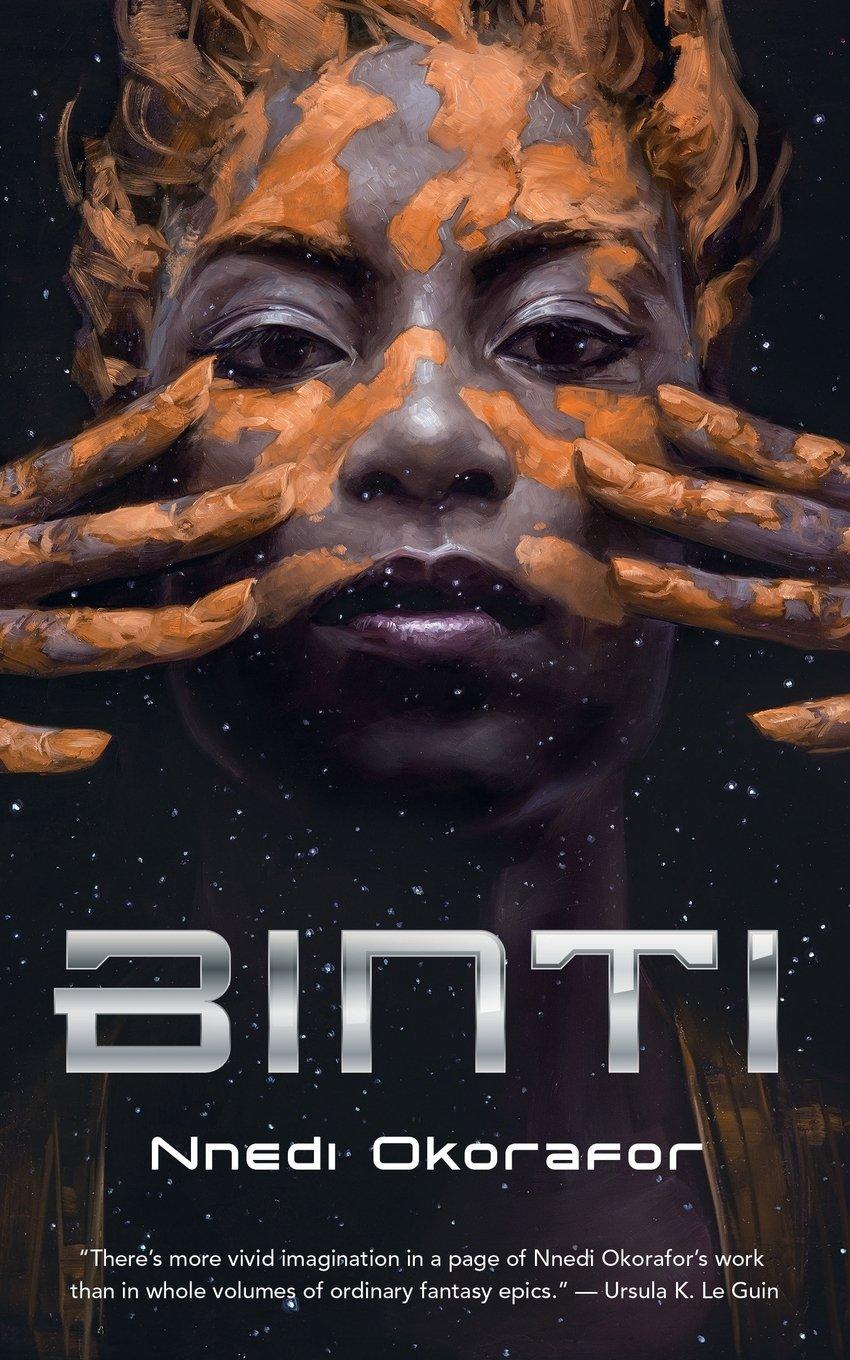
Binti by Nnedi Okorafor


This first appeared at Tor.com. It won the Nebula, NOMMO and Hugo awards and was up for the Locus and was reprinted by Paula Guran, Julie E. Czerneda. It will be produced by Hulu as a series.

Note: I commented on her use and others' uses of “force field” here, which has more to do with science than the quality of the work.

            Summary

See the source imageBinti has received a scholarship to go to the prestigious Oomza University, off-planet. Her family and friends try to discourage her as this is not the way of the Himba people. She is expected to carry on her father’s business, but instead a strong desire to learn pulses through Binti, which is why she applied in secret.

Shortly after she befriends her future colleagues headed to school with her on the spaceship, the ship is attacked and only Binti holds the key that help create peace between two long warring peoples. Her life and the lives of the fellow humans and Meduse—translucent and tentacled aliens.

            Commentary with Spoilers

The story is speculatively and culturally rich. The Himba with their isolated and mystical-scientific ways, the Meduse, the astrolabe, treeing, the edan. It doesn’t over- or undersaturate the story (although a few readers new to SF might be put off if they aren’t willing to stick with the estrangement). There’s nothing simple about these as some speculations grow to have more significance or unforeseen uses.

Binti is a sufficiently characterized and sympathetic. We care about her struggles with her family and the Medusae as well as the newness of the experience of going to university.

The best scenes are surprisingly, intensely and virtuosically held in a small room as Binti negotiates with aliens who have just wiped out the ship (as far as she knows), as she navigates her edan which becomes no longer an ancient tool, and as she consumes the last of her food.

Plot questions linger. For instance, if the Medusae are such a threat, why aren’t they anticipated? Why don’t Khoush see their enemies coming? Why isn’t there more grief over the loss of so many? Does the University not care? Why isn’t there at least a little more resistance to peace due to this? Binti is supposed to be a harmonizer, but it isn’t clear what she has done personally to facilitate this peace.

The telling is spare, which is smooth and largely pleasurable, but at times too spare. Sometimes she notices things (like food when the Medusae are their most threatening), and sometimes she doesn’t when she should. Being stuck in her room for a long period should cause her to study environs a little more closely. The Himba may not be good observers, but with her intelligence and the newness of her world, she should probably be engaging a little more with what she interacts with. This doesn’t mean tedious or pointless details but simply more.

The prose style has a curious threading where it comes around to the same thing and treats it again and again--for instance, the death of her classmates and her interactions with family and friends prior to leaving. The retreading of the same events would make sense in the case PTSD, yet the importance of her new friends’ deaths seems to disappear, so she seems to have recovered quickly, which might make sense depending on her personality, culture, and perhaps more tentative or superficial relationships with her new friends. It may be that these humans have less concern about lives lost in the past (vs. lives that could be lost), even if relatively recent.

Some of these plot questions and stylistic choices may be answered if this were cut from what was always intended as a novel. The opening and ending suggest as much since they don’t contribute to furthering the core of the novella but may unpack within the novel. The narrative is compelling enough to read further: to deepen our understanding of Binti, her people, the Khoush, the Medusae, treeing, and the edan (not to mention whatever the university has to teach).

Friday, December 29, 2017

"Hunter Lake" by Gene Wolfe

First appeared in Gordon Van Gelder's F&SF. Reprinted by Stephen Jones. 
Summary:
Mother (Susan) and daughter (Ettie) search for Hunter Lake, which is said to be haunted--whether because Native Americans tortured or were tortured is left unclear (see below). They travel down a scant trail to find their guide. They don't find him, but they do find the lake.

Discussion:
Their guide doesn't appear, but the water begins to rise. They've heard creepy stories about the lake being the hunter (although a hunter was also said to have found the lake), so Ettie runs, losing a loafer. The mother at first thinks it is a tidal phenomenon but catches her daughter's fear and flees behind her, with the lake in pursuit.

Tides can be a little creepy. (See video.) However, they can't chase someone dashing up a hillside. And this is a lake, not an ocean, which has a lot more water. Tides redistribute earth's water due to the gravitational pull of the moon. So water from other parts of the ocean are piling up on the near and far side of where the moon is.

They find a cabin that Susan initially takes as their own, but it is white clapboard, not log. Susan takes stuffing the cracks with clothes while Ettie decides to wake up from her dream.

It turns out Henrietta (Ettie?) has a daughter, Joan, who knows that her grandmother died from fluid in her lungs.

Some of the strangenesses of the tale:

  1. It was all a dream: Ettie/Henrietta wakes up. This is supposed to be a big narrative no-no. But it creates a somewhat interesting scenario. Ettie recognizes this is a dream early on. However, most of the logic seems fairly straight-forward except for the lake. That Ettie recognizes this is a dream but Susan does not, seems like it should be important. However, it is hard to say what exactly that means. Does Susan have a flawed personality that Ettie does not? The text doesn't really support a strong case although maybe Ettie has a stronger dose of reality. But isn't it Ettie that creates the fear of the lake in the first place?
  2. Dual POV: This allows us to inhabit both consciousnesses--Susan and Ettie. This is possible through the dream. Is it necessary? It does allow us to examine and compare each POV. Clearly, Ettie's is the preferred perspective since she is the survivor. Yet Susan seems to be the cooler and more reasoning head. Somehow she never see this is a dream. Should Ettie have stuck around to convince Susan to wake up? Or maybe it is only Ettie's dream, so that only she can wake up. If the latter, why pick a Dual POV? Maybe it is just for contrivance to create an old-fashioned flavor.
  3. Present-day dream leaps into the future: The main body of the story feels contemporary to its writing, discussing internet and rabbit-ear TV being outdated. But what we thought was the present day becomes a dream of a distant past--presumably at least twenty years into the future where Henrietta has a daughter of her own. Henrietta is rather old-fashioned name to begin with. By 1970, it had fallen out of the top 1000. (By 1956, the top 500; its heyday seeming to be from the 1900s through the 1920s.) So even the name juxtaposed against the internet makes the story have a dreamlike or asynchronous reality.
  4. Is this supernatural or science fiction?: One might assume this is a tale of horror/fantasy, but it was included in Wolfe's science fiction collection. Was he just toying with us? Or is the lake a reality, an alien visitor? If so, how did Ettie manage to survive? Why did it select to kill Susan and not Ettie?

Saturday, April 22, 2017

"The Examination" by Felix C. Gotschalk

First appeared in Robert Silverberg's New Dimensions IV. Reprinted by Harvey A. Katz, Martin H. Greenberg & Patricia S. Warrick, and Robert Silverberg. It was one of the stories that prompted his nomination for the John W. Campbell award for New Writers.

Summary:
A psychologist interviews a seemingly slow-witted eight-year-old African American girl in order to assess her intelligence. As they progress, her command of language keeps surprising him. She not only scores well at her age range, but also higher. And higher.

The tables get turned.
Discussion with Spoilers:
As she scores well even for an intelligent adult, her voice loses its homespun pronunciations. She sounds more and more like a machine until she announces she's an alien and that she is conducting an examination of his and his species' intelligence.

He attempts to communicate with the secretary outside the office to escape, but she foils the plot. She says she is adaptable, mold-able, and impossible to destroy. She asks questions about him and these tests. When liberators arrive at the door, she warns him not to divulge her identity as she now looks like a girl to them. Nonetheless, he announces she's an alien with all the details, and police officers cart him away.

The words they select in the examination have some parallel to his thoughts and their discussion, cleverly commenting on the surrounding text. In fact, the whole tale is pleasurable apart from the too-easy ending. It offers a critique of current intelligence assessments although it offers no alternatives.


Sunday, February 26, 2017

Arrival: Movie Review + Commentary/Analysis


Review:
This story, an adaptation of Ted Chiang's ("Story of Your Life" discussed here), follows the original fairly closely.
The movie opens with Louise Banks reminiscing on the life and death of her daughter. Then it cuts to her attempting to give a college lecture while most students are focused on the news of twelve space ships arriving. Col. Weber comes to recruit her. She demands to be taken to the aliens to interact with them. At first they refuse until they see she is the better candidate.

At first, they meet failure until she starts to communicate with written language and gets them to do the same. Twelve other countries initially do the same until they receive a message from the aliens that gears them up for war. Ms. Banks must learn the language and try to find a way around the inevitable showdown.

This movie is worth your time. The opening could have been slimmed down, and it is not an action film, but definitely worth your time. A moving piece that opens your head to new ways of thinking.

Commentary with Spoilers:
And lo, Banks sees answers to the questions she has in her future as bits of understanding finally fall into place. She sees herself lecture on the meaning of the terms and receives future private messages from the war instigator.

Chiang's written version has an immediate advantage over the film due to its verb tenses. The past is presented in past tense, future in future tense. This clarifies events from what is happening in time (although the scenes don't necessarily tip their hand until the last third or so). The movie does open with the reminiscence so that the clarity of flashbacks works there, but due to its form (and lack of verb tenses), the next flashback should have been pushed back to Banks's first interpretation of the language and surprise her with a flashforward. Otherwise, it was technically sound.

The movie's unusual feature is shots of ceilings. This clever shot prepares us for the reorientation we are about to feel--not just in the scene on the space ship where sideways becomes the new down--but overall, when time itself becomes reoriented into a continuum to be experienced at once. Banks also walks on clouds in a climactic scene with the aliens.

Clouds seem critical, as well, although I haven't yet pinpointed how they service the story. The cloudiness of time? of the future? They come upon the aliens through a fog bank (humans are in a fog? but no, the alien tank is full of clouds). Maybe its just the dwelling/acceptance of uncertainty. But if you know the future, surely it is no longer uncertain.

The quote below is not random. It fits into the film's theme. War is misinterpreted by one interpreter, and will be again later... although it could be said that "a desire for more cows" is the perfect incitement to war if cows are considered one's prime monetary system.

The movie may succeed over its predecessor in the degree of its involvement with the future child, to invest us in her welfare, so that her passing and life becomes more moving.

One thing the aliens and protagonist seemed to suggest was that the entire Earth would soon possess this sense of time once they grasped how to interpret the language. Banks's future husband, Ian, however, apparently does not possess the inevitability of time and the ability to relish the time that exists with family members as he divorces her once he learns of his child's inevitable demise. One might think that he would be one of the first to learn it. He does not, presumably.

Some of Chiang's ideas are lost from the original: notably, Fermat's Principle of Least Time (see link above). I'm not sure if the concept could have easily been displayed in a film format. And little seems to have been lost due to its disappearance (yes, it explains the primary reason for arriving at its conclusion, but we arrive, anyway). Unfortunately, the loss does erode Ian's role somewhat.

While "Story of Your Life" is clever in that it could apply to the baby or the reader, "Arrival" plays a nice double entendre: the arrival of aliens and the arrival of the baby.
Quote:
Dr. Louise Banks: Colonel?
Colonel Weber: [Answering a previous question about the Sanskrit word for war and it's meaning] Gravisti.
Dr. Louise Banks: That's the word but what did he say it means?
Colonel Weber: He said it means an argument. What does it really mean?
Dr. Louise Banks: A desire for more cows.

Friday, February 24, 2017

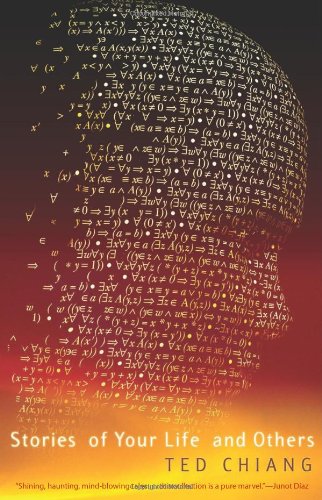
"Story of Your Life" by Ted Chiang

First appeared in Patrick Nielsen Hayden's Starlight 2. This won the Nebula, Seiun, and Sturgeon awards. It was up for the Hugo, Tiptree, Locus, and Homer awards and was reprinted by Gardner Dozois (twice), Robert Silverberg, David G. Hartwell, John Joseph Adams, Ann VanderMeer, and Jeff VanderMeer.

Summary:
Aliens arrive and the military (via Colonel Weber) hire Louise Banks to do the translating. She succeeds.... perhaps too well.

Meanwhile, interspersed with the alien narrative is Banks addressing her child in the future tense discussing memories. The point of these sections is a spoiler.
Commentary with Spoilers:
When I first read Chiang, I read him wrong. I kept expecting something that he wasn't doing. Chiang is old-school SF. He squeezes all he can out of an idea.

Here the idea is language:  What if you could read a language, not sequentially, but wholly at once? The shape of the aliens--not bilateral like us, which caused us to read sequentially, Chiang's story hypothesizes--is radial symmetry (that is, the same all the way around). So their language absorbs all information from the past, present and future. This in turn shapes their thinking so that they actually perceive future and past simultaneously.

When Banks grasps this, her brain alters so that she can perceive the future and the future child it contains--a child who will die. This is emotionally poignant--one of Chiang's more powerful works.

Chiang's idea rests, in part, on the Sapir-Whorf hypothesis that states language shapes the mind. This notion was discredited, but has reemerged with new nuances. Here are one and two articles from Scientific American that suggest that words can at least sharpen our awareness to what can be observed. This is SF, after all. It's aim is to get you think, not necessarily describe the universe perfectly. Who knows? Maybe a language will get us to grasp the universe in completely different terms.

When Colonel Weber arrives, the narrative is uncannily familiar. It took a minute to recall that it rang of the opening to Samuel Delany's Babel-17. No doubt this is an homage to Delany's own investigation into Sapir-Whorf.

The original idea that inspired Chiang's story is Fermat's principle of least time. Normally, in physics, we say that light travels in a direction at the speed of light until it hits a new medium where it slows a changes direction. Fermat suggested that light (as if it had agency of its own) arrives at its destination because it is the fastest route to get there, not a straight line, because it can travel faster in the first medium than the second. The way this applies to your own life might be traveling on the interstate as far as you can before entering city streets. You might overshoot your destination if you didn't have drive as long on the slower city streets. To see how this applies to the story in question, see quote below.
Quote:
"[T]he ray of light has to know where it will ultimately end up before it can choose the direction to begin moving in." 

Wednesday, May 4, 2016

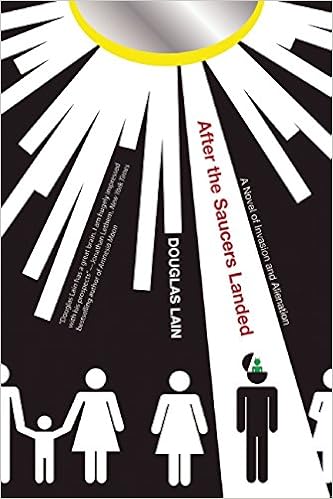
Review: After the Saucers Landed by Douglas Lain

What would a book read like if Connie Willis chose to write a Philip-K.-Dick style of novel? Probably something much like After the Saucers Landed by Douglas Lain. Appropriately enough, it was a finalist for the Philip K. Dick award, but maybe it should have landed on other award ballots as well. How many books change when you reread them? You read the same words both times, but you realize something else entirely is going on.


The protagonist, a popular UFO writer and professor, traverses the seventies to the nineties. Before the aliens land, he is a laughing stock among his colleagues. He does find refuge in his wife, Virginia. After the aliens, he is more respected, but he suspects that the identities of his wife--the woman he thought of as his wife--is really an alien, Asket. Asket has also been wife to other friends. She slips into and out of human identities so convincingly that even our protagonist is unsure, requiring the mall security to throw him out of its establishment.

Identity is the core issue here, explored in a subdued Dick fashion. Dick might have escalated the events to a fever pitch. But that is not the story here, which makes the novel in some ways more sinister. Things do and don't escalate. Events the should have escalated in the proper Fifties paranoid fashion, don't. You read one story by the novel's end, but as you turn back to page one and reread, you suspect that that explanation of events is not good enough.

It may take time before Lain's accomplishment here is recognized. After all, the novel begs to be read twice. On my first read, I'd have given the book four stars, but how could I not give five stars to a book that rewrites itself? If there are better books this year, it'll be one heck of a year for literature in deed.