Search This Blog

Showing posts with label capitalism. Show all posts

Saturday, March 9, 2024

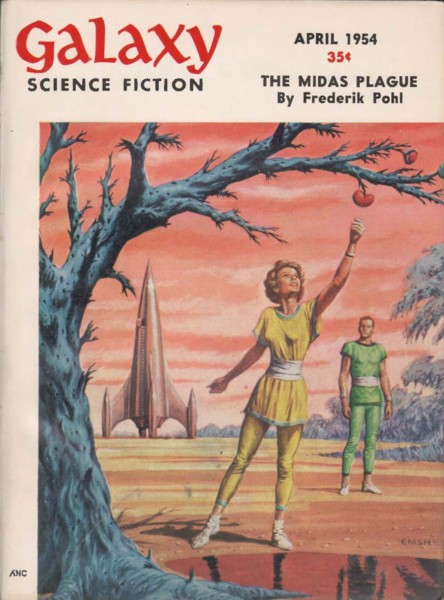
"Midas Plague" by Frederik Pohl

https://www.isfdb.org/wiki/images/7/7e/MLO4331.jpg

Originally appeared in H. L. Gold's Galaxy. Reprinted in several major retrospectives, by such editors as Arthur O. Lewis, Jr., Ben Bova, Gregory Fitz Gerald, Brian W. Aldiss, Kingsley Amis, Robert Conquest,  Isaac Asimov, Martin H. Greenberg, Charles G. Waugh. Lester Del Rey selected it as one of Pohl's best.


Summary:

The "Midas" world is one where energy is so plentiful, that to be a good citizen means consuming more. The more one consumes, the higher one rises on the societal ladder. How does one consume ever more? If one cheats to get ahead, how does one hide their misdeeds? Surely, the evidence of their guilt

Commentary with Spoilers:

First, we should point out the famous fairy tale of Midas, who had the golden touch. Everything he touched turned to gold, making him very rich... until he touched his daughter, suggesting that greed may make us regret how it affects other parts of our lives.

Pohl takes this fairy tale and completely repurposes it. Note what the titles are for anthologies and collections it was reprinted in (he named two of them): American Utopias, Nightmare Age, The Case Against Tomorrow. Now some seem to suggest he does not mean the world he proposes, but the subtitle of Nightmare Age--"Tomorrows... we may be building today!" suggests that his aim seems utterly realistic. I also like that someone thought this deserved a place among utopias, not dystopias.

There's some truth here, but of course it's exaggerated for effect. The coolest thing about this short work is that what starts as a dystopia ends as a kind of utopia. It looks like doom for our hero who at first tries to make it through honesty and is forced by unsavory characters who trick his wife into forcing the couple into having to consume more. So he has to cheat, using robots to help him achieve this end. As he's hailed as a hero of consumption, the noose of his getting caught is cinching around his neck... until it turns out that they knew all along what he'd been doing and were impressed, starting to employ his techniques for consumption. 

Absurd but strangely delightful. It's difficult to explain the metamorphic shift in storytelling as we learn we weren't living in the morality of the dystopia but a true if bizarre utopia. Little wonder it was listed as  one of the great short works in the history of SF.

Thursday, March 7, 2024

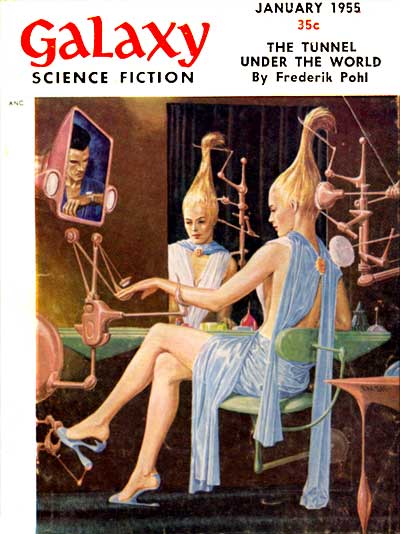
"The Tunnel under the World" by Frederik Pohl


Originally appeared in H. L. Gold's Galaxy. Reprinted in several major retrospectives, by such editors as Arnold Thompson, Brian W. Aldiss, Kingsley Amis, Susan Morris, Orson Scott Card, Tom Shippey, Isaac Asimov, Martin H. Greenberg, Brian W. Aldiss. Lester Del Rey selected it as one of Pohl's best.

Read online here.


I wrote about this earlier with a slightly different perspective here.


Summary:

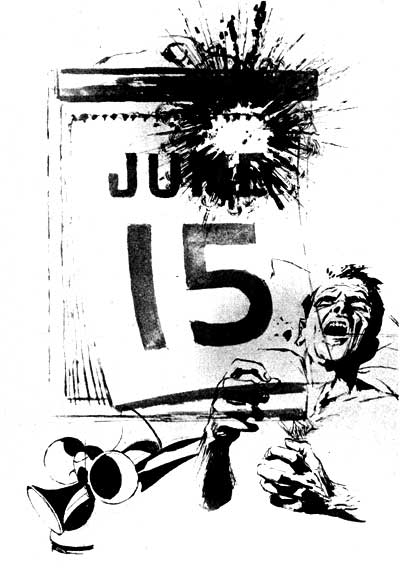
On June 15th, Guy Burckhardt wakes from a dream about an explosion, to a world that's off. One example would be a loudspeaker outside advertising "Feckle Freezers! Feckle Freezers!" repeated over and over that comes off angry, if not insane. Guy goes about his day attempting to make it as normal as possible but the oddity of existence keeps rearing its head until Guy meets someone who will help him piece together what this world is all about.


Commentary (with Spoilers--don't read this if you haven't read the story):

Guy is told that they've been asking questions about the world and it's always June 15th. Everyone remembers the June 14th explosion and keeps waking up here. He's taken to the underground tunnel where all is revealed in several frame by frame revelations. Not only are they all dead, but are tiny figures (robots) on a tabletop, part of an experiment in advertising.

If one were to limit one's self to just one Fred Pohl story, this may be it. Super cool. Comparing it to "The Midas Plague," it is half the length, but the speculation does feel more concentrated and, therefore, more awe inducing. Still "The Midas Plague" is worth reading, but this one is tight.

My only complaint is that there should feel like there's a gradual change to the changes in advertising, adapting to the subjects, so that it becomes impossible to be sure about any aspect of reality--at least that's how I'd write the movie version.

Pohl clearly has an aversion to advertising despite or because of having worked in it (see also "The Midas Plague" and The Merchants of Venus). He would have been born before the proliferation of ads and grown up with radio and catchy jingles and phrases that  people paid for to get customers to remember their products when they entered the store. It must have been jarring to move from a world where it didn't exist to emerge into a world where it did. Whereas later generations may understand where he was coming from, but accepted the ads as the price one paid to get listen to their favorite radio programs or watch TV shows. Nonetheless, our distrust and/or dislike of ads is mixed with our understanding why they exist.

But it's strange what advertising is foisted upon these people whose after-life is spent in a kind of advertising hell. There's coercive methods of ads, to what end? Perhaps they are testing out a kind of oppressive tyranny, seeing to what extremes they can press on people without making them snap.

The term "Feckle Freezer" is curious. They are frozen in time and place and thought. "Feckle" may be altered from "fickle" (erratic) or "fettle" (fitness) or "feck" (value/worth). It seems to be also have a corrupted term in Scotland suggesting one's mettle, to withstand adversity with resilience. Combing all of these definitions has a powerful effect. The sellers want to suggest one thing, but the buyers hear something else. Or maybe it's just meant as a nonsense word that is meant to suggest it has meaning. The cumulative effect is powerful.

There are a number of stories that begin questioning reality especially in the modern era, especially in the works of Philip K. Dick. Perhaps advertising, according to Pohl, is at least one root cause of our losing our grip on what reality is.