Search This Blog

Showing posts with label Albert Einstein. Show all posts

Wednesday, February 12, 2025

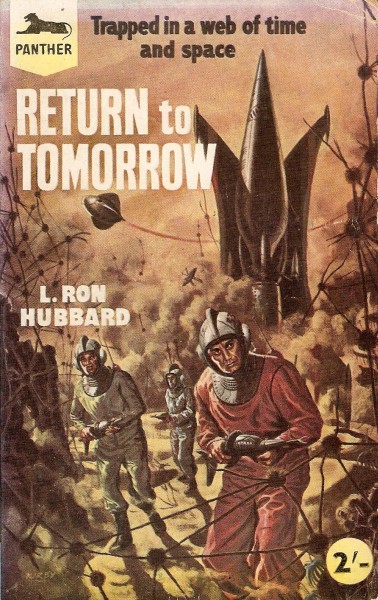
"Space Is Deep, Man": To the Stars, or Return to Tomorrow by L. Ron Hubbard

https://isfdb.org/wiki/images/7/7e/ASTFEB1950.jpg

 First appeared in John W. Campbell's Astounding. Was up for a Retro Hugo.


Somewhere far into our future, Alan Corday is in love. Despite being one of the few well educated and well bred tenth class in his day, Alan has no money to court her, so he is going to Mars to seeking his fortune. However, all that is changed when Alan has a black cat cross his path, hears piano music and steps into a packed bar that's otherwise strangely quiet, all listening intently to the music coming from the piano

In this short novel, Alan is taken on a long trip--that is, he's taken on a ship that has a distant destination. Can he get the crew to mutiny and take the ship back? Or should he just bide his time and hope his future wife is still waiting for him?

This is definitely a classic. According to the prefatory material, it was popular with readers at the time. It's easy to see why. 

The story didn't kick in until the piano scene--page 9 out of 210, about 4% in--but otherwise, it rocked. 

To compare the different titles is fascinating. Return to Tomorrow may be the more intriguing although I'm torn between which works better. It's fascinating that it underwent a transformation and returned to the original. Did the author return to his original? Or was one title forced on him?

The quote in my title is part of the opening line from the prologue, which actually says "Space is deep, Man is small and Time is his relentless enemy." As a reader and writer of poetry, I just loved the partial quote, which is perhaps too colloquial but also profound in its own way. While the prologue isn't bad and in places profound, I wonder if it hampered the tale from being more fondly remembered. After all, the story is the equal or near equal of the other works nominated.

I spent a good deal of time thinking about where it belonged in the pantheon of SF. I recently read The Time Machine by H.G. Wells, which is also known as classic (but perhaps not his best), and To the Stars hangs with Wells in scope and speculation in similar if different ways. It's true that Wells inspired what came after, but a number of space-travel-relativity stories have borrowed from this predecessor as well. Speaking of tributes, Hubbard has a tiny tribute to Tom Godwin's "The Cold Equations"--and there is a link, but perhaps more in theme than in plot.

Having recently read Frederik Pohl's best well remembered early classic, "The Tunnel Under the World," I find this hangs well with that. Arguments could be made about which is better.

Is it a must-read? I'll leave that for others to decide. Is it a classic that will repay your time? Absolutely. The reason it may not have been reprinted as heavily as some might be that it would consume half of most anthologies.

Some readers might object that women don't feature more prominently, but considering when it is written, they do play critical roles--some of whom tug at our heart although there is one I'd have liked to have seen her play a more prominent role as soon as it was clear what role she was playing although one might say the text let us imagine that role.

Highly recommended.
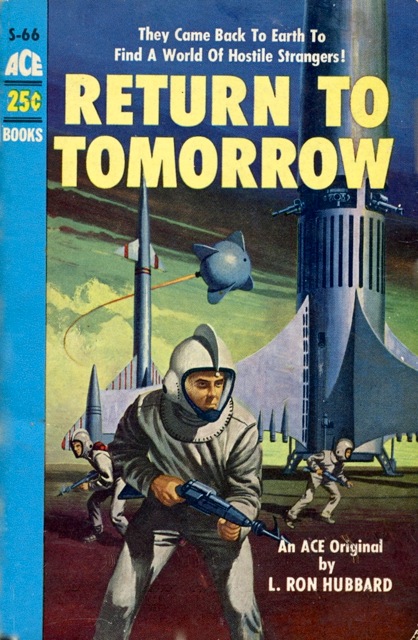
https://www.isfdb.org/wiki/images/1/1e/RTRNTTM1954.jpghttps://www.isfdb.org/wiki/images/a/ac/RTRNTTMRRW1957.jpg

Thursday, August 28, 2014

"Lieserl" by Karen Joy Fowler

First appeared in her collection, Peripheral Vision.  It was up for the Nebula and Locus Awards and reprinted in a few major retrospectives by Ellen Datlow, Terri Windling, James Morrow, James Patrick Kelly, John Kessel.

Background:
Fowler will depart from true history, so before reading the story, it would be useful to know a little background about Albert Einstein, his first wife Mileva Marić, and what was probably their first child, Lieserl (I have edited the text only to show the things that Fowler refers to) [from Wikipedia]:

"Einstein's future wife, Mileva Marić, also enrolled at the Polytechnic that same year, the only woman among the six students in the mathematics and physics section of the teaching diploma course. Over the next few years, Einstein and Marić's friendship developed into romance, and they read books together on extra-curricular physics in which Einstein was taking an increasing interest. In 1900, Einstein was awarded the Zürich Polytechnic teaching diploma, but Marić failed the examination with a poor grade in the mathematics component, theory of functions.... 
"With the discovery and publication in 1987 of an early correspondence between Einstein and Marić it became known that they had a daughter they called "Lieserl" in their letters, born in early 1902 in Novi Sad where Marić was staying with her parents. Marić returned to Switzerland without the child, whose real name and fate are unknown. Einstein probably never saw his daughter, and the contents of a letter he wrote to Marić in September 1903 suggest that she was either adopted or died of scarlet fever in infancy. 
"Einstein and Marić married in January 1903. In May 1904, the couple's first son, Hans Albert Einstein, was born in Bern, Switzerland. Their second son, Eduard, was born in Zurich in July 1910. In 1914, Einstein moved to Berlin, while his wife remained in Zurich with their sons. They divorced on 14 February 1919, having lived apart for five years."

Summary and Commentary (the story cannot be spoiled, but I do discuss the whole story, so caveat lector):
Where Fowler departs from the above supposed facts is Einstein's mother suggests that their relationship would not be a good and not get involved with Mileva.  She "plays tricks."  Whatever tricks these are, if any, Fowler does not directly suggest.  Perhaps there is no trick and Einstein tricks himself for believing there is a trick.  Or perhaps the existence of Lieserl is a trick.  Perhaps she never existed; or if she did, maybe she was given away as the above text suggests.  However, in terms of the story's greatest impact (even if it did not occur this way in real life), we should probably assume that there is no trick.

Mileva is an infinitely patient lover/wife.  She understands Einstein is a busy, important scientist and leaves him to his studies in an apartment away from Mileva and Lieserl.  She mails letters on schedule, talking about their daughter, Lieserl, and about how she grows up.  The letters are the best part of the story.  They are heartbreakingly cute, detailing how the daughter loves her papa:
"Papa, papa, papa, she say.  It is her favorite word.  Yes, I tell her. Papa is coming....
"I am not interested in boys, she answered.  Nowhere is there a boy I could love like I love my papa.
"Have I kept her too sheltered? What does she know of men? If only you had been here to advise me."
And so forth.  By now, you know the heartbreak.  Fowler's Einstein never visits his daughter.  He misses everything, from holding his daughter as a child to helping her choose a man.  Einstein passages about himself are comparatively (and probably designedly) boring. Oh, Einstein! the reader says sadly.

I used to have problems with writers using real people as characters, especially if it has something negative to say, but now I now I look at these as creations. This is not the Einstein of reality although there may be men like Fowler's fictive Einstein, and that's the point.

Tuesday, April 8, 2014

"Beyond All Weapons" by L. Ron Hubbard

First appeared in Super Science Stories. Reprinted by Forrest J. Ackerman, Pat LoBrutto, and Dave Wolverton.

Martian colonist rebels are just about wiped out by the evil inhabitants who've adapted to the North Pole (they'd already "destroyed all free governments" on Earth).  The last ship, Bellerophon, has to decide whether to surrender.  They don't.  They want to "crack the wall of light" to go to fifty times the speed of light to reach Alpha Centauri, regroup, and return to destroy the North Pole.

Hubbard taps into the American history--forced to doing what they don't want to, a small group going to colonize far off to defend themselves, a smaller weaker colony is set to defeat the bigger government.  What I wonder:  Does such tapping move those countrymen whose history does not mirror a historical story?

Spoiler: The above is used ironically.  While time slowed for them, time sped on Earth and Alpha Centauri.  Their lust for revenge has doomed them to have lost everything--wives, families, enemies. Effective irony.

Monday, August 19, 2013

Science and Technology links

 What happens when you step into a black hole, revisited?
"If the firewall argument was right, one of three ideas that lie at the heart and soul of modern physics, had to be wrong. Either information can be lost after all; Einstein’s principle of equivalence is wrong; or quantum field theory, which describes how elementary particles and forces interact, is wrong and needs fixing. Abandoning any one of these would be revolutionary or appalling or both."
Locations for future cities

New habitable planets

Inspirational terraforming clip

Inspirational clip about trash into treasure in Paraguay

David Brin's positive view of technology changing the world (environmentally)

The "Hyperloop" -- 800-mile-per-hour travel  (or 4000mph)

Standing/walking on the job:
"What you need as well, the latest research suggests, is constant low-level activity."
Artificial Chromosomes (enthusiastic article that could use a few more words  of caution)

Jo Walton points to John Brunner as at forefront of the internet SF, but Gregory Benford points out his own predecessor story although he allows it may not be the best.

Flattening ebook sales growth
Fails to point out (as one reader says, that this is growth; moreover, no mention is made of the decision to get rid of low-cost books at Amazon (<$2.99) because of their lucrative lack for authors/publishers.
Ian R. MacLeod titles out in ebook formats