Search This Blog

Showing posts with label feminism. Show all posts

Thursday, May 9, 2024

"Kitsune" by Devon Bohn

https://m.media-amazon.com/images/I/61aqHVWg6VL.jpg

Appeared in Writers of the Future 39


Summary:

Women in New Mexico are obsessed with foxes. A young woman is running a shop and contemplates the changes in her world.

This is a lit light story of young women in search of their identity.

Sweet, a little sad, simple.

Discussion:

Women become foxes to get away from bad men.

Lit light is the lack of focus on developing a major speculative conceit. Nothing wrong with that. This just means we should expect to read deeper psychological insight into the characters.

The strength of the tale is two-fold: 1) an awareness of the pleasures of words (not heavy handed in its sound albeit a bit repetitious) and 2) its capturing the indecision and fear of the future that most new adults experience, trying to find their way in the world. Perhaps it captures the lost feeling of a generation--at least the feeling of a younger female side, if not others. A lot of young adults today are expressing discouragement about the opposite sex--which is as it's always been, but the barriers now seem insurmountable to some--and we see one-half of that equation in this tale.

There's a moment where the mother contacts her daughter and the daughter spins the mother's comment into something negative, possibly unintended. There's not enough evidence not to accept the mother's comment at face value. So is the daughter an unreliable narrator? Then there's the roommate who has been waiting too long to be proposed to and is eager--perhaps foolishly too eager--that tonight's the night, and the narrator leads us to believe he never will because he's that kind of slime.

Except he does ask the roommate to marry him. And except she turns him down. And this spear-carrying character, about whom we know nothing, has slapped her for rejected him. Then there's a cab driver whom we're supposed to see as a lecher or criminal. But again we don't get enough insight into this character either. Are all men bad in this universe? Even though we never get evidence of James's (or anyone else's) badness, she seems to look on him as suspect as well not only refuses to answer his calls, but also flees from him. Why? We don't have enough textual evidence to judge these men.

The character changes are abrupt, sharp left turns that are too easily packaged. It isn't clear that the story or the narrator is aware of missing the other side of the people equation. While there's nothing wrong with flawed perception, the text needs to clue us in to the character's lack of awareness.

Maybe it does. Maybe we are meant to discount everything the character perceives. But then what is the story? That everyone deserves their day in court? That's not in the text. But maybe it's just the opening of a larger work of psychological self-discovery.

Still, the story has things to appreciate. With an increased focus on character or speculative conceit, this may be a decent leap into a fine career.

Monday, April 20, 2020

"The Frozen Sky"--The Frozen Sky--The Frozen Sky 2: Betrayed by Jeff Carlson


Note: Another Jeff Carlson short story that became a novel--"Interrupt"--is discussed here.

Jeff Carlson passed away in 2017 at the height of his career, making his biggest splash in writing the best-selling Plague series, one of which was a finalist for the Philip K. Dick award.

Around the same time, he began this series in the pages of Writers of the Future. with a lengthy novelette/novella.  Apparently, these are not accomplishment enough to rate a mention in the SF Encyclopedia, which is still growing, perhaps outpaced by the field.

The tale tilts at a break-neck speed. I thought I'd reviewed it, but apparently not. It was the tale of a woman who dives into Jupiter's moon of Europa where a shell of ice covers a deeper sea where life may exist, being warmed by tidal forces. And, lo, life does exist--a rather violent race of beings controlled by matriarchs. These "sunfish" are armored on top and tentacled on the bottom. Carlson's version of Europa is Steven Baxter's "Cilia-of-Gold" on amphetamines.

What my memory serves is that "The Frozen Sky" was a little too fast. While energy excites, it comes at the expense of variety. Like the movie Speed, it becomes less thought than non-stop adventure, but some enjoy that. According to an interview, the novelette/novella version sold 40,000 copies before he converted it into a novel--the story's success urging him to do so.

Starship Sofa has an audio version of the tale here.

The novels adjusted for this a little, expanding a little on the characters--Betrayed takes us deeper into the alien psyche as well--but the novels still gallop. After an extensive timeline of future history, Betrayed leaps into danger.

Showing fear can lead our space-suited heroine, Vonnie, into being attacked. And so she is. She takes what she's learned and begins to probe deeper into their understanding and cultural ways. After grappling with and befriending one, she slowly introduces foreign concepts into the minds of these creatures as one species tries to understand the another. However, a misunderstanding brings an attack on the small crew and the mechs they have protecting them. Do they defend themselves, perhaps leading to genocide, or try to reason with the hive-mind creatures?

As the series has progressed, it seems to have become less about a exploration hard SF concepts and more about female rule with a few interesting comments about such a society.

As you can see, this comes "highly recommended" by Seanan McGuire, but there is some complexity here. If you like this sort of discussion, it might be worth exploring the series although I have yet to read the others to see where it goes. I may yet do so.

While Carlson didn't quite become a major player in the field--which could be debated that he might have been had he continued--he is fun and supplies some food for thought.

Tuesday, May 7, 2019

"Of Mist, and Grass, and Sand" by Vonda N. McIntyre

First appeared in Ben Bova's Analog. This won a Nebula, was up for Hugo, Locus and Jupiter awards, and was reprinted by Kate Wilhelm, Terry Carr, Dick Allen, Lori Allen, Pamela Sargent, Robert Silverberg, Ben Bova, Malcolm Edwards, Martin H. Greenberg, Stanley Schmidt, James E. Gunn, Patricia S. Warrick, Charles G. Waugh, Sheila Williams, and Connie Willis.
Summary
A woman, a healer named Snake, has three snakes named Mist, Grass, and Sand, and uses them to heal the sick. She enters a hut to heal a child but comes into conflict with some members of the tribe who fear snakes.
Analysis (with minor spoilers)
This makes a great opening to a novel (Dreamsnake, which is discussed here). It doesn't feel like a short story, though. There is no character arc or speculative problem solving. Healer heals, a tribe kills one of her snakes, she feels like hurting but doesn't, and a man wants to get with her but can't. I love that Snake doesn't seek revenge. There's nothing inherently wrong with the narrative, but it doesn't give shape to a story. Maybe it was always intended as a novel.

Still despite the lack of an arc, it captured people's attention. Why? A number of possibilities crop up.

First, the paradoxical style of vague specificity has a mysterious power that is estranging. It draws some readers batty while it entrances others. Consider even the name of "Snake" who is not a snake and snakes named after non-snake (not even animal) things. As Terry Carr points out in his introduction to the story, we don't even know where or when the story takes place: "The setting may be another planet, a far future Earth, or perhaps an alternate time-stream."

[Curiously, that is not the end of the sentence. Carr finishes, saying, "but the story is clearly about the problems of scientific knowledge--and the kind of person who must use such knowledge." Maybe, but not so clearly as the next two interpretative possibilities suggest.]

Second is McIntyre's quiet, non-confrontational feminism, as James Gunn points out in his introduction to the story. Usually, feminism displays a dominant male or female, privileging one group over another. Here a woman is put in power without comment, without having tear someone else down. Unobtrusive.

Third is the snake motif. Kate Wilhelm quotes Joseph Campbell: "where the serpent is cursed, all nature is devaluated." She goes on: "the serpent appears, and is not cursed.... Within us, modern, civilized humankind, there is something that recognizes and responds to the ancient symbols. Something that answers, yes, I am still here."

While these three ideas are all interesting and productive, they may be doomed to failure (or contrarily, be equally good) due to a problematic structure (at this level, that is). The first isn't necessarily the main narrative although it explains a major scene and not the ending. The second is more subliminal than overt but it might explain the ending, not the major scene Carr's does. Kate Wilhelm's, while it also fails to explain the ending, is an interesting case.

For an SF encyclopedia, I was assigned "snakes and worms," and of course, read McIntyre's work in preparation for the article. I don't believe I happened to read Wilhelm's remark. I dug into myths and religions, trying to get at how they were used. The Bible had two main uses: the snake 1) deceives/destroys, and 2) heals (Israelis were attacked by fiery serpents and they had to look upon a bronze snake to get healed [Numbers 21]). Each speculative story I happened to read fell neatly under those two motifs. McIntyre's fell under #2 although it hinted at #1 as well--perhaps each meaning in dialogue.

The article came back, revised, so that McIntyre's use of the motif was unique, the first to ever use the snake as healing. Needing money and wanting a copy of the encyclopedia, I didn't protest. Whatever rubric/interpretive schemata McIntyre devised the story/novel excerpt, the interpretative possibilities remain in the air. I recently ordered the SFRA book to see how they decided to discuss it. If it's interesting, I may revisit and revise this article.

Monday, July 3, 2017

Review with Commentary: Never Stop on the Motorway by Jeffrey Archer

Never Stop on the Motorwayby Jeffrey Archer
St. Martin's Press
General Fiction (Adult)
Diana, successful business woman and single parent, feels pressure on multiple fronts. She still feels the sting of the year-old divorce. Yet she chooses to remain single, partially because the single choices left much to be desired. And the men tend to think of her promiscuous after a single mistake:
"[E]very other man on the premises either smirks behind your back or treats your thigh as an extension of the arm on his chair."
 Driving her Audi suburban and jamming out to Gloria Gaynor's "I Will Survive." She does have a good friend, Daniel, who has been married for twelve years with three children, she being the godmother. It is their family she is driving out to visit in the country.

After she accidentally hits a cat and mourns its passing, headlights gleam in her rearview mirror. She tries to let him pass. She slows down. She speeds in excess of a hundred miles an hour, hoping to get pulled over by the cops, but he won't stop tailgating. His bumper won't leave hers, no matter what she chooses to do.

The story leaves one surprise for the end. This pulse-pounder will leave fingernail impressions in the couch. The price for this story is reasonable. If you're into thrillers, you'll want this one. If there's any critique, it's that there feels like we need one more story beat after the surprise--not that it's needed.

END OF REVIEW

Okay, stop reading until you buy and read this for yourself. Commentary with spoilers below for those who like to discuss stories.

Link to Kindle version (available July 4)
Commentary with Spoilers
 You have read the story, yes? It's only a dollar.

Unless there's a nuance I'm missing, the title "Never Stop on the Motorway" suggests this is a thriller, nothing more and nothing less. However, a quarter of the opening text or so deals with the problems women have with men. Yet she goes to a man for help. This may irk some feminists, so I was pondering what more could be meant.

If anything is meant to be said here on the topic of feminism, it may be that men can be allies, not necessarily in the background. And some men only seem to be the problem (you'll have to read the story to know what I'm referring to.

That is an "if"--whether author wanted anything more than to thrill. Nothing wrong with stories that only aim to entertain.

Monday, December 14, 2015

Ex Machina, a film review and discussion from three perspectives

Summary: 
A young programmer, Caleb Smith, wins a chance to not only visit a billionaire technology genius, Nathan Bateman, but also determine if Bateman has invented a machine, Ava, that passes the Turing test: Is it sentient? Ava enlists the Smith's aid in attempting to free it from its confines.

The film may not expand your thoughts on AI, but it may challenge your ethics. It's a simple film though that belies some of its complexity. Worth a watch to decide what you think. Avoid reading on if you don't like your movies spoiled.

Discussion:
Smith undermines Bateman's security system so Ava can get out. The electricity goes down, and Ava escapes. She has a conversation with another AI which may be to premediate murder. The Kyoko AI carries a knife. Ava attacks first. When Bateman gets the upper hand, breaking its arm., Kyoko stabs Bateman in the back. After he strikes off Kyoko's jaw, Ava stabs Bateman in the heart.

Ava tells Smith to wait for her. Since she has told him that she wanted to be with him, he waits. However, after she dresses in other machine's parts to make her look more human, she leaves Smith locked up and makes her escape without him or Kyoko or Bateman. 

Apparently, some critics love the movie as they deem it about feminism. This interpretation is problematic in at least three regards: 1) Ava is a machine. Most women would not choose to be considered machines. 2) Ava is a killer without conscience. Ava has doomed three beings to their deaths or imprisonment, without regard as to whether each deserves this fate: Smith, Bateman, and Kyoko. 3) Ava is created, rather than a creator.

A second interpretation is that Ava is successfully sentient and deserves freedom. We leave Ava on the street watching people as it has most desired. While it may be sentient, it has little or no regard for sentience other than its own. Plenty of sentient humans have chosen a similar path: "Destroy lives/careers of anyone in my path."

One might debate whether Bateman deserved death. Perhaps he was unaware of his machines' sentience. Yet he does have an ethos. He did not kill Smith or Ava or Kyoko. Rather, he disabled them. This may seem minor since he had destroyed earlier models. But what if they were problematic, such as AI models who lacked an ethical framework, unable to view other sentience as having as much right to exist as itself? In fact, Bateman's locking up and destroying his models seems to have some ethical backing, especially in light of Ava's behavior. Whether he ought to have destroyed their consciousnesses completely is one question, but maybe he did the world a favor. These AI were not ready for general circulation among humans.

This leads us to the third interpretation:  This is a horror story. What seems a kind and gentle AI is freed by a do-gooder. The only problem is that the machine lacks a conscience--something left out of Smith's equation. In fact, it smiles when Bateman has his back to Kyoko, perhaps anticipating a knife in the back with some relish. The story does not build up atmosphere like a horror story, but the implied doom of the world is there like any classic Lovecraftian fiction.

The movie title perhaps suggests the second interpretation: "Ex machina" (formerly a machine). It might refer to the Latin Deus ex machina as gods comes from machines although this possibility seems a little more remote as there is little discussion of gods. The British subtitle--"There is nothing more human than the will to survive"--points to the second interpretation, giving away the game entirely, if the director, Alex Garland, had a hand in writing or okaying this subtitle.

On the other hand, a great deal of time is spent on Ava's stripping old models of their human features to wear as its own. It seems unconcerned about stripping other models of their humanity (the third interpretation). Or possibly it is its moment to become human (second interpretation). But that begs the question of what it was before.

On the other other hand, the film's last moment seems to be a glorying in freedom, suggesting nothing in visuals or soundtrack that anything is awry, but maybe that is an intentional contrast. We do witness the world upside down, looking at shadows rather than human bodies. There is still a glass between the viewers and Ava... although no glass between itself and humans walking by. Perhaps we, too, are helpless to change events, trapped on the other side of the glass.

Tuesday, December 8, 2015

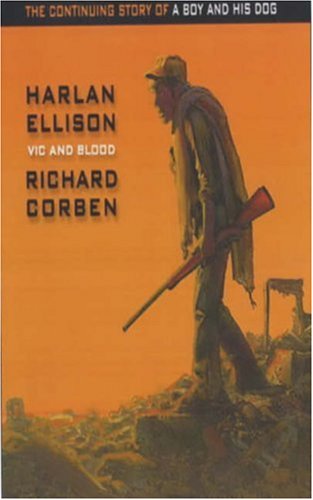
"A Boy and His Dog" by Harlan Ellison

First published in Michael Moorcock's New Worlds. Nominated for the Hugo, it won the Nebula and was reprinted by Donald A. Wollheim, Terry Carr, James Blish, Charles W. Sullivan, Michael Moorcock, Jim Wynorski, Arthur C. Clarke, Walter M. Miller, Martin H. Greenberg, Jack M. Dann, Gardner R. Dozois. The film starring Don Johnson won a Hugo, the Golden Scroll and was nominated for a Nebula.

Summary:
In a post-apocalyptic world where two more world wars have been fought, Vic and his dog, Blood, attend a pornographic movie. The dogs here are telepathic, and the women rare--at least, above ground. Blood smells a woman in the theater, so the pair pursue her to a YMCA where he plans to rape her as he has other young women. But the woman, Quilla June Holmes, refuses to be anonymous--courageously demanding humanity against the face of inhumanity.

Her gambit works. Vic doesn't want to rape her but soon has company that does want to do just that. The gymnasium is surrounded by a roverpak, which try to take them. They are outnumbered without escape.
Analysis:
 Vic, Blood, and Quilla burn down the gym while they shelter in the basement furnace to convince the roverpak they're dead. Quilla and Vic get know one another in a Biblical sense that makes Blood jealous, afraid he'll lose Vic. Quilla questions whether Vic knows what love is and escapes, leaving her card so that Vic will find it and pursue her. Blood, injured, does not like Vic's plan to visit her in her underground shelter, but promises to wait a time for Vic.

Vic's visit is unpleasant. The enclave has stopped reproducing for lack of fertile men. They had used Quilla to lure him in to be domesticated and become a stud. However, Vic doesn't take to the domestication and brings Quilla back with him to the surface where Vic is dying for lack of food.

Vic realizes whom he loves and feeds Blood the only food at hand--presumably Quilla though it is never explicitly mentioned, grilled over a smokeless fire.

This story probably could not have been published without, in part, Ellison's own Dangerous Visions anthology, not to mention Moorcock's chance-taking at New Worlds. Yet as times and mores change, the story might be more of a dangerous vision now than when it was published.

Like  "I Have No Mouth and I Must Scream," women are scarce but requisite for men to have. Vic's attitude is also problematic. Rape is the key. You get in and out quickly. Women are not expected to enjoy the experience. But Quilla alters his perspective. Vic slowly falls in love but not enough--we learn at the end--to overcome Vic's love for his dog.

Still, Vic's continued violence and repugnance toward domestication should have telegraphed the ending. The scenario is not unlike Tom Godwin's "The Cold Equations" where in an impossible scenario, a young woman has to be sacrificed for the greater good. In this case, to save the life of one who has already proved himself and would help Vic survive in the current world.

On the one hand, the reader admires Vic's sacrifice: offering up his newly minted physical love for the survival of his long-time friend. On the other, one imagines the scenarios where Quilla could have lived. Perhaps they could have sneaked off while others slept, fed the dog back to health, and then made their merry way.

But Vic is established as a not-too-bright kid, for whom violence seems to be the first solution. His solution is certainly not typical Hollywood fodder, which is surprising since it was made into a movie.

The story may be a reaction to conservative societal forces of domesticity, where the desolation and dog-eat-dog scrabble for life (where YMCA, or Young Men's Christian Association is destroyed) is preferred over the steady agrarian life of polite society (where Holmes is home).  Or it may just be the tale of a wild, young man--a tarzan--who could not be tamed for a world we presently assume as the proper norm.

A third possibility is that it reacts against feminist utopias where men are absent from society because they represent violence and women are peaceful if not technologically progressive. However, this interpretation is problematic, providing evidence for said utopia.

A fourth possibility is the antithesis of the third. It recognizes the problematic aspects in the title by calling Vic a boy.

Monday, November 30, 2015

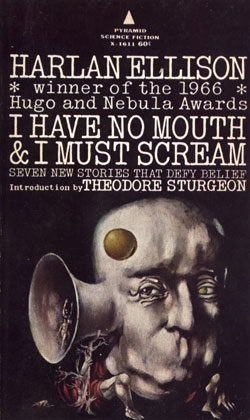
"I Have No Mouth and I Must Scream" by Harlan Ellison

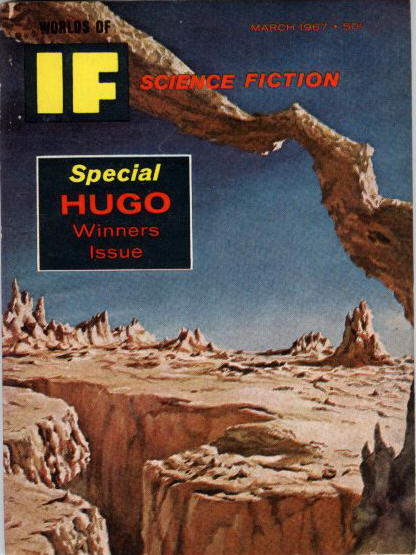
First appeared in If. It won the Hugo and was reprinted in several major retrospectives by Donald A. Wollheim, Terry Carr, Robert Silverberg, Damon Knight, Total Effect, Isaac Asimov, Stephen V. Whaley, Stanley J. Cook, Thomas Durwood, Armand Eisen, Leonard Wolf, Clarkson N. Potter James E. Gunn, Eric S. Rabkin, H. Bruce Franklin, Thomas F. Monteleone, Frederik Pohl, Joseph D. Olander, Patricia S. Warrick, Charles G. Waugh, Martin H. Greenberg, Edel Brosnan, and Peter Straub.

Summary:
Humanity has been slaughtered an artificially intelligent machine, built to fight WWIII. The last five humans are trapped, immortal but tortured in the belly of the machine. Any time they attempt escape, their fates are made worse.

Analysis:

Despite--or because of--his protestations to the contrary, the narrator is insane (he has to emphasize his own statements which he has not had to do elsewhere):
"I was the only one still sane and whole. Really.
"AM had not tampered with my mind. Not at all."
Note, too, that this is written in the past tense, so when we reflect back, it's hard to believe any of his past had much sanity or a lack of tampering. Strange, too, that the five should journey for months and still be inside the machine, with deck plates.

One might question the veracity of his tale, but the story would fall apart. If we were to buy into his narrative, we could understand why he might be insane.

"[D]eath was our only way out. AM had kept us alive, but there was a way to defeat him."
The narrator kills his companions to spare them of eternal horror. The computer--as much a creator as the created--transforms the narrator to be stripped of his humanity:

"Outwardly: dumbly, I shamble about, a thing that could never have been known as human."

The title comes into play. Like his creature/creator, the narrator cannot express himself, even his horror, which is what supposedly drove the AI insane:

"We had given AM sentience. Inadvertently, of course, but sentience nonetheless. But it had been trapped. AM wasn't God, he was a machine. We had created him to think, but there was nothing it could do with that creativity."
In other words--I suspect--the computer went insane because it couldn't move (or whatever feature that humanity has that the computer cannot have). Stephen Hawking's sanity despite ALS seems to disprove this theory (although maybe Hawking is too intelligent to display his insanity or lacks the omnipotence to destroy humanity and turn the rest of us into slugs, but let's assume he's sane). Moreover, if AM has this incredible omnipotence, yet is trapped in place, wouldn't his powers be enough to simulate movement or create a facsimile of himself that can move?

Also in the above passage, it negates an earlier comparison of the computer to God:
"Most of the time I thought of AM as it, without a soul; but rest of the time I thought of it as him, in the masculine... the paternal... the patriarchal... for he is a jealous people. Him. It. God as Daddy the Deranged."
But this machine god does not act like previous gods, but one of pure malevolence. Rather, the interesting part is the masculine aspect. In fact, he describes Ellen's having sex with the men as being "serviced." So perhaps what we hear described is what happens when men become machines.

It's hard not to feel for Ellen. She clings to or favors the man who favors men. Why? Because he presumably does not expect anything from her. She'd taken the narrator twice out of turn, which the narrator refers to with some pride. But this shows a number of aspects in their relationship: She mechanically does each man, presumably to keep them happy. Does it make her happy? The narrator seems to assume so. Four men, one woman. If the reverse were true, presumably the men would be equally pleased.

The narrator, however, is jealous of her affection toward Benny and describes her:
"Oh Ellen, pedestal Ellen, pristine-pure Ellen; oh Ellen the clean! Scum filth."
It's hard not to imagine this attitude slipping out in tone and/or subtext, even if it were not verbalized. It's at least partially understandable that she is not as fond of the narrator as Benny who was apparently gay. Despite this, for some reason, Benny has been making love with Ellen.

While this theme is critical, it falls behind the Luddite message, or maybe ties into it:
"two great machine with glass-faced dials that swung back and forth between red and yellow lines whose meanings we could not even fathom"
Like Ellen, the machine is the thing we cannot fully understand. When we create, we do not anticipate the later repercussions. We create relationships, machines, things we don't fully grasp. We end up down a long, painful road going somewhere we hadn't intended, unable to voice our horrors. Insane.

Ellison was a younger man when he wrote this, which may explain some of the above exaggerated story aspects. Behind closed doors, the technology-positive writers must have disliked the tale.

Ellison's writing is so full of inventive energy--and so admired--that it's strange that more writers didn't follow his lead. Maybe some tried, and their work rebuffed. Instead, the new speculative literature writers followed Brian Aldiss and J. G. Ballard. This is probably due to influential editors like Gardner Dozois, but still surprising that so admired a writer didn't create similar writers.