Search This Blog

Showing posts with label alternate history. Show all posts

Thursday, April 4, 2024

"The Mayor of Mare Tranq" by Frederik Pohl

undefined

This first appeared in Roger Zelazny's  The Williamson Effect, a tribute anthology to Jack Williamson. James Frenkel thought it one of Pohl's best. The writers collaborated on ten novels between 1954-1991.

Summary:

Jack Williamson, in this alternate universe, becomes not a writer, but a military man in the Army Air Corp From there, he pulls off a few miracles that did not occur in our world.


Discussion:

The first miracle is a political event that every writer of a certain age talks about--"Where were you when...?"--and the second miracle is one that every SF writer of a certain age talks about. 

The amazing thing is how, on the one hand, it pulls off the expected. On the other, it is a touching tribute to one of the major SF writers of the 20th century, often stating how they'd have done it differently. How could one story occupy two diametric positions?

To see how Pohl handles another story tribute (E.E. "Doc" Smith), click to see "The High Test"

or check out his Edgar Rice Burroughs tribute (and critique) in "Sad Solarian Screenwriter Sam."

Thursday, January 23, 2020

Bring the Jubilee by Ward Moore


Ward Moore’s most famous novel opens with a wonderful paragraph of just two sentences:

“Although I am writing this in the year 1877, I was not here until 1921. Neither the dates nor the tenses are error—let me explain:”
--Chapter 1. Life in the Twenty-Six States

That opening chapter is in fact a whirlwind of speculative alternate history wonder. It details a history of the Civil War where the South won and the North grew embittered, complaining even seventy years later. In the North the people tend to have indenture themselves to get ahead (although this isn’t fully explained why since it isn’t to go by ship to a different country). But it is apparently extremely difficult to get ahead.

The narrator is a clumsy farmhand for his family although he does come to a love of writing. Trackless locomotives, minibles (small dirigibles, it seems), and the post-office lottery sparkle in this strange new America which is plagued by poverty, indentured and prison labor, and gangs. The telegraph is still the main mode of communication. America’s new future (of the past) creates ripples of changes throughout the world where France still appears to carry out Napoleonic wars.

He briefly comes across a slave pursued by his master and he laments not jerking the horseman’s reins to give the slave a chance to escape. This becomes a key thematic moment about the ability to change the future.

Two women manage to train our narrator into a professorial writer who charts the course of Civil War. When he gets stuck, they help get back in the saddle by the invention of a new time machine with a chance to witness the past.

The novel dives into discussions of polygamous sexuality and gender and racial equality—possibly one of the first in the genre to do so. It is perhaps too didactic about these issues, however. Compare this to his story “Lot” which leaves much to readers to discover for themselves.

An early version first of the tale appeared in a presumably shorter form in F&SF, edited by Anthony Boucher and J. Francis McComas. This version was later reprinted by Frank D. McSherry, Jr., Charles G. Waugh, Martin H. Greenberg, and Harry Turtledove—one billed as The Best Alternate History Stories of the Twentieth Century. Dozens of critics and writers have recommended the novel version. Gollancz reprinted it as part of their SF Masterworks series. David Pringle included it in his Science Fiction: The 100 Best Novels. And it is discussed in various critical anthologies.

Nonetheless, the F&SF novella version, edited by Boucher and McComas, may be the best version though I haven’t laid my hands on a copy to investigate. The novel has discursive and abstract passages that bog the middle part of the novel down:

“I noticed however that he treated the consul no differently, either in politeness or honesty, from his other patrons, and by this time I knew Tyss well enough to attribute this courtesy not to the self-interest of a tradesman but to that compassion which he suppressed so sternly under the contradictions of his nature.”

and

“The new Catty was no more than the old was disingenuous or coquettish. She was simply mature, dignified, self-contained and just a trifle amusedly aloof. Also she was very busy. She did not pretend to any interest in other men; at the same time she had clearly outgrown her childish dependence on me. She refused any competition with Barbara. When I sought her out she was there, but she made no attempt to call me to her.”

Being trapped in a narrator’s semi-rambling thoughts for too long didn’t seriously mar his short fiction, but here it quagmired the narrative until the narrator was able to climb into a time machine. Thank God for time machines.

One might guess that he had planned to expand on these, or maybe the novel was too long to publish in 1953 that he compressed them without little grace. The middle has aspects to recommend it, but an expansion may not have improved the speculative aspects, so a ruthless excision (e.g. the novella) may be the best choice for aesthetic readers.

That said, the novel remains an established, influential classic, worth discovering for yourself. The intriguing ending, for instance, leaves the reader to wonder which future the narrator lands in. Also, the novel demonstrates how a small action (or inaction) can lead to devastating or beneficial effects. The novel’s merits and charms may overwhelm infelicities for some. I will await a cheap price on the Turtledove ebook before investigating the novella.

It is time someone collected his best short fiction—perhaps even this novella—into a book. Moore’s stories are difficult to chase down.


The Author
Ward Moore won no awards or nominations yet was respected by writers. Despite the appearance in several best-of anthologies, he seems to have never had a collection. Apparently, he appears as a character in books by Kenneth Rexroth, himself, and Jean Ariss. He is also well known as the author of the critically acclaimed stories, "Lot" and "Lot’s Daughter", which I discussed here. 

Sunday, May 5, 2019

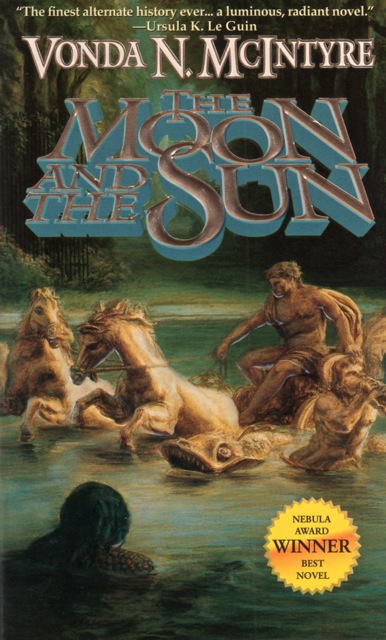
The Moon and the Sun by Vonda N. McIntyre

The Moon and the Sun won a Nebula and was up for the Tiptree and Locus awards.

Father Yves de la Croix--Jesuit priest, natural philosopher, and explorer--has returned to King Louis XIV bearing a gift of two sea monsters: one alive, one dead. Little by little, Yves does the autopsy with the assistance of his sister, Mademoiselle Marie-Josèphe de la Croix.

Marie tries to train or domesticate the sea monster as a pet, but slowly learns that there is more to the sea monster than she first supposed.

Eventually they communicate, and Marie gets a fuller understanding of this race or species. Unfortunately, the sea monster's flesh is rumored to give immortality, so they want to dine on its flesh. Marie has to come up with a way to prevent this.

Minor spoilers:

The main plot could be guessed as soon as the conflict is established. Of course, humans once again underestimate another species. The victims must be rescued. In fact, much of the basic scenario mirrors Guillermo del Toro's The Shape of Water: the capture and abuse of, and experimentation on a humanoid sea creature.

The sea "monster's" name is Sherzad--a nifty nod to 1,001 Arabian Nights. After all, Sherzad (like Scheherazade) has a story to tell to save her own life.

The first two-thirds is well written but pales in comparison to the last third except for the scene establishing communication and the autopsy which is a well-sketched painful moment. The real power comes in the last third when the court intrigue unfolds, and we learn more about this sea-person.

The speculation is rather limited, so maybe it is like LeGuin suggests above the illustration that this is an alternate history. Apparently, McIntyre did much research to capture the period, and it was convincingly captured. A historian might need to explain the departures and their ramifications.  I'm just a science dude.

When word got around Vonda N. McIntyre was ill, I decided to pull down this novel and give it a read. If I have McIntyre's ordering right, the novel began as a faux encyclopedia article, which she had to restrain from becoming a story with characters.

She took a script-writing class and wrote an earlier version of this story, which she later expanded into a novel. However, publishers move faster than the movie industry, apparently, and she published her novel well before they started shooting. The movie, starring Pierce Brosnan, has been filmed but remains unreleased pending special effects, four years later.

Maybe something went wrong elsewhere, but you'd think they'd try to recoup some financial losses by releasing it as straight-to-video, or have a limited release first. Surely, book fans would flock.

UPDATE: The movie was just released. See discussion here.

Sunday, March 12, 2017

"Seventy-Two Letters" by Ted Chiang

First appeared in Ellen Datlow's Vanishing Acts, reprinting by David G. Hartwell, Ann VanderMeer, and Jeff VanderMeer. It won the Sidewise award and was up for the Hugo, World Fantasy, Sturgeon, Locus, and Seiun Awards.
Summary:
Even as a precocious child, Robert Stratton put various Hebrew words in the mouths of clay dolls to watch them animate and see what they would do. He learns his precocious buddy has isolated and grown "preformed" spermatozoa to child-size.

When Stratton gets older, he creates the first golems who can manipulate objects with his hands. The idea was to ease the burden off the poor. His boss is horrified, however. He sees it as a way to put sculptors out of a job, and he will block Stratton every step of the way.

Meanwhile, a Kabbalist stops by wanting to exchange information. He knows the word to golems to feed themselves their own words. It's a no-deal.

Finally, Stratton learns there's a whole secret society existing to perpetuate experiments the public may not approve of. Their scientists have learned that society is doomed within five generations.
Commentary with Spoilers:
The homunculus--the idea that humans exist in a microscopic form in either the egg or sperm--is not a new device in SF, but it must certainly be a new take. Here the "preformed" were made at the beginning of creation and the number of preformed generations is about to end. This, they say, explains the cataclysmic end of earlier Earth species.

Add to that the idea that biological beings can be animated like the golems, and you have Chiang's resolution to the idea that humanity's preformation crisis. Humanity will live on with the word's inside them that allows them to live. The ending satisfies although an iota of power leeches away due to the undramatic nature of what must occur.

This may be one of Chiang's best. The characters are more striking. The rich ideas play out their complexity in a fresh and surprising manner. In some ways the plot mirrors the earlier "Understand", where scenes seem to appear just for the purpose of developing ideas; however, the dilemma behind the ideas unite the scenes so that transitions feel integral.

Saturday, December 28, 2013

"All the Myriad Ways" by Larry Niven

First appeared in Galaxy.  Was up for a Hugo award.  Reprinted by Robert Silverberg, Donald L. Lawler, Frederik Pohl, Martin H. Greenberg and Joseph D. Olander, including three major genre retrospectives concerning Galaxy magazine and alternate history.

Detective Trimble is investigating strange suicides, even of prominent citizens.  Why is it happening?  Trimble suspects the new opening of universes, finding universes of what-might-have-beens where your life turned out differently is the cause.  And then psychologically it hits him as it must have hit everyone else:
"There was no luck anywhere.  Every decision was made both ways.  For every wise choice you bled your heart out over, you had made all the other choices too.  And so it went, all through history....
"If every choice was cancelled elsewhere, why make a decision at all?"

The ending is left ambiguous leaving many possibilities on the table.  Or, more likely, all were taken.

Monday, January 7, 2013

"The Man with Great Despair behind His Eyes" by Ken Scholes

Talebones, Winter 2005

Available online (Baen)

Meriwether Lewis is sent to the Pacific, not only to find a way west and map it, but also to investigate a note that has a picture of Andrew Jackson twenty years older, and on a twenty-dollar bill is his picture.

Out west, Lewis discovers an old man named John Fitzgerald Kennedy who will translate for Lewis an exchange with The-Man-from-the-River, who decorates his dirt floor lean-to with thousands of dollars bills from the future.The-Man-from-the-River talks Lewis into swimming the dream waters.

They use the bills to smoke herbs that allows Lewis to see the future, but Lewis' deepest question remains.

A creative play with history, if not resonant, quite moving.