Search This Blog

Showing posts with label Lawrence Watt-Evans. Show all posts

Thursday, May 15, 2014

"One-Shot" by Lawrence Watt-Evans

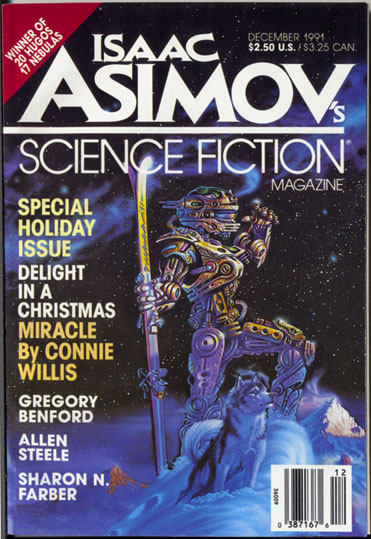
First appeared in Asimov's.  Reprinted by Charles Ardai, Cynthia Manson.
A man travels through time to save Kennedy's life.  He kills the criminal.  

*spoiler*  Comment to help keep you from accidentally reading spoiler:  A lot of stories from this era about Kennedy (a few about his killer as well).  The surprise ending:  The criminal turns out to Kennedy's famed lover.


Wednesday, May 14, 2014

"New Worlds" by Lawrence Watt-Evans

First appeared in Asimov's.

The probably plays into readers' affections for New Worlds, a British magazine with multiple reincarnations--most famously with Michael Moorcock at the helm, captain of the New Wave.  Unfortunately, the current zine appears to be in its death-throes with no submissions, registration required to view anything, and difficult to retrieve lost passwords.  Ah, technology.  So wonderful yet such a pain.

Beings from a different universe arrives via crosstime gate to investigate a spaceport and other technologies.  However, they are immediately arrested.  The different Earth beings discuss trading technologies, but not their most valuable.  Stalemate.

*spoiler* The crosstime people exit and blow up the gate, thinking the other more powerful with access to alien technologies.  The faster-than-light crowd is jealous of the zero-time travel....

It's hard to tell how much this tale is a tribute to that magazine, but there is a nice contrast between high technologies--both deathly afraid of the other's technology thinking the other superior.  The grass is always greener.  But they both decide to pursue technologies they now know is possible

"Windwagon Smith and the Martians" by Lawrence Watt-Evans

First appeared in Asimov's.  It won the Asimov's readers' award.  Reprinted by Gardner Dozois, Sheila Williams, and Orson Scott Card.

From Ray Bradbury, Lawrence Watt-Evans received permission and approval of this story.  It combines Bradbury's Martian Chronicles with a little Burroughsian overtones, told from a tall-tale voice of one nineteenth-century Thomas Smith.  Because of his fine windwagon on Earth, Thomas Smith is whisked off to Mars to race against the fastest racer on Mars.

Watt-Evans does a good job increasing tension and stakes of the race.  Nice narrative voice, as well.  This appears to be Watt-Evans' second-most popular tale.

Another Watt-Evans story mash-up is "Real Time", which mixes time travel and paradoxes with the unreliable first-person.

Tuesday, May 13, 2014

"Dead Babies" by Lawrence Watt-Evans

First appeared in South From Midnight.  Reprinted by Stephen Jones, John Betancourt, including a Year's Best.

Bill Sellers, the narrator, takes his wife to have her baby.  Their baby died, says Doc Everett, on its cord.  Somehow they died get their child right away, so they want their child's body back.  Bill and his wife insist that the funeral director open the coffin  immediately.  It's empty.  Has the doc been stealing babies?

*Half-spoiler* Doc Everett has been saving dead babies for his sister.  To replace the old ones.  Watt-Evans takes it a couple of more strangenesses beyond that.

"Pickman's Modem" by Lawrence Watt-Evans

First appeared in Asimov's.  Reprinted (perhaps the most frequent) by Gardner Dozois, Jim Turner, Sheila Williams, John Gregory Betancourt, and Colin Azariah-Kribbs.

The title indicates it is a play off of H.P. Lovecraft's "Pickman's Model" where the narrator learns that a talented artist on the outs with his artist community because of his grotesque drawing has truly been seeing such visions.

Although the story states it explicitly, Watt-Evans' Pickman is anything but talented.  He'd bought a second-hand Miskatonic Data System modem and it changed his poor grammar/spelling into something more elegant if archaic.  Whereas Pickman tells a person to do something crude, the modem phrases it in a less direct manner.  Pickman is disturbed but not enough to get a new modem....

Maybe you can guess what happens next.  How else can a Cthulhu story end?  This tale gains humor/power when compared to its original.

Monday, May 12, 2014

"Real Time" by Lawrence Watt-Evans

First appeared in Asimov's.  Reprinted by Charles Ardai and Mike Ashley.

Protagonist stops time paradoxes from occurring.  He feels something in his telling him who/what will cause the disturbance and takes them out himself, vigilante style.  The question is "How reliable is our protagonist?"  It's a smooth transition from one style to another.

Another Watt-Evans story mash-up is "Windwagon Smith and the Martians", which mixes Ray Bradbury, Edgar Rice Burroughs, and the American tall tale.

Sunday, May 11, 2014

"Storm Trooper" by Lawrence Watt-Evans

First appeared in Asimov's.  Up for an Asimov's Reader's Poll award.

If you like your SF wild and wooly, here's one for you.  In this time stream, time storms strike and carry, drop off items from one universe into another--such as sky whales.  Mitsopoulas and two partners, storm troopers, investigate changes in an area, but they find a brand new building that wasn't there.  This is before they arrive at the supposed time anomaly.  They investigate.

The building is called New York City Internal Security.  They treat it cautiously, as police--as this sounds like another police organization.  When they break out a megaphone to tell the police to come out, the police inside do likewise.  It's a standoff.  So Mitsopoulas decides to go inside and investigate, without his firearms.  Both parties are convinced that the other is living in a different time stream.  But it's worse than Mitsopoulas imagined.  The organization's name indicates they have a slightly different agenda.

Worth checking out.

"The Drifter" by Lawrence Watt-Evans

Appeared in Amazing.

Man volunteers to hope aboard a time-travel experiment.  He and the scientist take a trip across universes where small changes accummulate every second--changes that add up over time.  Eventually, the worlds he occupies look little like the one he left.

Pretty fair fare of a time-travel yarn.  It reminded me of A.E. Van Vogt's classic "The See-Saw".  Title has an interesting play--the protagonist is a kind of drifter before, during, and after the story.

"An Infinity of Karen" by Lawrence Watt-Evans

Appeared in Amazing.

A man lost his wife, so he hunts her down through various parallel universes.  He finds her, but she's already married to him (uncomfortable shenanigans ensue).  He seeks her in a universe where she's lost him.  He does, but she's gone to look for him.

Despite the brevity of description above, I found the tale quite emotionally compelling, wrenching.  In fact, I'd intended only to read a few stories from the collection, but the [expletive deleted] writer sucked me into his other stories as well.

Since Watt-Evans plays a variety of emotion chords, I'm surprised this one hasn't been reprinted or received an award nod.  Maybe fewer people read it, or it only seems stronger next to other stories of its kind.  But worth checking out if you like time-travel stories.  Crosstime Traffic is rather strong collection for such fare.

Saturday, May 10, 2014

"A Flying Saucer With Minnesota Plates" by Lawrence Watt-Evans

First appeared in Asimov's.  Up for the Asimov's Reader's Poll award.  Reprinted by Cynthia Manson and Charles Ardai. A sequel to "Why I Left Harry’s All-Night Hamburgers".

This time Harry is the main character.  A traveler's UFO has broken down in  the early hours of the shop's parking lot, and it can't be repaired.  What can they do to keep from having Harry's discovered?  *spoiler*  Use it as a publicity stunt.

Charming tale with a great title, but not an especially strong addition to the series, probably because it does not appear to challenge the protagonist especially.  Watt-Evans had the right idea as the series needs expansion.  It is strengthened, though, being next to its prequel in his Crosstime Traffic collection.  I love the clever MN plates in the book cover to the right.

"Paranoid Fantasy #1" by Lawrence Watt-Evans

First appeared in The American Atheist.  Reprinted by Isaac Asimov, Terry Carr, and Martin H. Greenberg.

For a one-page story, this has remarkable sophistication--not only that, it was Lawrence Watt-Evans's first story.  I don't know if he had Joseph Heller's quote from Catch-22 in mind when Watt-Evans scribbled this down, but it smells like it:
“Just because you're paranoid doesn't mean they aren't after you.”
Nathan has a number of superstitious habits:  wearing crosses, spreading garlic, avoiding sidewalk cracks.  His friend Eddie harasses him for his superstitions and then... *spoiler* gets carried off by monsters.

What makes this sophisticated is the question:  What is the paranoid fantasy?  The monsters that come out at night?  The whole thing (constructed by protagonist)?  Or the reality of those that think that paranoid fantasies cannot be real?  It could as equally apply for or against any religious or anti-religious affiliation.

If the above description intrigues you, it's worth checking out.  It opens Watt-Evans' collection, Crosstime Traffic, so you can read it as a sample.

Friday, May 9, 2014

"Why I Left Harry’s All-Night Hamburgers" by Lawrence Watt-Evans

First appeared in Asimov's.  Reprinted in a few major retrospectives (even one named after this title) by Sheila Williams, Charles Ardai, Isaac Asimov, Martin H. Greenberg, Bruce Coville, John Gregory Betancourt, Norm Sherman and others uncredited.  It won a Hugo and Asimov's Reader Poll awards, was up for the Nebula and Locus awards.  Audio and online.

I've read this story I don't know how many times.  I thought it was interesting enough, but why was it a classic?

Sometimes stories break rules successfully.  This is one of them.

First, we have an ordinary joe, the narrator, who needs a job while in high school.  He doesn't even really like school except to see friends and girls.  He's rootless, wandering through life, doesn't know where he belongs, but the money's good.  This should fit a large majority of readers who went to high school bored, not seeing it as a ticket to somewhere better.  Typical.

Next, we have the diner, Harry's.  He's got stringent rules, but they can be broken without consequence.  What's cool about this ordinary, off-the-beaten-path joint, is that it has weirdness.  Who doesn't want a little spice and adventure in their everyday, humdrum existence?  People come in April dressed as if it were mid-winter, others as if it were a muggy July or August.  Some don't even look that human.  But they are--just from different universes.  People, the unmoored, pass through, knowing they can get stuff at this diner without questions.  In other words, it's a kind of Cheers except nobody knows your name.

(Side note:  Three women walk in shirtless--having come from a vastly different society.  Having been written near the hippy generation when it was cool to be so liberated, this probably struck a chord with those readers.  The newer generation may have pulled up short, thinking it gratuitous.  I prefer my magazine covers not to flash gratuitous boobs myself, but I understand where the earlier generation is coming from.)

Next, we have what lies beyond the diner, what it represents:  other possibilities.  There's a world out there, just for you, the wanderer.  It's just what you've been looking for, but it will take some looking.  But... you might not ever find your way home again.

Read in this way, while it doesn't have the supposed necessary ingredients of a good story, it's a kind of wish fulfillment, but not just starry-eyed wonder.  There's a cost.  Will you pay it?