Search This Blog

Showing posts with label biology. Show all posts

Sunday, February 6, 2022

Prima Belladonna by J. G. Ballard [Vermilion Sands]

Eventually, the hub of commentary on the Vermilion Sands will be located here.

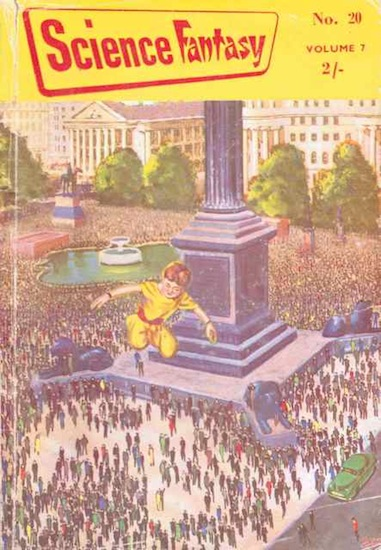
This story first appeared in John Carnell's Science Fantasy. Reprinted in a few major genre retrospectives by Judith Merril, Martin H. Greenberg, Damon Knight, Joseph D. Olander, Kathryn Cramer, David G. Hartwell. 

All the guys seem to go crazy for a golden-hued female mutant named Jane Ciracylides. Except Steve, the narrator, who is attracted but restrains himself. Instead he focuses on his choro-flora--plants that sing although the conditions and environment have to be just so, or he could lose his crop.

The trouble comes when Jane visits his plant shop. 

Commentary with Spoilers

The one plant she wants he cannot sell. She makes his plants sing in ways he's never seen. 

She turns out to be a major singer herself, and becomes Steve's lover. It all ends when Steve suggests it will end. The ending, though, is a bit ambiguous.

The description makes it sound like the plant that she's been drawn to, is aroused. Is it that or is her entrance an act of pollination? She, after all, has insect eyes. A third possibility is that she, entranced or conscious, is consumed by the plant.

When Steve tries to pull her away, she begs to continue, so Steve prevents his friends from disengaging her from the plant.

The story makes it sound like she might have been killed, or possibly continued on elsewhere. Perhaps it's a Schrodinger's cat scenario.

Note: 1) A prima donna is a talented singer, if perhaps full of herself. 2) Belladonna is a deadly plant although it has medicinal properties. Perhaps all meanings are on display.

Judith Merril praised it as "one of the very few entirely new s-f ideas of the last few years." Also laudable is the characterization of men--those driven and those restrained. Although some of the speculation may seem implausible, it is developed in a methodical manner that feels plausible.

We have a scale that goes up to or beyond "K" (which could be true if octaves were re-vamped in the future, perhaps introducing half tones), plants that sing (that seems plausible given holes and wind, however, these create music and read the music off one another, which is a huge step). Also, what kind of mutant is Jane? Maybe?    

Even though she's a human variant, she feels alien although her parentage brought her from Peru. Perhaps this is in such a distant future that science indeed feels strange. It's also interesting that she is said to cheat at cards. Perhaps this is meant to suggest that she somehow also cheats at life or some other endeavor, to make it interesting.

Elsewhere, Ballard argued for more sex and violence in the arts. It's interesting that they launched his career.

Sunday, January 23, 2022

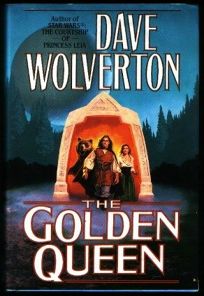
The Art of Golden Queen by David Farland / Dave Wolverton

The Golden Queen (The Golden Queen, #1) by Dave Wolverton

Dave Wolverton passed away on January 14, 2022. This is just a tribute to one of my favorite novels of his. 

I recently commented on what I think was one my favorite stories, "After a Lean Winter," and what made it so brilliant.

The Golden Queen is a science fantasy. It would be easy for a long-time reader of fantasy just to accept this as a somewhat traditional fantasy with some of the usual oddities such as a talking bear, but then we have two moons. The novel opens this way

"Veriasse could taste the scent of vanquishers in the crsip mountain air. Beneath the sweaty odor of the horses, lying deep below the aroma of pine needles and leaf mold, he could barely detect the acrid scent of dronon vanquisher's stomach acids. This was the third time he had caught that scent in as many days, but this time it was closer than in the past."

Really, this could go either way in reading it: fantasy or science fiction. But the heavy emphasis on scents has a distinct odor of biology. Straddling the divide between science and fantasy creates a beautiful friction, a paradox of sorts, a broad palette of samples to taste. We inhabit two genres simultaneously. Just when you settle into the fantasy of it, the text will either imply or call up the science of what's happening.

But the most powerful aspect is the characters themselves. And the story takes off in the inn in Clere, the characters giving one another a hard time in a playful manner (notice how the barbs fly off at everyone, sometimes multiple people at once):

"Nooo, no!" Father Heany threw up his hands as if to ward off a blow. "You can't go trying to unload your ugly niece onto the boy," the priest said. "That would be a sin. She's a nice enough girl, but with those buck teeth--"

"You don't say!" Seamus frowned in mock horror. "You daren't talk about my niece that way."

"I will," the priest said. "God agrees with me on this point, I'm sure. The girl has tusks as dangerous as any wild boar's. Now, if Gallen is looking for a nice young woman, I'm sure others could  be found."

Fiction Book Review: The Golden Queen by Dave Wolverton, Author Tor Books  $22.95 (318p) ISBN 978-0-312-85656-4

Maggie got up from her churn. The cream had hardened to butter, and she could no longer turn the crank. Her face and arms were covered with perspiration. Gallen figured it must be midnight, yet she'd been working since before sunrise. She stood wearily, put a heavy log into the fire, then sat at a nearby table with a sigh that said, "Ah, to hell with it."

"Well, there is Maggie here," Seamus said with a wink, and Gallen saw that he'd been planning this all along. With Gallen and Maggie sitting so close together, it was a perfect opportunity to torment them both. No one in town could have missed the glances they exchanged, and Gallen had just about decided that Maggie was the one for him. "Now, Maggie has it all--she has her wit, she's a charmer, and she works as hard as three people."

Maggie also gives Gallen a hard time of it, too. However, the playfulness gets challenged when the beautiful Golden Queen herself arrives to send our heroes off on a journey, looking for a guide or an armed escort who can also defend. However, though Gallen shows himself worthy as a guide, he's rebuffed when he inquires about her name. An act not lost on Maggie.

Forgive me. I love Orrick the bear, too, but I can be less specific about that. Perhaps it is just our innate desire to befriend animals, but Farland does seem to capture some of the beariness of Orrick in a few deft gestures such as his voracious appetite, lapping milk from a bowl, and mysterious behavior like this: 

"God be with you, for I shall not," the bear said.... Gallen shivered at the sound of Orick's cryptic farewell.

There's much to love. It's almost as wonderful as knowing the man himself.

Wednesday, June 23, 2021

A Word That Means Everything by Andy Dibble

Appeared in Writers of the Future 36, edited by David Farland.

On the planet Murk, Pius is trying to translate scripture into a language for the Thulhu, aliens with tentacles and vestigial wings--aliens that look a lot like Lovecraft's creatures of Cthulhu. His first challenge is even to get them to respond to him. Translating the Judeo-Christian scripture into something these creatures can understand is proving nigh impossible.

Suddenly, Pius's slow and modest success is interrupted by a famous translator, David Nestor, sent to replace Pius.


Comment with some spoilery bits:

This tale of religion and language treads similar ground as Ted Chiang, James Blish and Mary Doria Russell--some august company to keep.

It's hard to tell what what Dibble's theological perspective might be, but he is clearly knowledgeable of his subject matter. People think they can deviate anywhere with a theology and proceed to make rookie mistakes, but deviations within a theology occurs within certain boundaries and Dibble seems keenly aware of those boundaries, aware of where he can play. It's stunning. Even on a second read, I'm just as hooked as the first. 

The language issues seem very genuine as if Dibble is equally skilled at languages, too, although I suspect it would be hard to begin the process of any language if your alien won't communicate (an issue I didn't think about until I was combing over it on a third read to pick at the story with a lens and tweezers).

Least probable are the aliens. I suppose one could say, given the vastness of the universe, anything is likely to occur. But a creature whose primary locomotion is water based (water propulsion and tentacles) is probably not going to have vestigial wings. Of course, there are flying fish, but these occurred with fish who leap out of the water, which an octopus is unlikely to do.

Of course, the whole point of the story is to ask what it would be like to communicate the concept God to a Lovecraftian creature. So in a sense, this alien biology critique is nitpicking.

Dibble's style is very Asimovian and it works well at this length. The density of philosophical or linguistic discussion--while almost pure joy--is a workout, and might tire out a reader at novel length unless it were specifically designed as a novel of short stories or novelettes, so that the reader can exercise, then rest on the side of the pool before leaping forward.

With impeccable timing Dibble throws the monkey wrench of David Nestor into the story which enriches and gives Pius a new challenge.

While all of these writers are a pleasure to discover, Dibble provides an old-school (or a Ted Chiang sensibility, if you prefer), uncommon level of speculation  As Dibble's craft improves, this writer might be the discovery of the decade.

The author has appeared multiple times in Sci Phi Journal

Wednesday, March 10, 2021

Comments Published, Howard Waldrop story updated, Future Posts


"The King of the Beasts" by Philip José Farmer

It's interesting that "The King of the Beasts" is #17 on this blog's most popular posts. That suggests that the story has more impact on readers than one might have supposed. Time permitting, I will need to revise it. It has more relevance than the tone may have implied. 

The theme deals with how, as a consequence of allowing so many species to become endangered. humanity itself might become one of its own victims. Potent, surely. 

I still contend that, instead of building up to the surprise, the idea might have been developed a little more although one could argue that that would be unnecessary due to its brevity. 

I will rewrite this post to incorporate the above.

"Microcosmic God" by Theodore Sturgeon

This post is #8 on the all-time most popular blog posts. I will need to reread the story with the question of ethics and morality in mind. What a fascinating question. Thank you.

I looked up the definitions and commentary and it appears that most of us use them interchangeably. However. some view morality as a personal thing and ethics as a group thing. 

I don't. I see morality as a group and personal thing. They are the rules we live by and sometimes share with others. Ethics would be examining these rules closely, trying to eliminate bias, to understand our rules and others' rules. Morality would be the vine that grows naturally. Ethics would be the trellis that someone constructed (or that someone examined). Others have made different distinctions--if there are any. 

I hope to eventually write a post addressing this, assuming that, when I reread it, I will come up with something interesting. Great question. 
 
Future Posts

I hope to write about more mentors and colleagues who became friends as a result of our mutual interest in writing. SF is a small field. Some mentors were kind, some were not. Some I disagreed with ethically, some not. You probably cannot guess which is which by the way I write about them here since I try to maintain integrity in examining the stories. Stories are not people. Besides these comments are as much for me as for others.

Howard Waldrop was a mentor. As Chad Oliver called him, he was a story doctor, knowing how to diagnose a story's ills. His perspective always surprised our Clarion class.

After winning the Writers of the Future contest, I plan to read and discuss stories from those anthologies as well L. Ron Hubbard's own oeuvre. I discussed a few of his works on here: Fear and "Beyond All Weapons." I thought there had been more. In terms of books, Battlefield Earth I found particularly interesting for its discussion of economics though I forget now what that discussion entailed (hence, the blog). Ole Doc Methuselah wasn't as effective. As a young man, I remember getting enthralled by the opening of the Mission Earth sequence; however, my rereading was interrupted. I am most fond of his pulp stories, though. So I plan read those. I seem to recall being particularly fond of "Crossroads."

The WotF contest has its own, self-guided workshop with essays by Hubbard and videos with Orson Scott Card, Tim Powers, and Dave Wolverton. Pretty interesting, so far.

Some claim they have the contest figured out. I don't, so I don't know that I can offer general advice. However, I do think the "After the Workshop" podcast on this link is particularly enlightening. If you're submitting a story to the contest, good luck!

Tuesday, June 23, 2020

Free ebooks, understanding and preparing for COVID-19, Foundation trailer

Kristine Ong Muslim (a talented poet) writes:
If you haven't done so yet, you can download for FREE and in three digital formats Lightspeed Magazine's People of Colo(u)r Destroy Science Fiction, as well as two other volumes in the groundbreaking book series. Nalo Hopkinson and I selected the short stories for the original fiction section of POC Destroy SF, which went on to win the British Fantasy Award for Best Anthology in 2017. The books can be downloaded here [at destroysf.com]
#


Be careful of graphics like this. Do you see the problem?

We have percents but no sense about what kinds of numbers they refer to. Cut 1000 by 50% and get 500. Add 50% to 10 and get 15. Which number is greater? 500 or 15? [In my classroom if a student left a number like 500 unlabeled, I'd ask, "500 what? Ostriches? Hippopotami? Orangutans? But here I'm leaving open possibilities and assuming that 500 and 15 represent similar comparable figures.]

Look at the number and the trends. Kansas is going up, but 50 new cases per million is actually better than most states. Hawaii is up, but they've been super low (less than one case per day on average). They shot up, sixty times where they were. Yes, 60. But that's stll low in comparison (7 or 8 cases per million per day, which is far better than nearly everyone in green). 50 seems to be a dividing line between states that have work to do although, of course, we'd like the numbers to be zero, but is that realistic? Discussion about this later.

#

Face-shields preferred over face-masks 

#


I loved the first three books of Isaac Asimov's Foundation trilogy although I was just a kid when I'd read them. They had grand imaginative scope. I'm not sure how they'd transfer to screen, but as a series, this sounds like it might be promising.


Saturday, June 20, 2020

COVID: Good News, Bad News

As you've probably heard, new cases are on the rise in the U.S. although some states are trying to curb that rise.


What you may not know is the new deaths have been on the decline--even with the rise in new cases:


Now I graphed this out: New Cases/New Deaths (weekly average) over time.

NOTE: The following graph approximates a trend but is problematic. The deaths could come at any time after someone is diagnosed. It likely would not occur at the same time although it might in a few cases. If I could match the diagnosis with deaths, the graphs would be highly accurate. If I could find the average length of time between diagnosis and death, it would be close. If I get an average, I will modify the graph at that point. However, until that time, this graph should still show the general trend.

Also note that these numbers deal with averages to remove spikes that might be artifacts of differences in reporting. Moreover, the percentages would be lower still if we could factor in those infected by COVID-19 who remained asymptomatic.


It seems that at one point, Day 45, we peaked on the percent [7.6%] of those who contracted and also died, noting the above caveats. The opening numbers probably do not reflect accurate numbers due to the delay between contracting and passing. When I get an accurate average, I will shift the data.

Here's what it would look like if the average death occurred five days after diagnosis (please assume same labels):


Seven days:


Ten days:


As I suspected, the opening parts did not match, but the ending parts do correspond well--numbers approach two or three percent. The numbers for ten days seem to start too steep, so that seems improbable (one out of three patients died at first?), but it isn't our place to question the data until we get a better average.

I'll post a variety of news articles later.