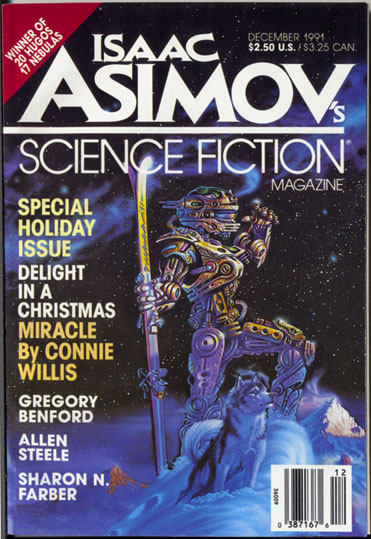
First published in Michael Moorcock's New Worlds. Nominated for the Hugo, it won the Nebula and was reprinted by Donald A. Wollheim, Terry Carr, James Blish, Charles W. Sullivan, Michael Moorcock, Jim Wynorski, Arthur C. Clarke, Walter M. Miller, Martin H. Greenberg, Jack M. Dann, Gardner R. Dozois. The film starring Don Johnson won a Hugo, the Golden Scroll and was nominated for a Nebula.
Summary:In a post-apocalyptic world where two more world wars have been fought, Vic and his dog, Blood, attend a pornographic movie. The dogs here are telepathic, and the women rare--at least, above ground. Blood smells a woman in the theater, so the pair pursue her to a YMCA where he plans to rape her as he has other young women. But the woman, Quilla June Holmes, refuses to be anonymous--courageously demanding humanity against the face of inhumanity.
Her gambit works. Vic doesn't want to rape her but soon has company that does want to do just that. The gymnasium is surrounded by a roverpak, which try to take them. They are outnumbered without escape.
Analysis:

Vic's visit is unpleasant. The enclave has stopped reproducing for lack of fertile men. They had used Quilla to lure him in to be domesticated and become a stud. However, Vic doesn't take to the domestication and brings Quilla back with him to the surface where Vic is dying for lack of food.
Vic realizes whom he loves and feeds Blood the only food at hand--presumably Quilla though it is never explicitly mentioned, grilled over a smokeless fire.
 This story probably could not have been published without, in part, Ellison's own Dangerous Visions anthology, not to mention Moorcock's chance-taking at New Worlds. Yet as times and mores change, the story might be more of a dangerous vision now than when it was published.
Like "I Have No Mouth and I Must Scream," women are scarce but requisite for men to have. Vic's attitude is also problematic. Rape is the key. You get in and out quickly. Women are not expected to enjoy the experience. But Quilla alters his perspective. Vic slowly falls in love but not enough--we learn at the end--to overcome Vic's love for his dog.
Still, Vic's continued violence and repugnance toward domestication should have telegraphed the ending. The scenario is not unlike Tom Godwin's "The Cold Equations" where in an impossible scenario, a young woman has to be sacrificed for the greater good. In this case, to save the life of one who has already proved himself and would help Vic survive in the current world.
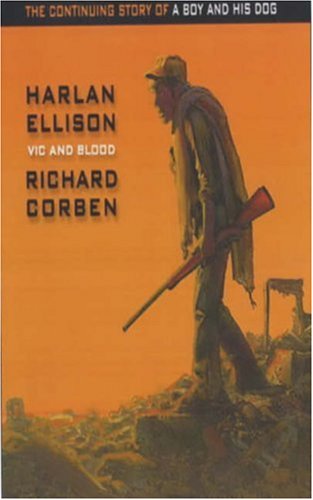 On the one hand, the reader admires Vic's sacrifice: offering up his newly minted physical love for the survival of his long-time friend. On the other, one imagines the scenarios where Quilla could have lived. Perhaps they could have sneaked off while others slept, fed the dog back to health, and then made their merry way.
But Vic is established as a not-too-bright kid, for whom violence seems to be the first solution. His solution is certainly not typical Hollywood fodder, which is surprising since it was made into a movie.
The story may be a reaction to conservative societal forces of domesticity, where the desolation and dog-eat-dog scrabble for life (where YMCA, or Young Men's Christian Association is destroyed) is preferred over the steady agrarian life of polite society (where Holmes is home). Or it may just be the tale of a wild, young man--a tarzan--who could not be tamed for a world we presently assume as the proper norm.
A third possibility is that it reacts against feminist utopias where men are absent from society because they represent violence and women are peaceful if not technologically progressive. However, this interpretation is problematic, providing evidence for said utopia.
A fourth possibility is the antithesis of the third. It recognizes the problematic aspects in the title by calling Vic a boy.