Search This Blog

Showing posts with label Harlan Ellison. Show all posts

Friday, May 19, 2023

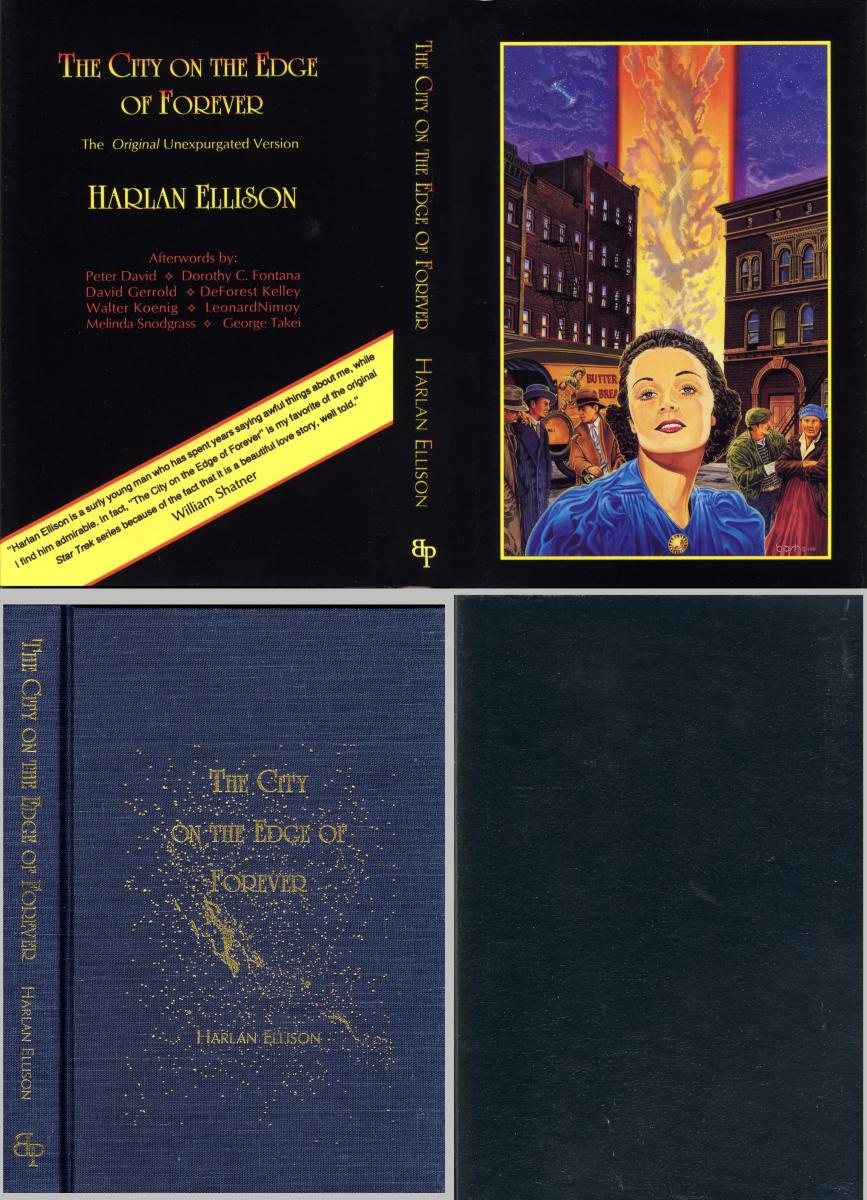
Harlan Ellison vs. Gene Roddenberry in the "City on the Edge of Forever" Arena: Which Was Star Trek Script Better? the Original or the Televised?

https://www.isfdb.org/wiki/images/c/c9/THCTNTHDGF1995.jpg

I'm a big Star Trek buff but also a Harlan Ellison fanatic where, as a lad, I'd read everything I could get my hands on--a mesmerizing voice that still energizes me to this day. 

This strange collection of essays and variant on a teleplay have been loitering in the to-be-read pile  for awhile--a kind of novelty item, I figured. But it's more interesting than one might suppose.

The first third is Harlan Ellison setting up this epic battle between the titans. Harlan Ellison's original version won the Writers Guild of America Award. Meanwhile, the televised version won a Hugo. It is consistently rated the best Star Trek episodes. I don't mean to suggest that Roddenberry's contribution matches Ellison's, but he at least oversaw the rewrite.

Does the play need a third of the book to explain itself? It is pure Ellison--always a plus. But it is too long.* If you love Ellison, you'll read it, anyway. Wikipedia may cover the gist, so I won't summarize.

Ellison takes his gloves off and goes after Roddenberry, but in Ellison's favor, he quotes his critics when possible. The last several pages are the responses of writers and actors who either worked in Star Trek or actually had an actual impact on the script. They yield substantive angles on the debate and, of course, weigh in on Ellison's side.

Shared plot setup without spoilers:

The Enterprise is heading to investigate a time anomaly. The crew beam down to a planet to find a "city" there. A time irregularity occurs. Spock and Kirk investigate to restore the timeline.

My perspective on this battle may differ from most. In part, I trust the spirit of what everyone mentioned in the book says, bearing in mind that Roddenberry wrote lyrics to the Star Trek theme song [never used], which allowed him to get a split the composer's royalties (the clip with Tenacious D is a bit crude but funny):


Discussion with Spoilers Galore:

So let's start with the aired script's opening: The usual bumpy spaceship bit. They pair this with a sick patient on the bridge. There's some sort of unnamed risk with using "cordrazine," but McCoy is the doctor. He knows what he is doing, yet he accidentally overdoses himself.

Let's leave aside the space "turbulence"--a bit corny and a bit too often used, but okay, maybe. Let's leave aside the madness. Also overused, but okay. 

The turbulence ends as soon as McCoy injects himself. Also, McCoy's madness ends when it's no longer needed either. Can it be so dangerous if you can just wait it out? Lock him in his quarters until the effects wear off. They were going to go back in time and catch him before him before he injects himself (maybe it happens and they just don't show that). We should probably leave aside the time paradox of stopping McCoy before injecting himself (then who stops him if he doesn't do it?).

Now the opening does seem like a logic mess when you pause to consider it, but maybe because the improbabilities are just the set-up, we buy them. We'll grant those.

One advantage to Ellison's version are the space pirates, which as is implied, some of the crew might have been made up of the same people. Not too many. It would be improbable that so many births would have been the same. But it would be a fascinating philosophical quandary that one could evolve a wholly different ethos if time had taken another path. This may have been an absurdity for Roddenberry: Either the perfect future lies ahead or it doesn't.

However, someone should decide how a pirate timeline fits in to this story. Perhaps that theme might be about how people decide what someone else's fate should be. Who gets to decide? Why?

Ellison's opening brings up the interesting part. Roddenberry was apparently telling people that Ellison made Scotty a drug dealer, which isn't true. Ellison made up a crew member who dealt drugs--the ostensible baddie of the tale. This is an intriguing perspective. The Star Trek crew are flawed.

Roddenberry rejected the idea as apparently no one on the ship was bad. Now that's fascinating. It would help to know your idealistic future before sending writers off to write stories for you. It would be more realistic to have a crew member go rogue (although I'm not sure if they'd discussed the monetary system yet, which might make a black market system pointless). 

But the fascinating bit is how it pits the realistic against the utopian. The utopian aspect is part of the show's charm and unique draw. After all, this is politically correct before politically correct was a thing. It showed the universe as it should be--cooperation between races and alien species toward a common goal. 

But it is unexplored how they got here--not to mention improbable. Even if you start with everyone on the same page, one of the crew is bound to get bitter about any story's outcome and start poisoning the atmosphere of the work environment.

Now Roddenberry is from another generation. He was trained to go along with society, served in armed forces, and later in the police department, so his perspective had to be one of obedient cooperation. Their Federation does work under military conditions. Still, it seems probable that this would go awry. Even the military has need of the law and courts. So not everyone is perfect.

But that is part of Star Trek. So I get why Roddenberry used Scotty's name--to show how [to him] immediately ludicrous it was to consider having any upstanding member of the crew misbehave since they all were upstanding. You can probably locate episodes where crew stepped out of line, but at least we can see why Roddenberry used temporary madness instead.

One wonders if part of the secret sauce that made this episode the most popular show is this tension between realism and idealism. Maybe Ellison sensed this on some level and was putting it to the test.

My problem with the use of the new crew member is that the addiction or the character's personality isn't well utilized. Does he deserve his fate? Would the members of the Enterprise have allowed this? Shouldn't they have called for an end to this?

It may that a Guardian of Time sees the violation of time as a crime punishable by eternal death, but we'd need to understand that ahead of time. And how could the guy have known that his act of kindness was a greater cruelty? Maybe that's part of Ellison's intended theme. It does open a can of worms, but it would be interesting to dive into them.

One of the things I liked about the televised script better is the earlier appearance of Edith, granting more time to develop more of a relationship (did they maximize this?). The closer the connection between the Captain and Edith, the more we'll feel the pain.

Also, instead of being told what their goal is, to find a cryptic focal point in time, Spock works up an apparatus with early 20th century materials to find the focal point. The problem is what is Spock's apparatus? Is it a TV? Why is it seeing newspaper articles? Why is it seeing articles from the future? Does Spock already know how to see in the future? Why not do that in all episodes then with fancier equipment and solve problems before they occur?

The Guardian of Time might as well have just told them what the focal point is for that era.

There's one last problem for both scripts. Why kill Edith? Why couldn't they have taken her into the future with them? There has to be a better explanation for this. Why must she die instead of being transported into the future with them, especially if Kirk is in love with her. This has to be at least debated.

It'd be cool to see an updated version of this, combining the best of both scripts:

1) Harlan's opening, but with a story use of addiction or the use of somebody so irresponsible with his ethics: disposing of and manipulating people so easily, so cruelly. It needs to play a more vital role in the unraveling of the tale.

2) Since our baddie is a vital aspect of this version, his story/character should be developed a bit more. Does he deserve his fate? Should he be rescued? If no, why not? If so, what do you do with him afterwards?

3) Why does Edith have to die? This needs to be clearer. It would make more sense to get upset over the televised episode of Star Trek than Tom Godwin's "Cold Equations" because there's no reason for her death. Ellison's script seems to have taken Godwin's scenario to heart and has two men die for this one female, suggesting the cruelty of fate. They serve as foils or counterpoints to Edith's demise. At least her death had value. Maybe one can only go backwards into time. That would explain why Edith had to die.

4) Develop James and Edith's relationship so we believe the relationship is a bit more than a momentary attraction. His pain should be more palpably felt. 

5) Space pirates or not? How do they fit in with the new theme?

All of these changes would suggest a two episode or movie development. If it's a movie, one might think more deeply about the theme.

*Note:

A scan of Ellison's other new editions suggests this is a common issue--introductions growing too unwieldy in their length, like a lawn left to grow knee-high weeds. His essays can be fun, energetic, but maybe future editions should leave off the introduction to the introductions or, for the completists and for the curious, thrust it into a back appendix. For now, new readers should skip them.

Friday, November 8, 2019

The Man Who Folded Himself by David Gerrold

This was up for the Hugo, Nebula, Locus and Jupiter awards


This is a novel that may be exhilarate and disturb. For some, it may disgust. For others, they may see precursors as having covered this before, but the novel’s target audience will be those who delight in the bizarre “sexcapades” and time paradoxes. If you are only into the latter, read the first half and the ending.

Imagine expanding the world’s greatest time-travel story (Robert A. Heinlein’s “All You Zombies”) to novel length. It might look something like David Gerrold’s The Man Who Folded Himself. There are differences, which I’ll discuss below. If you haven’t read Heinlein’s story, do so.

In Gerrold’s novel, Danny, our narrator, has inherited what he believes to be 143 million dollars since his Uncle Jim had suggested as much. So Danny is living off the fat of the land. Except it turns out, after Uncle Jim dies, that he has been living on the last of the fortune. All that is left is a belt.

The belt, though, is a time machine, which allows him to change his life.

Discussion (Spoilers Galore)

Some argue this novel should have won the major awards. The winner, Rendezvous with Rama, seems to be controversial—a mysterious, alien ship floats through space with little characterization—but others have argued for completely different novels (Lethem in favor of Thomas Pynchon's Gravity's Rainbow), so perhaps that is why Clarke's novel won. Other reasons may exist.


It’s similarity to Heinlein’s work may have marred the work in some eyes, but it takes different narrative, tonal, and philosophical paths. The narrative changes (the time skip, the expansion into the sexual nature) aren’t especially significant in terms of meaning but the other two are.

In the sixties, sex seemed to have lost its taboo nature. A lot of books tried to exploit and explore the new boundaries of decency when court cases like Allen Ginsberg’s Howl won. Harlan Ellison’s Dangerous Visions, mined this vein. It is into this atmosphere the novel is released.

Danny and his future self go to the races and bet on horses. They win handsomely, knowing the outcome of events. They invest and become rich. But at some point (midway into the novel), Danny is warned by one future self that another future self will seduce him because being himself, the future selves understands his needs better than anyone.

Now the narrative is somewhat sly. The events may or may not have or will have happened. He is, after all, reading the diary of a future self, and he may or may not choose to fulfill these things, which is an intriguing concept in itself. It prevents the protagonist from actually committing acts he may but hasn’t yet committed.

Another interesting aspect is the textual assumption that one will be attracted to one’s self. Narcissism is usually a metaphorical abstraction, but here it’s literal—a physical reality. But not everyone is attracted to himself. So the text for those, will at best be strange, foreign angle, much as the text justifies itself.

A third aspect that differentiates this and makes it stand out is its tonal difference from Heinlein’s story. In Heinlein, the narrative is as epic and inescapable as Oedipus Rex. But here, flux and uncertainty about the future is the name of the game. What’s interesting about this is the narrator’s attempts to avoid this flux by remaining near his “home time” or his era since other eras become too foreign the further away he is from what he knows. Also, just as he maintains the livelihood of his own future, he tries to keep the present past aligned with his own memory of events since that might change his present.

The narrator is preoccupied with his own inevitable death, his failure at love outside himself (or even with himself) and this maintaining of his present. These and speculative inventions like the Time Skim (although not fully utilized) sets this tale at least a little distance from Heinlein’s.

It's a little surprising that this and Heinlein's story haven't been named for a Retro-Tiptree award.

Tuesday, May 28, 2019

Review: "Repent, Harlequin!" Said the Ticktockman by Harlan Ellison

May 27th was Ellison's birthday. He passed on June 27, 2018, Los Angeles, CA
Image result for repent harlequin

"Repent, Harlequin!" Said the Ticktockman 
by Harlan Ellison 
Open Road Integrated Media 
Sci Fi & Fantasy

Harlan Ellison has been my go-to writer whenever I'm down and the writer's-block blues bang their drums, it's Ellison, the mythic man, the legend with a frenetic pen. His quill vivisects your heads and dribbles in his ink.  Even when he's bad, he's good.

If you haven't tried him, this is a perfect sampler. It opens with a short essay, hits with the main event story--winner of the Hugo, Nebula and Prometheus awards and reprinted more the two dozen times--and closes with a personal reflection.

The tales opens with the middle, rewinds to the beginning, and then closes at the open end. Even though he tells you what he'll do, it still comes as something of a surprise. Harlequin is plaguing the city of the future. He's upsetting the Tictockman, who has to see that everything starts and end on time. If not, he takes those lost minutes off the end of your life. Harlequin, meanwhile, distracts shoppers and construction workers and average citizens who are trying to get their work done on time by shouting at them through megaphones and distributing jelly beans--lots of jelly beans (which is never explained, but oh well. Ellison warned us).

Ellison's prose sizzles. It crackles and pops.

Here's an excerpt from the closing essay:
"When you come into my bedroom, you see the bed up on a square box platform covered with deep pile carpeting. It's in bright colors, because I like bright colors. Now, there's good solid, rational reason why the bed is up there like that. Some day I'll tell you why; it's a personal reason; in the nature of killing evil shadows. But that isn't important, right here. What is important is the attitude of people who see that bed for the first time. Some snicker and call it an altar. Others frown in disapproval and call it a pedestal, or a Playboy bed. It's none of those. It's very functional, and serves an emotional purpose that is none of their business, but Lord, how quick they are to label it the way they see it, and to lay their value-judgment on it and me."
The Tictockmen have very good reasons for their value-judgments.

Some of you are wondering, why do we need to hear about Ellison again? Why do we need to hear about Ellison again?

Because there's always a new generation that hasn't heard of him, and there's always a new, vocal group in every political faction that wants to strangle any opposition, authoritarian-style. "Repent, Harlequin!" Said the Ticktockman may not be the cure, but it may flush a few more harlequins out from their bunkers.

Of course, if you're the Tictockman, you may not want to read this story.

Sunday, July 31, 2016

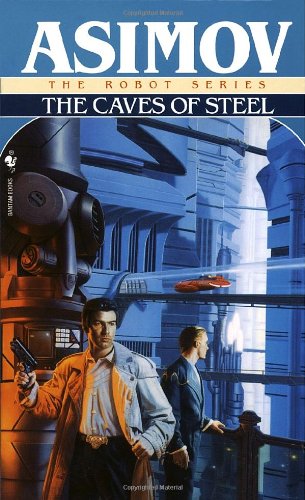
Caves of Steel by Isaac Asimov

Isaac Asimov dabbled in mystery and SF, occasionally combining them. Apparently, the first of these, Caves of Steel, is being written as a movie. The BBC made it into a TV movie by in 1964--of which only excerpts exist.


Akiva Goldsman, Oscar winner and screenwriter of I, Robot and Fringe, is slated as the third screenwriter to give it a go for Fox. How many before Fox? It may be difficult to put on the big screen. Another attempt of turning the novel into a "movie"--or, rather, a VCR game:


[Side note: The I-Robot credit will turn off many, but it actually does utilize a number of Asimovian plot turns and verbiage. I, Robot was also a short story, so to fashion a movie out of it is impressive. No, it isn't what Asimov would have written but it keeps and comments on Asimov's ideas--not to mention maintaining Asimov's works in the public eye.  I have only read Ellison's script opening to I, Robot and, though I enjoy the work of both writers, the opening didn't grab me. SF Encyclopedia [John Clute] writes:
"the screenplay itself makes clear how difficult it would have been to translate Asimov's archaic concepts... onto the contemporary screen."
I will try again, later. 
While Goldsman's Batman films and a few others were regrettable, he did a fine job on A Beautiful Mind on other adaptations like I, Legend. Fringe was a romp. Yes, he differs from the original books, but that's okay. They weren't mockeries, but rather interesting deviations. One can always examine the original. One could complain of a Hollywood treatment, but isn't that the point? To sell movie tickets? How many more books were sold because of the movie?]

Summary:
Earth Detective Elijah Baley is told he must work with a humanoid robot, R. Daneel Olivaw (the "R." stands for Robot) to solve a murder of a Spacer. On Earth, by law, robots don't look like people, but Olivaw does not appear robot-like. This gives Olivaw an advantage (Olivaw threatens violence to Earth citizens) until a rumor circulates that Olivaw is a robot. Baley's own wife hears the rumor which worries her about Baley's safety.

The Medievalists is a society of Earthlings who hearken back to a less technological day of wearing glasses or using windows. They seem benign enough: Baley's boss and his wife are members. But when they make signs to one another at a dining hall where Baley and Olivaw eat and pursue after Baley and Olivaw in a chase scene across slidewalks, they seem a lot less benign.

Though Baley tries to prove his partner, Olivaw, is the true murderer, Baley gets no closer to finding out who did it. In fact, evidence seems to point to Baley himself. The Spacers and Olivaw get what they came for--proof that Earth would have citizens willing to go into space--so that Baley appears to be left to pay for a crime he didn't commit.

However, Baley thinks up a loophole that gives him an hour and a half to solve the crime.

Themes and importance:
Asimov extrapolates a few key speculative ideas:

  1. Overpopulation leads to city overgrowth, to the extent that people fear going outside. Agoraphobia. The works well with the mystery, limiting what characters would and would not do.
  2. Technophobia on Earth leads to Earth's phobia of robots, especially robots that look like humans. 
  3. Technophiles are the few who escape Earth and building colonies. These, the Spacers, are the elite. They do not have disease and comparatively long-lived.
  4. Space colonization is so lovely that Spacers are willing to overlook murder if it can achieve a greater aim.
  5. Being long-lived leads to complacency, which ironically a spacer cannot be. Therefore, the Spacers have to recruit from Earth.

The Caves of Steel has its admirers. James Gunn used it to teach SF--one of the major novels shaping SF. It is one of the first major SF novels to treat robots, overpopulation, and mystery in SF. The theme of the importance of space colonization was common if not ubiquitous.

This last, for me, was the Achilles heel--not because I'm against colonization but because it was above questioning. Spacers (only here, not later) are too benevolent and wonderful. They provide an instant contrast that glorifies colonization and berates those rubes who remain on Earth.

Asimov corrects this in The Naked Sun, creating Spacers with their own foibles, which is the better novel for this and for a mystery that plays a little more fairly. The contrast between societal flaws is fascinating. I'd love this one to become a movie, but it does hinge somewhat The Caves of Steel. So maybe it has to be written first.

Tuesday, December 8, 2015

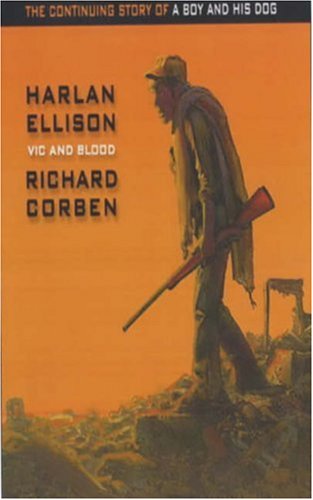
"A Boy and His Dog" by Harlan Ellison

First published in Michael Moorcock's New Worlds. Nominated for the Hugo, it won the Nebula and was reprinted by Donald A. Wollheim, Terry Carr, James Blish, Charles W. Sullivan, Michael Moorcock, Jim Wynorski, Arthur C. Clarke, Walter M. Miller, Martin H. Greenberg, Jack M. Dann, Gardner R. Dozois. The film starring Don Johnson won a Hugo, the Golden Scroll and was nominated for a Nebula.

Summary:
In a post-apocalyptic world where two more world wars have been fought, Vic and his dog, Blood, attend a pornographic movie. The dogs here are telepathic, and the women rare--at least, above ground. Blood smells a woman in the theater, so the pair pursue her to a YMCA where he plans to rape her as he has other young women. But the woman, Quilla June Holmes, refuses to be anonymous--courageously demanding humanity against the face of inhumanity.

Her gambit works. Vic doesn't want to rape her but soon has company that does want to do just that. The gymnasium is surrounded by a roverpak, which try to take them. They are outnumbered without escape.
Analysis:
 Vic, Blood, and Quilla burn down the gym while they shelter in the basement furnace to convince the roverpak they're dead. Quilla and Vic get know one another in a Biblical sense that makes Blood jealous, afraid he'll lose Vic. Quilla questions whether Vic knows what love is and escapes, leaving her card so that Vic will find it and pursue her. Blood, injured, does not like Vic's plan to visit her in her underground shelter, but promises to wait a time for Vic.

Vic's visit is unpleasant. The enclave has stopped reproducing for lack of fertile men. They had used Quilla to lure him in to be domesticated and become a stud. However, Vic doesn't take to the domestication and brings Quilla back with him to the surface where Vic is dying for lack of food.

Vic realizes whom he loves and feeds Blood the only food at hand--presumably Quilla though it is never explicitly mentioned, grilled over a smokeless fire.

This story probably could not have been published without, in part, Ellison's own Dangerous Visions anthology, not to mention Moorcock's chance-taking at New Worlds. Yet as times and mores change, the story might be more of a dangerous vision now than when it was published.

Like  "I Have No Mouth and I Must Scream," women are scarce but requisite for men to have. Vic's attitude is also problematic. Rape is the key. You get in and out quickly. Women are not expected to enjoy the experience. But Quilla alters his perspective. Vic slowly falls in love but not enough--we learn at the end--to overcome Vic's love for his dog.

Still, Vic's continued violence and repugnance toward domestication should have telegraphed the ending. The scenario is not unlike Tom Godwin's "The Cold Equations" where in an impossible scenario, a young woman has to be sacrificed for the greater good. In this case, to save the life of one who has already proved himself and would help Vic survive in the current world.

On the one hand, the reader admires Vic's sacrifice: offering up his newly minted physical love for the survival of his long-time friend. On the other, one imagines the scenarios where Quilla could have lived. Perhaps they could have sneaked off while others slept, fed the dog back to health, and then made their merry way.

But Vic is established as a not-too-bright kid, for whom violence seems to be the first solution. His solution is certainly not typical Hollywood fodder, which is surprising since it was made into a movie.

The story may be a reaction to conservative societal forces of domesticity, where the desolation and dog-eat-dog scrabble for life (where YMCA, or Young Men's Christian Association is destroyed) is preferred over the steady agrarian life of polite society (where Holmes is home).  Or it may just be the tale of a wild, young man--a tarzan--who could not be tamed for a world we presently assume as the proper norm.

A third possibility is that it reacts against feminist utopias where men are absent from society because they represent violence and women are peaceful if not technologically progressive. However, this interpretation is problematic, providing evidence for said utopia.

A fourth possibility is the antithesis of the third. It recognizes the problematic aspects in the title by calling Vic a boy.

Saturday, December 5, 2015

"The Beast that Shouted Love at the Heart of the World" by Harlan Ellison

First appeared in Harlan Ellison's collection The Beast that Shouted Love at the Heart of the World. It won the Hugo award and was reprinted in few retrospectives by Isaac Asimov, Robert Silverberg.

Summary:
In a place where time does not exist as we know it, a seven-headed dragon is drained from a man so that he becomes sane. Semph, one of two observers draining the insane creature-man, "interposed himself," presumably stopping or impeding the job. He is sentenced to die.
Analysis:
This has one of Ellison's titles that intrigues, conjures the story and its theme if obliquely. When I first read Ellison, I imagined the title both conjured the story and its artist: spreading ugly truths (through violence or whatever unpleasant reality) with verve and joy. I'd not venture to say that now though, especially with an opening where a man does something terrible to people and then turns around to say how he loves them.

What the story seems to suggest is that our insanity--albeit, a destructive force--is a part of us, a part of who we are. To lose it is to lose ourselves, our identity. This insanity is ineffable. When confronted by it, no one knows what to do with it (see ending where Semph's memorial, which is amazing and may or may not have started WWIV, is quickly forgotten, let alone not understood). In the "center... there is no madness."

There is a slight allusion to Pandora:
"Friedrich Drucker found the many-colored box. Maddened... the man tore at the lid of the box.... But Friedrich Drucker had little time to ponder the meaning of the purple smoke, for the next day, World War IV broke out."
So like Pandora, while Friedrich Drucker might have unleashed evil forces on the world, something good like hope might have also been unleashed (love? but if so, it's a bizarre kind of love).

Semph says that this insanity could be drained, "[b]ut what we'd have left wouldn't be worth having." Our insanity makes us human or who we are?

The tale could be a little more lucid. The writing is at times Ellison Wonderous--"Cyclones and dark, winged, faceless shapes that streaked away into the night, followed by a last wisp of purple smoke smelling strongly of decayed gardenias."--and at times forgettable:
"Linah spread his hands in futility. 'Survival.'
"Semph shook his head slowly with a weariness that was mirrored in his expression."
 An interesting work, nonetheless, if not one of Ellison's best.

Wednesday, December 2, 2015

“Repent, Harlequin!” Said the Ticktockman

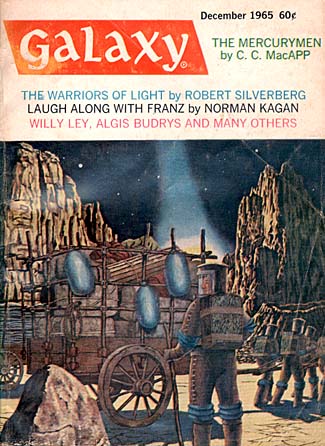
First appeared in Frederik Pohl's Galaxy. It won the Hugo, Nebula and Prometheus awards. Reprinted in several major retrospectives by Damon Knight, Donald A. Wollheim, Terry Carr, Frederik Pohl, Dick Allen,  Willis E. McNelly, Leon E. Stover, Thomas E. Sanders, Isaac Asimov, Daniel Roselle, Bernard C. Hollister, Charles W. Sullivan, Leo P. Kelley, Martin H. Greenberg, Patricia S. Warrick, Bonnie L. Heintz, Frank Herbert, Donald A. Joos, Jane Agorn McGee, Rich Jones, Richard L. Roe, Leslie A. Fiedler, Arthur C. Clarke, Jerry E. Pournelle, John F. Carr, Ben Bova, Martin H. Greenberg, Applewhite Minyard, David Hartwell, Orson Scott Card, David G. Hartwell, Jack Dann, Gardner Dozois, Rob Latham, Veronica Hollinger, Joan Gordon, Istvan Csicsery-Ronay, Jr., Arthur B. Evans, Carol McGuirk, John Joseph Adams.

Summary:
The Harlequin is disrupting a future dystopia ruled by time or, rather, the Ticktockman. He holds the cardioplates of its citizens and can end peoples' lives prematurely if they are late to work, etc. The Harlequin slows schedules with a $150,000 in jelly beans gumming up slidewalks, badgers shoppers not to be slaves to time, and eludes capture (getting would-be captors caught in their own web).

Analysis:
This has one of Ellison's patent-pending titles that simultaneously intrigues, conjures the story and its theme if obliquely. This tale provides an intriguing contrast to "I Have No Mouth and I Must Scream," which has a similarly loaded title.

The latter story, however, at first appearance seems simple enough but proves to be thematically elusive or at least complex. This story's theme, on first glance, feels elusive but turns out rather simple if compelling. It is spelled out immediately from Henry David Thoreau's "Civil Disobedience":

"The mass of men serve the state thus, not as men mainly, but as machines.... there is no free exercise whatever of the judgement...they put themselves on a level with wood and earth and stones."
Men choose to become machines--as they did in "I Have No Mouth and I Must Scream," albeit to a different effect.

What surprised and disappointed as a lad yet empowers me as an adult--coming midway into the story--was that the Harlequin was an ordinary man, in love with an ordinary woman. They have a spat about his extracurricular activities and lateness (later, when he's told that his wife or girlfriend ratted him out, the exchange about whether she did or didn't takes on a different flavor).

Although the theme is somewhat clear, the ending is elusive. It involves at least three possibilities:
  1. Harlequin confesses, gets killed, yet somehow infects the Ticktockman with anti-clock mentality. This seems least probable since most in power would want to cling to that power.
  2. Harlequin somehow escapes, forces the Ticktockman to believe he is the Harlequin, gets the Ticktockman to confess as if he were the Harlequin and gets killed while the Harlequin becomes the Ticktockman. We aren't witnesses to this complicated event. While Harlequin might be trickster enough to pull this off, is the Ticktockman truly gullible enough to fall for an identity switch? Nothing in the story really leads us to this.
  3. Harlequin is the Ticktockman. Both mask their identities. The Ticktockman's irregularities at the end match the Harlequin's usual habits. We don't know if this is unusual for the Ticktockman, but being in charge, he could probably get away with it. 
Additional confirmation of the lattermost interpretation comes at the opening where to whom the narrator is referring--Harlequin or the Ticktockman--gets confused. We open with an unknown, unassigned "he" pronoun. In fact, even after the Ticktockman is introduced, most readers will assume the narrator is speaking of the Harlequin, yet the last "he" mentioned after the Ticktockman's mention is the Ticktockman. So grammar rules dictate that the Ticktockman should be the "he" referred to.

Finally, there is a temporary irony (or hypocrisy) that loses its meaning if Harlequin is the Ticktockman:
"[H]e was called the Ticktockman. But no one called him that to his mask.
"The cardioplate here in my right hand is also named, but whom named, merely what named."
We know what the Ticktockman is--the Master Timekeeper--but not who he is since he is masked.

The theme isn't much altered in the first two ending possibilities. But the third suggests that the revolutionary and the problematic cogwork-makers sprout from the same scarcely sane source. The theme alters considerably. It might be paraphrased by The Who's "Won't Get Fooled Again":
"Meet the new boss. Same as the old boss."

Monday, November 30, 2015

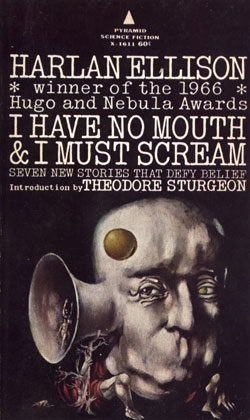
"I Have No Mouth and I Must Scream" by Harlan Ellison

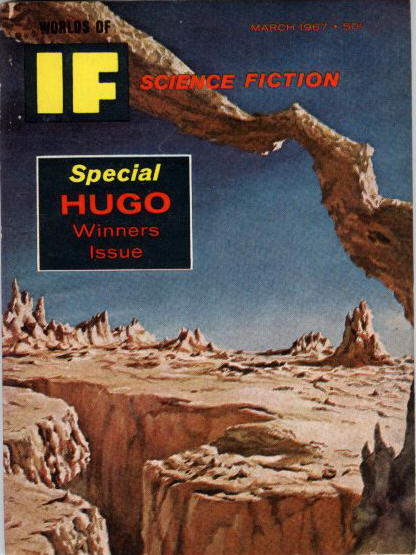
First appeared in If. It won the Hugo and was reprinted in several major retrospectives by Donald A. Wollheim, Terry Carr, Robert Silverberg, Damon Knight, Total Effect, Isaac Asimov, Stephen V. Whaley, Stanley J. Cook, Thomas Durwood, Armand Eisen, Leonard Wolf, Clarkson N. Potter James E. Gunn, Eric S. Rabkin, H. Bruce Franklin, Thomas F. Monteleone, Frederik Pohl, Joseph D. Olander, Patricia S. Warrick, Charles G. Waugh, Martin H. Greenberg, Edel Brosnan, and Peter Straub.

Summary:
Humanity has been slaughtered an artificially intelligent machine, built to fight WWIII. The last five humans are trapped, immortal but tortured in the belly of the machine. Any time they attempt escape, their fates are made worse.

Analysis:

Despite--or because of--his protestations to the contrary, the narrator is insane (he has to emphasize his own statements which he has not had to do elsewhere):
"I was the only one still sane and whole. Really.
"AM had not tampered with my mind. Not at all."
Note, too, that this is written in the past tense, so when we reflect back, it's hard to believe any of his past had much sanity or a lack of tampering. Strange, too, that the five should journey for months and still be inside the machine, with deck plates.

One might question the veracity of his tale, but the story would fall apart. If we were to buy into his narrative, we could understand why he might be insane.

"[D]eath was our only way out. AM had kept us alive, but there was a way to defeat him."
The narrator kills his companions to spare them of eternal horror. The computer--as much a creator as the created--transforms the narrator to be stripped of his humanity:

"Outwardly: dumbly, I shamble about, a thing that could never have been known as human."

The title comes into play. Like his creature/creator, the narrator cannot express himself, even his horror, which is what supposedly drove the AI insane:

"We had given AM sentience. Inadvertently, of course, but sentience nonetheless. But it had been trapped. AM wasn't God, he was a machine. We had created him to think, but there was nothing it could do with that creativity."
In other words--I suspect--the computer went insane because it couldn't move (or whatever feature that humanity has that the computer cannot have). Stephen Hawking's sanity despite ALS seems to disprove this theory (although maybe Hawking is too intelligent to display his insanity or lacks the omnipotence to destroy humanity and turn the rest of us into slugs, but let's assume he's sane). Moreover, if AM has this incredible omnipotence, yet is trapped in place, wouldn't his powers be enough to simulate movement or create a facsimile of himself that can move?

Also in the above passage, it negates an earlier comparison of the computer to God:
"Most of the time I thought of AM as it, without a soul; but rest of the time I thought of it as him, in the masculine... the paternal... the patriarchal... for he is a jealous people. Him. It. God as Daddy the Deranged."
But this machine god does not act like previous gods, but one of pure malevolence. Rather, the interesting part is the masculine aspect. In fact, he describes Ellen's having sex with the men as being "serviced." So perhaps what we hear described is what happens when men become machines.

It's hard not to feel for Ellen. She clings to or favors the man who favors men. Why? Because he presumably does not expect anything from her. She'd taken the narrator twice out of turn, which the narrator refers to with some pride. But this shows a number of aspects in their relationship: She mechanically does each man, presumably to keep them happy. Does it make her happy? The narrator seems to assume so. Four men, one woman. If the reverse were true, presumably the men would be equally pleased.

The narrator, however, is jealous of her affection toward Benny and describes her:
"Oh Ellen, pedestal Ellen, pristine-pure Ellen; oh Ellen the clean! Scum filth."
It's hard not to imagine this attitude slipping out in tone and/or subtext, even if it were not verbalized. It's at least partially understandable that she is not as fond of the narrator as Benny who was apparently gay. Despite this, for some reason, Benny has been making love with Ellen.

While this theme is critical, it falls behind the Luddite message, or maybe ties into it:
"two great machine with glass-faced dials that swung back and forth between red and yellow lines whose meanings we could not even fathom"
Like Ellen, the machine is the thing we cannot fully understand. When we create, we do not anticipate the later repercussions. We create relationships, machines, things we don't fully grasp. We end up down a long, painful road going somewhere we hadn't intended, unable to voice our horrors. Insane.

Ellison was a younger man when he wrote this, which may explain some of the above exaggerated story aspects. Behind closed doors, the technology-positive writers must have disliked the tale.

Ellison's writing is so full of inventive energy--and so admired--that it's strange that more writers didn't follow his lead. Maybe some tried, and their work rebuffed. Instead, the new speculative literature writers followed Brian Aldiss and J. G. Ballard. This is probably due to influential editors like Gardner Dozois, but still surprising that so admired a writer didn't create similar writers.

Thursday, May 14, 2015

The Callahan Chronicals: pt 3 Time Travelers Strictly Cash by Spider Robinson

Other discussions of The Callahan Chronicals:
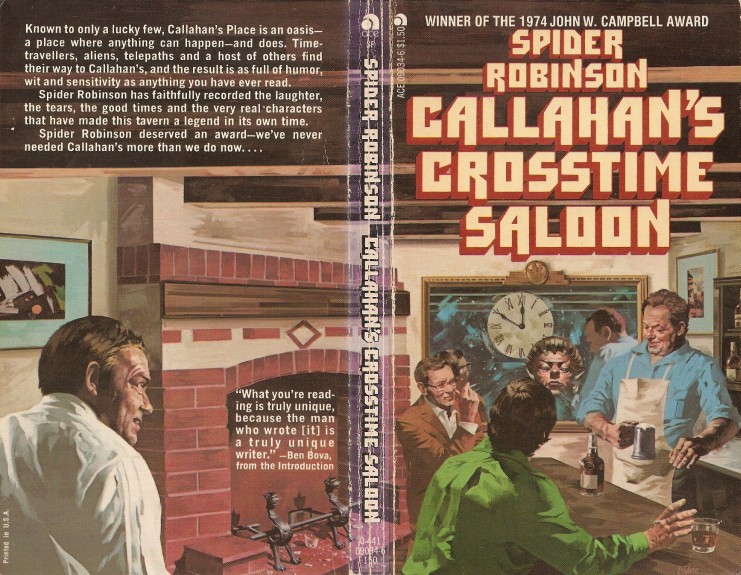
  1. pt 1 Callahan's Crosstime Saloon
  2. pt 2 Callahan's Crosstime Saloon
  3. pt 4 Callahan's Secret
Summaries and Commentaries with spoilers:

  • Fivesight: First appeared in Omni. Reprinted by Ellen Datlow. Two regulars tell rather embarrassing personal stories where they learned better. A gal tells her story where Cass, her soon-to-be husband, helps prevent a migraine from an accident he foresaw. He has limits. If he tries to avoid an incident, something worse occurs. They marry and he side-steps or ameliorates various incidents. She's happy until her son Bobby died in a bus accident. He knew in advance but did nothing.
Commentary: She makes a date with a supermarket stockboy, and finds a gun brought into the house. Murder? Hers? the stockboy's? She runs to the bar. Suicide, they learn. They help her date escape with an alibi.

Jake finally tells his story--how he caused the death of his wife and child trying to save money doing his own breaks--to help her see he can empathize with her sorrow. In fact, it's the fifth anniversary, which was why other regulars told their embarrassing tales.

This is the first we get much background on our narrator, Jake. The title is a pun. Cass is likely a reference to Cassandra from Greek myth, who foretells events no one believes. 
  • Dog Day Evening: First appeared in Analog. It was up for the Hugo and Locus awards. A German Shepherd and a man enter bar.  The man wants to prove his dog can talk. Callahan allows the bet so long as it doesn't follow the famed joke [see below]. Callahan puts an apple in the man's mouth. And the dog talks.
Commentary: Not only does the dog talk, but the man is mute. So the dog talks for him (not the opposite the regulars had anticipated). They can't make a living without conning people. The Callahan regulars come up with jobs for both: Radio talk show for the dog and typing for the mute.

Play on the old joke about a talking dog that goes into a bar. The dog answers questions about what's on top of a house? "Roof" Who's the best baseball player? "Ruth," etc. The joke's barkeep throws the man and dog out, and the dog asks his owner, "Should I have said Jackie Robinson?" Robinson cleverly inverts this joke.

Title refers to a 1975 film, Dog Day Afternoon, about a botched bank heist to pay for a lover's sex change. Some loose correlation.
    • "Have You Heard the One...?"First appeared in Analog. It was up for the Locus and Analog Readers Poll awards. A Santa pretender--he says he's an alien in a Santa disguise since no one would question Santa--brings gifts: The Universal Panopticon. He has a machine the improves one's mood, etc. All at the cost of pennies.
    Commentary: No trick about the pennies. That's what he wants because he's actually a time-traveler who needs copper pennies to navigate his machine since the future lacks copper. His inventions, though, are all an illusion. Josie, the time-cop lady arrests him--a ten-dollar crime. She wants to prevent paradoxes. It's not clear why the time-cop gal wouldn't allow the guy pennies to time-travel [after all, she explains what he's doing to the past--the explanation of which, one would think, might create paradoxes as well], or why she waited to reveal herself, but so it is.

    Still a fun and semi-sophisticated tale, especially compared to the earlier stories. The protag-/antagonist feels something like the disruptive harlequin in Harlan Ellison's "'Repent, Harlequin!' Said the Ticktockman."

    The last two stories present interesting scenarios where three people, backed into a corner, perform minor swindles. The dog and the mute not only get away with it despite the Callahan regulars' knowledge, but they also get full-time employment. Santa, on the other hand, gets hauled away. It's not clear why the different treatments. I point out a similar predicament that occurs at the end of  Starseed where two criminals attempt the same evil deeds yet get treated differently.
      • Mirror/rorriM Off the WallFirst appeared in Analog. There are no mirrors in Callahan's [to prevent vanity--ha, ha], but one appears, anyway. Meanwhile, where a stranger sits in the bar, the mirror shows the stool empty. The regulars move away, nervous about vampires. The stranger, Trebor, willingly trades great liquor for poor. Seeing a trick clock with the numbers reversed, Trebor tries to jump through the mirror. Callahan catches the fleeing figure for not paying his bill and paying with phony money.
      Commentary: Trebor is the reverse of Callahan's. He tricks the "Trebor" of Callahan's world to take the fall for a crime in a different dimension. He wants to swap irritating pollutants for non-irritants, but just as dangerous. Through a trick, they push him into the correct dimension. Interesting that they stopped the guy from exiting then forced him into it, minutes later. Still fun, though.

      "Pyotr's Story" nicely reverses the vampiric expectations.

        Series Commentary:
        Apart from "The Mick of Time," these may be my favorites in the series. Robinson combined idea well with milieu. He really hit his stride here.

        Friday, January 9, 2015

        "PRESS ENTER []" by John Varley

        First appeared in Shawna McCarthy's Asimov's. It won the Hugo, Nebula, Locus, Science Fiction Chronicle Readers Poll, Seiun (Japanese translation) awards. It was reprinted by Gardner Dozois, Donald A. Wollheim, Arthur W. Saha, Terry Carr, George Zebrowski, Isaac Asimov, Martin H. Greenberg, Sheila Williams, and Orson Scott Card.
        Summary:
        Victor Apfel gets mysterious automated phone calls that eventually lead him to investigate the home of his reclusive neighbor, Charles Kluge. He left a suicide note and his property to Victor. Enter Lisa Foo. Like Kluge, she is a computer hacker, talented enough to funnel any funds her way. She's the only person who knew something of what Kluge was up to. She also knows that Kluge would

        Discussion:
        In their investigations, Victor and Lisa stumble on the possibility that the responsible party is not alive, strictly speaking. It will go on to kill others.

        Computer-takes-over-the-world stories were not new. Harlan Ellison famously had "I Have No Mouth and I Must Scream." But at this time, computers were becoming ubiquitous--in schools, home and work. Ellison's was an omnipotent behemoth. Varley's lurked on the edges of a nascent world-wide web. The first-person narrative also lends a possible unreliability although the reader is never really lead to buy into such a possibility. In a sense, this nebulous SF monster becomes a shade more sinister.

        Orson Scott Card lauds this tale for its believability. Strahan, on the other hand, believes it hasn't dated well. I tend to side with Strahan (who wrote fifteen years or so after Card, after all). Probably the mention of 8-bit computers in the context of artificial intelligence erodes the modern reader's suspension of belief. Likewise, Asimov's spools and microfiche haven't weathered well. But technological possibility isn't what's interesting in older SF. Rather, it's what has been done for its time period. One must plant one's self in that day.

        "PRESS ENTER" was a common command in the software of the day. It indicates penetrating deeper within a program, or entering anything, really. But what specifically?

        The 80s, especially for SF fans, were never far removed from the 70s and their revolutions. Varley pushed that a little further, with stories that pushed the conventional-morality envelope. Many in the field questioned what morals were necessary. This attitude brought those who felt on the fringe into the SF fold.

        Here, Kluge and Foos are also on the moral edge. Maybe they've already taken the leap. Their financial dealings are at least unconventional and suspect if not illegal. Foos, in addition, has no real emotional connection with people. She has had sex with an older man in exchange for education. She is okay with this. Her relationship with Victor is itself problematic, legally speaking, and would rile up many on the political right and left. That this story won so many awards indicates a different political climate than the present.

        I submit this amorality is what the reader is entering. Not just the new human world, but also a newer amorality, which is not afraid to murder to protect its existence. And where would a new-born artificial intelligence gain such human morality?

        This story isn't meant to frighten its readers that the computers are coming, the computers are coming! Rather, it pushes them into a deeper discomfort on one level or another. At least, that is its intent. No doubt, some rare readers will not respond to it. But for most--no matter how liberated from conventional morality they think they are, how understanding of other cultural practices, how numbed by the horrors of war--there may exist an amorality that repels you, even forces you to hide in the woods.

        Note: I tried to get out of the story's way and present it in its most meaningful light. I do not mean to comment on its morality, one way or another.