Search This Blog

Showing posts with label Roger Zelazny. Show all posts

Wednesday, February 19, 2025

"Comes Now the Power" by Roger Zelazny

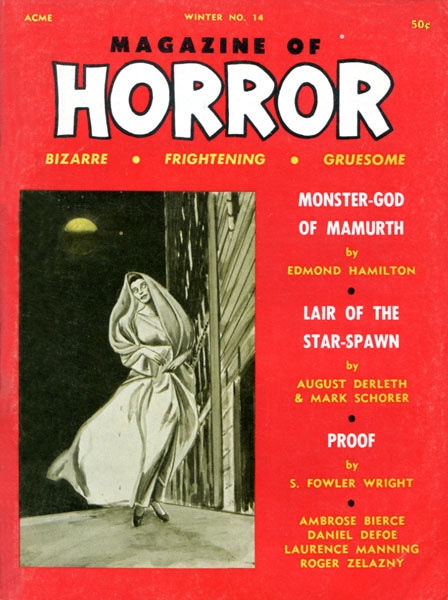
 https://www.isfdb.org/wiki/images/3/34/MGZNHRRWINTER1966.jpg

First appeared in Robert A. W. Lowndes's Magazine of Horror, finalist for the Hugo, reprinted by Lee Harding, Matthew Berger, Alexander Klapwald, Kenneth Sharp, Brian Attebery, Ursula K. Le Guin, Tracy Hickman, Margaret Weis.


Summary:

A man, who used to have telepathy, has forgotten how to do it. He finds a female mind who is able to do it, so he seeks her.


Discussion (Spoilers):

After a few failed connections, the man connects and she helps him breakthrough whatever was blocking him. However, he learns she is a young woman, hopitalized and dying, so his connection brought her memories of his life, so before her death, he gives her all that he has.

This is a wonderful, efficient little tale. I'm conflicted. It does a beautiful job executing the story in an emotionally impactful way. Any complaint would be negligible. However, is it one of the great tales? Does it resonate past its confines? Emotionally, yes. Is it a classic that makes you ponder the outcome in some meaningful way? I'm not sure that it does except to a minor degree. However, its inclusion--and a number of these brief, impactful tales--is a kind of challenge. What kind of story does belong? Does it need to be of a certain length? Fredric Brown's "The Weapon" is just a few pages long, but it wouldn't surprise me to be in such a major anthology like Norton's considering the way it forwards an integral question, better than stories 10x its length. What makes a major work? Something to ponder. 

Also interesting that this originally appeared in a horror magazine but there's really nothing of horror in it. Perhaps the major magazines passed on it--which boggles the mind--and Lowndes took it despite the lack of horror. 

(It appears that the title changed over the years and at one time had "and strange stories" which would makes more sense. Perhaps it was trying to hop on the horror train and dropped the original title.)


Wednesday, June 16, 2021

BOOM: A Lovecraftian Urban Fantasy Thriller Kindle Edition by Ben Farthing

Reminder: Ben Farthing's ebook, The Piper's Graveyard: A Small-Town Cult Horror Thriller Suspense, is on sale at 99 cents. I haven't yet read it.

Ben Farthing demonstrated his worth as a writer by having a story come in second in the Baen Fantasy Adventure Award. 

Last year, I encountered Farthing's first book, Boom--extremely strange, in the best sense of the term. If you like weird, chances are you'll like it. Read the excerpt first. If you're enchanted, then buy the ebook. Its speculative invention starts strong and barrels toward the finish. 

The story follows Everard Harrison, a resident of the D.C. metro area, pulls his truck to a stop to help a woman who appears to be in distress. He is presently unaware of his latent supernatural abilities until they fall upon him when threatened by others who have long been using theirs:

She breathed in deep gasps. Not crying--hyperventilating. 
"Hey, are you all right?" A stupid question.

He spotted a scrap of paper next to her that she must have dropped. He picked it up and touched her shoulder. She looked up. Her expression wasn't panic, but exhaustion, like she'd just run a marathon. Sweat beaded on her skin and glistened in her hair. She was slender, slightly older than Everard--probably mid-thirties--and gorgeous despite the blemishes across her cheek....

It wasn't acne, or age spots, or scars. It was a swarm of holes, moving both together and independently like a school of fish. Each deep enough to show teeth or bone, but instead only revealing pink flesh descending into shadow....

The holes glided over her face, over--oh, God--over her eyes, her open eyes, tiny fleshy pits slipping along whites and blues and irises. He should run. That what he should do, and he would, as soon as he could figure out what was going on with her skin.

It's interesting the author slapped a lot of labels on to clue readers into what they'd be in for: Lovecratian, thriller, urban fantasy, horror. He removed the label, but it did have a super-hero label as well. They are all useful guide posts to what's inside, but still inadequate. If you like non-stop break-neck thrillers that make it hard for you to catch your breath, this could be a good fit. 

I'd offer Roger Zelazny as a stronger comparison, more so than Lovecraft (though the design of the creatures that populate this realm share something of the Lovecraftian spirit). We have a protagonist who has forgotten, had his memory wiped, or somehow never knew of his connection to the strange inner world that operates beneath our own.

Because of its pacing, I almost failed to notice the deeper political significance of the work, situated as it is in the Washington D.C. vicinity. So it also offers some intellectual entertainment for those who like that sort of thing, but obviously without overbearing or overwhelming the work--subtly done.


Sunday, April 2, 2017

Reduced ebook lunches (expanded)

Map: Collected and Last Poems by [Szymborska, Wislawa]For whomever likes poetry and reading on Kindles, Wislawa Szymborska is on sale for $3.49.

Time to read her work again.

#

Song of Kali 
by Dan Simmons 
$1.13

#

Beyond the Farthest Suns: The Complete Short Fiction v.3 
Greg Bear 
$1.99


#

Jack of Shadows (Rediscovered Classics) 
by Roger Zelazny
$3.99 

#

Henry and June: From "A Journal of Love" -The Unexpurgated Diary of Anaïs Nin (1931-1932)
by Anaïs Nin 
$ 1 99

#

Alien Morning  
by Rick Wilber 
$2.99

#

The Essential Rumi 
by Jalal al-Din Rumi
$1.99 

#

Ham On Rye: A Novel 
by Charles Bukowski 
$1.99

#

Post Office: A Novel 
by Charles Bukowski
$1.99

#

This Boy's Life: A Memoir 
by Tobias Wolff
$1.99

#

On the Road: The Original Scroll
by Jack Kerouac 
$1.99

#

The Sheltering Sky 
by Paul Bowles
$1.99

#

I Sing the Body Electric: And Other Stories 
by Ray Bradbury
$1.99

#

White Noise 
by Don DeLillo
$1.99

#

The Fireman
by Joe Hill
$1.99

#

Neuromancer 
by William Gibson
$1.99

#

Rendezvous with Rama 
by Arthur C. Clarke
$1.99

#

Lilith's Brood: Dawn, Adulthood Rites, and Imago
by Octavia E. Butler
$1.99

#

The Lacuna 
by Barbara Kingsolver
$1.99

#

The Collected Novels: Lie Down in Darkness, Set This House on Fire, The Confessions of Nat Turner, and Sophie's Choice 
by William Clark Styron
$1.99

#

Number9Dream
by David Mitchell
$1.99

#

Anansi Boys 
by Neil Gaiman
$1.99

#

Anathem 
by Neal Stephenson
$1.99

#

Seveneves
by Neal Stephenson
$2.99

#

A Natural History of Dragons: A Memoir by Lady Trent 
by Marie Brennan
$2.99

#

Synners 
by Pat Cadigan
$2.99

Friday, April 11, 2014

New and reduced ebook lunches -- Updated with John Joseph Adams, Samuel R. Delany and Matthew Hughes

Military Science Fiction 1 by Bob Mayer $0.99
"2 Great Books for the price of one written by West Point Graduate and former Green Beret Bob Mayer."
Scott Nicholson
--from 99 cents to 2.99

Babel-17 
by Samuel R. Delany 
$1.99

The Compleat Guth Bandar 
by Matthew Hughes 
$2.99

The Galactic Center Companion 
by Gregory Benford 
$2.99

Ultimate Book of Impostors: 
Over 100 True Stories of the Greatest Phonies and Frauds 
by Ian Graham 
$2.51

By Blood We Live
 by John Joseph Adams, Editor 
$3.03

Awake in the Night Land 
by John C. Wright 
$4.99
--tales in William Hope Hodgson's Night Land
--first reprinted in Dozois' Year's Best SF

First Person Peculiar 
by Mike Resnick 
$4.99
--includes prize nominees

Age of Shiva 
(The Pantheon Series) 
by James Lovegrove 
$5.38

The Fall 
by Simon Clark 
$5.99

A Dark Traveling 
by Roger Zelazny 
$6.97

A Promise Of Stars 
by David Gerrold 
$6.99

The Adjacent 
by Christopher Priest 
$7.69


The Last Defender of Camelot 
by Roger Zelazny 
$7.97 

Dark Eden 
by Chris Beckett 
$7.99 

Welcome to the Monkey House: 
The Special Edition: Stories 
by Kurt Vonnegut (Author), 
Gregory D. Sumner (Editor) 
$7.99
--Editor analyses drafts and discusses how Vonnegut wrote title story.
--Could be a blast or a bomb.


 Waldo & Magic, Inc. 
by Robert A. Heinlein 
$8.99 

7 Steps to Midnight 
by Richard Matheson 
$8.99

Upon A Sea of Stars 
(The John Grimes Saga) 
by A. Bertram Chandler 
$8.99
--four novels/collections in series

The Time Traveler's Almanac 
by Ann VanderMeer and Jeff VanderMeer 
$11.04

The Revolutions 
by Felix Gilman 
$11.04

Terry Pratchett
--new Discworld novel
--two Discworld companion books
--forthcoming: nonfiction

Shipstar 
by Gregory Benford and Larry Niven 
$12.74 
--sequel to their Bowl of Heaven
--a look at a dyson-sphere world
--similar to Ringworld with more emphasis on characters.
--two SF masters at play

Other Worlds, Better Lives: 
Selected Long Fiction, 1989-2003 
by Howard Waldrop 
$9.95

Tuesday, June 4, 2013

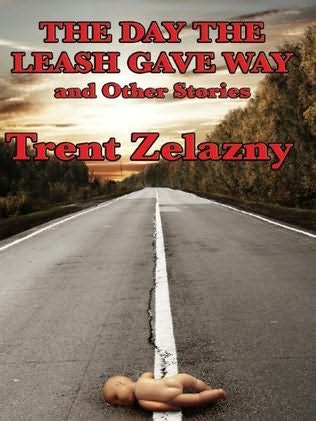
Review: The Day the Leash Gave Way by Trent Zelazny

One of my favorite writers since my youth has been Roger Zelazny.  I learned he'd had a son, Trent (clearly, a name destined to write), who also wrote, so I dug deeper.  Of father-son writers--Kingsley Amis and Martin Amis, Stephen King and Joe Hill, Richard Matheson and Richard Christian Matheson--this may be the biggest leap in styles although both Trent and Roger are intentionally stylish in their prose.  Where Roger in smooth, Trent is jagged and rough, noir-ish and dark, very dark.

The title story is a true oddity.  It begins, "Sam was surprised twice over."  Double that, and  you'll come close to what's in store for the reader.  Sam carries prize money to the Kellys'.  Before he's even in the house,  a dead dog is tied to its leash on the back bumper of a car.  On the dog's hind leg, the Kelly boy has clenched his teeth.  That's only outside the home.  Inside we find the Kellys have had the mother stuffed.  Men in suits arrive to take her away, but Mr. Kelly won't have any of it.  "At least Sam, our protagonist, is normal," you might say.  Not really.  He might be the star oddity in someone else's story, but here he shines as a beacon of sanity.  Sort of.  If you're looking for normalacy, this is not the place to look.  Expect to be disturbed.

Another standout which should appeal to most readers is "Found Money"--also sold as a separate ebook.  Nick lost his job at the bookstore because he was accused of stealing money which he could not have had access to.  However, he does find an envelope with $3,087 inside.  It was intended to go to a hit man, but the inept mobsters failed to deliver, and the head mafioso is ticked, not to mention the hit man.  Poor Nick tells his buddy about the money who accidentally discusses the find in front of the mobsters.  A delicious light crime tale and a palate cleanser for the edgier stuff.

My theory of opening stories in collections is that it should introduce the writer to something iconic about the writer yet also offer as easy a transition as the writer's work allows from traditional narrative (unless all of the writer's work is experimental).  Trent Zelazny's collection opens with "Hooch," a story of low-class people looking for sex, booze, profanity, and violence, all of which inundate the story.  If you can't stomach Quentin Tarantino, your stomach will disgorge any Tarantino you may have partially digested.  In "Hooch," Tim wants to get boozed and lucky but he's not so sure about Darlene, the girl he wants to make it with.  They move to the playground.  Enter low-life jocks who engage in a boozed battle, where one hero does not make it out.  Two escape the frying pan into the fire.  The relentless intensity dims some of its impact.

This is followed by the torture porn of "Acupuncture" where a man overdoes revenge for a man having an affair with his wife.  It's interesting--two stories in a row with the amusing if depressing theme:  Life sucks, then it gets worse.

"Harold Asher and His Vomiting Dogs" introduces us to Harold and choir of vomiting dogs who perform on stage to the tune of "Singing in the Rain"--with another weird surprise, in store.

My favorite is probably "The House of Happy Mayhem" where the normal-seeming narrator subtly reveals himself as deeply odd.  We meet him in the park as he watches people--in particular, a married couple. He comments to himself on their inner feelings.  Gradually, we learn our narrator absconds himself not just in the private lives of these people, but also in their houses, listening to their arguments and marital indiscretions.  It gets worse.

Zelazny has given us a collection of dark materials--from crime to edgy horror.  Some of it is an acquired taste, but others should appeal to broader predilections.

Wednesday, June 16, 2010

"Collector's Fever" by Roger Zelazny

Availability:
  • Galaxy June 1964
  • The Doors of His Face, the Lamps of His Mouth, Doubleday 1971
  • 100 Great Science Fiction Short Short Stories, ed. Isaac Asimov, Martin H. Greenberg & Joseph D. Olander, Garden City, NY: Doubleday 1978
  • 100 Amazing Little Alien Stories, ed. Robert Weinberg, Stefan R. Dziemianowicz & Martin H. Greenberg, Barnes & Noble 1996
  • Threshold: Volume 1, NESFA Press, 2009
  • online reproduction of text
Pre-Reading:
  • Science has much strange vocabulary when you first encounter it. So does science fiction. What readers of science fiction do is temporarily suspend the immediate need to know, suspecting they can learn what the term is from context. See if you can do that with this story. Write down the new term. Each time it appears, jot down any new layers of meaning you might get from the context. Don't worry if you can't come up with much.
Summary: A human, who never earns a name, has come to the newly christened planet of Dunghill in order to collect specimens for his rich uncle. This human plans revenge, using what he knows about the scientific nature of the unusual rock species found on Dunghill.

Questions:
  1. Stone asks a lot of questions. Why? When you finish reading the story, compare your experience of reading the story to Stone's experience of hearing the human's story. How are they similar? When and where do you think this happens on planet Earth every day?
  2. "Human" never gets a name. What does that do to him as a person? Does he deserve this? Using the text, point to where you get this feeling.
  3. How does human feel about his uncle? Using the text, point to where you get this feeling.
  4. Why does human call the planet, "Dunghill"? What does Stone think the human refers to?
  5. Human quotes, "one-eyed man in a kingdom of the blind," in order to convince Stone of its future importance in a place he doesn't want to be. What text does this allude to? Country of the Blind by H. G. Wells (Wiki): "In the Country of the Blind the One-Eyed Man is King." Knowing how well that works for Wells' protagonist, should Stone feel comforted by such an allusion? Explain.
  6. Half way through the story, the term "deeble" is introduced. Write down the new term. Each time it appears, jot down any new layers of meaning you might get from the context. Don't worry if you can't come up with much. The reason you will want to catalog this experience--at least once--is that it mirrors how you and infants acquired language.
  7. What happened to Stone in the ending? to human? Is it a happy ending? Justify your answer.
  8. What are two ways to refer to this statement by another sentient rock: "An excellent deeble.... It always pays to be a cautious collector."? (Hint: two creatures are collecting in this story.) Considering the first statement, which is the more likely interpretation? Might the author want us to consider both?
  9. What is fission? Does it release or absorb energy? How does society, especially France, use this energy today? [Tie-in to social studies] What makes alternative energy so attractive to world leaders today? Where has fission been used destructively in history?
  10. Stone says, "I've added so carefully to my atom collection, building up the finest molecular structure in the neighborhood [in order to deeble]." What sorts of atoms must Stone be collecting? Hydrogen? Helium? Lead? Uranium? something else? Explain your answers.
  11. "[T]he space... sedan, customized by its owner, who had removed much of the shielding." What's the point of shielding an atomic pile? Is this human very bright to remove the shielding? What is the atomic pile probably releasing?
  12. If you can think of other possible questions , please let me/us know.

On Teaching:
  • One way to use this story would be after an introduction to nuclear reactions. However, it may be useful at the beginning of a course for students to feel more comfortable with the upcoming unfamiliar terminology coming up.
  • For teaching physical science students the difference between fission and fusion, we break down the words: FISSion looks a lot like fizz, where bubbles leave your soda. So FISSion = FIZZ apart. FUSion comes from FUSe, where you fuse things together. An over-simplification, but the mneumonic solidifies their understanding well enough for that level. Also fUSion occurs on the SUn. Does the sun release energy? Do you think fusion releases energy? Fission occurs in nuclear bombs and in reactors. Do nuclear bombs and reactors release energy? Do you think fission releases energy?
Applications:
  • Language
  • Psychology: Language Acquisition
  • Understanding Science Terminology
  • Physics
  • Chemistry
  • Physical Science