Search This Blog

Showing posts with label confessional poetry. Show all posts

Friday, March 15, 2019

Banned Books: Henry Miller's Tropic of Cancer

Image result for The Henry Miller Reader
This post is rated PG, but it discusses and links to R-rated material or higher. There's a reason this is listed among the most banned books.

#

When I first read Henry Miller in college, I had no idea he'd been banned in the US and Great Britain. I picked up a volume called The Henry Miller Reader--a volume compiled to get around the ban by leaving out all of the salacious bits, which is the volume I would recommend to those who want to get a taste for his work but don't want their sensibilities offended--and was smitten by the prose. I read what amounted to a feast of food and words and swooned. I read and reread the passage, seeing what he'd done. I bought a metric ton of his books based on that five-page work alone.


#


But I never returned--at least not systematically. Instead, I read him haphazardly. I'd pore over a passage, fall in love, and close the book, feeling no compulsion to read anymore. I thought it a flaw, at the time. South Park creators, Matt Stone and Trey Parker, call this "And, then" writing (see video clip on right), which they consider bad--at least from the standpoint of getting most people to follow your art.

#

I was inspired to revisit Miller thanks to the Bradfield video here (he discusses a book I suspect was never banned and might be a safer exposure to Miller). Bradfield recommends Tropic of Capricorn and Big Sur over Tropic of Cancer. However, others have recommended it over other books--for example, the Modern Library lists as one of the top one hundred books of the 20th century, so why not?


#

The way to view Miller's work is through the lens of a lyric poem. In a narrative poem, we expect to be centered in the world. In Miller's work, we are centered in the mind of the narrator or persona who may or may not give you a map, who may or may not lay out entrances and exits, who may or may not (well probably not) give you transitions in place and time. All he lends the reader is his consciousness and unique voice.

#

I thought I'd hit upon an original perspective of Miller but no, at least not completely. Karl Shapiro suggested this in part in his introduction to Tropic of Cancer:

"I do not call him a poet because he has never written a poem; he even dislikes poetry, I think. But everything he has written is a poem in the best as well as in the broadest sense of the word."
Side note: I am curious if Miller's autobiographical fiction influenced the confessional mode of poetry. Clearly poets like Shapiro were reading him in the 50s before the ban was lifted.

#

There will be those who struggle with Miller's work, not just sexual prudes or narrative prudes, but also moral prudes. He will push all the buttons. He will test readers whether they read for aesthetic purposes or political ones. It's a kind of litmus test. If you don't pass, well, try out his Reader mentioned above. If this had been twenty years ago, I would have been surprised at even the necessity of discussing the distinction between art and morality.


#

I don't find his work as sexy although it is full of sexual situations, rather grimy ones--sometimes repulsive. You can try out the Miller Tropic of Cancer excerpts here. The first one links to the first forty pages. The second is an edited excerpt about Germaine--more of a character portrait than a story. It appears about a page and half after the first excerpt. This one cuts out Claude from the original text, which is a comparison of whores. I felt no arousal but found the description a fascinating perspective.

#


How can I recommend a writer without sharing his values or suggesting that others have to agree with him? How can one be a good reader and not read about people different from him? Sure, we are free to condemn, but that lies outside the scope of aesthetics and art--two separate issues.

The difference might be likened to watching a nude master swimmer in a public pool. You can comment on his skill on the one hand, and talk about the indecency on the other. Sure, you can focus on only the indecency, but you've missed out on much of the experience.

Do you have to read Miller? Should Miller be forced on others? No and no, respectively, but he is worth experiencing. What I notice in complaints is that a sample represents the whole, missing out on the bigger picture. One could say that he missed the boat on some aspects of human experience, but that is the human experience in literature: It is largely filtered by a human being who may be flawed.

#

That said, there are vulgarities that repel me from reading--offensiveness for the sake of being offensive which is not an aesthetic perspective. Maybe if Miller had spent too much time on vulgarity I would not be able to read him [ETA: I just read Quiet Days in Clichy, which did test my resolve. Link will function as soon as I finish writing about it]. It is not even just a matter of quantity but of quality. Miller is an observer, a student of himself, others, and humanity, which is part of what imbues his work with charm. He's a hungry artist, wandering the streets, apartments and brothels of Paris. He is perpetually looking for food and money, perpetually short of both. He is perpetually hungry for words and sex and finding a vitality in both. He is living in Paris after most of the famous literary artists had been there, following footsteps but making his own imprint. He is living in Paris during the Depression and the coming Second World War. His appetites are phenomenal to caress both aurally and on the page.

Since much of the work is within the narrator's consciousness and lacks the kind narrative thread one can follow, I'm not sure if an audio book is the best way to experience Miller, but then his words are also an aural feast, so I'm not sure if even that assessment is correct. There may be multiple paths into Miller's work.

Here's an excerpt that captures much of the elegance and energy and perspective that Miller offers:

As luck would have it I find a ticket in the lavabo for a concert. Light as a feather now I go there to the Salle Gaveau. The usher looks ravaged because I overlook giving him his little tip. Every time he passes me he looks at me inquiringly, as if perhaps I will suddenly remember. 
It’s so long since I’ve sat in the company of well-dressed people that I feel a bit panic-stricken. I can still smell the formaldehyde. Perhaps Serge makes deliveries here too. But nobody is scratching himself, thank God. A faint odor of perfume . . . very faint. Even before the music begins there is that bored look on people’s faces. A polite form of self-imposed torture, the concert. For a moment, when the conductor raps with his little wand, there is a tense spasm of concentration followed almost immediately by a general slump, a quiet vegetable sort of repose induced by the steady, uninterrupted drizzle from the orchestra. My mind is curiously alert; it’s as though my skull had a thousand mirrors inside it. My nerves are taut, vibrant! the notes are like glass balls dancing on a million jets of water. I’ve never been to a concert before on such an empty belly. Nothing escapes me, not even the tiniest pin falling. It’s as though I had no clothes on and every pore of my body was a window and all the windows open and the light flooding my gizzards. I can feel the light curving under the vault of my ribs and my ribs hang there over a hollow nave trembling with reverberations. How long this lasts I have no idea; I have lost all sense of time and place.

I discuss (or will discuss shortly) two other Henry Miller novels:
  1. Quiet Days in Clichy  (his most filmed) and
  2. Black Spring.

Tuesday, March 14, 2017

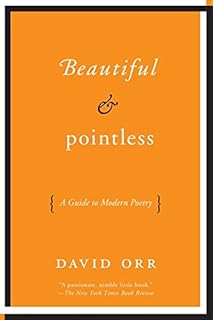
Beautiful & Pointless by David Orr

"I don't expect you to agree with everything that's said in each of [the chapters]; in fact... I hope you don't. If you do, you'll be preventing your own response, the most vital and disturbing faculty you possess, from fully developing its power. You want to become a reader of modern poetry, not a receiver of the verdicts of modern poetry critics."
--David Orr, "Introduction" 
In his introductory essay, David Orr makes a case that this book should be where a poetry reader / poet starts, as opposed to the usual topics of introductory poetry. The opening three essays probably would supplement a good poetry-writing or -appreciation course, but a few of the essays would push new readers out of their depth. I'll leap off the above quote to deviate along a parallel course.

Let's start with the final essay first: "Why Bother?" [with poetry, presumably]. It provides the main course for discussion in other chapters.

Orr presents the possibility often stated in poetry, that poetry is pointless but beautiful. He astutely shows that poetry is no greater a human endeavor than, say, gardening. We'll pass on the "beautiful." It may or may not be--each reader's aesthetics may vary (not that all are equivalent)--but let's examine the idea of pointlessness.

Historically, people have feared pointed-art as it might eschew art to become didactic. However, a simpler truth underlies art with a point: What does it mean to be human?

Orr describes how he tried to teach his father poetry as he lay dying. Why do this? Probably it was 1) to forge a bond, 2) to show his father why Gregory did what he did, 3) to justify himself, 4) to teach poetry or teach how words convey meaning between humans. Why did his father participate? 1) to forge a stronger bond with his son before leaving. I cannot guarantee this, but one could probably wager, visit the senior Orr in the after-life, inquire and probably win the bet.

For some, if art has a point, it must be as didactic as a classroom meter stick slapped across the palm. August Kleinzahler likely was speaking directly to this when he wrote as a blurb:
“David Orr reminds us that poetry is an ancient and living art, a robust American art, and not a commodity or vehicle for self-expression, social betterment, or career enhancement.” 
But sometimes art is just that frisson, that tiny burst of energy which addresses a small aspect of humanity we've just recognized or forgotten. It doesn't have to be world-shaking or political or personal or didactic--just human.

A-ha! someone asks, what about "The Red Wheelbarrow"? A moment in a human being's life, a moment noted and captured. That would explain "so much depends upon".

What about language poetry? Isn't that what humans use to communicate? Of course, it is human... if at a remove.

What about sounds and emotions and symbols, etc. in poetry? All of these are implied above. There is probably a human aspect to any human endeavor.

What about animals? Human create bonds between themselves and animals, often anthropomorphizing. SF has been dealing with aliens for a century and a half or more. Not only do we see our connection with the other, but also we often put ourselves in its place. However, some aliens are easier to connect with than others. More human? After all, not many weep over the death of thousands of cells every time you scratch your head or spray Lysol to kill germs in a hospital.

How well a poem addresses the question may explain how well and how many respond to the poem.

Plenty of caveats lurk in the sage brush, waiting to ambush us. On the one hand, this is not to advocate any single human perspective, since any single perspective would be limiting, privileging one group of humans over another. On the other, a single human perspective is all we have. We are individuals and as such we have individual voices, capable of utterances that are both human yet paradoxically unique.

*

Orr launches into the opening section called "The Personal" 1) to point out the popular misconception of poetry being so personal as not being able to critique it, and 2) to talk about confessional poetry. On the first point, he uses embarrassment as a key to discerning whether the personal is art or not, drawing up a make-believe scenario where a man plays a kazoo to lament the passing of his mother. But embarrassment is human and should be fodder for poets and artists to exploit. Woody Allen and other comedians rely on it. Whether the kazoo is beautiful or not, is a different matter.

The second aspect is confessional poetry. Some love it, some hate it. In some ways it addresses "What does it mean to be human?" better than most poetry. The problem with this sub-genre, for me, lies in its inability to step out of its frame. As Salman Rushdie said, "To see the picture, you have to step out of the frame."

When I was a child, my mother would ask--whenever I cried about someone else's behavior--"What did you do to them?" I had to experience this earth-shattering revelation multiple times before it sank in: I created some scenarios that I was suffering through. When I punched/sassed Johnny, Johnny punched/sassed back.

However, sometimes I had done nothing to deserve the attack. I still remember a kid flicking a paper football in my eye having done nothing to provoke him. He was just a bully. So it goes. Sometimes we provoke our bullies, sometimes not. I made these revelations between six and eight years old (even if I implemented them imperfectly); therefore, writers with more maturity than an eight-year-old can and should stand outside one's self for a broader perspective, to see the whole picture.

Reading a famous confessional, I felt for the persona's plight when I noticed that a completely different set of explanations for people's behavior could exist than those the persona assumed. That she didn't challenge her assumptions made her an unreliable narrator, and the text didn't doubt itself. I put the book down. Maybe it justified itself later. I try again at a later date.

Is this an authorial embarrassment for the confessional? Maybe. Not necessarily a detrimental one. It can at least be appreciated for its aesthetics--its skill at craftsmanship, the way sound splashes across the page. But it does have dribble stains across its shirt front.

*
"Almost all poets, including myself, lean left. There are maybe five conservative American poets, not one of whom can safely show his face at a writing conference for fear of being angrily doused with herbal tea." --Orr, "The Political"
The aforementioned "What does it mean to be human?" also affects "The Political" section. Art should not be immune to the political as it impacts humanity, but the political limits itself when it remains inside the frame.

Too much art is wasted being voluntarily walled in with Fortunato for a chance to sample a cask of Amontilado. Unless one is in the business of propaganda, it would behoove one's political poetry to take a wide-angle lens, to photograph native politicos in the wild as they behave, not as one's political party would have it. Be it liberal, conservative or something that lies outside the two-party system, political poetry should be more than a mouthpiece. Moreover, to state what is stated on a political platform is not asserting one's individual voice, "preventing your own response, the most vital and disturbing faculty you possess, from fully developing its power," as Orr put it.

Orr also suggests that poets and politicians both persuade although "[a]dmittedly... of very different things." Yet when one examines the important poetry, how much is persuasive? Further, poetry is a rather small community. Whom are they trying to persuade? the "maybe five conservative poets"? or the choir? One is reminded of Hamlet's soliloquy: "to take Arms against a Sea of troubles."

This isn't to say that politics or any subject matter is forbidden, but persuasive essays will likely serve best as it frees them from the shackles of having to reproduce humanity with accuracy. As one removes these shackles, however, one moves away from art, toward propaganda. If you aren't interested in art, then it shouldn't trouble you when you engage in propaganda.

On the other, other hand, today's battlefield of political words exists in pithy memes. One might make a case for poetry entering the fray there. However, the shorter the vision, the more reductive one's persuasion, the less faithful one is to the greater swath of humanity, the less accurate and less vital one's art. Art services humanity over partisanship. This does not preclude opinion but leavens it.

*

The other three essays cover their territory. The first essay, "Form", discusses form that is rigid, organic, apparent, and shapeless. Orr's take is original and thoughtful but leads to few surprises.

"Ambition" (called "The Great(ness) Game" from 2009), however, was surprising and thoughtful. It first appeared in The New York Times Book Review. He references Donald Hall's "Poetry and Ambition" reprinted online here. One must imagine some consternation at its publication. It posits that ambition as defined by writers like Robert Lowell, Geoffrey Hill, Jorie Graham, and Derek Walcott--as being an aggressive, extroverted poetry with words like pyre and fire. Whereas, the presently more popular Elizabeth Bishop resides at the opposite end of the continuum: the small, minute topics which she brushes away.

Did Orr hit the target? or is he being reductive? This will require some study.

The most provocative essay, "The Fishbowl", makes one question everything about poetry as an institution. Is it just a shell game? One hears of contests where the winners were predetermined. I've heard of famed magazines--from those who had worked behind the scenes--that did the same, soliciting works and ignoring submissions entirely. It puts a new spin on the book's title, However, we probably should not think the worst of a rather broad field. But this essay might open a few eyes.