Search This Blog

Showing posts with label Guillermo del Toro. Show all posts

Sunday, May 5, 2019

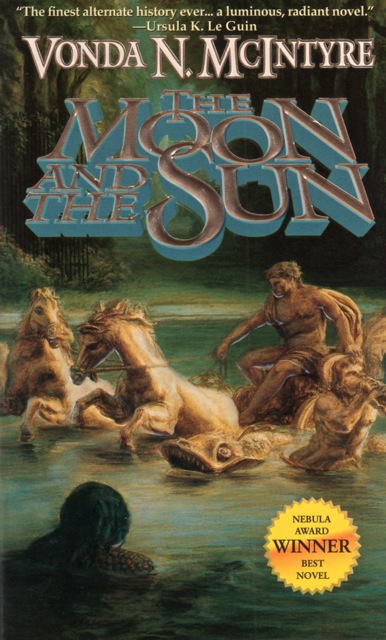
The Moon and the Sun by Vonda N. McIntyre

The Moon and the Sun won a Nebula and was up for the Tiptree and Locus awards.

Father Yves de la Croix--Jesuit priest, natural philosopher, and explorer--has returned to King Louis XIV bearing a gift of two sea monsters: one alive, one dead. Little by little, Yves does the autopsy with the assistance of his sister, Mademoiselle Marie-Josèphe de la Croix.

Marie tries to train or domesticate the sea monster as a pet, but slowly learns that there is more to the sea monster than she first supposed.

Eventually they communicate, and Marie gets a fuller understanding of this race or species. Unfortunately, the sea monster's flesh is rumored to give immortality, so they want to dine on its flesh. Marie has to come up with a way to prevent this.

Minor spoilers:

The main plot could be guessed as soon as the conflict is established. Of course, humans once again underestimate another species. The victims must be rescued. In fact, much of the basic scenario mirrors Guillermo del Toro's The Shape of Water: the capture and abuse of, and experimentation on a humanoid sea creature.

The sea "monster's" name is Sherzad--a nifty nod to 1,001 Arabian Nights. After all, Sherzad (like Scheherazade) has a story to tell to save her own life.

The first two-thirds is well written but pales in comparison to the last third except for the scene establishing communication and the autopsy which is a well-sketched painful moment. The real power comes in the last third when the court intrigue unfolds, and we learn more about this sea-person.

The speculation is rather limited, so maybe it is like LeGuin suggests above the illustration that this is an alternate history. Apparently, McIntyre did much research to capture the period, and it was convincingly captured. A historian might need to explain the departures and their ramifications.  I'm just a science dude.

When word got around Vonda N. McIntyre was ill, I decided to pull down this novel and give it a read. If I have McIntyre's ordering right, the novel began as a faux encyclopedia article, which she had to restrain from becoming a story with characters.

She took a script-writing class and wrote an earlier version of this story, which she later expanded into a novel. However, publishers move faster than the movie industry, apparently, and she published her novel well before they started shooting. The movie, starring Pierce Brosnan, has been filmed but remains unreleased pending special effects, four years later.

Maybe something went wrong elsewhere, but you'd think they'd try to recoup some financial losses by releasing it as straight-to-video, or have a limited release first. Surely, book fans would flock.

UPDATE: The movie was just released. See discussion here.

Monday, April 8, 2019

3 Movies Ruined by their Endings, pt 2: Paranormal Activity, and The Shape of Water

So the first movie, Saturn 3, was damaged by not paying attention to the thematic threads woven together. The next two share their flaws in their characters. You could blame the characters in the first as well, but the issue seems more overarching, more systemic.

Paranormal Activity 
This one bloomed into a franchise, which suggests a certain sustaining popularity. There seem to be at least seven films, but it's hard to tell what belongs and what is a copy-shark, coasting in its wake. Paranormal Activity is itself a copy-shark, but actually better than its predecessor, Blair Witch Project. Both are found footage, but this one is actually spooky with characters you can at least feel for.

The story is simple: A couple cohabit, but she has a supernatural being who follows her. The male partner plans to come up with a way to stop her supernatural being from its pursuit.

Even if the ending flops, the movie is worth watching. The trailer captures the movie's spirit, but I wonder if it shows too many cards. Skip the trailer unless you have no plans of watching it.
Spoilersville
What makes this one lose a few quality points is its unawareness of the characters it's created. The ending has little to do with its characters. Spooky, but doubts linger since this didn't spring from the characters it laid down.

The Shape of Water 
This one was a critical darling. Having loved Pan's Labyrinth, I swooned to the atmosphere, history, moving plight of its quirky cast, but then the climax hit. The ending was so awful, I didn't know at first what had gone wrong. I must have been swept away by the work that I missed something obvious in retrospect.

This story is also simple. A merman is captured by a mean government man. A mute cleaning maid falls for him. Probably you can guess the outcome.


The trailer here captures the beauty of the film without giving much away--at least that the premise itself doesn't already give away.
Spoilersville
Guessing the outcome is the problem. Sometimes you can see the outcome coming and still appreciate the film. Not so here, the film's defect is laid bare. Our villain, though full of his own quirks, is still a stereotype. The ending hit the expected target and failed to surprise. How many B-movies have used this same guy? If we'd been handed a character of nuance and/or complexity to begin with (or leave out a baddie altogether), we'd have never arrived here. Perhaps we'd have had a work of genius. Right now it's just a beautiful promise. Maybe it's best to turn the movie off before you get to the ending, and imagine your own.

Wednesday, April 30, 2014

Analysis of "Mimic" by Donald A. Wollheim

First appeared in Astonishing Stories. Reprinted--in a few major genre retrospectives--by Alden H. Norton, Mary Gnaedinger, Chester Whitehorn, Robert Arthur, Terry Carr, Bill Pronzini, Barry N. Malzberg, Isaac Asimov, Martin H. Greenberg, Stefan R. Dziemianowicz, Robert Weinberg, Brian Thomsen, Steven Utley, Michael Bishop, Jeff VanderMeer, and Ann VanderMeer.  Made into a movie directed by Guillermo del Toro.  Read online.

Fascinating use of plot structure and societal prejudices.  The plot relies on an unusual structure for its effectiveness.  It begins with nonfiction, then delivers the speculative content in a narrative manner although the narrator isn't heavily involved in the tale except as an observer.  Nonetheless, it delivers quite a creepiness punch as the narrative closely parallels the nonfiction.

First, it tallies off all of humanity's recent discoveries to say how little we know about the world we live in (raise credibility for the incredible that's to come).  Next, it describes mimicry in nature, how various insects have used it, how it's used to protect itself by looking like something dangerous. Third, we are introduced to a solitary man who clothes himself mysteriously in slouch hat and coat, keeps to himself, draws himself up short when women pass, and makes strange noises in his apartment.  Finally, the narrator and police let themselves into his apartment after a time when he doesn't show.  He's passed away....

Spoilers:

As you may have guessed, the single man/recluse is an "it."  Various parts are made to look like normal human parts, i.e. wings are his coat, etc.  If that's not creepy enough, the best is saved for last:

The creature has had babies.  When they open a box, out fly a bunch of little men creatures into the night.   And the narrator--no one else--spies a creature in the shape of a chimney, peel off a roof and pursue the little men.  Cool.

I haven't investigated Wollheim's initial claims for the example creatures of mimicry in nature, but his point remains the same.

What's most fascinating is a hidden assumption within the text.  As a single guy who's lived in tiny towns, where residents are so bored they make guesses about your sexuality (decorated on desks, whispered to you by preschoolers, newly placed chairs propped next to your bedroom window), how intriguing it is that the single man is a mysterious alien creature whose motives are impossible to fathom.   He was and apparently still is--at least in some areas of the US.

Thursday, December 20, 2012

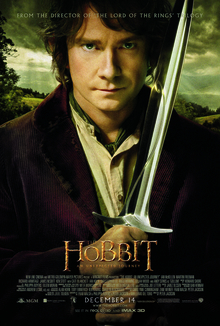
The Hobbit (movie) review

The Hobbit is worth seeing.  The opening scene in the Shire, however, is too long.  Perhaps it lacks Tolkien's charm.  From there, though, the pacing moves along well, and the closure is spot on.  You get fully invested in Bilbo at this point.  Unfortunately, a nice stumbling-upon-the-answer moment is lost, but the layered narrative (which I do not recall in The Hobbit novel--memory says it is continually within Bilbo's point of view) works well at maintaining viewer suspense.  Go and enjoy.