Search This Blog

Showing posts with label Philip K. Dick. Show all posts

Wednesday, March 1, 2023

"The difference between a short story and a novel" by Philip K. Dick

 "The difference between a short story and a novel comes to this...."

"It is in sf stories that sf action occurs; it is in sf novels the worlds occur.... Crisis is the key to story-writing,a sort of brinkmanship in which the author mires his characters in happening so sticky as to seem impossible of solution. And then he gets them out... usually.... But in a novel the actions are so deeply rooted in the personality of the main character that to extricate him the author would have to go back and rewrite his character. This need not happen in a story, especially a short one.... [T]his makes clear why some writers can write stories but not novels, or novels but not stories.... [A]nything can happen in a story; the author merely tailors his character to the event.... As a writer builds up a novel-length piece it slowly begins to imprison him, to take away his freedom; his own characters are taking over and doing what they want to do--not what he would like them to do. This is one one hand the strength of the novel and on the other its weakness."

--Philip K. Dick, The Collected Stories of Philip K. Dick [originally 1968, so probably from the 1969 collection, The Preserving Machine.

Friday, February 24, 2023

"Beyond Lies the Wub" by Philip K. Dick

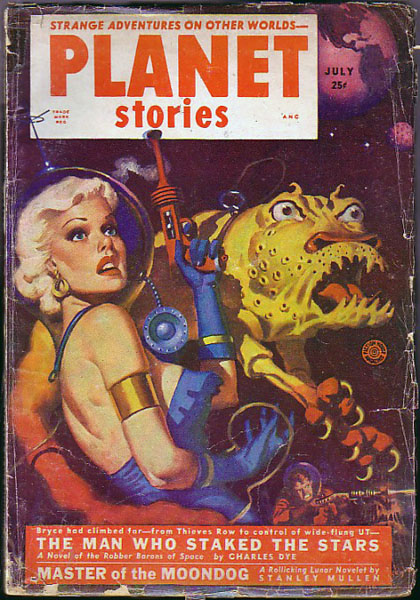
https://www.isfdb.org/wiki/images/b/bf/PLANETJUL1952.jpg

First appeared in Jack O'Sullivan's Planet Stories, reprinted by Robert Silverberg, Malcolm Edwards, Martin H. Greenberg, Damon Knight, Joseph D. Olander, Peter Davison, Susan Price, Stefan Dziemianowicz, Robert Weinberg, D. E. Wittkower, John Gregory Betancourt,  Ann VanderMeer, Jeff VanderMeer, Peter Ross.

A human crew collect their things readying to exit the planet. One has purchased a 400 lb. wub, a creature which  looks like a pig, presumably larger than a man at that mass. The natives respect the creature, but the humans--at least some of them--see it as a source of food. Even finding out the wub can read minds does not seem to deter the ship captain's appetite.

Analysis (with Spoilers)

The first reprinting of this story nearly two decades later was in Dick's own collection, The Preserving Machine. Perhaps an apt title. No one seems to have thought it demanded a second look when it first arrived. 

Robert Silverberg was the first editor to reprint it, twenty years later for his Alpha anthology, aimed at showcasing what SF he considered "literary"--a term which seems to mean different things to different people. Since Dick's story isn't necessarily highly evocative prose or rich characterizations, he must mean stories that provoke thought, which this certainly does do.

Dick's comment on "Roog" would probably apply here: "each creature view[s] the world differently from all other creatures." I will add more of his comment after I find my copy of Dick's collection.

What happens at the end of the penultimate section is vaguely worded and a little unclear. One possibility lies in the the wub's allusions to two major works of literature: the Bible (Jesus driving out demons that have possessed a herd of pigs) and the Odyssey (Circe transforming sailors into pigs)--the parentheticals are presumably the parts of the story Dick's is alluding to.

This possibility suggests that when the captain looks into the wub's eyes, he becomes the wub and vice versa. Or maybe, as the Vandermeers suggest, eating the wub makes one the "wub." This seems a strong possibility due to the allusions.

However, the other possibility is that the wub controls the captain as it did earlier, freezing the captain. So that the captain shoots himself. The wub assumes the role of captain and serves the former captain as dinner. This seems a good possibility because of the wub's early mind-control, the wub's discussion of sacrificing other members of the crew to eat, the vaguely worded "meat," and the reactions of the crew not wanting to eat the meat, due to cannibalism. Presumably if eating the meat made them "wub," at least a few others would have dug into the wub meat for supper becoming wub. But would they treat the pig as captain? Or is it controlling them to make them think of his as captain? The thing is that if the wub transfers from one creature to another, the alien probably wouldn't be a wub, but some other creature, originally, and there'd be no reason to "respect" the wub, necessarily.

The title seems to suggest that the wub is or will exist in the future or their future--physically or otherwise. Whatever's going on, the captain or the wub seems perfectly affable and chatty about the situation. In rereading, one wonders about what the native "respect" for the wub entails.

Saturday, February 18, 2023

"Frozen Journey" or "I Hope I Shall Arrive Soon" by Philip K. Dick

توییتر \ @RobinSandza در توییتر: «Very rare #illustration ...

First appeared in Playboy.  

Reprinted in various major retrospectives by Terry Carr, Brian Attebery, Ursula K. Le Guin, Chris Hables Gray, Alice K. Turner,  Jonathan Lethem. 

This won a Playboy award and was up for a Locus.

#

A man is cryogenically suspended for the duration of a journey across space. His chamber malfunctions so that he awakens ten years from his destination. He cannot be fully awakened or have his chamber repaired, so the ship computer dials up his memories for the man so he can dream pleasantly. But none of it goes as planned. 

Discussion (with spoilers):

The man keeps turning the memories into something darker, and as the ship's computer adjusts, trying to compensate, making the dreams lighter. The new, fake if dark memories bleed into every adjustment the computer makes. He can see through the illusions the computer makes.

When he arrives, his ex-wife summoned from another planet to help him adjust, he cannot accept the true reality.

Brilliant concept--at least not one I remember seeing before (although right after writing this, a newer TV show had a similar scenario, but not as thoughtfully executed. It doesn't feel like a classic but at least as profound as the great classics, so maybe it is classic? 

The story suggests that the past is preparation for whatever reality or future distorts how we view the present reality. Probably true--to an extent as we do test reality.

Terry Carr summarizes the above, more or less, and closes with "Could any computer, no matter how extensive its abilities, keep him sane?"

Is it about sanity? Maybe, kinda. But part of this summary is refuted by the story because the computer is not all powerful. In fact, it is relatively "dumb," limited in what it can do. It does see a problem, but not how to correct it. This, for me, is a critical part of the story, mentioned a few times. The computer doesn't intend to channel the person's reality--but simply to make him happier, which it fails to do.

This point in the story many not be wholly true as people (as opposed to the ship's computer) do actively try to channel people toward how they should view reality, but the basic concept is solid and thought-provoking. Perhaps it was somewhat less the case in the 70s and 80s that one might ignore the influence.

It's interesting that Dick's original title was rewritten by Playboy--probably more evocative or enticing to a reader. What's surprising is that Playboy's title is reprinted, not Dick's, despite Dick publishing his preferred title, even titled such as part of a collection. The Playboy title does suggest the man is stuck in his journey, frozen in time. 

"I Hope I Shall Arrive Soon" suggests more of the protagonist's state of mind, inviting the reader in to entertain the state, the feeling of making progress, of wanting to reach the destination but never arriving. It is more empathetic (his belief that he should be arriving soon even though he already has) and, hence, more tragic toward the character's failure to accept his reality. The "Frozen" unintentionally looks down on the character.

Ursula LeGuin's The Norton Book of Science Fiction has a nice tribute to Dick in the introduction, that he was finally getting his due. However, beyond adding the usual Dick-plays-with-reality, it offers no insight into this particular story, and it doesn't really add much insight into any particular story except in broad strokes. 

A famous, knowledgeable writer once said that the anthology chose the stories for a certain brand of politics. It may not have been, but let's entertain the notion. This will take a while since it's not high priority, but I'll touch on it.

The anthology arranges stories by year, presumably to show either progression in sensibility, changes in topical concerns, quality, etc. But presumably those were the best stories from that year. Only Carr selected this story as one the best of the year. It's numbered eight on Locus (with no other award nominations), so maybe the listing by year (in terms of quality) is misleading. However, an editor may think stories were overlooked in a given year, so that may be a factor. It could be the issues facing the public during that year. Was 1980 a year of being frozen in place, compared to any other year? But if so, why doesn't the anthology discuss issues facing the field during that time?

Finally, this could be the story most representative of the writer from 1960-1990, but then the listing as stories by year would be misleading. Moreover, a lot of important writers were excluded from this collection, which would be a major flaw for an anthology with this particular title, which sounds like it has a wide-enough-angled lens to capture the full scope. The anthology was never revised, so maybe the flaws are well known as being too limited in scope to bear its current title, lacking a number of key players who helped shape the field during this era.

The anthology does use the Playboy title over Dick's. If it were a political selection, it was the positive portrayal of the ex-wife. She was empathetically drawn. Hopefully, it is not for the wise woman/foolish man (or worse men-bad/women-good) portrayals, which would be sexist if this is a consistent pattern--limiting both genders to certain roles that can be played. Hard to say from this distance. Perhaps the editors felt they needed to counteract other portrayals, but still it's problematic if it's men-good/women-bad. Humanity has lots genes, lots of differences to limit the species to a handful of portrayals. 

Feminism becomes important to the field, especially during this era, so one would expect it to be addressed, but it is certainly not the only issue, and the anthology would require a different label to be more honest to the public about the anthology's aim. But that's only the case if it were true that LeGuin's anthology is political--a hypothetical claim being entertained at present. And we'll come back to it later, fingers crossed.

Still, the story's a lovely little gem, whatever reason people selected it.  Maybe some will read it as a tale about sanity, or about gender-power dynamics, tripping some triggers. That's okay. For me, it's a potent tale with a broader application for all humanity--not a select few--about a human being whose propensity to find flaws in his own life led him to a place that made it difficult to deal with his present circumstances. Surely, that is a theme that people of whatever gender can empathize with.

Wednesday, February 15, 2023

"Roog" by Philip K. Dick

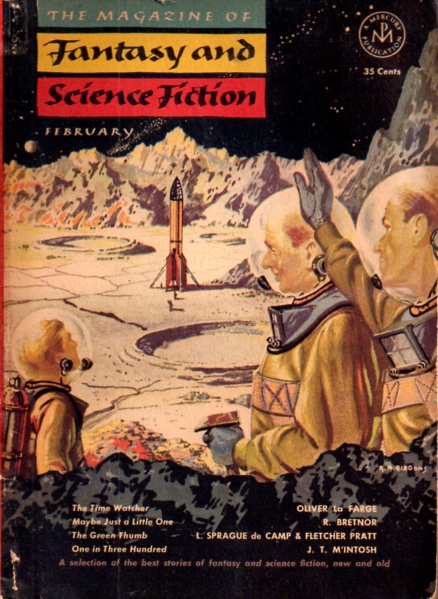
https://www.isfdb.org/wiki/images/2/26/FSFFeb1953.jpg

First appeared in F&SF. Reprinted by Anthony Boucher, J. Francis McComas,  Robert Silverberg, John M. Landsberg, Jonathan Ostrowsky-Lantz, Jack Dann, Gardner Dozois, Stefan Dziemianowicz, Martin H. Greenberg, Robert Weinberg.

This was Philip K. Dick's first accepted story, but not his first published. It tells of a dog who can see aliens as garbage men.

Discussion (with minor spoilers):

While not a classic, this is utterly charming. Part of it is the perfect name for the alien which sounds a bit like how a dog might sound, barking.

What's fascinating is a debate with the famed editor Judith Merrill over the story (a debate which you cam read about over here). She thought that the description of the aliens did not match the garbage-men she'd seen. This is the kind of debate that sidetracks a lot of literal-minded fans and editors and critics. Myself included. 

Even Dick is mostly persuaded by Merrill's argument that he have lost sight of his own story. He calls it a fantasy through the dog's point of view. It could be. A realistic tale of a dog who thinks garbage men are aliens. But there are other possibilities--more interesting ones.

That's the key: Whose POV is it? It's probably not the dog's. Maybe, but probably not. Was the dog there to witness all events? Maybe? Certainly not the humans--at least not these humans since they don't seem to know what's going on (perhaps humans in a post-human-Earth era?). Maybe the aliens, but they don't seem to be there to witness everything as well.

Perhaps it is simply an omniscient narrator. The aliens, if real, admit what they're doing. They're making the dogs or Guardians seem like deluded creatures. Maybe they are. 

Or maybe the aliens are deluded into thinking the dog see them. Maybe the dogs don't see the aliens as aliens at all.

But again maybe the dogs do. Maybe they are masked and dogs can see through the disguise.

What the aliens are up to, isn't clear. Are they just after trash? Why is it an "offering urn" and why do they eat it? Do they consider themselves gods? Or do they offer it to other gods, carrying it in a blanket? Whatever is going on, it sounds sinister. And once they clear out the dogs, they will be able to execute that plan.

Tuesday, May 30, 2017

Blade Runner -- analysis and commentary

Note: Work will slow down my posts here. I hope to do one a week, if possible.

The Dilemma
A friend watched Blade Runner while distracted, she admitted, but didn't appreciate it. I looked for a simple webpage to point her to, but nothing obvious cropped up although Wikipedia quotes it as showing up on multiple Best lists (mostly belated as a cult classic). Worse,  Siskel and Ebert panned the movie when it first came out:


They picked the worst scene of the movie to highlight, which allowed them to say it was cliche but with great effects and cinematography. So I decided to tackle the movie myself.

Note that there are multiple versions. Yes, I will ruin the movie. But you have probably already seen it. If not, go see it and compare notes. If you have questions the remain unanswered, you are supposed to ask and see if the work supports them. Yes, you may need to re-watch the film.

The Set-Up
What are Blade Runners? "Blade runners are people assigned to assassinate 'replicants.' "

You have to realize what this film was doing. The old noir movies had a small resurgence. This was an SF version of that. Is that a cliche or an homage? The change of setting, I think, is enough to make it original. Plus, how many other SF movies were noir up to this time? Cliche, on rare occasions, but most of it dealt with the lives of artificial people destined to die in four years. Was that a cliche at the time?

Luckily, few listened to the lazy critics and watched the movie, anyway.

This is an SF mystery. It's easy to miss out on critical details if distracted. Especially, early on, missed details will confuse you. 

The mystery is something of a macguffin for the thriller and speculative aspects, but it asks the viewer to buy into the detective scenario because it will play off mystery expectations and surprise viewers with a different perspective.

It opens with an effective mood-setting scene. It creates a tone of dark futurity, alternating bright and dark. The music does not work as well today as it would have then since back then the sound was fresh, electronic, futuristic although some of it is nearly as effective as it would have been--usually the sexy sax.

Next is a scene that at first glance seems to be an interview with an unintelligent man, but the man reacts with murder. So the stakes are higher than we thought, Rewatching the scene afterwards (yes, you should rewatch it), you realize the man is trying to evade detection through misdirection.

Deckard is taken in to hunt down killer androids who have escaped, learning they have only four years to live since they might become fully human. Deckard doesn't want the job, but their best guy was shot (not dead, after all). Fairly classic scene. 

Deckard interviews Tyrell and his beautiful assistant. With difficulty, he identifies her as a replicant. Along the way, she plants seeds of doubt about who she is and what he does. She becomes a love interest.

Analysis with Spoilers
Basically, the subtext here is that the replicants are effectively becoming human, indistinguishable. They are being killed to prevent that. Deckard buys into his job at first but begins to question it.... even before the movie starts.

The main romance scene left much to be desired (the worst bit of the film). Maybe the point of that scene is that she is too emotionally young (less than four years old and only beginning to feel emotions) and needs to be taught how to love, but the smaller shots/reactions were more effective. There are voice-over clips that spell things out, but I think the narrative does a decent job. That photo of her make-believe childhood, in fact, is what the director uses to show us how he is falling for her as he keeps returning to it. 


We aren't in her POV much, so it is difficult to say why she falls for him, but her vulnerability and her ability to cut him where it counts is what draws him to her. Plus, she saved his life. One can only presume that she is interested in his returning to her. Here is a man who knows who she is--a type he has killed in the past--and not only accepts her, but also finds her fascinating and wants to run off with her.

Batty, as one might guess from his name, is erratic. He establishes himself as such. His whole chase scene with Deckard is a game of cat-and-mouse. Where did the dove come from? The dove came from the rooftop. It is used more as a symbol, but it adds to his strange character. Every time we see him, his behavior is off, so for him to grab a dove should not surprise us any more than the rest of his behavior. In fact, all of these replicants are a little off. Attacking someone via somersaults? The most normal was the snake gal. 

Batty knows he is dying. He drives a nail into his palm as it is clenching up. The dove shows physically and mentally that he has had a change of heart although we don't know that. His speech tells us that he wants Deckard to feel what they feel. If he succeeds and kills Deckard, what does that accomplish? Maybe Deckard's replicant girlfriend has suspected Deckard's heart is good, but I'm not sure if Batty's seen that. Maybe it's a risk he's willing to take. If Deckard can pass on the knowledge, maybe he change the lives of future replicants.

Clearly, Batty is a Christ symbol and one of the best I've seen. The nail in the palm. The dove. His dying instead of Deckard, sparing Deckard's life even though he deserves death.

The unicorn dream is clearly symbolic. I would have to watch again to decide on a more exact significance. The final origami was a unicorn. That may be what she is to him--an impossible fantasy but one worthwhile. But is that your interpretation? That's you're job as a viewer. You have to interrogate the art/text.

It's a good movie with minor flaws. I'm not crazy about that love scene or the Batty's final monologue which everyone quotes, but the imagery is stunning and evocative. The themes and symbols were effective. It's a good SF romp with heart. 

Watch it again.

Wednesday, May 4, 2016

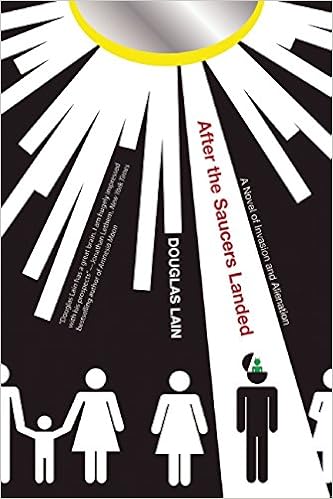
Review: After the Saucers Landed by Douglas Lain

What would a book read like if Connie Willis chose to write a Philip-K.-Dick style of novel? Probably something much like After the Saucers Landed by Douglas Lain. Appropriately enough, it was a finalist for the Philip K. Dick award, but maybe it should have landed on other award ballots as well. How many books change when you reread them? You read the same words both times, but you realize something else entirely is going on.


The protagonist, a popular UFO writer and professor, traverses the seventies to the nineties. Before the aliens land, he is a laughing stock among his colleagues. He does find refuge in his wife, Virginia. After the aliens, he is more respected, but he suspects that the identities of his wife--the woman he thought of as his wife--is really an alien, Asket. Asket has also been wife to other friends. She slips into and out of human identities so convincingly that even our protagonist is unsure, requiring the mall security to throw him out of its establishment.

Identity is the core issue here, explored in a subdued Dick fashion. Dick might have escalated the events to a fever pitch. But that is not the story here, which makes the novel in some ways more sinister. Things do and don't escalate. Events the should have escalated in the proper Fifties paranoid fashion, don't. You read one story by the novel's end, but as you turn back to page one and reread, you suspect that that explanation of events is not good enough.

It may take time before Lain's accomplishment here is recognized. After all, the novel begs to be read twice. On my first read, I'd have given the book four stars, but how could I not give five stars to a book that rewrites itself? If there are better books this year, it'll be one heck of a year for literature in deed.

Thursday, May 8, 2014

On Reading part 2: Reading Protocols, or I can't believe you don't read / think / see the world like I do

Will Self's interest in the serious novel and Chuck Windig's retort also sparked this half of the essay--from a different slant of light.

Upon request, I collected links to my online writings, often experimental back then (some good, some so-so), and bumped into old reviews of earlier stories.  I found one review angrily (why angry?) slammed me regarding a story whose style/structure I borrowed from Paul Auster and Charles Dickens.  Mostly the insinuated complaint was that I made them think in ways they weren't accustomed to.  I've since realized SF isn't a genre for difficult stories and books.  Look at Philip K. Dick's and Harlan Ellison's reaction to Samuel Delany's Dhalgren (Wikipedia):
"By contrast, fellow writers such as Philip K. Dick and Harlan Ellison hated the novel. When the book appeared, Ellison in the L. A. Times (Sunday, February 23, 1975, p. 64) wrote: 'I must be honest. I gave up after 361 pages. I could not permit myself to be gulled or bored any further.' In an interview 27 years later, he said: 'When Dhalgren came out, I thought it was awful, still do ... I ... threw it against a wall.' Dick called Dhalgren 'a terrible book' that 'should have been marketed as trash. ... I just started reading it and said this is the worst trash I've ever read. And I threw it away.' "
Why did they react angrily?  It wasn't a game they wanted to play.  Unfortunately, that's what people do.  They trash things they don't like reading.  Some people dislike SF.  I quit dating someone who said, "So you like reading SF?" and laughed (not that that was the only reason, but a constellation of similar symptoms*).

Each book, each genre plays its own games.  You have to be versed in the game, familiarize yourself to the rules.  Delany speaks of SF reading protocols [summarized here--Heloise Merlin, very sharp gal whoever she is].  So, too, do James Gunn and Jo Walton.

But it confuses people as well.   H. P. Lovecraft's 1927 essay “Supernatural Horror in Literature” trashes Henry James because he doesn't focus on what Lovecraft does--the singular lens of fear.  I find James a more rewarding experience in terms of style, character, and thought, but your mileage may be different.  Maybe fear is your only criterion for evaluating literature.

Here's the Scratch Interview with Jonathan Franzen by Manjula Martin [registration required].  Not a Franzen hater myself (I don't know why people hate him and don't care), I found this curious:
"MM: Define 'serious novel.' 
"JF: Read the first five pages. Count clichés. If you find one, the buzzer goes off: it’s not a serious novel. A serious novelist notices clichés and eliminates them. The serious novelist doesn’t write 'quiet as a mouse' or paint the world in clichéd moral terms. You could almost just substitute the adjective 'cliché-free' for 'serious.' "
So Franzen's singular lens is the cliché.  Clichés are not admirable, of course, but literary artists have used them, sometimes purposefully.**  Here's Aaron Sorkin, Academy and Emmy-award winning American screenwriter, producer, and playwright who reused a few lines.  (Even better is this Slate parody with Josh Charles and Amy Schumer .)

Here's Junot Diaz's complaint of his MFA experience and Karin Gillespie, a self-professed Chick-Lit writer, on hers.  Again they both seek people who write what they're interested in.  No shame in that.  But neither should what they do be the only reading/writing protocol that exists.  It surprises me why more readers and writers haven't glommed on to this.  Anyway, I am glad Diaz has created an MFA program for what he sees as the proper lens for literature.  The more lenses, the merrier.  Find what fits for you, but do try on different lenses.  See what it looks like inside someone else's spectacles.

Side notes on the cliché:

* a cliché from medicine applied to different circumstances.

**Like word choice, clichés can lend a character a certain voice, depending on the type deployed.  No character or person is cliché-free unless you were able to write and revise everything you said before you said it.  Not that a cliché  should be any writer's first choice, but that there may be legitimate reason to use one, sparingly.  However, I can imagine some writers/readers where this is the only point of writing--being cliché-free.  Someday, technology will uncover just how many phrases writers have borrowed from other writers.  It may be higher than we suppose.  Maybe we'll be able to quantify the tolerable number of cliches--or the uses of a phrase which makes it a cliché, or how those clichés are deployed.***

*** I'll give examples of how clichés used well in the article, " 'A Dozen of Everything' by Marion Zimmer Bradley (or cliches can characterize)" clichés also used by Penelope Fitzgerald, Booker Prize winner, and Garry Wills, Pulitzer and National Book Critics Circle winner, who probably consider themselves serious).