Search This Blog

Showing posts with label Theodore Sturgeon. Show all posts

Monday, July 12, 2021

Politicizing What Doesn't Need Politicizing

I once advocated for more politics in the arts--to create conversations, not to advocate one political party over another. But in the last decade or so, the arts barbed with politics have sown the field, choking out anything else.

Janice Pariat penned "Decolonising creative writing: It’s about not conforming to techniques of the western canon[.] The universal rules of ‘good’ or ‘bad’ writing are turning out to be colonial relics." 

The article proves nothing that the title and subtitle claim simply because they cannot. Experienced writers help writers by creating rules to guide one's writing--rules that seem to help most stories. The Iowa Writer's Workshop came up with rules that seemed to work. They produced a number of writers who attained some success, which drew more writers to their workshop. They have their pick, so they get to keep the cream. If their rules failed, they wouldn't have attained their success and notoriety.

They aren't the only ones to come up with rules. SF has had a number of rules come out of workshops, perhaps most famously the Turkey City Lexicon. There are rules that popular writers have come up with, by studying bestsellers.

What Janice is rebelling against is the very nature of rules, especially in writing. She's hardly the first. W. Somerset Maugham wrote:

"There are three rules for writing a novel. Unfortunately, no one knows what they are." 

As far as Turkey City goes, no doubt a few novels that use "plot coupons" turned out excellent specimens. Perhaps they'd have been better if they had not.

Kate Wilhelm advised against "their eyes fell to the floor" literalizing it, but really it's a standard narrative convention and would only be misunderstood if we were in story where such a thing could happen. 

Theodore Sturgeon critiqued the literary quality of his most famous short story, "Microcosmic God." Was he wrong? No, he'd have probably been eviscerated in certain workshops, but the story remains one of his most enduring. To have been literary, it would have needed to have been written differently, and he'd have wound up elsewhere, not writing the same story. Could it have been written better? Perhaps. Perhaps not.

The rules aren't rules but guidelines to refer to if something's not working. That is a legitimate criticism leveled against workshops. They pound out anything that doesn't look like what they've been told to recognize, so they use the rules to smash. "This is a plot coupon!" "This character is cardboard!" This is a failure of critics and workshoppers. 

First, read the story. If it fails, then apply the rules where it's broken. Don't plaster up limbs that aren't broken. The Hippocratic Oath advises us to do no harm.

Then again, maybe they have a point. You have to evaluate what you've been told with what you've done. Some writers and poets have to persist in what they're doing before they're recognized. Kay Ryan, for instance.

Rules stultify experiment and sometimes writers' unique voices, but they are good guidelines. Do you have to write 3D characters? No, but it's a good idea. Do you have to write interesting, escalating plots? No, but it's a good idea. Do you have to write strong, evocative sentences? No, but it's a good idea.  

Also, different genres have different protocols--some emphasizing one element over another. Rules that help in one field may not work in another, and you might be trapped in a workshop where you aren't writing what other writers are reading and writing. If you don't want to do what they're doing, get out. It's no conspiracy. They may feel assured that they are helping you. Exit with grace. Look for your people elsewhere.

Wednesday, March 10, 2021

Comments Published, Howard Waldrop story updated, Future Posts


"The King of the Beasts" by Philip José Farmer

It's interesting that "The King of the Beasts" is #17 on this blog's most popular posts. That suggests that the story has more impact on readers than one might have supposed. Time permitting, I will need to revise it. It has more relevance than the tone may have implied. 

The theme deals with how, as a consequence of allowing so many species to become endangered. humanity itself might become one of its own victims. Potent, surely. 

I still contend that, instead of building up to the surprise, the idea might have been developed a little more although one could argue that that would be unnecessary due to its brevity. 

I will rewrite this post to incorporate the above.

"Microcosmic God" by Theodore Sturgeon

This post is #8 on the all-time most popular blog posts. I will need to reread the story with the question of ethics and morality in mind. What a fascinating question. Thank you.

I looked up the definitions and commentary and it appears that most of us use them interchangeably. However. some view morality as a personal thing and ethics as a group thing. 

I don't. I see morality as a group and personal thing. They are the rules we live by and sometimes share with others. Ethics would be examining these rules closely, trying to eliminate bias, to understand our rules and others' rules. Morality would be the vine that grows naturally. Ethics would be the trellis that someone constructed (or that someone examined). Others have made different distinctions--if there are any. 

I hope to eventually write a post addressing this, assuming that, when I reread it, I will come up with something interesting. Great question. 
 
Future Posts

I hope to write about more mentors and colleagues who became friends as a result of our mutual interest in writing. SF is a small field. Some mentors were kind, some were not. Some I disagreed with ethically, some not. You probably cannot guess which is which by the way I write about them here since I try to maintain integrity in examining the stories. Stories are not people. Besides these comments are as much for me as for others.

Howard Waldrop was a mentor. As Chad Oliver called him, he was a story doctor, knowing how to diagnose a story's ills. His perspective always surprised our Clarion class.

After winning the Writers of the Future contest, I plan to read and discuss stories from those anthologies as well L. Ron Hubbard's own oeuvre. I discussed a few of his works on here: Fear and "Beyond All Weapons." I thought there had been more. In terms of books, Battlefield Earth I found particularly interesting for its discussion of economics though I forget now what that discussion entailed (hence, the blog). Ole Doc Methuselah wasn't as effective. As a young man, I remember getting enthralled by the opening of the Mission Earth sequence; however, my rereading was interrupted. I am most fond of his pulp stories, though. So I plan read those. I seem to recall being particularly fond of "Crossroads."

The WotF contest has its own, self-guided workshop with essays by Hubbard and videos with Orson Scott Card, Tim Powers, and Dave Wolverton. Pretty interesting, so far.

Some claim they have the contest figured out. I don't, so I don't know that I can offer general advice. However, I do think the "After the Workshop" podcast on this link is particularly enlightening. If you're submitting a story to the contest, good luck!

Sunday, March 17, 2019

Poetry in the News

W. S. Merwin passed away. His poem "Language", with its Biblical overtones, could be read as his own eulogy/elegy:
"Certain words now in our knowledge we will not use again, and we will never forget them.... they are, trembling already for the day of witness. They will be buried with us, and rise with the rest."
A number of people are using his poem, "For the Anniversary of My Death," which sounds like someone will speak to us wisdom from the grave, but it's a little tricky like Robert Frost's "The Road Not Taken." It's actually a living man who speaks:
 "Every year without knowing it I have passed the day"
"I have passed" indicates he's alive (also it's a clue, too, that the poet was alive when writing the poem). The phrase "without knowing" is key. The lack of knowledge but the presence and possibility of death seem to hang over him. It is both definite and mysterious. He later alludes to life as a "strange garment."

The next five lines discuss death, but the last seven address his life right now--not just the love of a woman, or the problems of the world--but this very moment, staring into nature, observing its beauties. The final line is almost Biblical, a warning about what one serves in life, knowingly or unknowingly.


#

Poetry reading is up, according to this USA Today article. (The title claims fiction reading is down, but later quotes that the fall is statistically insignificant.

#

In a similar vein--at least, the logical next step--here's an answer to the question about poetry careers which, given that it is a poem, is no answer at all:

When we were younger, guidance counselors steered us
toward respectable occupations: doctor, lawyer,
pharmacist, dentist. Not once did they say exorcist,
snake milker or racecar helmet tester....
#

I'm not sure to what extent Theodore Sturgeon could be a called a poet, but he does use poetic techniques, and this interviewer had that in mind.

Wednesday, April 26, 2017

Star Trek: Season 1, Episode 15. "Shore Leave"

 Summary:
Entire crew weary, needing of sleep and rest. Kirk and Spock have no plans on resting, however. McCoy and Sulu are on shore leave on an uninhabited planet in the Omicron Delta region, appreciating time off and collecting biological samples. McCoy, alone, spots the White Rabbit and Alice, not long after saying the planet was like "something out of Alice in Wonderland."

Spock tricks Kirk into commanding himself to go on shore leave.

Analysis with spoilers:
Manifested hallucinations abound. Kirk claims to have been grim as a student named was Finnegan, and Finneagan appears. Yeoman Barrrows imagines she'd like to meet Don Juan although he's more than she bargained for. Kirk spots an old flame, Ruth.

Spock reports underground industrial complex seems to be draining communications power from devices and Enterprise itself. Sulu discovers during an encounter with a samurai that even their phasers have died. Spock beams self down when he sees that all communications and transport will leave crew and captain stranded (although why he didn't beam them out before isn't explained).

McCoy, certain this is all an illusion, stands in the path of a jousting knight... and dies. More shenanigans until a robed caretaker appears to say that it's all an amusement park. When Kirk asks for more info about the people who build it, he's told they're too much for him to understand. Spock agrees. Why? (Apart from writer not wanting to explain, that is.)

Episode closes with Spock saying it was "Most illogical" that humans should enjoy themselves on shore leave. Illogical of him to say except if one considers everyone had phoney experiences with faux people.

Episode interspersed with shots from perspective of antenna "watching" visitors.

Quotes designed to foreshadow events. Episode written by Theodore Sturgeon. Interesting that Sulu's quote is challenged, even the key. We lay at the feet of humans and animals all our troubles, but troubles can still pop up.

Quotes:
  1. Kirk: "a planet remarkably like Earth or how we remember Earth to be: park-like..."
  2. Sulu: "Beautiful, beautiful. No animals, no people, no worries."
  3. Kirk: "The more complex the mind, the more need for play."
  4. Caretaker: "My impression is you are not ready to understand us, Captain."

    Notes:
    1. Apparently 433 people on Enterprise.
    2. First discussion of [Starfleet] Academy. 
    3. First episode where Kirk seems to reject female advances (Yeoman Barrow, Ruth, but maybe he rejected Barrow's advances because he knew McCoy was interested).
    4. McCoy's first flirt with a real woman (first flirt was an imaginary human). Interestingly, he throws her over a pair of phony women.
    5. McCoy's first death (not wearing red).
    6. Dead "dummy" knight wiggles nose.
    7. Good guys in the future--or at least the peaceful ones--always wear long flowing robes.
    8. Dry run for the future ST:NG holodeck.

    Sunday, January 15, 2017

    Review: Sacrificial Nights by Bruce Boston and Alessandro Manzetti

    Every review is a tightrope walk. You navigate between being fair to the author and fair to the reader. The review's job is to point readers to books they might love, and steer away those who would not. It is to their mutual advantage as both might forge future relations.

    This one is especially tricky due to all of the genres involved: poetry, fiction, experimental, supernatural, natural, mystery, horror.

    For instance, a blurb claimed this novella/collection was noir, so I kept searching for noir and being disappointed that is wasn't there--as might other readers. Not only are proper labels useful but they are also critical to avoid aggravating readers that they damn works through no fault of the author.

    Who will be interested?

    As far as poetry, those who read primarily for mood or tone will be delighted. As for fiction, we have multiple story threads with dark bodings bordering the land that lies between horror and mystery--although the supernatural bent is more hinted at. The threads are too tenuous to build characters, but they do intrigue in how they weave together, so those who love strangely assembled narratives--think along the lines of Theodore Sturgeon's Some of Your Blood--may also fall for this one.

    The book is lavishly illustrated (by Ben Baldwin) and is its own wonder. If you admire the combination of art and moody words, look no further.

    If you are seeking Bruce Boston's more thoughtful verse, this probably is not the droid you're looking for. This is my first book for Manzetti, so I have nothing to compare.

    But it does have art. Two ubiquitous motifs are rain and fire. They are tiresome until you realize they have been cultivated for the opposite reason they are normally employed:
    "Watching the pendulum of the wipers on the rain-spotted glass, she prays silently for rain and more rain, a rain to end all rains, one that could wash her mind clean of the cold white darkness that infests it like disease." --from "Rose and the White Stalker"
    It takes a few readings to glom on to this reversal. It is the rain--or at least the waters it leaves behind--that allows disease to fester. It is not until the extended conflagration scenes that baptism by fire occurs.

    "Rose and the White Stalker" is probably where my interest was first piqued by the individual poems. A woman, Rose, kidnapped--but nothing happens to her, which is both a momentary relief and curious. All's well that ends well, right? Her story doesn't end here.

    More fascinating is Eva in "Cannibal at Large" who follows Harry, despite knowing he has consumed her father and mother. The narrative returns to her and Harry at the end, with a surprising twist. These may be my favorite characters of this circuitous narrative.

    Of interest, as well, is "The Xacto Killer: Interior Monologue," which details how a serial killer might decide to up his game.

    Other characters include Jean-Paul, a painter; Sandoval, a detective on the trail of the Xacto Killer; and Eugene who begins the fire at the whore house. The narrative picks up again with Eugene final act--an act which ties up (mostly) the dangling loose ends.

    This collection/novella isn't for everyone, but for some, they will hug this testosterone-boosted adventure into cross-genres fiercely.

    Tuesday, October 8, 2013

    Free and reduced ebook lunches (includes award finalists and winners)

    The Coyote Kings, 
    Book One: Space-Age Bachelor Pad 
    by Minister Faust
    Free

    Devil's Manhunt (Stories from the Golden Age) 
    by L. Ron Hubbard
    Free

    Fear 
    by L. Ron Hubbard
    Free

    A Book of Horrors 
    edited by Stephen Jones 
    $2.26

    (a bunch of Stephen Jones' Best New Horror)

    A Fair Maiden 
    by Joyce Carol Oates 
     $2.51

    Frontera 
    by Lewis Shiner 
    $2.99
    (up for Nebula, Locus, and Philip K. Dick awards)

    Deserted Cities of the Heart 
    by Lewis Shiner 
    $2.99
    (up for Nebula, Locus, and Crawford awards)

    (other Shiner titles--cheap)

    All for Naught 
    by John E. Stith 
    $2.99
    (two stories up for Locus, Anlab, and HOMer awards--the lattermost award the novella won)

    Manhattan Transfer 
    by John E. Stith 
    $2.99
    (up for Seiun and HOMer awards--the lattermost award the novella won)

    Redshift Rendezvous 
    by John E. Stith 
    $3.49
    (up for the Nebula, Locus, and HOMer awards--the lattermost award, the novel won)

    The New Space Opera 2 
    edited by Gardner Dozois and Jonathan Strahan
    $3.79

    Grandmaster Brian W. Aldiss is the rockstar of SF.  He has a new novel coming out, too.  TIt's a shame more of his back catalog isn't available... although Earthworks is--a novel whose opening images have stuck with long past any others.  The Helliconia Trilogy won the Campbell award and British SF award (twice).  Plus they were nominated for several Nebulas, Locus and other awards.


    The Perfect Host: 
    Volume V: 
    The Complete Stories of Theodore Sturgeon
     $4.74

    Tuesday, April 30, 2013

    Reader’s Guide for "Yesterday Was Monday" by Theodore Sturgeon

    Summary:

    Although yesterday was Monday, Harry Wright wakes up, walks to work, and finds out it's Wednesday.  Somehow he's lost a day.  Folks talk of actors and set builders, but Harry just wants to do his job, only a short guy's already doing it.  Harry is actually one of the actors, but he doesn't get it.  "Wednesday isn't a time," they explain; "it's a place."  When Harry asks about Tuesday, they point the direction and their hand disappears.  The play, they say, is for "Ones who may be amused."

    The producer  says actors like Harry are "sending requests for better parts. Listening carefully to what I have to say and then ignoring or misinterpreting my advice.  Always asking for just one more chance, and when you get it, messing that up, too."

    Questions:

    1. What are some cliches people say about time?  Which has Sturgeon literalized here?  
    2. List at least two that the story thwarts our expectations of reality.
    3. What about Harry Wright, an ordinary mechanic, makes him right for this experience?
    4. Who might the producer represent?
    5. What might it mean that your life is an amusement for someone else?
    6. What does it mean that Harry has to label himself differently than he's used to?
    7. Harry arrives in his own time/place.  Will everything be the same for him?
    8. Instead of talking about time, what does Harry say towards the end of the story that shows his perspective is skewed?  Why might he have stumbled over his words?
    9. What advantages might there be to reframing how we see the world?


    Selected Bibliography (ISFDB):


    1. Unknown Fantasy Fiction, ed. John W. Campbell, Jr.
    2. Masters of Fantasy, ed. Martin Harry Greenberg, Terry Carr
    3. The New Twilight Zone, ed. Martin H. Greenberg
    4. The Mammoth Book of Fantasy, ed. Mike Ashley
    5. The Best Time Travel Stories of the 20th Century, ed. Harry Turtledove, Martin H. Greenberg
    6. Microcosmic God, ebook

    Monday, April 29, 2013

    Reader's Guide to Theodore Sturgeon's "The Hurkle is a Happy Beast"

    Summary:  Through a mishap in another dimension, an alien pet is sent through a scientific device that lands the creature outside a school room.  The teacher, Stott and students immediately begin to itch, but Stott spots the being and startles it.  When it returns, he's ready with powdered DDT--only things don't go as either the alien or human had planned.

    Commentary:  What a heady shot of ingenuity from such a humble title.  This is good for science students as well cultural studies:  What works well on some organisms, does not work the same for all.  Moreover, how a drug works on one human does work the same in another.  Even within a body, drugs can have different effects on different cells.  The same holds true for those moving between different culture--even within cultures.

    Questions:

    1. What was your initial impression of the title?
    2. How does your interpretation of the word "happy" transform over the course of the story?
    3. Contrast how the Lirhtians think to the humans.
    4. Who is narrating the story?  Who did you think was narrating it?\
    5. How does the narrator get into the mind of the other creatures? (or does it?)
    6. What does it mean that both the Lirhtians mistakes turn things toward very different directions?
    7. Knowing that the teacher has forty students under his charge, the students are called "animals", the Moscow is discussed with places on Lirht, and the story begins, "Lirht is either in a different universal plane or in another island galaxy. Perhaps these terms mean the same thing," could the story be interpreted differently?
    8. If you buy #7, what does it mean that the humans scratch themselves?
    9. What does it mean that Stott's actions not only fail but also exacerbate the situation?  Is this not unlike his early overreaction with the ruler?


    Selected Bibliography for the story (ISFDB):

    1. The Magazine of Fantasy, Fall 1949, ed. Anthony Boucher, J. Francis McComas
    2. The Best Science-Fiction Stories: 1950, ed. Everett F. Bleiler, T. E. Dikty
    3. The Science Fiction Roll of Honor, ed. Frederik Pohl
    4. The Great Science Fiction Stories Volume 11, 1949, ed. Isaac Asimov, Martin H. Greenberg, 
    5. The World Treasury of Science Fiction, ed. David G. Hartwell
    6. The Perfect Host, ebook

    Tuesday, April 23, 2013

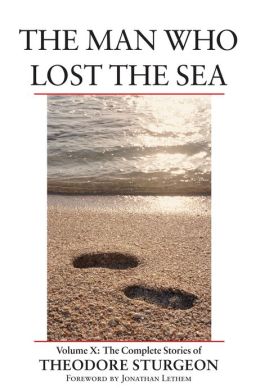
    "The Man Who Lost the Sea" by Theodore Sturgeon

    Availability:
    Available in this collection
    and online at Strange Horizons.

    Nominated for a Hugo award
    Reprinted in

    • Best American Short Stories
    • 5th Annual of the Year’s Best S-F, ed. Judith Merril
    • Best from Fantasy and Science Fiction: Ninth Series, ed. Robert P. Mills
    • Arbor House Treasury of Science Fiction Masterpieces, ed. Robert Silverberg & Martin H. Greenberg
    • World Treasury of Science Fiction, ed. David G. Hartwell
    • Isaac Asimov Presents the Great SF Stories: 21 (1959), ed. Isaac Asimov & Martin H. Greenberg
    • A Century of Science Fiction 1950-1959, ed. Robert Silverberg & Martin H. Greenberg

    Summary/Discussion (of entire story):
    This narrative feels confused--third person, then second with some unnamed narrator, advising--until you learn this character has crash landed on Mars and is semi-delusional.  He believes he is stranded on a beach... No, he is a boy talking to boring man who looks like he is from Mars.  He realizes by his footprints that he's alone on the sands of Mars, alone.  Despite his inexorable demise, he cheers, "God, we made it!"

    Ironic title as he gained something more.

    Monday, April 22, 2013

    "The Silken-Swift" by Theodore Sturgeon


    Availability:


    • F&SF 
    • The Best Fantasy Stories from the Magazine of Fantasy & Science Fiction, ed. Edward L. Ferman
    • Masterpieces of Fantasy and Enchantment, ed. David G. Hartwell
    • The Oxford Book of Fantasy Stories, ed. Tom Shippey
    • The Fantasy Hall of Fame, ed. Robert Silverberg
    • online
    • ebook
    The events are intriguing enough.  Del chases after Rita, but Rita won't be had by any man.  Del is so lusty she temporarily blinds him.  He runs into Barbara, the vegetable stall girl, who tells him of a unicorn, but he thinks it's Rita and chases her off.  

    When Del can see, he corners Rita.  Rita still won't be had, and no, she never said anything about a unicorn.  But since she's a virgin she'd like to capture it for herself.  However, the unicorn isn't fooled.

    Interestingly, the story wasn't widely collected until thirty years later.  It must have had something to say to that generation--probably about sexuality.  I enjoyed Barbara getting the upper hand, but the character's are unusually flat for Sturgeon, who usually takes time to imbue nuances of depths.

    The language is sometimes magically inspired (after describing how animals and plants help Barbara out):
    "[I]f a fruit stayed green for two weeks longer until Barbara had time to go to the market, of if a mole could channel moisture to the roots of the corn, why it was the least they could do."
    Other times, the language oversweetens as it stretches for poetry.  I might need to read what the above editors wrote in regards to this story.  I may have missed something.  Dozois wrote, "[O]ne of the most renowned of all unicorn stories, [Sturgeon] explores the subtle differences between those who are blind and those who will not see."  If you've read it and found nuance, let me know.  I have changed my mind--"Microcosmic God" for one.


    Monday, April 15, 2013

    "Rescue Party" by Arthur C. Clarke

    I thought I'd read this, but I hadn't.  Eric Flint compared this to Theodore Sturgeon's "Thunder and Roses," but this is more of the optimistic side of humanity's future.

    A group of aliens see that Earth's Sun is about to go supernova (not sure where science was in regards to stars, but scientists do not believe it could go nova--and definitely not within two hundred years.  I read a more recent SF story where this occurred, but I forget whose).  So a starship arrives to whisk the inhabitants away.  However, they cannot find any.  They cover the planet, they look under the ocean, and they even take an elevator through Earth.  Nothing.

    SPOILER / discussion:

    Finally, they realize humanity had already left, using what little technology it had.  The aliens admire them, even fear them.  Interesting last note to end on.  It reminds me a bit of Mike Resnick's note in "Seven Views of Olduvai Gorge."

    The power of this tale is how Clarke takes what looks like a traditional disaster tale and turns it on its head.  "Oh, no!  Humans are all gonna die! ... Oh, wait. They're actually going to thrive."  Instead, the aliens themselves need rescuing--perhaps in and out of the narrative.

    Saturday, April 13, 2013

    "Killdozer" by Theodore Sturgeon


    Before Richard Matheson and Steven Spielberg's Duel, before Stephen King's Maximum Overdrive/"Trucks," Theodore Sturgeon built the first intelligent (?) rampaging killing machine.  Our planet had another intelligent race inhabiting it before ours--a race destroyed by the metal-inhabiting aliens.

    The last remaining mutant alien inhabits a pocket of neutronium on an obscure Pacific island.  I suspect Sturgeon's use of the term goes back to Andreas von Antropoff's 1926 usage as an element with an atomic number of zero--first element of the periodic table.  This gives it an atomic feel and perhaps fear of the mysterious coming atomic power (publication date 1944).

    The story is familiar, but it is an early model of its kind.  Without a doubt, this is a meditation on men and machines.  We built machines, but can we master them?  Any motorhead is enchanted by their mechanical puzzle, their cohesive ecology that comes together to do work.  But what if it strikes back?  What can we do to stop it?  What if it finds ways to work around its limitations?

    This may be also be a meditation on race, but if so, I will need to reread it a few more times to tease out the details.

    Availability (list from Locus & William G Contento online)
    1. Astounding Nov 1944
    2. Best of Science Fiction, ed. Groff Conklin, Crown 1946
    3. Best of Science Fiction, ed. Groff Conklin, Crown 1963
    4. Spectrum 3, ed. Kingsley Amis & Robert Conquest, Harcourt, Brace & World 1964
    5. Wondermakers, ed. Robert Hoskins, Fawcett Crest 1972
    6. Strange Orbits, ed. Amabel Williams-Ellis, Blackie 1976
    7. The Great SF Stories 6 (1944), ed. Isaac Asimov & Martin H. Greenberg, DAW 1981The Golden Years of Science Fiction: Third Series, ed. Isaac Asimov & Martin H. Greenberg, Bonanza/Crown 1984
    8. Machines That Kill, ed. Fred Saberhagen & Martin H. Greenberg, Ace 1984
    9. A Touch of Sturgeon, Simon & Schuster UK 1987
    10. Cinemonsters, ed. Charles G. Waugh, Martin H. Greenberg & Frank D. McSherry, Jr., TSR 1987
    11. 13 Short Horror Novels, ed. Charles G. Waugh & Martin H. Greenberg, Crown/Bonanza 1987
    12. To Marry Medusa, Baen 1987
    13. The Mammoth Book of Golden Age Science Fiction, ed. Isaac Asimov, Charles G. Waugh & Martin H. Greenberg, Robinson 1989
    14. Astounding Stories: The 60th Anniversary Collection, Vol. 2, ed. James Gunn, Easton Press 1990


    Reader's Guide to "Thunder and Roses" by Theodore Sturgeon


    David Drake wrote, "If you were a kid [in the Fifties] who read SF, the feeling of dread [of nuclear war] was all the more acute."

    Eric Flint says that this story has "[h]eroism, which has none of the trappings of heroes, and is therefore all the more reliable."

    Summary:

    Pete Mawser and Sonny are survivors of one-half of a nuclear war, stuck on a military base, both plagued by thoughts of suicide.  They discover a formerly hidden door that has unlocked due to the high-level of radiation.  They get spooked and leave.  Starr Anthim is a popular singer but gives a performance without being flashy.  She sings the "thunder and roses" of the title:
    With thunder I smote the earth
    With roses I won the right
    With the sea I washed, and with clay I built
    And the world was a place of light
    Starr says of her song "All that is fresh and clean and strong about Mankind is in that song."  She discusses that it doesn't who bombed them, but that they ought not to retaliate.

    Pete Mawser hunts down Starr to interrogate her:  Why is she spreading this message?  A nuclear key to launch the missiles remains and they are looking for it.  However, though she's dying from radiation, she doesn't want a doctor.  She wants him near.

    Sonny wants to send the missiles to retaliate, though, and thinks he has found a way\.

    Questions:

    1. What is the significance of the characters names:  Pete (rock) Mawser (maw), Sonny (son? or sunny? yet a fighter), Starr (star) Anthim (anthem)?
    2. Reread the song's stanza.  So thunder is the sound of violence, but what of roses?  It wins the right to do what? to smite or to do what follows?  Why roses?  The outcome in the last line:  Is it good or bad?  How does one arrive at that good?
    3. After being bombed, why shouldn't they retaliate, according to Starr?
    4. Why does Bonze's cot shake?  What did you think at first?  How does the change from your first impression to the reality enhance the theme?
    5. How do Pete and Sonny represent different responses?
    6. Explain why Pete both hits and strokes Sonny's head.


    Availability online:


    Also available here:
    1. Astounding Nov 1947
    2. Strange Ports of Call, ed. August Derleth, Pellegrini Cudahy 1948
    3. My Best Science Fiction Story, ed. Leo Margulies & Oscar J. Friend, Merlin Press 1949
    4. The Astounding Science Fiction Anthology, ed. John W. Campbell, Jr., Simon & Schuster 1952
    5. The First Astounding Science Fiction Anthology, ed. John W. Campbell, Jr., Grayson 1954
    6. A Way Home, Funk & Wagnalls 1955
    7. A Way Home, Pyramid 1956
    8. Thunder and Roses, Michael Joseph 1957
    9. Astounding Tales of Space and Time, ed. John W. Campbell, Jr., Berkley 1957
    10. The Second Astounding Science Fiction Anthology, ed. John W. Campbell, Jr., Four Square Books 1965
    11. Mind in Chains, ed. Christopher Evans, St. Albans: Panther 1970
    12. The Astounding-Analog Reader, Volume Two, ed. Harry Harrison & Brian W. Aldiss, Doubleday 1973
    13. The Best of Astounding, ed. Anthony R. Lewis, Baronet 1978
    14. The Road to Science Fiction #3, ed. James E. Gunn, Mentor 1979
    15. Isaac Asimov Presents the Great SF Stories: 9 (1947), ed. Isaac Asimov & Martin H. Greenberg, DAW 1983
    16. War and Peace (Anthology #6), ed. Stanley Schmidt, Davis 1983
    17. Countdown to Midnight, ed. H. Bruce Franklin, DAW 1984
    18. The Golden Years of Science Fiction: Fifth Series, ed. Isaac Asimov & Martin H. Greenberg, Bonanza 1985
    19. Science Fiction, ed. Patricia S. Warrick, Charles G. Waugh & Martin H. Greenberg, Harper & Row 1988
    20. Nuclear War, ed. Gregory Benford & Martin H. Greenberg, Ace 1988
    21. Thunder and Roses: The Complete Short Stories of Theodore Sturgeon, Vol. 4, North Atlantic Books 1997

    Friday, April 12, 2013

    Reader's Guide for "The Other Celia" by Theodore Sturgeon

    Available as an ebook.  Story online.


    This deceptively simple story is a heart-breaker.  It begins with a simple man, Slim Walsh, with a simple yet overwhelming desire:  curiosity.  He wasn't looking for hurtful information, but just information.

    He's laid off work because a co-worker applied a wrench to his head.  This isn't bad as he gets to snoop in his neighbors' apartments.  One especially odd single woman captures his attention that he stands at her door even to listen.  When she's gone, he sneaks into her apartment to see what's inside.  When he finds a human-sized skin, he bores a hole into her apartment to watch what she does.  When he learns, he has to find what happens if she can't do what she normally does after work as a store clerk, studiously not drawing attention to herself.

    What's amazing here is how Sturgeon takes so small an indiscretion and makes it feel criminal.

    Questions:
    1. How might Slim's name fit this narrative?  
    2. Knowing Slim's imperfections, why might the coworker have hit Slim in the head with a wrench?  What might this foreshadow--if not directly?
    3. How does the quote below fit in thematically?
    4. What aspect of this story might be more relevant today than Sturgeon's (and vice versa)?
    Quote:
    "[W]ithin the anthill in which we all live and have our being, enough privacy can be exacted to allow for all sorts of strangeness in the members of society, providing the strangeness is not permitted to show."


      "A Saucer of Loneliness" by Theodore Sturgeon


      Available here. This was also made into an equally moving radio play for X Minus One.


      Samuel Delany wrote in his introduction to Sturgeon, "One of Theodore Sturgeon's themes is love."  That's nowhere more apparent than in "A Saucer of Loneliness."

      A young man stops a young woman from committing suicide.  She is not grateful, but she does tell her story.  She is the woman to whom the small flying saucer spoke.  The government hounds her, but she won't tell.  Her mother is embarrassed and shuns the young woman.  Wherever she works--in a diner or as a maid--she is hounded by men who pretend to be interested in her just to get the story from her.  Finally, she has been throwing bottled messages out to sea.  It turns out the narrator, a flawed man himself with a club foot, had found one and sought her for two years.  He knows just what the alien message.


      Thursday, April 11, 2013

      Reader's Guide to "Microcosmic God" by Theodore Sturgeon


      Gene Wolfe wrote, "The first [sf] story I read was 'Microcosmic God' by Theodore Sturgeon. It has sometimes occurred to me that it has all been downhill from there."

      Summary: Voted as one of SF's best stories of all time, "Microcosmic God" tells of James Kidder, jack-of-all-sciences, who invents dozens of things to improve the world.  He invents tiny creatures, Neoterics, which evolve at an incredibly fast rate.  Kidder wanted them to out-evolve humans due to his impatience to see further.  He tortures them, so that they had to become inventive to protect themselves against the elements he subjected them to.  As they grew intelligent, Kidder created laws that must be obeyed or he'd wipe half of them out.

      Meanwhile, his banker, Conant, is power-hungry.  He ruthlessly climbs the corporate ladder, then worries about Kidder.  Afraid that Kidder might one day try to wield power, Conant puts Kidder on the job of creating a new power source (interesting to create the literal for what he figuratively wants).  Kidder overhears Conant's designs, but dismisses it since he was in no one's way.  When Kidder has the Neoterics come up with the model, he brushes off Conant.  But Conant, not to be put off, arrives on the island with a team of engineers, engineers who slowly realize they were well-paid prisoners of Conant's, but for what they didn't know:
      "Conant liked that man [his engineer, Johansen].  He was, for a moment, a little sorry that Johansen would never reach the mainland alive."
      However, Conant overreaches to take over the United States government and bomb Kidder's island, Kidder has to save the Neoterics.

      Questions:

      1. In what ways may the word, Microcosmic, be intended?  Break the word into micro and cosm as well.
      2. Why is Kidder named kidder?  Who might he be kidding?
      3. Does Kidder like his fellow humans?  How does his misanthropy affect events?  Is he out to get humans?
      4. What aspect might the Neoterics represent that Kidder is more fascinated to the exclusion of all else?  What do the Neoterics provide?
      5. What aspect of society does Conant represent?  Do his machinations succeed or fail?  Why?  
      6. Who is the microcosmic god?  Kidder who is literally the god of the Neoterics?  Or Conant who wields Kidder's powers ruthlessly?  Or are the Neoterics, as a race, the actual god since their powers do the saving?
      7. Is Kidder any better a human than Conant?  Consider how he behaves toward his created beings?  Support your answer from the text.  If you think his behavior is okay, how do you justify his perpetual near-genocides?  If reprehensible, what do you make of what has become of the Neoterics compared to where we started?  If you find it difficult to pick sides, what might the authorial perspective be?

      Collected Theodore Sturgeon stories here at last


      The stories of Theodore Sturgeon, the man who inspired Kurt Vonnegut's Kilgore Trout, are now available in ebook formats.  

      Sturgeon was a writer of not only style--even early on (one of my favorite's of his voice is "Poker Face" included in Microcosmic God)--but also of the heart.  Other famous stories in The Ultimate Egotist are "It" and "Bianca's Hands"; in the Microcosmic God are the famous title story (discussed below), "Yesterday Was Monday" and "Shottle Bop."


      The first story in The Ultimate Egotist is "Heavy Insurance" is more of a quickie mystery, where a con artist is trying to make off with carbon ice.  Two things stand out in the next, "The Heart":  One, we have a tough-guy-voiced female character who, two, delivers  some good lines:
      "In that second I was deathly afraid of her, and that in itself was enough to get me interested."

      Sunday, February 24, 2013

      The Arts (links)

      Tarkovsky Films Now Free Online

      Salon.com says, "Sorry, the short story boom is bogus."
      Response:  Laura Miller makes great points, but she doesn't produce proof that there isn't a boom.  Rather, she disagrees that the evidence is evidence for boom, but disagreeing with evidence does not negate the existence of a thing.  Perhaps there is a boom compared to story sales prior to e-reading.  Perhaps not.
      Make art to accompany Neil Gaiman's stories.

      Nebula nominees announced

      On Building  a Book Blog

      Boskone 50 "The Paper Menagerie:" Anatomy of a Winning Story

      Top 10 SF movies of 21st Century?

      10 Novels That Are Scarier Than Most Horror Movies

      Walter Jon Williams on the suspension of disbelief

      China Mieville's Top 50 books

      Top Ten Innovative Alien Stories

      Importance of Theodore Sturgeon's "Maturity" [Michael Swanwick & Jason Sanford; also of interest History of SF Flame Wars]

      Donate to writing scholarship and receive ebook [Octavia E. Butler Scholarship]

      Essay:  An Exercise in Doubt:
      "Argumentation is a good skill to have, but the real argument should be with oneself. Especially when it comes to the development of young writers, it is crucial to nudge them past that self-righteous inveighing, that shrill, defensive one-track that is deadly for personal essays or memoirs, and encourage a more polyphonic, playful approach. That may be why a classic essay technique is to stage an inner debate by thinking against oneself."